Franck
Perfect, I recommend it for a nice setup.
Comment from 6 March 2026 — Experience from 2 March 2026
Automatically translated — Show original (French)
Parfait je recommande pour une belle installation.
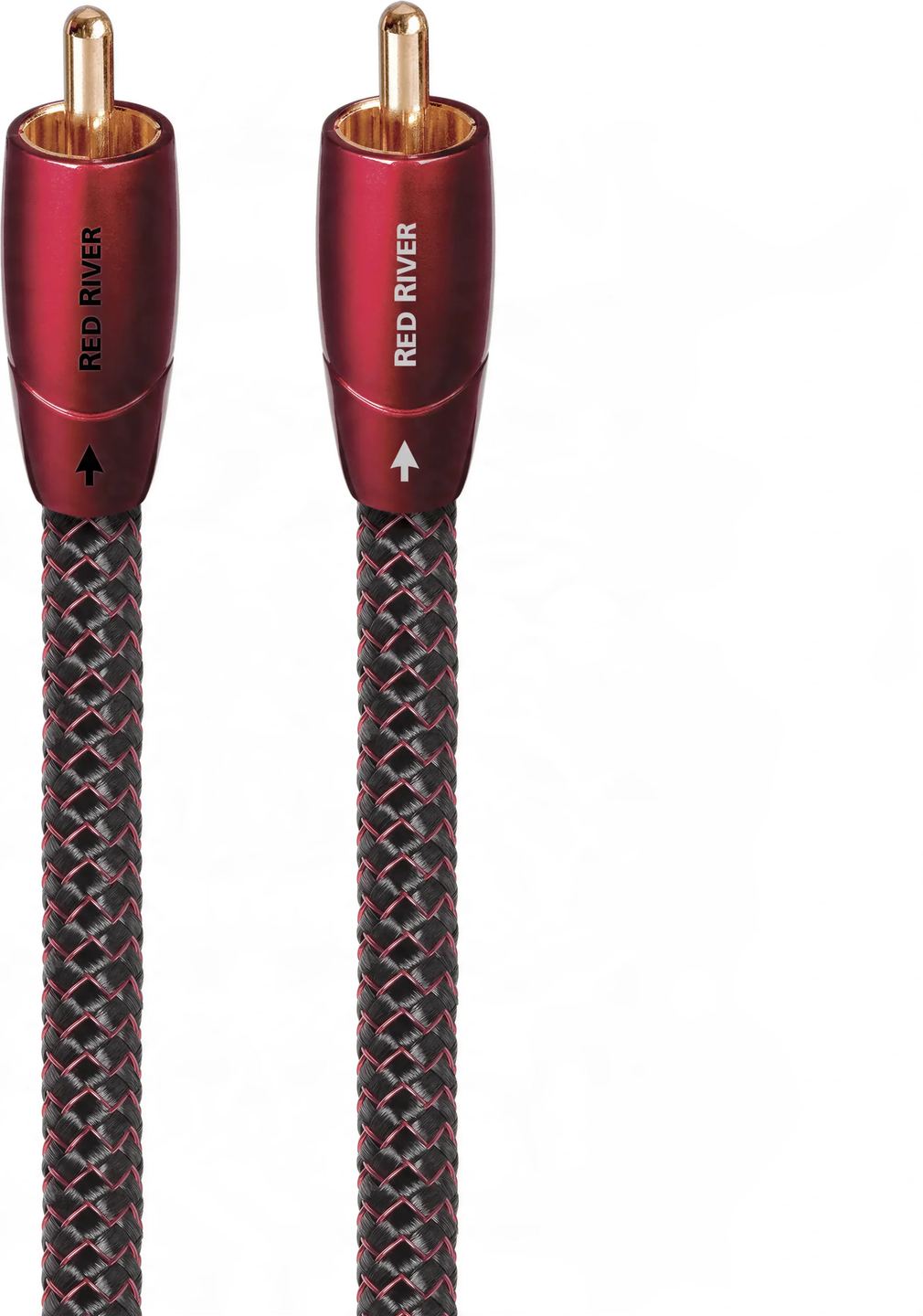
Between a source and an amplifier, the analog signal travels at a very low level, and anything the cable picks up or distorts along the way ends up in the speakers. AudioQuest built the Red River, an RCA cable in the Rivers series, around solid copper conductors and a shield that dissipates radio-frequency noise without ever serving as a signal path.
The conductors are made of Perfect-Surface Copper (PSC), a high-purity, low-oxide copper whose surface is protected at every stage of wire drawing (stretching the metal into wire) by a process unique to AudioQuest. The smoother this surface, the fewer irregularities the signal encounters at the boundaries between the metal grains, one of the sources of distortion the brand seeks to reduce. Each conductor consists of a single solid strand. In a stranded cable, neighboring wires interact electrically and magnetically, something a single conductor avoids. There is a mechanical trade-off: a solid wire bends less easily and does not tolerate repeated flexing well. This drawback matters little for a connection installed once and left in place behind your equipment. The Mackenzie, just above it in the Rivers series, moves up to PSC+, an even purer version of this copper.
AudioQuest listens to the copper from each batch and chooses the direction in which it will be installed. This direction is indicated by arrows on the plugs, which point toward the device receiving the signal, namely the amplifier or preamplifier. The installation direction determines how radio-frequency noise picked up by the cable is drained away from the most sensitive parts of the circuit.
In most RCA cables, the signal return passes through the braided shield, which acts as both protection and conductor. The Red River uses a geometry the brand calls Triple-Balanced: the positive and negative poles each run through an identical PSC conductor, with a separate ground reference added. Both halves of the signal therefore benefit from a path of equal quality, while the shield serves only to protect. The connection remains unbalanced, since an RCA connector has only two contacts: the word “balanced” here describes the cable’s construction, not the type of connection.
Around the conductors, the metal-layer Noise-Dissipation system absorbs and reflects most of the radio-frequency energy before it reaches the grounded layer. The aim is to prevent this noise from disturbing the equipment’s ground plane, the common electrical reference on which all its circuits rely.
Any insulator absorbs a small portion of the signal’s energy and releases it with a slight delay, blurring fine detail and reducing dynamic contrast. Air stores almost none. The Red River’s Hard-Cell Foam insulation is a nitrogen-injected polyethylene foam filled with air pockets that greatly limits this effect. Because this foam is rigid, it also keeps the conductors at the same distance from one another along the entire length of the cable. Impedance therefore remains constant from end to end. The jacket is firm, however: behind a device placed close to a wall, you need to allow enough room for a gentle curve rather than bending the cable at a sharp angle.
The gold-plated RCA plugs are cold-welded: a press secures them to the conductor under very high pressure, fusing the metals without tin. This avoids introducing a solder alloy into the signal path, a potential source of distortion. The ground shells are stamped rather than machined, allowing their metal to be chosen for its conductivity rather than its ease of machining. The assembly is protected by a black braided jacket with a red pattern.
The Red River connects to all analog RCA outputs: a CD player or SACD player, DAC, streamer, phono preamp output, preamplifier to power amplifier, or the analog inputs of an AV receiver. A turntable equipped with RCA outputs can also be connected directly to a phono preamp. In this case, its ground wire must still be connected separately, as the cable does not include one.
Nothing gets damaged and the music plays normally, because the analog signal travels in both directions. The indicated direction only concerns the draining of radio-frequency noise. Following it simply means connecting the cable as AudioQuest intended.
Electrically, yes: a receiver’s subwoofer output provides a line-level signal, just like a source. But the Red River RCA is sold as a pair, whereas a subwoofer only needs a single cable. For this purpose, AudioQuest offers subwoofer cables sold individually, such as the Irish Red.
No. A coaxial digital connection (S/PDIF) requires a cable with a 75-ohm impedance to transmit the digital stream correctly, which the Red River does not guarantee. It is designed for analog signals. For a coaxial connection between a transport and a DAC, a dedicated digital cable is required.
It all depends on the connectors on your devices. If both devices have XLR connectors and genuinely balanced circuitry, the XLR version benefits from the noise rejection inherent in balanced connections. Note that an XLR connector does not guarantee that the internal circuitry is balanced. The XLR output level is also generally 6 dB higher than RCA, which affects the volume setting. If either device only has RCA connectors, the RCA version remains the right choice, without an adapter.
Yes. The preamp outputs on an AV receiver deliver a line-level analog signal, which the Red River transmits just like any other source. This is a common setup for boosting the front pair with a separate stereo amplifier.
Not this pre-terminated version: its braided jacket is not certified for in-wall installation. AudioQuest makes a Red River on a spool, with a CL3/FT4-certified black PVC jacket with red stripes, which can be run through walls and then terminated with wall sockets or plugs.
Franck
Perfect, I recommend it for a nice setup.
Comment from 6 March 2026 — Experience from 2 March 2026
Hervè
Very good, nice balance.
Comment from 20 February 2023 — Experience from 16 January 2023
Bruno
Very good quality product.
Comment from 8 March 2022 — Experience from 6 February 2022
* Attention ! Un crédit coûte de l'argent et doit être remboursé
Pour un achat de 300 € en 4 fois : acompte de 75 €, puis 3 mensualités de 75 €. Crédit de 225 € au taux débiteur fixe de 0% sur 3 mois. Coût du crédit 0 €. Montant total dû 300 €. TAEG 0%. Le coût du crédit est pris en charge par l'enseigne.
Sous réserve d'acceptation par Alma SAS (almapay.com), société de financement agréée par l'ACPR (code CIB : 17408). RCS Nanterre 839100575. Contact : support@almapay.com