Audioquest Yukon XLR 1m
Awards

Diapason d'Or
The number 1 in classical music and hi-fi. It is a benchmark in the field of classical music and hi-fi, as well as the distinction it awards to the best devices each year
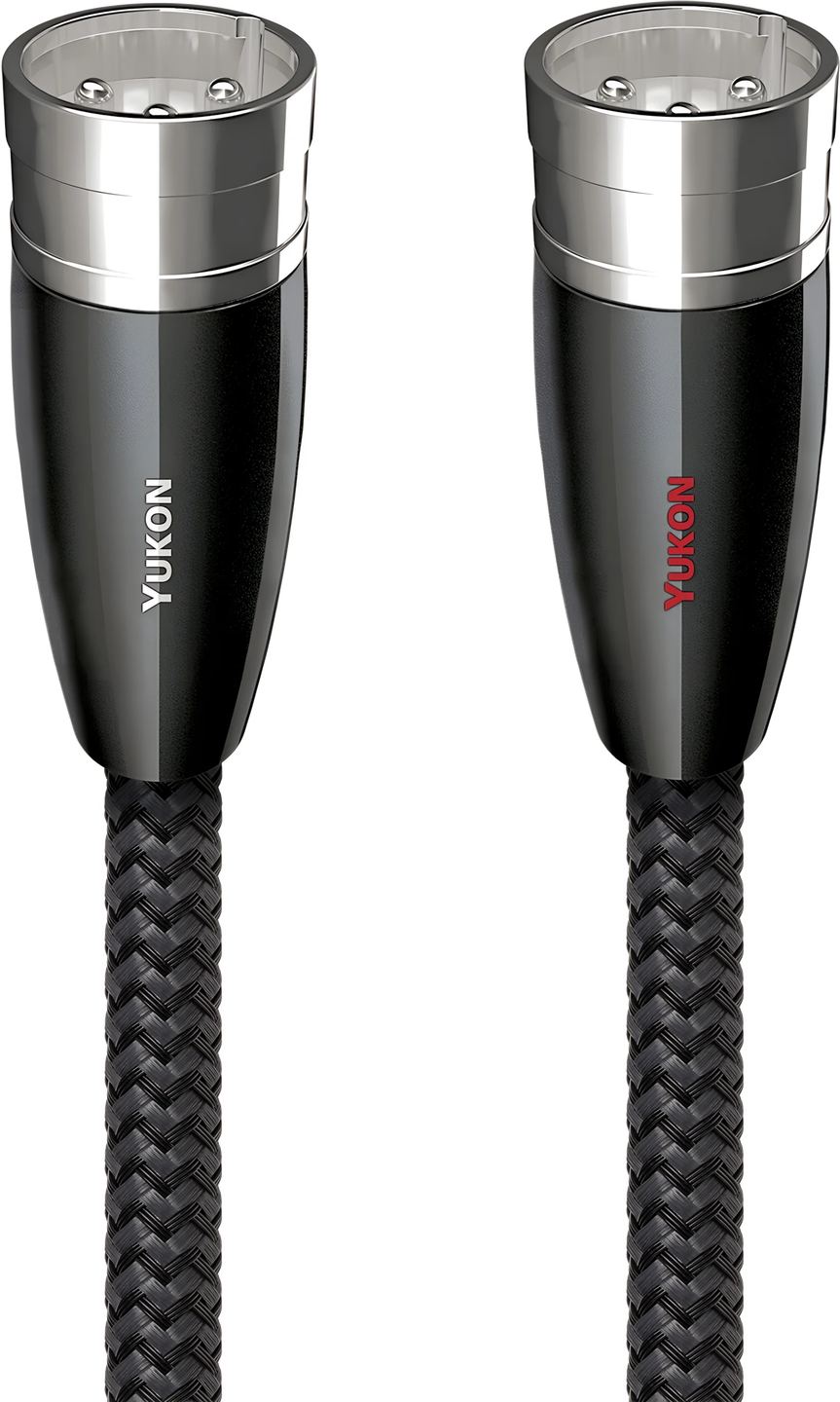
Audioquest Yukon XLR, a balanced interconnect cable
Connecting an analog source to an amplifier via a balanced connection requires a cable that preserves the signal without adding noise or coloration. The Yukon sits at the top of Audioquest’s Rivers series, just above the Mackenzie, whose foundations it builds upon by adding air-tube insulation. Solid copper conductors, carbon shielding, and solder-free connectors define this interconnect cable, right at home in carefully assembled hi-fi and home theater systems.
The pinnacle of the Rivers series
Audioquest names its cables after rivers, and the Yukon crowns the Rivers series. Compared to the Mackenzie, which serves as its foundation, the improvement comes down to one specific point: polyethylene air-tube insulation replaces the solid material used in the models below it. The rest of the recipe remains shared, with PSC+ conductors, a three-layer carbon shield, and a three-conductor balanced geometry. The Yukon thus takes everything that made the Mackenzie and grafts onto it a more transparent dielectric.
Solid perfect-surface copper
The signal travels through Perfect-Surface Copper+ solid conductors, which Audioquest designates with the abbreviation PSC+. A single strand, rather than a twist of fine wires, eliminates the electrical and magnetic interactions between strands — one of the sources of harshness and blur in an ordinary cable. The copper surface receives a treatment that keeps it smooth and pure along its entire length, limiting distortion caused by the metal’s grain boundaries. The conductors are installed in a defined direction of flow, marked on the jacket, to drain high-frequency noise toward where it causes the least interference.
Triple-balanced geometry
The Triple-Balanced design distributes the signal across three conductors, one of which is dedicated to ground. The shield therefore never serves as a return path for the signal — a role it performs poorly in many cables. The positive and negative channels follow paths of identical quality, with the same very low distortion. The left and right channels travel in two separate jackets, which allows flexibility when routing connections behind a piece of furniture or a rack.
Polyethylene air-tube insulation
Around each conductor, the insulation is not a solid material but a tube in which the wire is surrounded primarily by air. Air absorbs almost no energy, and the polyethylene forming the tube itself exhibits low losses. This air-tube insulation reduces the blurring effect caused by denser dielectrics, which store and then release a portion of the signal’s energy in the form of distortion. This is the feature that sets the Yukon apart from the Rivers cables below it.
Carbon shielding against interference
Three layers of carbon and carbon-loaded synthetics form the noise dissipation system, which Audioquest calls the Noise-Dissipation System. Their role is to absorb and redirect radio-frequency interference before it reaches the electronics’ ground, where it would manifest as a veil over the sound. The coverage extends across the entire length of the cable. Combined with the defined direction of flow imposed on the conductors, this shielding keeps RF interference and electromagnetic fields at bay — both of which surround any audio system.
Cold-crimped, solder-free connectors
The XLR connectors are not soldered to the conductors. Audioquest cold-crimps them, creating a junction with no solder joint — soldering being one of the sources of distortion in a cable. The contacts, silver-plated, rest on high-purity purple copper barrels rather than the common nickel-plated metals. The assembly ensures a stable, long-lasting connection and solid mechanical retention of the connector.
Where to place this cable in a system
The XLR format requires two devices equipped with balanced inputs and outputs. The Yukon then connects an analog source (DAC, network streamer with integrated converter, CD player, or turntable routed through a phono preamplifier) to an amplifier or active speakers. The benefit of a balanced connection is most noticeable with devices whose internal electronics are themselves balanced, and over longer cable runs, where common-mode rejection protects the signal against noise picked up along the way. In a modest system or over a very short run, the difference compared to a good unbalanced cable narrows.
Technical Specifications
Cable Type
- Balanced analog audio interconnect cable
- Connectors: male XLR to female XLR
- Designed for high-end Hi-Fi and Home Theater systems
Conductors and Materials
- Solid Perfect-Surface Copper+ (PSC+) conductors
- Pure purple copper contacts with silver plating
- Direction-controlled conductors for optimized signal transmission
Insulation and Dielectric
- Air-tube insulation in low-distortion polyethylene
- Reduced losses and preservation of audio signal integrity
Design and Shielding
- Three-conductor Triple-Balanced architecture with dedicated ground conductor
- Carbon Mesh Noise-Dissipation System (NDS) shielding
- Triple-layer carbon noise-reduction system against external interference
Connectors and Manufacturing
- Cold-crimped XLR connectors with silver plating
- Cold-welded terminations for a reliable and durable connection
Key Features
- High-fidelity balanced transmission
- Advanced reduction of RF and EMI interference
- Extremely low distortion
- More natural, detailed, and transparent sound reproduction
- Excellent dynamics and tonal accuracy
- High-end construction designed for long service life
Listening Benefits
- More open and better-defined soundstage
- Better instrument separation
- Greater respect for musical nuances and micro-details
- More precise bass and more natural midrange
- Audio signal preserved from source to electronics
Recommended Applications
- High-resolution Hi-Fi systems
- Premium Home Theater installations
- Preamplifiers, amplifiers, and audio sources equipped with XLR connections
- Demanding audio systems seeking neutrality and precision
Frequently Asked Questions
Is the Yukon also available in an RCA version?
Yes. The same design is found in a model with RCA connectors, with PSC+ conductors, air-tube dielectric, and carbon shielding. The choice between the two depends on the connectors available on your source and your amplifier, not on a difference in range.
Which way should the cable be connected?
The conductors have a defined direction of flow, indicated by an arrow on the sheath or connector. The arrow points in the direction of the signal, from the source to the amplifier. Respecting this orientation allows the dissipation system to drain noise on the correct side.
Is the cable sold in pairs for stereo?
A stereo connection requires two cables, one per channel. Depending on the packaging, the Yukon is sold individually or as a matched pair; you therefore need two identical lengths to equip a complete left and right channel setup.
Is a break-in period necessary?
Audioquest recommends leaving the cable in use for a few days before judging it. The real extent of this break-in is debated depending on listening tests; the simplest thing is to connect the cable and let it operate without worrying about it.
- Eco-contribution included in the sale price.
- Manufacturer reference: YUKON01X