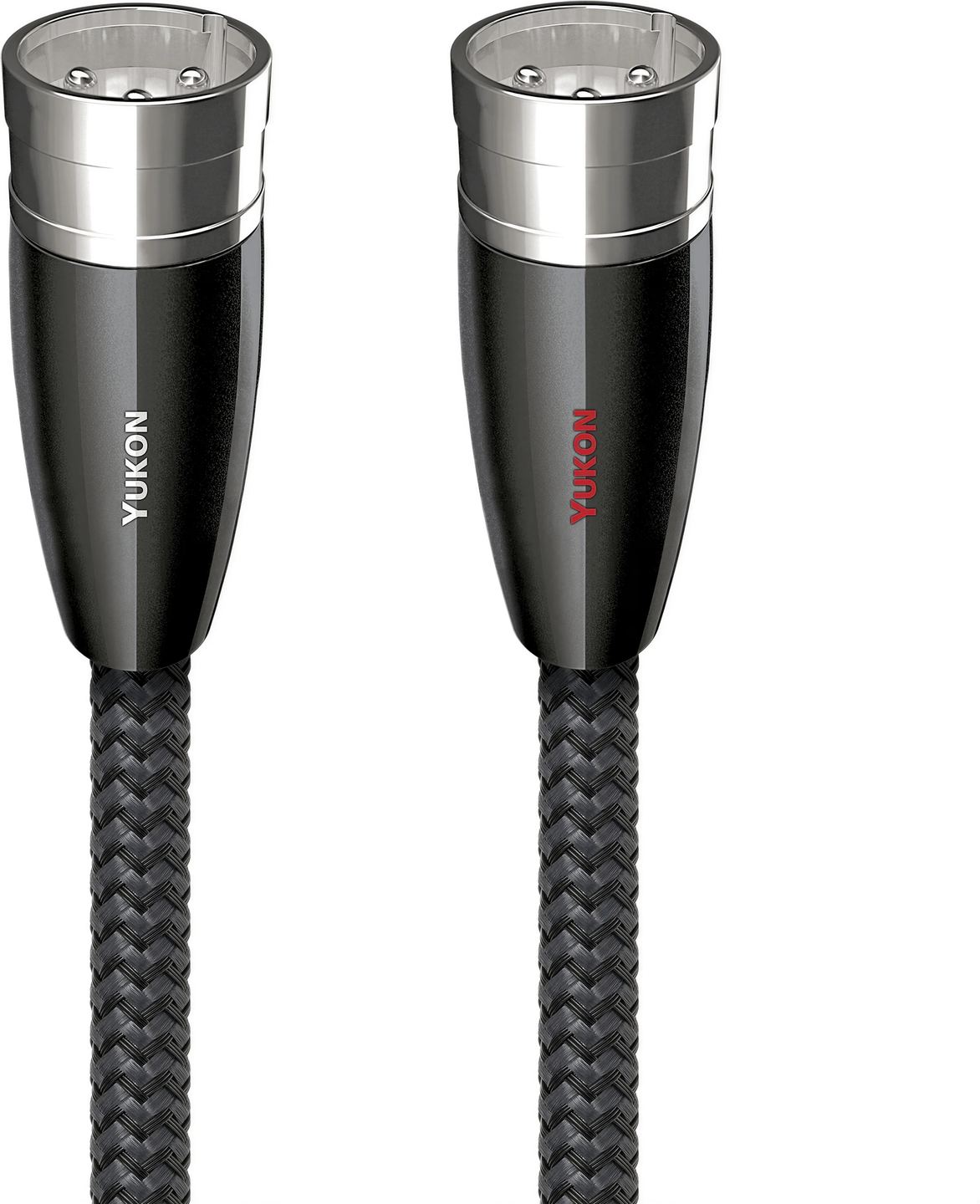
Audioquest Yukon XLR, a balanced interconnect cable
Connecting an analog source to an amplifier via a balanced connection requires a cable that preserves the signal without adding noise or coloration. The Yukon sits at the top of Audioquest’s Rivers series, just above the Mackenzie, whose foundations it builds on by adding air-tube insulation. Solid copper conductors, carbon shielding, and solder-free connectors define this interconnect cable, perfectly suited to carefully assembled hi-fi and home theater systems.
The top of the Rivers series
Audioquest names its cables after waterways, and the Yukon tops the Rivers series. Compared with the Mackenzie, which serves as its basis, the improvement comes down to one specific point: polyethylene air-tube insulation replaces the solid material used in the models below it. The rest of the formula remains the same, with PSC+ conductors, three-layer carbon shielding, and a three-conductor balanced geometry. The Yukon therefore takes what made the Mackenzie successful and adds a more transparent dielectric.
Solid perfect-surface copper
The signal travels through solid Perfect-Surface Copper+ conductors, which Audioquest designates by the acronym PSC+. A single strand, instead of a twist of fine wires, eliminates electrical and magnetic interaction between strands, one of the sources of harshness and blur in an ordinary cable. The copper surface receives a treatment that keeps it smooth and pure over its entire length, which limits distortion linked to the metal’s grain boundaries. The conductors are installed with a defined direction of signal flow, marked on the jacket, to drain high-frequency noise toward the place where it causes the least interference.
Triple-balanced geometry
The so-called Triple-Balanced design distributes the signal across three conductors, one of which is dedicated to ground. The shielding therefore never serves as the signal return path, a role it performs poorly in many cables. The positive and negative paths follow routes of identical quality, with the same very low distortion. The left and right channels travel in two separate jackets, which provides flexibility for routing connections behind a cabinet or rack.
Polyethylene air-tube insulation
Around each conductor, the insulation is not a solid material but a tube in which the wire is surrounded mostly by air. Air absorbs almost no energy, and the polyethylene forming the tube itself has low losses. This air-tube insulation reduces the blurring effect caused by denser dielectrics, which store and then release part of the signal’s energy as distortion. This is the point that sets the Yukon apart from the Rivers cables positioned below it.
Carbon shielding against interference
Three layers of carbon and carbon-loaded synthetics form the noise dissipation system, which Audioquest calls the Noise-Dissipation System. Their role is to absorb and redirect radio-frequency interference before it reaches the electronics ground, where it would translate into a veil over the sound. The coverage extends over the entire cable. Combined with the defined direction of signal flow imposed on the conductors, this shielding keeps RF interference and the electromagnetic fields surrounding any audio system at bay.
Crimped solder-free connectors
The XLR connectors are not soldered to the conductors. Audioquest cold-crimps them, creating a junction with no solder point, solder being one of the sources of distortion in a cable. The silver-plated contacts are mounted on high-purity purple copper barrels rather than the usual nickel-plated metals. The whole assembly ensures stable long-term contact and good mechanical strength for the connector.
Where to place this cable in a system
The XLR format assumes two devices equipped with balanced inputs and outputs. The Yukon then connects an analog source (DAC, network player with built-in converter, CD player, or turntable used with a phono preamp) to an amplifier or active speakers. The benefit of a balanced connection is most noticeable with devices whose internal electronics are themselves balanced, and over long runs, where common-mode rejection protects the signal against noise picked up along the way. In a modest system or with a very short connection, the gap compared with a good unbalanced cable narrows.