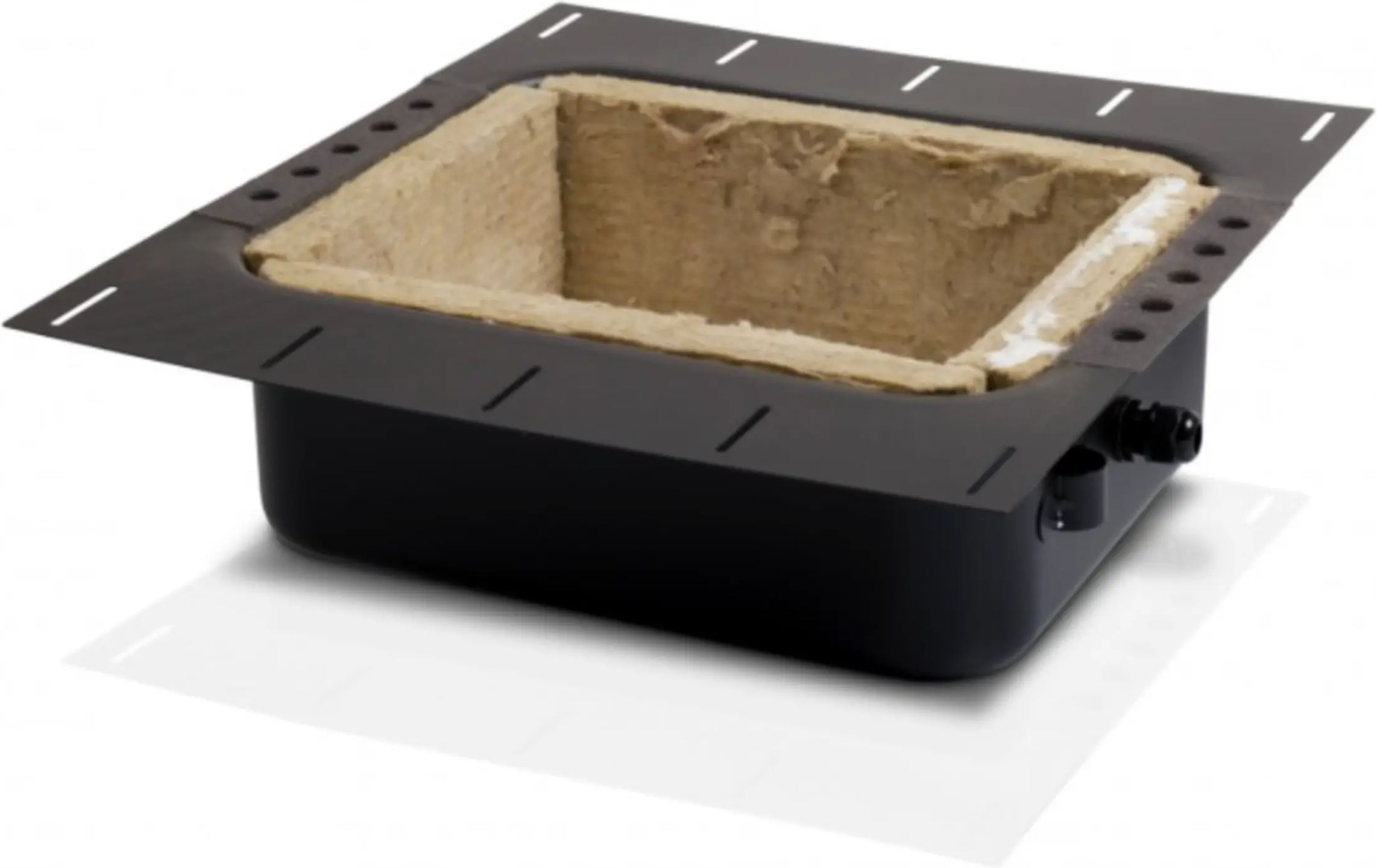
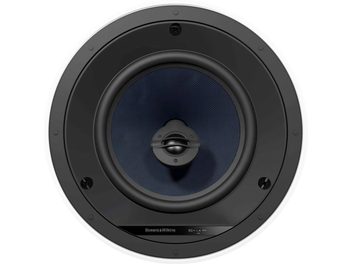
An in-ceiling speaker without a back box radiates backwards into the void above the suspended ceiling, a space whose volume, airtightness and contents vary from room to room. This metal back box gives the speaker a sealed, consistent rear volume, limits sound travelling upstairs or into the next room and seals the ceiling opening with a fire barrier. It is installed before the ceiling is closed up, in both new builds and major renovations.
A defined rear volume for the speaker
When a cone moves forwards into the room, it pushes just as much air backwards. In an open suspended ceiling, this rear wave dissipates into a cavity of unpredictable dimensions, crossed by ducts and joists, which creates its own resonances and makes bass performance difficult to predict from one installation to another. The BB6C replaces this void with a sealed enclosure measuring approximately 25 × 32 × 12 cm internally, or just under 10 litres, which Bowers & Wilkins has sized for its 6- and 8-inch ceiling speakers. Bass becomes tighter and more consistent: it sounds the same in the living room as in the bedroom, because the speaker always operates within the same volume. The improvement is measured in control rather than bass quantity, and that is often what a ceiling installation lacks.
In masonry or a shallow ceiling, the back box also defines a suitable working volume where the available cavity would be too small, even if that means extending beyond the framework.
Less sound travelling upstairs, a barrier against fire
A ceiling cut-out is a hole in a surface that also protects the room above from both noise and fire. The metal enclosure comes lined with a 25 mm layer of insulation that damps vibrations from the rear wave and reduces the amount of sound transmitted to neighbouring rooms. The metal seals the opening and forms the fire barrier that some building regulations require around recessed equipment. The cable passes through a sealed entry, complemented by a cable clamp that prevents the wire from pulling on the terminals or vibrating against the sheet metal.
Installation to plan before closing up the ceiling
With a footprint of 48.9 × 43.8 cm and an overall depth of 14 cm, the back box is secured to the structure (joists, tracks or furring channels) before the plasterboard is fitted. Slotted holes on each side accommodate fixing spacings of between 38.1 and 46.4 cm across, and 40 cm from top to bottom, allowing some flexibility to match the actual spacing of the framework. The plenum height must therefore exceed 14 cm at the chosen location.
The open face of the back box accepts a Bowers & Wilkins pre-mount kit, sold separately. This frame defines the exact position of the cut-out and then serves as a support for the speaker: the plasterboard installer closes up the ceiling using the kit as a guide, and the speaker is fitted once the finishing work is complete.
Compatible Bowers & Wilkins speakers
The BB6C accommodates both speaker sizes in the brand’s ceiling ranges, 6 and 8 inches, with a single back box model. It accepts the CCM 362 and CCM 382, the CCM 662, CCM 663, CCM 663RD, CCM 664, CCM 665, CCM 682, CCM 683 and CCM 684, the single-point stereo versions CCM 663SR and CCM 664SR, as well as the Marine 6 and Marine 8. On the same project, all ceiling speakers in these series can use the same back box, simplifying orders and the plasterboard installer’s work.