United States
EN
Contact
Account
Quote
Basket

Naim Audio SUPERNAIT 3

This product is no longer available for sale!

Awards

Diapason d'Or

The number 1 in classical music and hi-fi. It is a benchmark in the field of classical music and hi-fi, as well as the distinction it awards to the best devices each year

Overview

The Naim Audio Supernait 3 integrated amplifier represents six years of research and development by the British manufacturer. Now in its third generation, this cult model includes a moving magnet phono preamplifier, benefits from a class A preamplifier output stage that also powers the headphone output, and adopts technical improvements inherited from the Statement system, the brand’s flagship. With 80 watts per channel into 8 ohms and an oversized 400 VA power supply, it delivers outstanding speaker control.

Meticulous construction built on decades of expertise

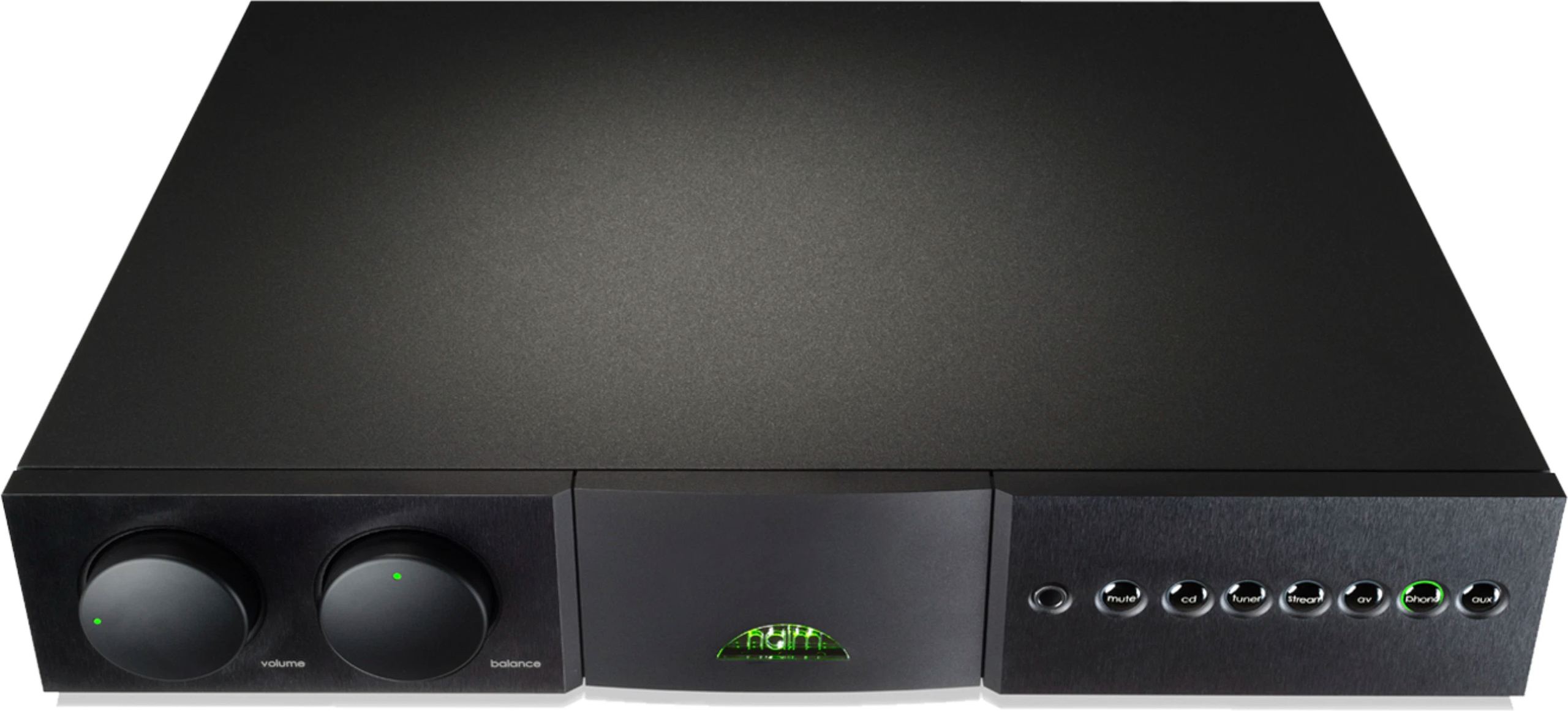
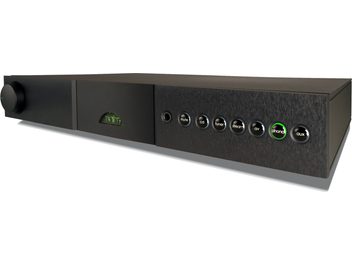
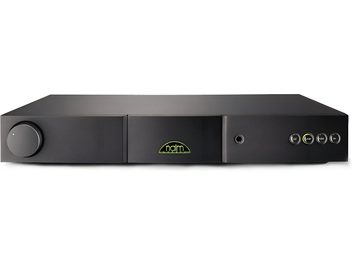
The Supernait 3 chassis retains the clean, understated aesthetic that defines Naim’s Classic range. This continuity ensures visual consistency and helps maintain excellent resale value. The 14 kg extruded aluminum case measures 43.2 cm wide, 8.7 cm high, and 31.4 cm deep.

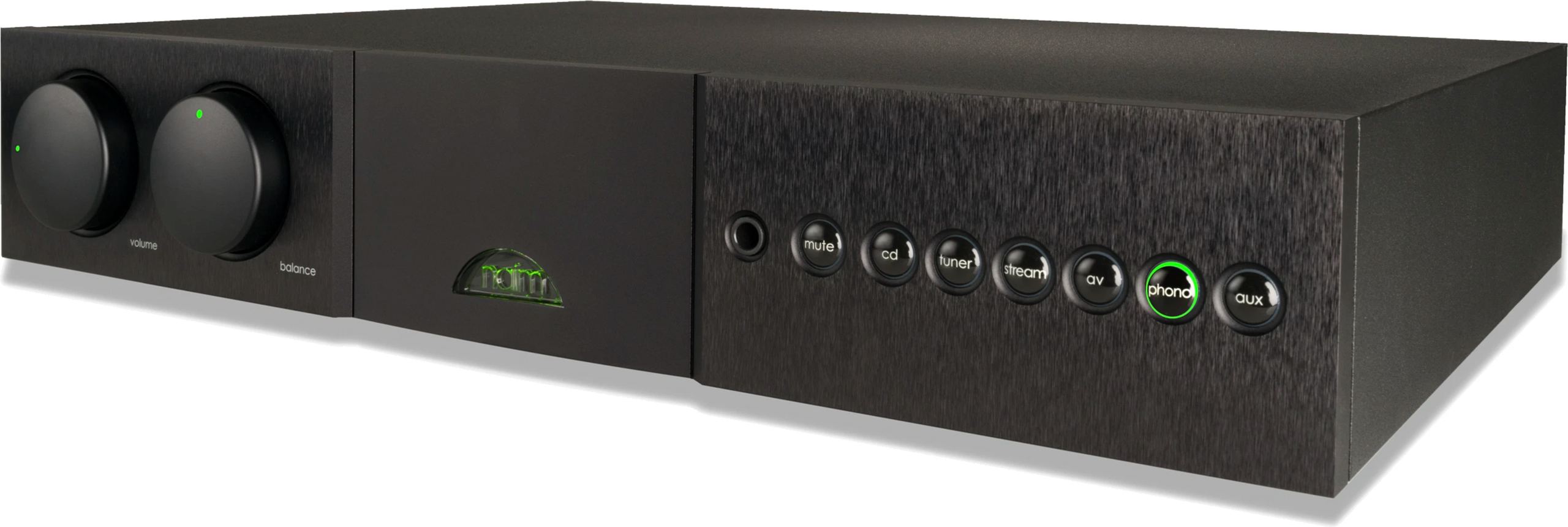
On the front panel, two large Alps Blue Velvet potentiometers control volume and balance. Input selection buttons complete the interface, accompanied by LEDs which, since December 2024, emit a white light. A 6.35 mm headphone jack sits in the center of the front panel.

On the back, four line-level inputs accept either conventional RCA connections or 5-pin DIN connectors, a format Naim favors because its star-grounding scheme helps prevent ground loops. The MM phono input has an impedance of 47 kΩ and a sensitivity of 5 mV. Outputs include two fixed line-level outputs, a variable subwoofer output, a preamplifier output, and an output dedicated to bi-amping. The speaker terminals accept banana plugs only.

A revealing detail of the care taken in the design: the IEC mains socket is mounted with a slight mechanical play to reduce the transmission of vibrations to the chassis.

Cutting-edge technologies derived from the Statement system

The Supernait 3’s main improvement lies in its power stage. The output transistors use ceramic insulators derived from the Statement system. This material reduces parasitic capacitance by a factor of nine compared to mica, eliminating one path for noise ingress. This improvement allows removal of the additional cascode transistor usually employed. By simplifying the circuit, Naim doubles the slew rate, which directly enhances transient response and perceived dynamics.

The preamplifier operates in pure class A, ensuring maximum linearity. This same stage powers the headphone output, making it capable of driving demanding models such as the Sennheiser HD 800 S with authority.

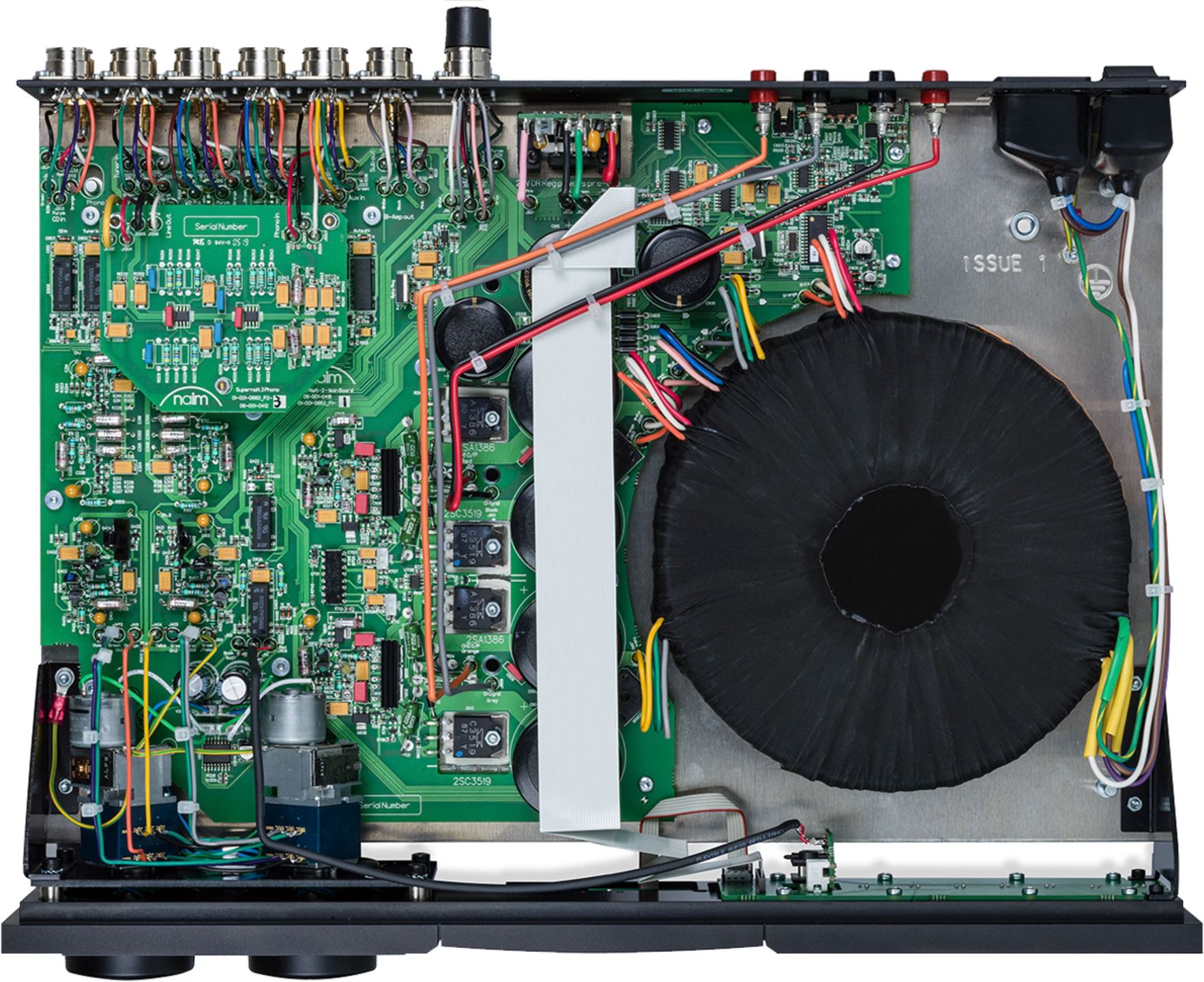
The power supply is built around a 400 VA toroidal transformer, generously specified to provide substantial reserves. The preamplifier section includes a 24 V module using DR (Discrete Regulator) technology. These discrete regulators, the result of two years of development, reduce background noise by a factor of 30 compared to previous generations.

The microprocessor control section is galvanically isolated. The printed circuit boards are mounted on microphonic-isolating supports. Each input is individually decoupled and hand-wired, and internal switching is handled by relays rather than mechanical contacts.

A high-performance built-in phono preamplifier

The integration of a phono preamplifier is the most visible new feature of the Supernait 3. Naim had not equipped its amplifiers with such a circuit since the Nait 3 in the mid-1990s.

The circuit uses a three-stage topology that ensures very low noise and optimal RIAA equalization. All capacitors are selected for their resistance to microphonic effects and their transient performance. The dedicated discrete power supply delivers musicality close to that of a quality external phono stage. Designed for moving magnet cartridges, the circuit does not support low-output moving coil cartridges. For those, Naim offers the Stageline external phono preamplifier, which can be connected to a 24 V powered DIN output.

Scalability that pushes the limits of the integrated format

The Supernait 3 can operate in three ways: as a full integrated amplifier, as a preamplifier with an external power amp, or as a power amplifier with an external preamp.

Adding an external power supply is the first logical upgrade path. Naim offers three options: the Flatcap, the Hi-Cap DR, and the SuperCap DR. The Hi-Cap DR, with a capacity of 500 VA, is particularly interesting. When connected, it creates two independent power supplies: the Hi-Cap DR powers the preamplifier, while the internal supply is dedicated to the power stage. This separation eliminates micro-instabilities caused by the power stage’s current draw.

To go further, the Supernait 3 can act as a preamplifier when paired with a Naim power amplifier such as the NAP 250 DR. Conversely, it can operate as a standalone power amplifier when connected to an external preamp. This step-by-step approach lets you invest over time without having to part with your original amplifier.

A sound philosophy focused on timing and engagement

Naim has built its reputation on its ability to bring out the rhythm and drive in music. The Supernait 3 inherits this signature while benefiting from the improvements in its power stage.

The doubled slew rate translates into better responsiveness to transients. Percussion attacks retain their bite, and dynamic shifts are rendered naturally. Bass, which had room for improvement in previous generations, now reaches a clearly higher level of definition and depth. The midrange has a balanced character that makes listening at high volume easier. The treble combines detail with smoothness.

With 80 watts into 8 ohms and 130 watts into 4 ohms, the Supernait 3 drives the vast majority of speakers without apparent difficulty. Its generously specified power supply gives it an authority that far exceeds what the wattage figures alone would suggest.

Technical specifications

Analog inputs

  • 4 pairs of RCA or 5-pin DIN: CD, Tuner, Stream, AV
  • 1 x 5-pin DIN input: Aux (with Phono power supply +24 V)
  • 1 MM moving-magnet phono input
    • Impedance: 47 kΩ
    • Sensitivity: 5 mV
  • Line-level RCA / DIN inputs
    • Impedance: 47 kΩ
    • Nominal voltage: 2 V
    • Sensitivity: 130 mV

Analog outputs

  • 2 fixed line-level 5-pin DIN outputs: AV, Stream
    • Output voltage: 130 mV
    • Impedance: 600 Ω
  • 1 variable line-level RCA pair: subwoofer
    • Output voltage: 775 mV
    • Impedance: < 50 Ω
  • 1 variable line-level 5-pin DIN output: preamplifier
    • Output voltage: 775 mV
    • Impedance: < 50 Ω
  • 1 variable line-level 4-pin DIN output: bi-amping
    • Output voltage: 775 mV
    • Impedance: < 50 Ω
  • 1 5-pin DIN output with Phono power supply: +24 V
  • 1 headphone output: 6.35 mm jack

Output power

  • 80 watts into 8 Ω @ 0.1% THD+N
  • 130 watts into 4 Ω @ 0.1% THD+N

Control and connectivity

  • Front-panel controls: volume, balance, selector buttons
  • NARCOM-5 remote control supplied
  • Rear-panel jack for remote control
  • Updates: mini‑B USB port

Power supply

  • Power consumption in standby mode: 14 W
  • Power consumption in normal use: 170 W
  • Mains power: 115 V or 230 V, 50 / 60 Hz

Dimensions and weight

  • Width: 43.2 cm
  • Depth: 31.4 cm
  • Height: 8.7 cm
  • Weight: 14 kg

Included accessories

  • Power-Line Lite mains cable

Frequently Asked Questions

Does the Supernait 3 require a break-in period?

Yes, Naim explicitly states that a substantial break-in time is required. Users report that around 200 hours of operation are needed for the amplifier to reach its full potential. During this period, the sound gradually refines, gaining in openness and subtlety.

Why doesn’t the amplifier have digital inputs?

Naim has deliberately chosen not to integrate a digital-to-analog converter into the Supernait 3. This decision stems from experience with the original Supernait, which did include one: digital inputs increase cost and can affect analog performance. Furthermore, a quality external DAC generally offers better performance than a built-in module and allows for independent upgrades.

What is the main sonic difference between the Supernait 2 and the Supernait 3?

The Supernait 3 delivers deeper, better-defined bass than its predecessor. The doubled slew rate provides greater dynamism and precision in transient reproduction. Some users find the Supernait 3 less powerful at first listen, but this is due to the richer bass, which can give the impression that more volume is needed. The built-in phono preamplifier is, of course, a major advantage for vinyl enthusiasts, who no longer need an external Stageline.

User reviews

Charif

Fast delivery and top prices as always at homecinesolutions .well-finished product, easy to use and a delight paired with focal kanta 1, dynamic, detailed and fast sound, the artists' voices full-bodied and textured, a pleasure to listen to.

Comment from April 11, 2026 — Experience from December 04, 2025

Automatically translated — Show original (French)
Livraison rapide et prix top comme toujours chez homecinesolutions .produit bien fini, simple d'utilisation et un régal associé à focal kanta 1 , son dynamique détaillé et rapide, la voix des artistes charnelle et texturée, un plaisir à écouter.

Vicente

Satisfied with the purchase, it meets the expectations I had based on the comments and reviews I read before buying it. I already had a Naim unit from the Olive series, and this one is an improvement.

Comment from December 28, 2025 — Experience from December 07, 2025

Automatically translated — Show original (Spanish)
Satisfecho con la adquisición, cumple con las expectativas que tenía de acuerdo a los comentarios y reseñas que leí antes de comprarlo. Ya tenía un equipo naim de la serie oliva, este lo mejora.

J-Jacques

Magnificent: Let the music play!
The Naim SN3 represents a significant upgrade compared to my old Micromega IA-60 amplifier. The goals have been achieved:

- Breathing new life into my speakers: the antique, indestructible, and inseparable Cabasse Sampan 311.
- Dynamism, clarity of the musical message, with notably perfect bass definition—even at low volume. (Not a 2019 Diapason d'Or winner by chance).
- Compact design, making integration easier.
- Inclusion of a headphone jack.

Add to that the build quality (made in Salisbury) and the brand's reliability, which makes it hard to find second-hand!

This choice comes after a long search, during which I reluctantly ruled out tube amplifiers. The SN3 is the perfect proof that some transistor amplifiers can fully rival tube amps.

Undoubtedly one of the best amplifiers in this price range, as even the much more expensive Luxman L505Z loaner failed to properly awaken my speakers. The SN3, therefore, seems to be compatible with a wider range of speakers. As for the Heed Lagrange S and McIntosh MA252, they were on my list but beyond my budget.

A few flaws of the SN3 fade in comparison to its musicality:

- The lack of a standby mode: my rating would have been 4.5 instead of 5/5 if this had been possible.
- The specificity of alternative connections to RCA: DIN instead of XLR.
- Recommended Naim speaker cables.

Important note: the provided documentation explicitly mentions a considerable break-in period.

I'll end with a "cocorico" (a proud French cheer), highlighting the French component of the English brand Naim. Alongside Focal, Naim is part of the French Vervent Audio Group.

Comment from September 27, 2024 — Experience from September 14, 2024

Automatically translated — Show original (French)
Magnifique : place à la musique !
Le Naim SN3 représente une sérieuse montée en gamme par rapport à mon ancien ampli Micromega IA-60. Les buts sont atteints :

- Donner une cure de jouvence à mes enceintes : antiques, inoxydables et inséparables Cabasse Sampan 311.
- Dynamisme, clarté du message musical, avec notamment une parfaite définition des basses : y compris à bas volume. (Pas Diapason d'or 2019 par hasard).
- Compacité de l'appareil facilitant l'intégration.
- Disposer d'une prise casque.

Ajoutons à cela la qualité de fabrication (à Salisbury) et la fiabilité de la marque : donc difficile de le trouver en occasion !

Ce choix intervient après une longue recherche, après avoir difficilement écarté les amplis à lampes. Le SN3 est la preuve parfaite que certains amplis à transistors rivalisent pleinement avec les amplis à tubes.

Assurément un des meilleurs amplis existants dans cette catégorie de prix, car le prêt du Luxman L505Z bien plus cher n'a pas réveillé comme il se doit mes enceintes. Le SN3 convient donc apparemment à une plus grande majorité d'enceintes. Quid du Heed Lagrange S et McIntosch MA252 qui figuraient sur ma liste, mais hors budget.

Quelques défauts du SN3 s'effacent devant sa musicalité :

- l'absence de possibilité de mise en veille : ma note aurait été de 4.5 au lieu de 5/5 si cela avait été possible.
- La spécificité des connexions alternatives au RCA : DIN au lieu de XLR.
- Cable HP Naim recommandé.

Remarque importante : la documentation fournie stipule explicitement un temps considérable de rodage.

Je termine par un cocorico, en notant la composante française de la marque anglaise Naim. Avec Focal, Naim fait partie du groupe français Vervent Audio Group.
  • Eco-contribution of €2.58 included in the sale price.
  • GTIN / EAN: 5056351706981
HomeCineSolutions
Loading