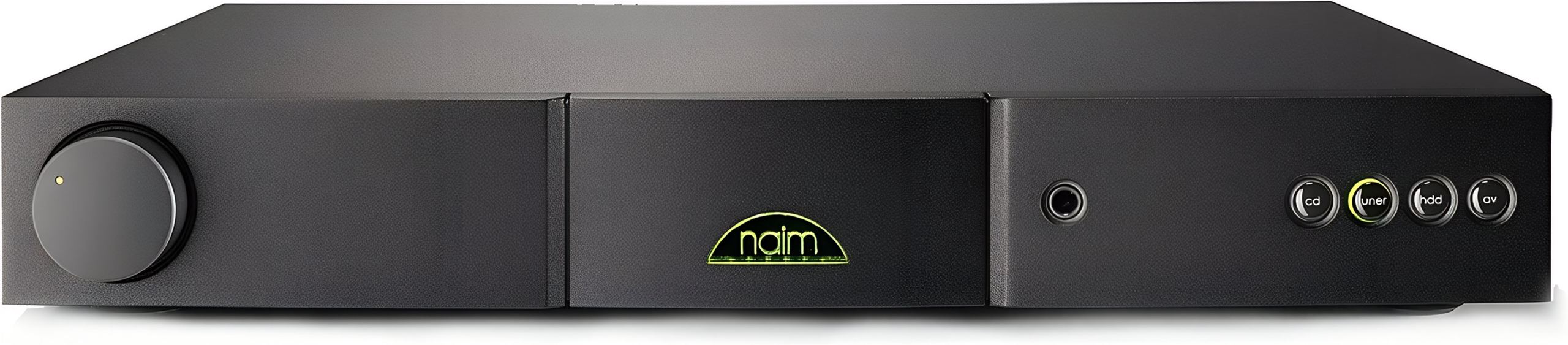
Forty years after the first NAIT, Naim Audio continues to uphold a distinctive approach to integrated amplification. The Nait 5si embodies this philosophy: a compact chassis, a modest output of 60 watts per channel, and an unapologetically analog design. This generation benefits from a redesigned power supply and an optimized output stage, while preserving the essential priority: putting musicality first.
The NAIT legacy reimagined for today
The first NAIT, launched in 1983, surprised its era with just 13 watts per channel, going against the trend that equated high power with sound quality. Julian Vereker, Naim’s founder and self-taught engineer, made a deliberate choice: prioritize power supply quality over sheer output power. The Nait 5si remains faithful to this lineage while benefiting from four decades of technical evolution.
Compared with its predecessor, the Nait 5i, this version gains an extra 10 watts per channel thanks to a more generous toroidal transformer, now rated at 300 VA. The main circuit and internal wiring are derived from the work carried out on the brand’s high-end DAC-V1 converter. The power stage and signal capacitors have also been revised.
A power supply at the heart of the design
Naim places particular importance on the power supply section, considering it crucial to an amplifier’s ability to drive speakers and reproduce musical transients. The Talema toroidal transformer, specifically designed for this unit, feeds four BHC reservoir capacitors of 10,000 µF each. This reserve enables peaks of up to 300 VA, or 90 watts per channel into 4 ohms.
The unit has an idle power consumption of around 19 watts. Naim recommends leaving the amplifier powered on for optimal performance, as the capacitors take a long time to reach full operating conditions. In practice, about twenty minutes is enough to achieve stable operation.
Clean front panel and minimalist ergonomics
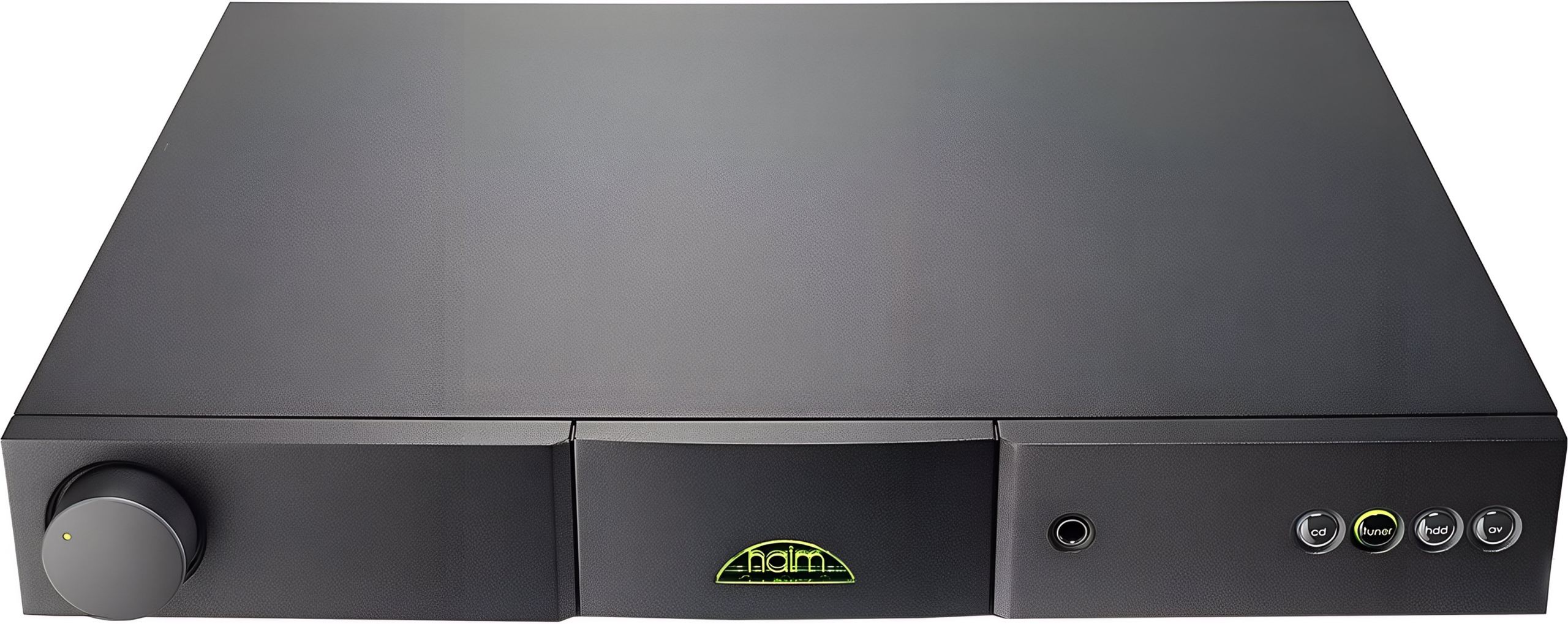
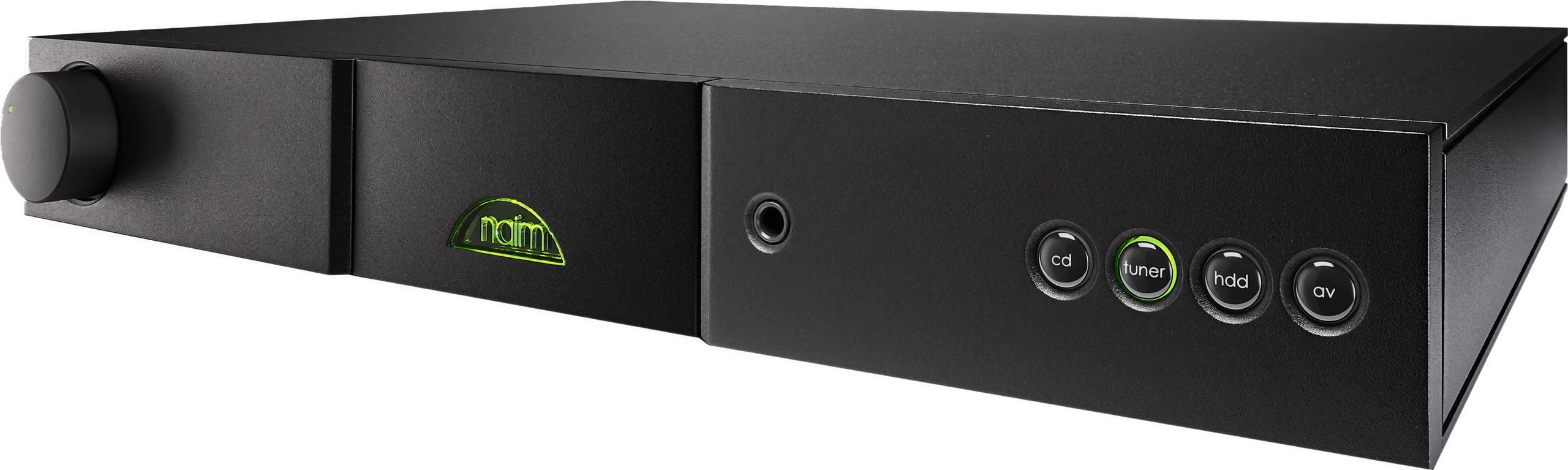
The die-cast zinc and aluminum case features a deliberately understated front panel. The volume knob sits on the left, four input selection buttons on the right, and the 6.35 mm headphone jack is placed in the center. The active input is identified by a green halo around the corresponding button the unit has no display.
This minimalism is the result of a technical decision: keeping the transformer away from the inputs to reduce electromagnetic interference, and shortening the signal paths thanks to surface-mounted components. The control circuits are optically isolated from the audio section and automatically deactivate when not in use.
The compact dimensions (43.2 × 7 × 30.1 cm for 6.8 kg) make it easy to integrate into a cabinet or on a shallow shelf. The supplied NARCOM-4 remote control handles volume and source selection.
Analog connectivity and AV Bypass mode
The rear panel offers four stereo inputs: two of them provide both RCA connectors and 5-pin DIN sockets wired in parallel (CD and Tuner), while the other two accept only RCA. Naim recommends using DIN connections where possible, claiming better ground integrity. A fixed line output (150 mV into 600 ohms) lets you connect a recorder or an active subwoofer.
One of the inputs can be configured in AV Bypass mode. In this mode, the preamplifier passes the signal through at a fixed level without alteration: the power amp is then driven directly by an external home theater processor, which retains volume control. This setup allows a two-channel system and a multichannel system to coexist while sharing the same pair of front speakers.
Discrete headphone amplifier
Unlike many integrated amplifiers that simply tap their main output stage for the headphone jack via a load resistor, the Nait 5si includes a dedicated class A headphone amplifier. This circuit, inherited from higher-end models in the range, offers an output impedance suited to common headphones. Plugging in headphones automatically mutes the speakers.
Pairing with the CD5si player
The Nait 5si forms a coherent combination with the CD5si player, sharing the same aesthetics, dimensions and sonic design philosophy. The NARCOM-4 remote controls both units. The connection between the two can be made via DIN to take advantage of the wiring recommended by the manufacturer, or via RCA depending on the cables available.