
Giuseppe
Excellent balance. Full and defined sound.
Comment from July 09, 2026 — Experience from May 31, 2026
Automatically translated — Show original (Italian)
Ottimo equilibrio. Suono pieno e definito.
The entire Cardas range is based on the same proportion, the golden ratio (1.618), which even appears in the brand’s nautilus-shaped logo. In this cable, conductors of different gauges are arranged concentrically according to this proportion, and the air tubes in the outer layer are sized 1.618 times wider than those in the core. The goal is to reduce inductance and resonance effects that color the signal.
The name reveals the intent: Clear refers to the brand’s current range, Reflection to a return to its older models. The cable combines the transparency and resolution typical of the Clear series with the warmer, more organic signature of Cardas’s past references, such as Golden Reference. The brand aims for a balance between detailed playback and roundness, without pushing the cursor too far in either direction.
Cardas is one of the few manufacturers to cast its own copper, in its Bandon foundry. The cable uses grade 1 OFC copper, 99.9999% pure, coated with transparent SPN enamel in a Litz construction where each strand receives its own insulating coating. At the center, a Kevlar core manages synchronized propagation (Matched Propagation): the signal propagation speed in the conductor and in the dielectric is adjusted, strand by strand, with precise control of the twist pitch, to limit distortion linked to dielectric charge offsets. The selected gauge is 2 x 25.5 AWG.
The internal structure is a suspended air-core twisted pair, in a so-called cross-field geometry, where the conductive layers are crossed to reduce coupling. The conductors are held in place by antistatic LDPE air tubes, wrapped in carbon-impregnated PTFE tape. The two composite shields, in tinned copper and magnet wire, are deliberately kept away from the signal conductors by wider PTFE air tubes, which reduces stray dielectric charges. The whole assembly is insulated under an extruded PFA jacket, then covered with a very flexible black TPR outer jacket. The outer diameter reaches 10.66 mm.
Cardas presents this cable as a gateway to the level of its high-end models, in real-world systems rather than on a test bench. The brand describes good extension in the upper spectrum and speed, with a slightly forgiving character that avoids harshness. The presentation is intended to be neutral and dynamic, against a very quiet sonic background. The soundstage is wide and three-dimensional; timbres remain rich and natural, without aggressiveness.
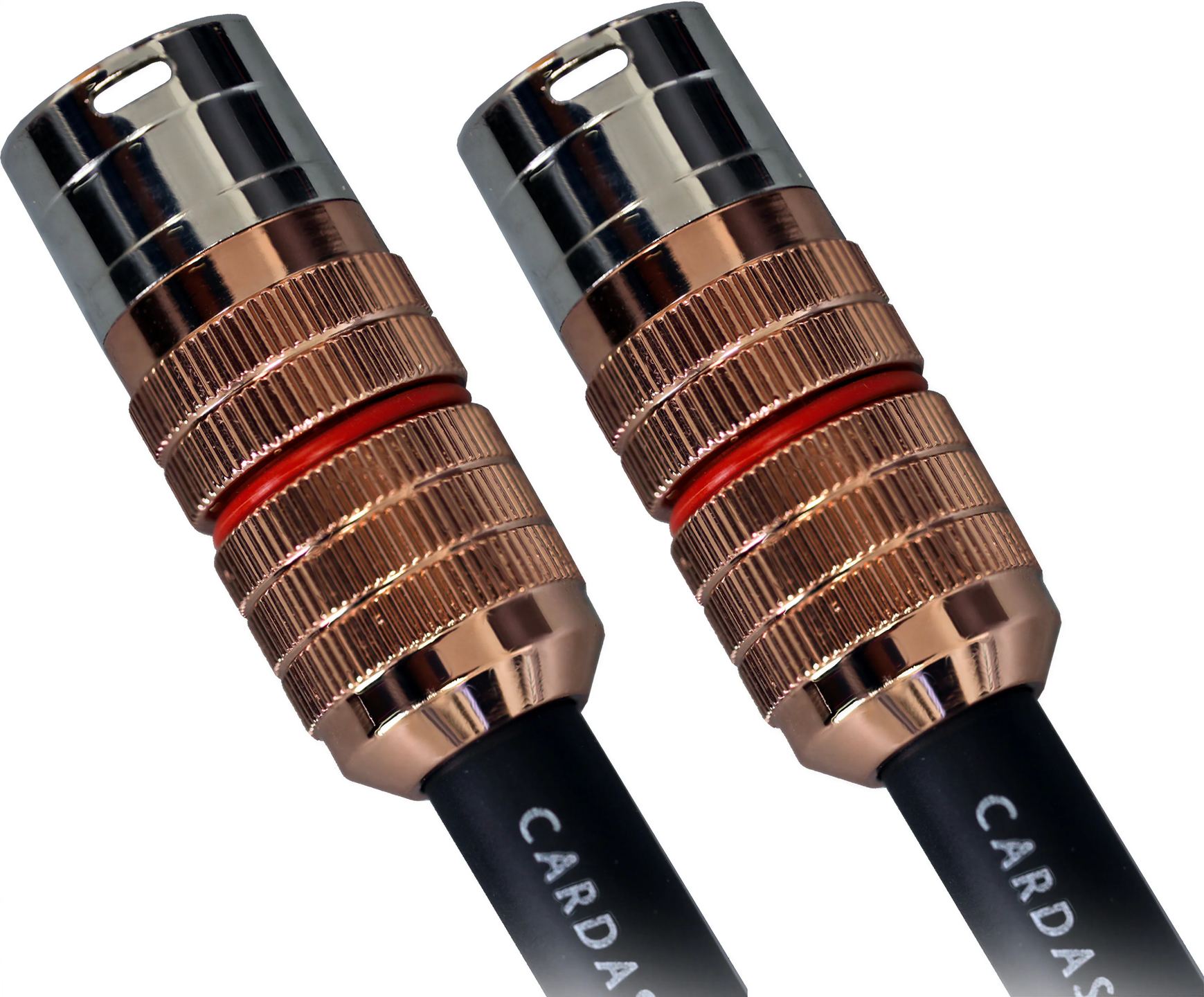
The cable is terminated with Cardas’s in-house XLR connectors (reference CG XLR-CU), in a copper tone matched to the rest of the Clear Reflection range. Each example is hand-terminated in the Bandon workshop. The very flexible TPR jacket makes it easier to route behind a piece of furniture and connect to tightly spaced sockets. The cable covers most links between a source and an amplifier, or between a preamplifier and a power amp.
Cardas offers the Clear Reflection in several lengths, including shorter formats (0.5 m, 0.75 m, 1 m), and makes it available in both XLR and RCA. Custom lengths remain possible from the manufacturer.
Like most Cardas cables, it benefits from several dozen hours of use before delivering stable performance. The brand recommends a break-in period and offers a dedicated frequency disc to speed up the process.
A balanced connection carries the signal over two conductors in opposite phase, allowing the receiving component to reject interference picked up along the way. The advantage becomes noticeable over longer distances or in an electrically noisy environment. The connected devices must still have genuinely balanced inputs and outputs.
The copper hue first complements the range’s black-and-copper aesthetic, but the connector remains a contact point in its own right. A clean, properly crimped contact affects signal transmission just as much as the conductor itself; keeping XLR pins clean remains a good habit.
This is a line-level interconnect cable, used between a source, a preamplifier, and an amplifier. For a phono signal, which is much weaker and more delicate, a dedicated tonearm cable remains more suitable.
The cable is thicker than a basic entry-level interconnect, but its very flexible TPR jacket limits strain. It bends easily behind most furniture, provided you allow for a reasonable bend radius near the connectors.
Giuseppe
Excellent balance. Full and defined sound.
Comment from July 09, 2026 — Experience from May 31, 2026
Pedro
The Cardas Clear Reflection XLR is one of those rare components that does not try to impress through spectacle, but rather through the naturalness and musical coherence it brings to a system.
What stands out most is its fluidity, harmonic richness, and complete absence of listening fatigue, while still preserving detail, soundstage, and musicality in a very organic way.
In a well-balanced system, it has the almost magical ability to make you forget the technical side of the equipment and simply enjoy the music for hours.
An extremely serious and musical cable.
Comment from May 08, 2026 — Experience from April 27, 2026
Jordan
The Cardas Clear Reflection XLR cable offers a very musical reproduction, with a sound that is both warm and detailed. The soundstage is wide and well-structured, which improves instrument separation and listening depth. The highs remain smooth and natural, without harshness, while the bass is full and well-controlled. The build quality is also excellent, true to Cardas’s expertise.
Comment from March 09, 2026 — Experience from February 23, 2026





