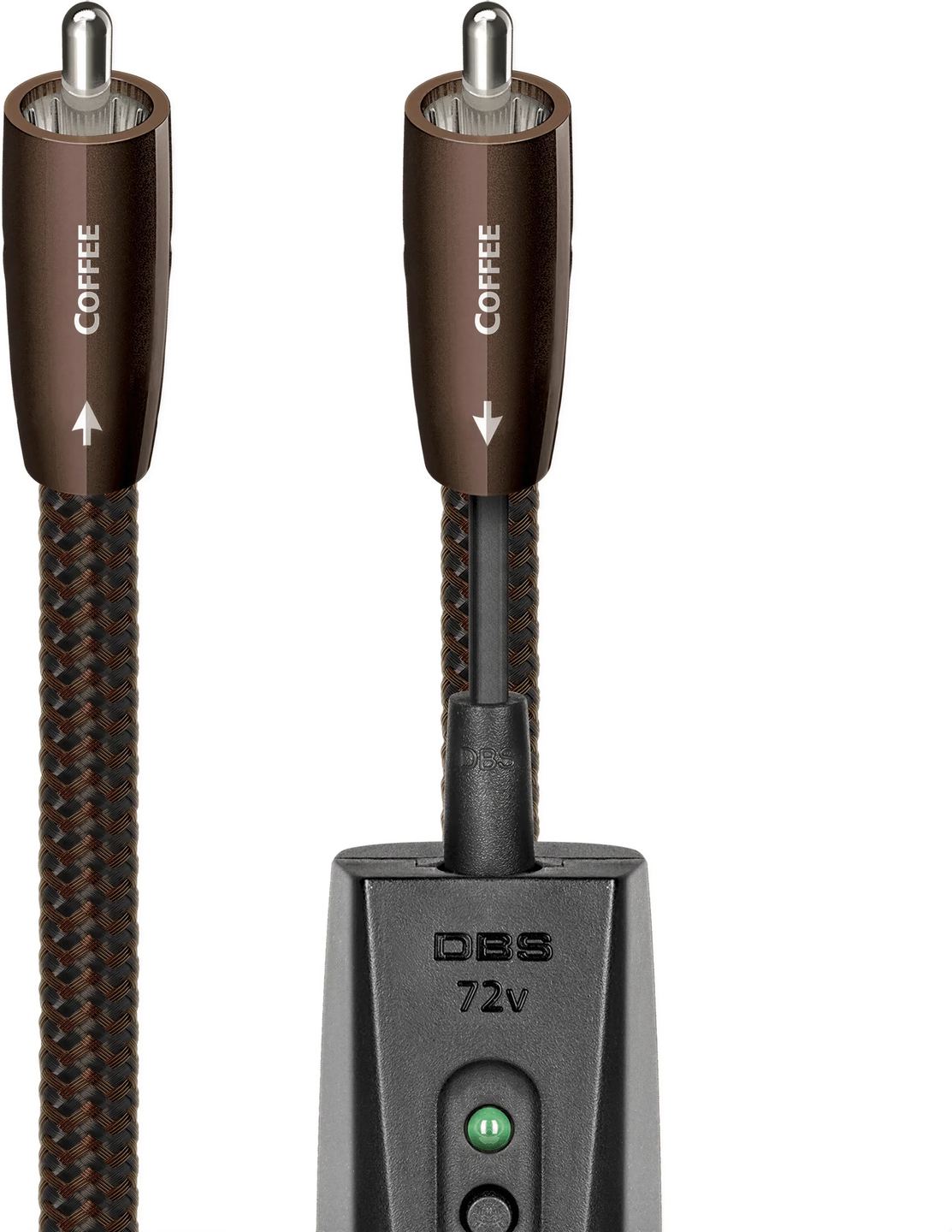
AudioQuest Coffee Coaxial: the high-end S/PDIF connection
A single RCA plug at each end, and the entire stereo stream from a CD player or streamer reaches the converter. The coaxial S/PDIF connection may seem trivial; yet it is demanding, since its impedance, shielding and the radio-frequency noise it allows through determine what the converter receives. AudioQuest positions this model just below the Diamond, at the top of its silver-plated copper digital range.
One cable for both channels
The confusion is common: the plugs are those of an analogue interconnect cable, but the task required is entirely different. A coaxial connection carries the complete stereo stream over a single conductor, with a characteristic impedance of 75 ohms that must be maintained over the entire length. One output socket on the source, one input socket on the converter, one cable: there is no need to buy two as with an analogue connection.
A distinctive feature of coaxial geometry: the shield is not merely protection, it is also the return conductor. Everything it picks up therefore ends up in the signal path, which explains the care taken in its construction.
The choice of silver plating
The conductors are solid, long-grain copper with 10% silver plating. AudioQuest’s reasoning is based on frequency: an S/PDIF signal operates in the megahertz range, and at these frequencies current flows almost exclusively on the surface of the conductor. Placing the most conductive metal on the outside therefore treats the area that matters, without paying the price of a solid silver conductor, reserved for the Diamond.
Using a solid core rather than stranded wire eliminates electrical and magnetic interactions between neighbouring strands. The selected gauge, around 21 AWG, remains modest: this is consistent with a low-amplitude high-frequency signal, where surface matters more than copper volume.
Shielding that protects the shield
Achieving 100% coverage presents no particular difficulty; the essential part comes afterwards. Conventional shielding absorbs radio-frequency noise and then drains it to the device ground, modulating the reference ground plane on which the electronics rely to reconstruct the signal. The NDS system addresses this specific issue with five alternating layers of metal and carbon-loaded synthetic materials, which absorb and reflect stray energy before it reaches the layer connected to ground.
In other words, the cable does not merely block external interference: it prevents it from being passed on to downstream electronics. This is where AudioQuest ranges differ most clearly from one another, with the number of layers increasing with the model level.
Permanent dielectric biasing
This is the defining difference from the Carbon, positioned just below it. The insulation surrounding a conductor behaves like a parasitic filter that stores and then releases energy, with delays varying according to frequency. The DBS system applies a 72 V DC voltage to this insulation to saturate and align its molecules, which linearises the filter and improves the dissipation of induced radio-frequency noise over a wide bandwidth. The process is patented and powered by a battery pack attached to the cable, featuring a test button and an LED to check the charge status from time to time.
This voltage never passes through the signal: it polarises the insulation, with no useful current flow. In practical terms, the battery pack adds bulk midway along the cable, and the additional layers make the cable thicker than entry-level models. Behind a tightly fitted cabinet, it is best to plan for this before installation.
Hard foam to maintain the geometry
The insulation uses nitrogen-injected hard-cell foam. Nitrogen, like air, does not absorb energy or return it to the conductor, which limits distortion introduced by the insulation itself. The rigidity of the material plays a second, more mechanical role: it maintains the relative position of the conductors along the entire cable length, a requirement for stable characteristic impedance.
On a 75-ohm connection, this stability is not cosmetic. A change in geometry creates an impedance mismatch, and therefore signal reflections that may blur the transition edges the converter uses to recover the clock. The brand’s more affordable ranges use expanded polyethylene based on a similar principle, but less rigid.
Solder-free assembled plugs
The terminations use cold welding: the contacts are assembled by compression, without filler alloy whose conductivity would be lower than that of the metals it joins. The contact consists of a silver deposit applied directly to pure red copper.
Two practical consequences. The cable is made to the ordered length and cannot be shortened afterwards: measure before purchase, allowing a little extra for the actual routing behind the cabinet. And because the conductors are directionally controlled during manufacture, printed arrows indicate the connection direction, from the source to the converter.
Formats supported by the coaxial input
This depends on the interface rather than the cable, but it affects the choice. A coaxial S/PDIF connection carries stereo PCM up to 24-bit/192 kHz on most devices, although some are limited to 96 kHz. DSD is carried via DoP encapsulation, generally up to DSD64. Compressed multichannel streams such as Dolby Digital and DTS also pass through, making connection to the coaxial input of a home cinema amplifier possible.
However, high-definition and object-based formats remain beyond the reach of this socket: they require an HDMI connection. A CD player, transport, network player or Blu-ray player used as a stereo source remain the natural starting points for this type of cable.