Audioquest Red River XLR 8m
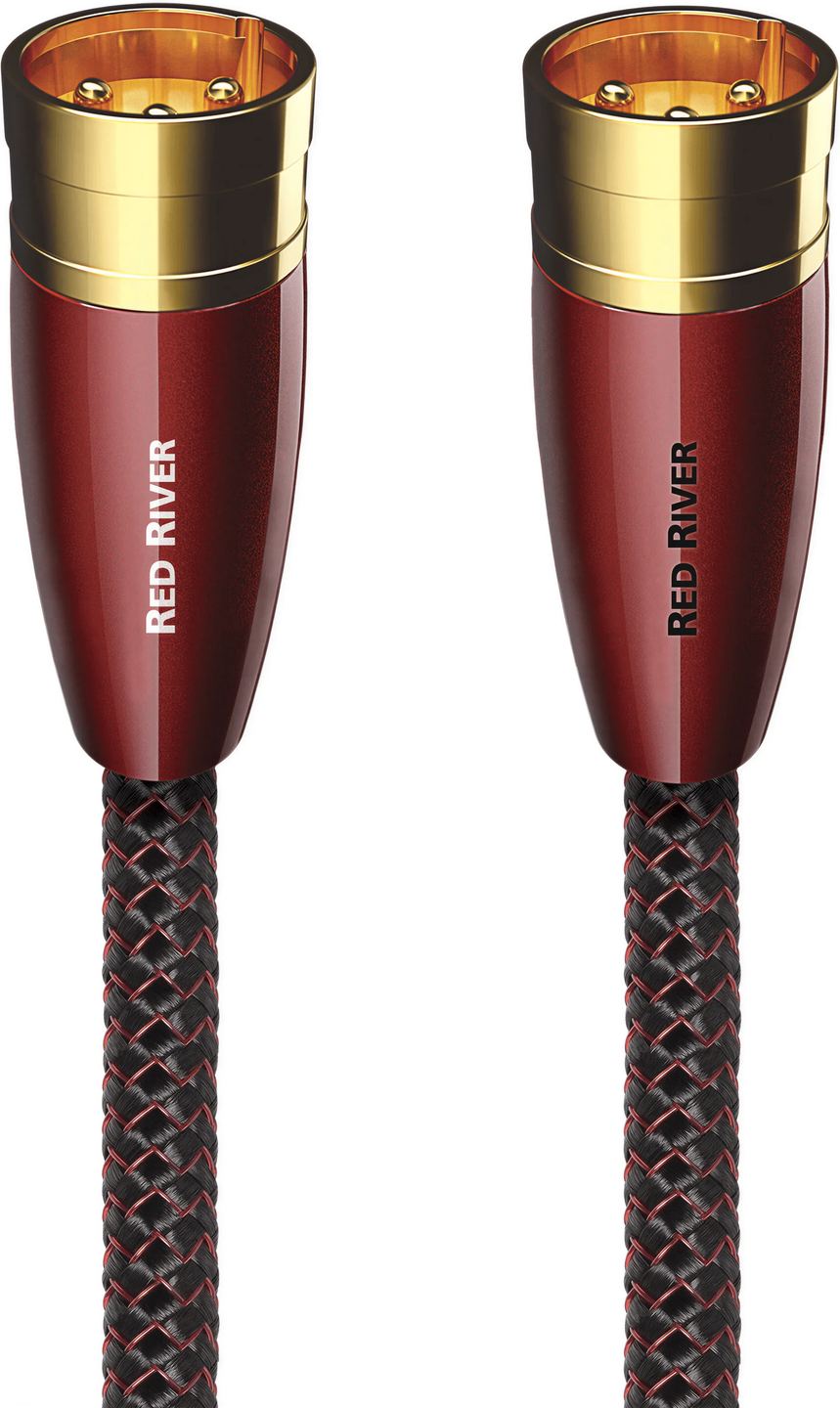
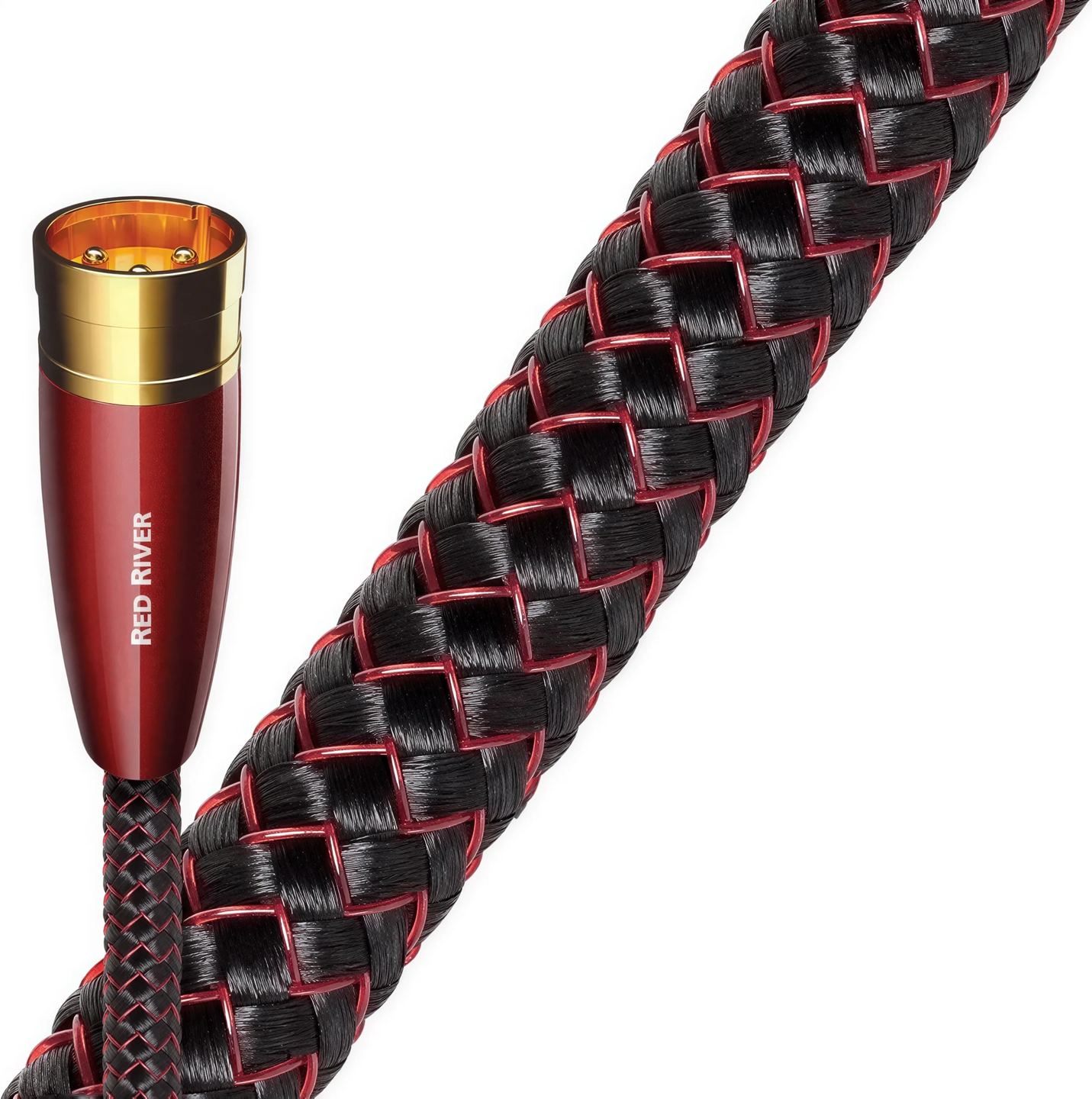
Audioquest Red River XLR Cable
Connecting a DAC to a power amplifier via a balanced connection requires three conductors: the positive signal, the negative signal, and a dedicated ground. Many cables dispense with the third conductor and assign this role to the shielding. Audioquest rejects this shortcut across its entire XLR range, with the Red River opening the catalog with surface-treated solid copper and solder-free assembled plugs.
Three conductors rather than two
The principle of a balanced connection lies in subtraction. The receiving device receives the same signal twice, in phase and out of phase, then subtracts one from the other. Noise picked up along the way is identical on both lines and disappears during this subtraction. The mechanism assumes that the two paths are electrically equivalent; otherwise, noise rejection deteriorates.
This is precisely where the Red River’s Triple Balanced geometry comes in. Shielding used as a return conductor has neither the cross-section nor the impedance of the strand carrying the signal: the two paths become unbalanced. The cable therefore separates the roles with two identical signal conductors, a dedicated ground conductor, and shielding that does nothing but shield. The same construction is used for the RCA versions in the series, where it primarily provides a ground separate from the shield.
Solid copper with a smoothed surface
Each conductor is a single solid strand rather than a bundle. In a stranded cable, the strands make irregular contact and current jumps from one to another according to areas of oxidation, which Audioquest considers a source of dynamic distortion. The copper used, called Perfect Surface Copper, is low-oxidation copper whose surface is protected at every stage of wire drawing. The claim is based on the skin effect, whose extent remains modest at audio frequencies on a small-gauge conductor: this distinction is worth noting, even if the process also ensures appreciable manufacturing consistency.
The conductors are also directional, according to a direction determined by the brand, which says it chooses it through listening tests batch by batch rather than from a published measurement. Arrows appear on the plugs. With XLR, the matter resolves itself: the cable’s female connector mates with the source’s male output, the male connector goes into the amplifier’s female input, and the direction of signal flow is therefore mechanically imposed.
Preventing noise from reaching ground
Covering a cable one hundred percent with a metal shield is inexpensive. The issue is what happens to the captured energy: conventional shielding drains it to the device’s ground, which serves as the reference for all downstream electronics. Modulating this reference amounts to modulating the signal itself.
Audioquest’s dissipation system adds a metal layer that absorbs and reflects some radio-frequency interference before it reaches the layer connected to ground. In a living room filled with routers, light dimmers, and switching power supplies, this high-frequency pollution is constant. A cable will not, however, solve a ground loop or hum related to the electrical installation: these are two different issues, even if a balanced connection helps protect against them.
Rigid nitrogen-injected insulation
Any material in contact with a conductor is part of the circuit and behaves like a poor capacitor: it stores a little energy and releases it with delay. Nitrogen-injected Hard Cell Foam insulation replaces part of the plastic with pockets of gas, which absorb virtually nothing.
The rigidity of this foam serves a second purpose, less often explained: maintaining constant conductor spacing throughout the entire run. A geometry that moves means characteristic impedance that varies. The trade-off is noticeable during installation, with a jacket that is firmer than an entry-level flexible cable, something to anticipate when sockets are close to a wall or at the back of a narrow cabinet.
Cold-welded plugs
Solder introduces a filler metal, generally a tin-lead or tin-silver alloy, whose conductive properties bear no resemblance to those of the copper it joins. Audioquest does without it and uses high-pressure crimping that mechanically compresses the conductor against the contact. The contacts are gold-plated, a material that does not oxidize and retains its contact resistance through repeated reconnections.
Another manufacturing choice: the ground bodies are stamped rather than machined from solid stock. The brand sees this as the freedom to select a metal for its electrical qualities rather than its ease of machining. The XLR connector lock remains the format’s mechanical advantage over RCA, since the plug cannot come loose under the cable’s weight.
Where this connection belongs
The most common use connects a line-level source, DAC, network player, or CD player, to an integrated amplifier or a preamplifier. Next comes the preamplifier-to-power-amplifier connection, often the one that runs across the room and where noise rejection matters most. Active speakers and studio monitors, almost all equipped with XLR inputs, fall within the same scope.
One point should be checked before switching from RCA to XLR: the presence of a three-pin socket does not guarantee that the device is truly balanced internally. Some models convert the signal immediately behind the connector, in which case the benefit is limited to mechanical locking and noise rejection along the cable run. The change is also noticeable in volume level, as the XLR standard conventionally provides six decibels more than RCA: perceived volume changes at the same setting.
The first tier of the XLR range
The Red River occupies the entry-level position in the brand’s balanced catalog. Above it, the Mackenzie uses PSC+ copper and a more elaborate dissipation system, the Yukon continues this progression, followed by the Black Beauty, Pegasus, ThunderBird, and Dragon series, whose prices move into an entirely different range. The Rivers series groups the first three, with a common logic: three-conductor geometry and cold welding are present from the first model, with evolution focusing mainly on metal quality and the sophistication of noise treatment.
Technical Specifications
Conductors
- Type: balanced analog audio cable
- Solid Perfect Surface Copper (PSC) conductors
- High-purity copper with an ultra-smooth surface
- Reduced loss and distortion
- Excellent signal transmission
- Natural, detailed reproduction
- Directional conductors
- Oriented according to signal flow
- Optimized dissipation of interference
- Connection direction marked on the plugs
- Improved sonic transparency
Triple Balanced Geometry
- Three independent conductors
- True balanced transmission
- Dedicated ground conductor
- Shielding not used as a signal conductor
- Reduced noise and crosstalk
Noise Dissipation
- Metal-layer shielding
- Reduced radio-frequency interference (RFI)
- Limited electromagnetic interference (EMI)
- Preservation of audio signal integrity
Insulation
- Nitrogen-injected Hard-Cell Foam (HCF) insulation
- Reduced energy absorption
- Perfectly maintained conductor geometry
- Minimized distortion
- Stable impedance throughout the cable length
Connectivity
- Male XLR to female XLR connectors
- Gold-plated contacts
- Cold-weld termination
- High-pressure mechanical connection
- Metal body
- Excellent long-term reliability
Sound Quality
- Faithful, natural reproduction
- Deep, controlled bass
- Precise midrange
- Detailed treble
- Stable stereo image
- Low noise level
- Excellent dynamics
Frequently Asked Questions
Can this cable be used for a digital AES/EBU connection?
That is not its intended use. An AES/EBU connection also uses XLR connectors, but it requires a controlled characteristic impedance of 110 ohms, which an analog cable does not guarantee. The signal will often pass through, with an increased risk of jitter and dropouts depending on the length and the equipment. Audioquest offers XLR models specifically designed for digital use.
What should I do if only one of my two devices has XLR connectors?
An XLR-to-RCA adapter negates the benefit of a balanced connection and shorts the pin carrying the inverted signal, which some outputs handle poorly. It is better to choose a cable designed for this purpose, or to remain with RCA until both components are balanced. The Red River is available in an RCA version with the same internal geometry.
How many cables are needed for a pair of active speakers?
One connection per speaker, each receiving its own channel. Studio monitors and hi-fi active speakers each have their own XLR input and amplification stage: there is no single cable that powers both.
Can the connection direction be reversed by mistake?
No, the connectors prevent it. The cable’s female connector only mates with a male output, and the male connector only with a female input. The printed arrows confirm the direction of signal flow, so the user does not need to worry about it.
What does the Mackenzie offer compared with this model?
The move to PSC+ copper, a superior surface quality in the brand’s metal hierarchy, and more advanced noise reduction. The three-conductor geometry and the solderless plug principle remain common to both references: the difference lies in the refinement of the materials, not in the overall design.
Is this type of cable useful for a modest setup?
The benefit depends mainly on the context. A short connection between two nearby devices, in an electrically quiet environment, leaves little room for improvement with a well-made cable. A connection that runs across the room, alongside a power strip or near a network enclosure is in a situation where shielding, dedicated grounding and symmetrical construction are more justified. It is the overall logic of the system that determines this, not the amplifier’s level alone.
- Eco-contribution included in the sale price.
- Manufacturer reference: RRIVER08X