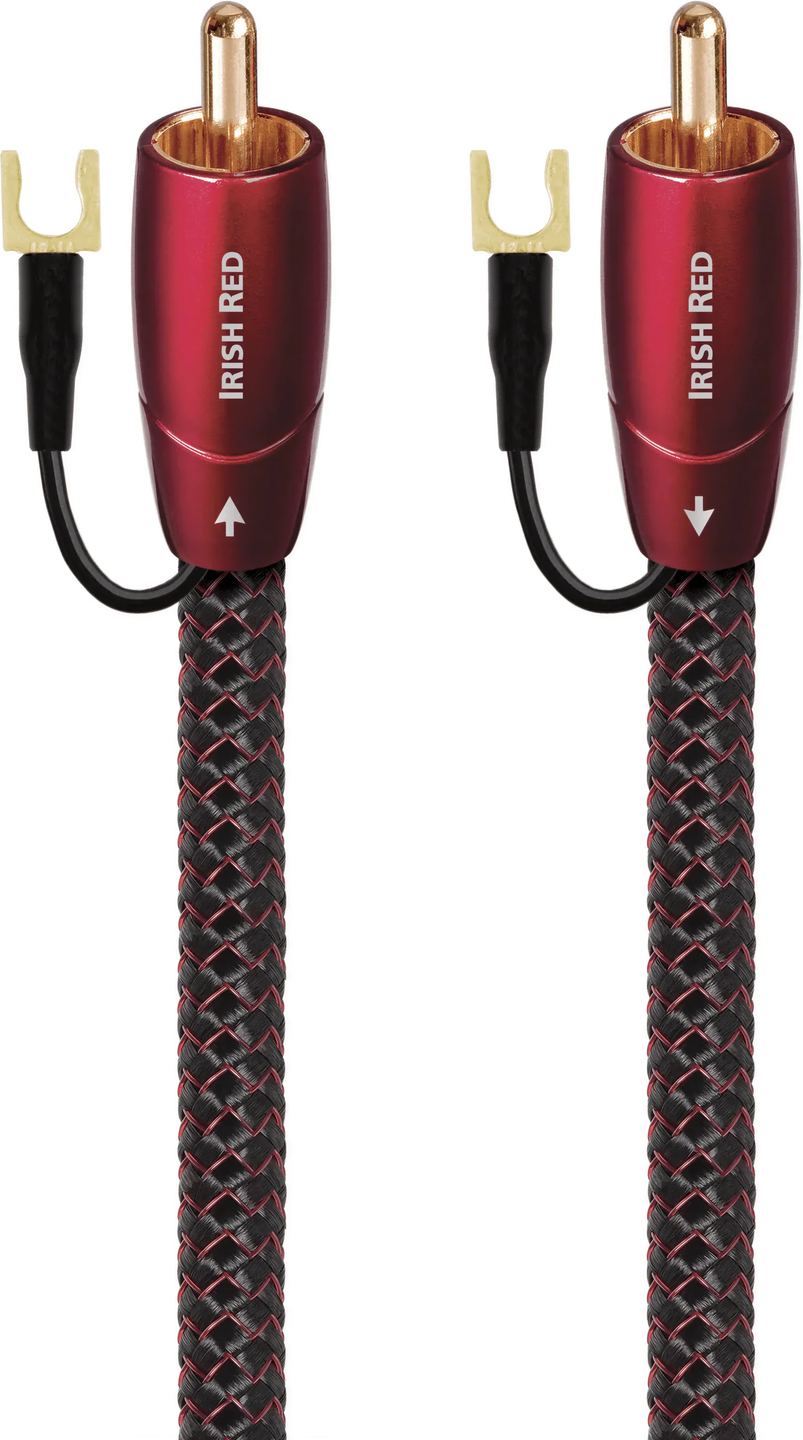
AudioQuest Irish Red Subwoofer Cable
Connecting a subwoofer to its amplifier may seem trivial, until a low hum creeps into the bass or a long run alongside a power strip starts interfering with the signal. AudioQuest’s subwoofer cable addresses this specific situation: carrying a mono LFE signal (the channel dedicated to low-frequency effects) over what is often a considerable distance, shielded from the electrical interference lurking behind a TV cabinet.
The signal path, from core to insulation
Each conductor is a solid copper strand, silver-plated to 0.5%. The choice of solid-core construction is far from insignificant: in a stranded cable, the signal jumps from one wire to another, and this interaction degrades performance. A single continuous conductor avoids this. The silver plating promotes surface conduction, where the highest frequencies travel. On an LFE channel limited to low frequencies, this refinement remains subtle; it comes fully into its own if you repurpose the cable for a standard line-level connection, which its construction allows. The symmetrical coaxial geometry positions the positive and negative conductors identically, with the shielding kept away from the audio path. The insulation is nitrogen-injected foamed polyethylene: the air it traps absorbs very little energy and limits dielectric losses that blur the signal.
Keeping interference away from ground
Behind a TV cabinet, the subwoofer cable runs alongside power cords and power supplies, sources of radio-frequency and electromagnetic interference. Conventional shielding picks up this interference and then drains it to the system ground, potentially contaminating this reference that is supposed to remain stable. AudioQuest takes a different approach with its metal-layer noise-dissipation system: rather than sending everything to ground, it absorbs and reflects part of the stray energy before it reaches the ground plane of your equipment. The background becomes quieter, and the bass stands out more clearly.
Cold-welded connectors, without solder
The RCA connectors are gold-plated and finished without a single solder joint. AudioQuest crimps the conductor under very high pressure, creating a mechanical contact known as cold welding. The benefit: it avoids solder, whose poor conductivity would otherwise sit in the signal path. The contact remains secure over time, and the plug fits firmly into the subwoofer’s input as well as the amplifier’s subwoofer output.
The ground wire that eliminates hum
An active subwoofer connected to an amplifier or AVR can sometimes produce ground hum, that deep, continuous buzz revealing a ground loop. The cable includes a simple solution: two small terminals connected to a ground wire. In the event of buzzing, one terminal is screwed to the metal chassis of the subwoofer amplifier and the other to that of the source device, neatly closing the loop. Most installations will not need it, but the day the problem arises, the solution is already in the box.
Where the Irish Red sits in the range
AudioQuest offers its subwoofer cables in an animal-themed series, from the entry-level Black Lab to the more fully featured Boxer and Husky models. The Irish Red sits in the middle: it adopts the geometry and shielding principle of the lower models, then raises the material standard with silver-plated conductors and a more refined outer finish. The step up is measured less in flashy specifications than in consistent build quality.