

Cardas Parsec Digital 1.5m
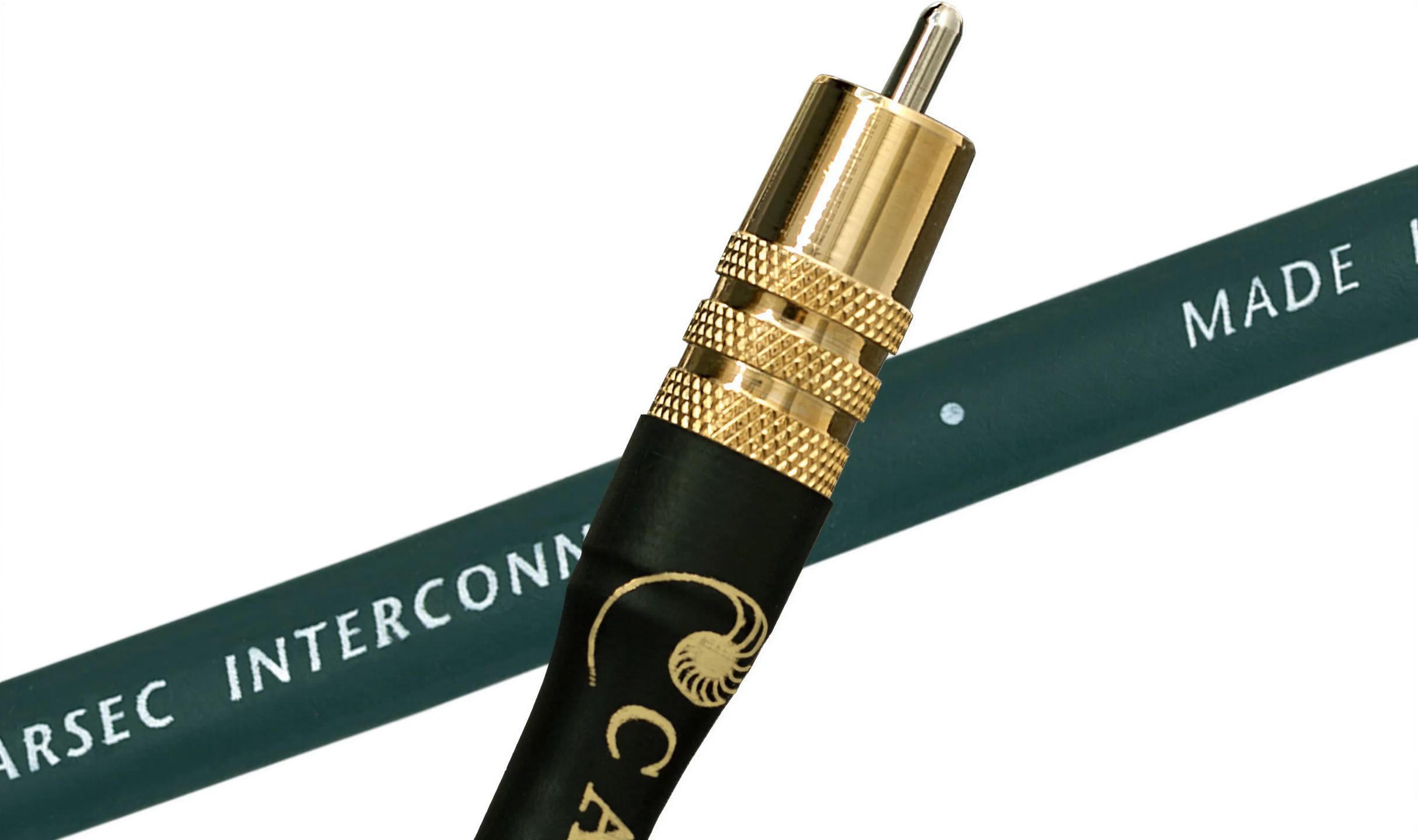
Cardas Parsec Digital, digital coaxial cable
Between a CD player and a DAC, the coaxial connection carries data, but how it carries that data matters: a cable with varying impedance distorts the signal edges and makes the receiver’s job harder. The entry-level model in the Cardas digital cable range, the Parsec Digital replaces the former High Speed Data with a more flexible jacket, better-quality plugs and a construction derived from the analog Parsec range.
A 75-ohm impedance maintained from end to end
The coaxial S/PDIF standard sets the impedance of the source output, the DAC input and the cable connecting them at 75 ohms. When these three values match, the signal passes from one device to the other without bouncing back; when they differ, some of the energy is reflected at the ends and blurs the transitions between digital signal states. The bits still arrive, but the precise timing of each transition becomes less clear, and it is this timing uncertainty, known as jitter, that the DAC must then absorb. On the Parsec Digital, the 75-ohm impedance results directly from the cable’s geometry, meaning the conductor’s diameter and its distance from the shielding through the chosen insulating materials. The actual benefit also depends on the DAC: a model with an effective reclocking stage is less sensitive to the quality of the connection than a simpler receiver.
Six-nines copper with individually enamelled strands
The central conductor is grade 1 oxygen-free copper with a purity of 99.9999%, the same as that used in Parsec interconnect cables. It consists of strands individually coated with clear SPN enamel, following the Litz wire principle: insulated from one another, the strands do not exchange current, and the enamel protects the copper from oxidation throughout the cable’s life. The strand diameters follow the proportions of the golden ratio, an approach developed by George Cardas and found throughout the brand’s products, and the layers are wound in a geometry known as cross-field, with each layer wound in the opposite direction to the previous one to limit the conductor’s inherent resonances. PTFE insulation, the material known as Teflon and valued for its low losses, surrounds the assembly.
Double shielding held at a distance by air tubes
Around the insulation, low-density polyurethane air tubes are held together by FEP tape, a fluoropolymer similar to PTFE. These tubes keep the shielding at a consistent distance from the conductor, and this stable distance determines the impedance along the entire length; air, one of the best insulators available, also reduces the amount of solid material in contact with the signal. The shielding combines two layers: an aluminized polyester film that covers the entire circumference and blocks high-frequency interference, and a tinned copper spiral that ensures ground continuity. The dark green outer jacket, more flexible than that of the High Speed Data, matches the color of the other Parsec cables. The cable remains lightweight and bends easily, making it easier to route behind furniture without putting strain on the devices’ RCA sockets. This flexibility has a logical trade-off: a very tight bend or crushing locally changes the spacing between conductor and shielding, and therefore the impedance, so it is best to guide the cable through curves rather than bend it sharply.
GRMO plugs in rhodium-plated eutectic brass
The ends are fitted with Cardas GRMO RCA plugs whose bodies are made of eutectic brass, a non-magnetic alloy that melts and solidifies at a single temperature, without an intermediate phase, giving it a homogeneous structure. These bodies receive an underlayer of silver, an excellent conductor, followed by rhodium plating. A very hard metal, rhodium resists wear from repeated connections and corrosion, whereas silver alone would eventually tarnish; its bulk conductivity is lower than that of silver or gold, but as a thin layer it provides excellent contact that does not deteriorate over time. The gold-plated brass shell protects the plug and provides a good grip without forming part of the signal path. The cable is hand-terminated at the Cardas workshop in Bandon, Oregon.
The devices connected by the Parsec Digital
A digital coaxial output is fitted to most CD players, transports and network players, while the corresponding input is found on DACs, integrated amplifiers with a digital section and many home theater amplifiers. The Parsec Digital carries stereo PCM up to 24-bit and 192 kHz, depending on what the devices support, as well as compressed Dolby Digital and DTS 5.1 streams; lossless cinema formats (Dolby TrueHD, DTS-HD Master Audio) and full-resolution Dolby Atmos require an HDMI connection. Compared with a Toslink optical connection, coaxial supports higher sampling rates on many devices, with optical often limited to 96 kHz. However, it electrically connects the grounds of the two devices, whereas optical fiber isolates them: when there is hum caused by a ground loop, optical retains an advantage. For devices equipped with BNC sockets, the Parsec Digital is also available in a BNC version and a mixed RCA-to-BNC version.
Technical Specifications
Construction
- Eutectic brass body
- Double shielding
- 75 Ω digital coaxial cable
Finishes
- Rhodium plating over silver
- Gold-plated brass connector
Dimensions
- Cable length: 1.5 m
Frequently asked questions
What does the Parsec Digital offer compared to the old High Speed Data?
It takes over its role as Cardas’s entry-level digital coaxial cable, with improved shielding, greater flexibility, more refined connectors and a softer jacket matching the rest of the Parsec range.
Can a digital cable change the sound?
The transmitted data remains identical from one cable to another as long as the connection works. Any differences concern the timing accuracy of the received signal, which the converter must reconstruct before conversion. Their magnitude depends mainly on the receiver: a converter with carefully implemented reclocking greatly reduces the cable’s influence, while a more basic receiver remains more sensitive to it.
Can it be used for an AES/EBU connection?
No. AES/EBU uses XLR connectors with a balanced connection and requires a 110-ohm cable. The Parsec Digital is an unbalanced 75-ohm cable with RCA plugs, intended exclusively for coaxial S/PDIF.
Can it be used as a subwoofer cable?
Technically, yes: a coaxial cable with RCA connectors can easily carry a mono analog signal such as that from a subwoofer or LFE output. Its 75-ohm impedance has no effect at audio frequencies. For a stereo analog connection, the Parsec range offers interconnect cables sold in pairs.
Is the cable sold individually?
Yes. A digital coaxial connection requires only one cable, with the signal for both channels carried on the same conductor.
How do I route it behind a piece of furniture?
Simply allow it to follow gentle curves, without bending it sharply or trapping it under a furniture leg, to keep its impedance consistent. Keeping it away from power cords, or crossing them at right angles rather than running them side by side, reduces the risk of interference. To unplug it, it is better to pull on the plug housing rather than the cable sheath.
Which cable ranks higher in the Cardas digital range?
The Clear Digital is the next step up. It uses the construction of the brand’s Clear range, a notch above the Parsec range.
- Eco-contribution included in the sale price.


