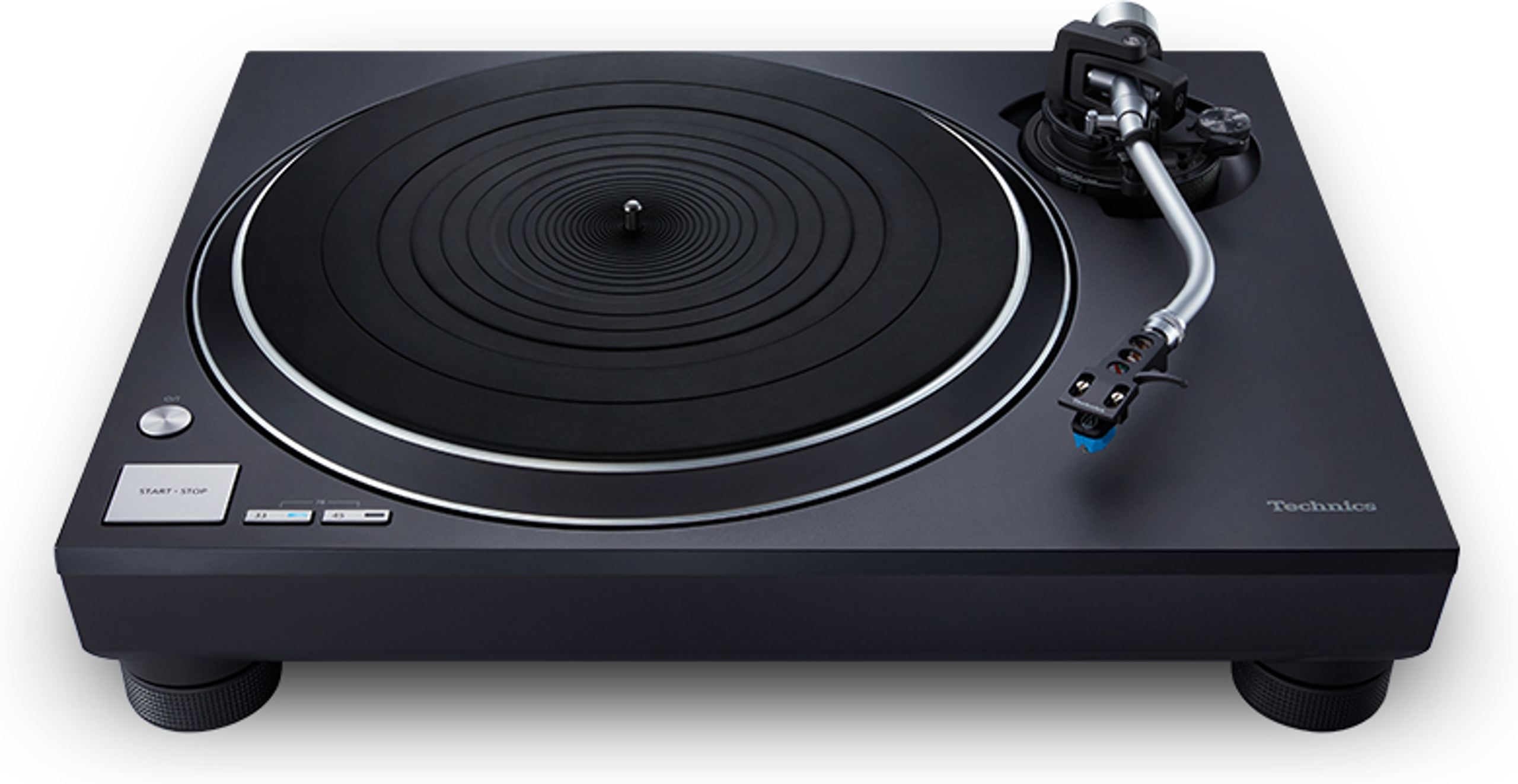
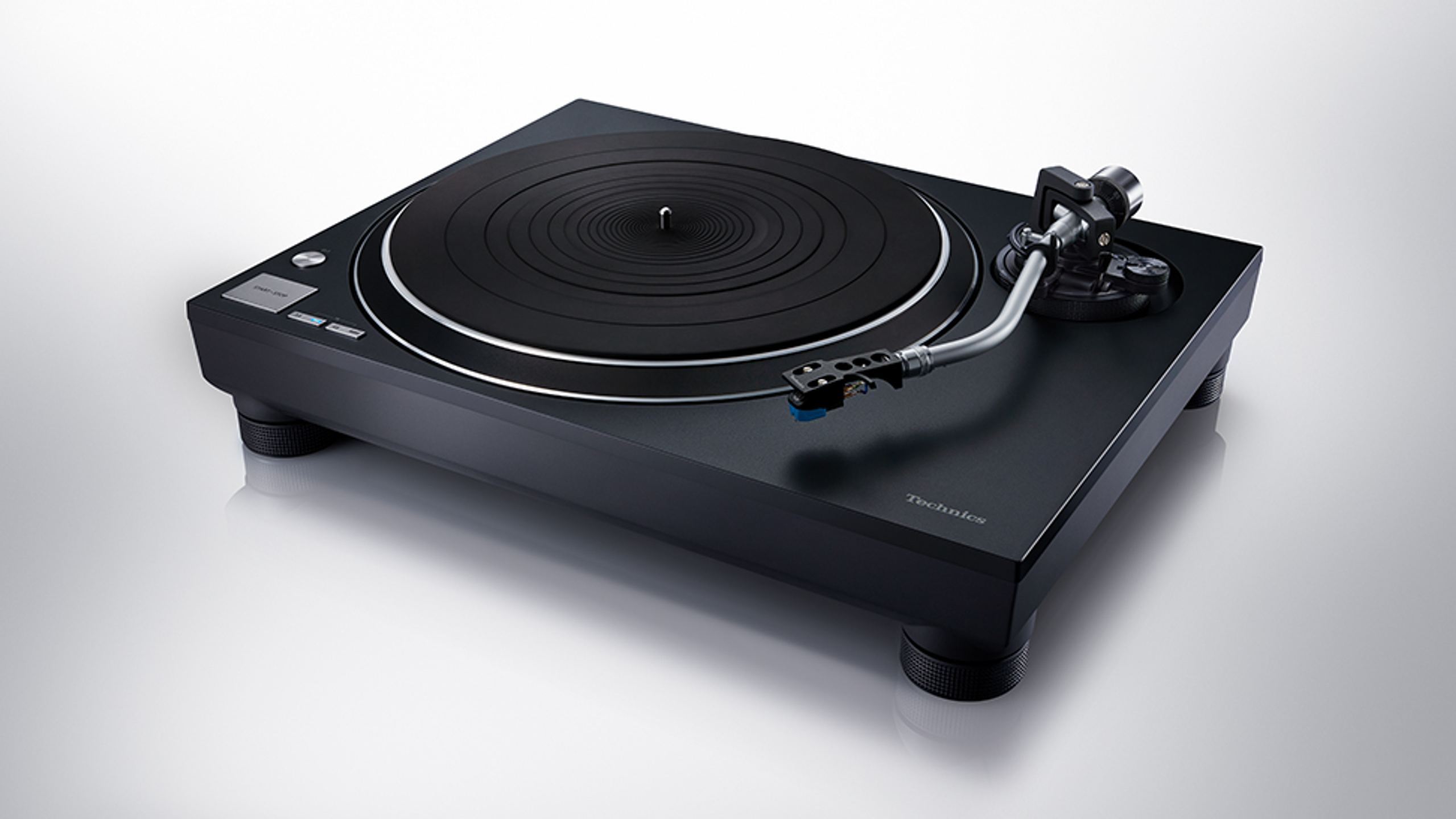
Technics SL-100CEG-K, direct drive without preamp
Removing the phono preamp from a turntable means removing a convenience in order to give the listener a choice. Technics has adopted this option for this version of the SL-1500C: the mechanics remain identical, with a coreless direct-drive motor and an S-shaped tonearm mounted on precision bearings, but RIAA equalization takes place outside the chassis. An Audio-Technica cartridge comes factory-fitted and adjusted.
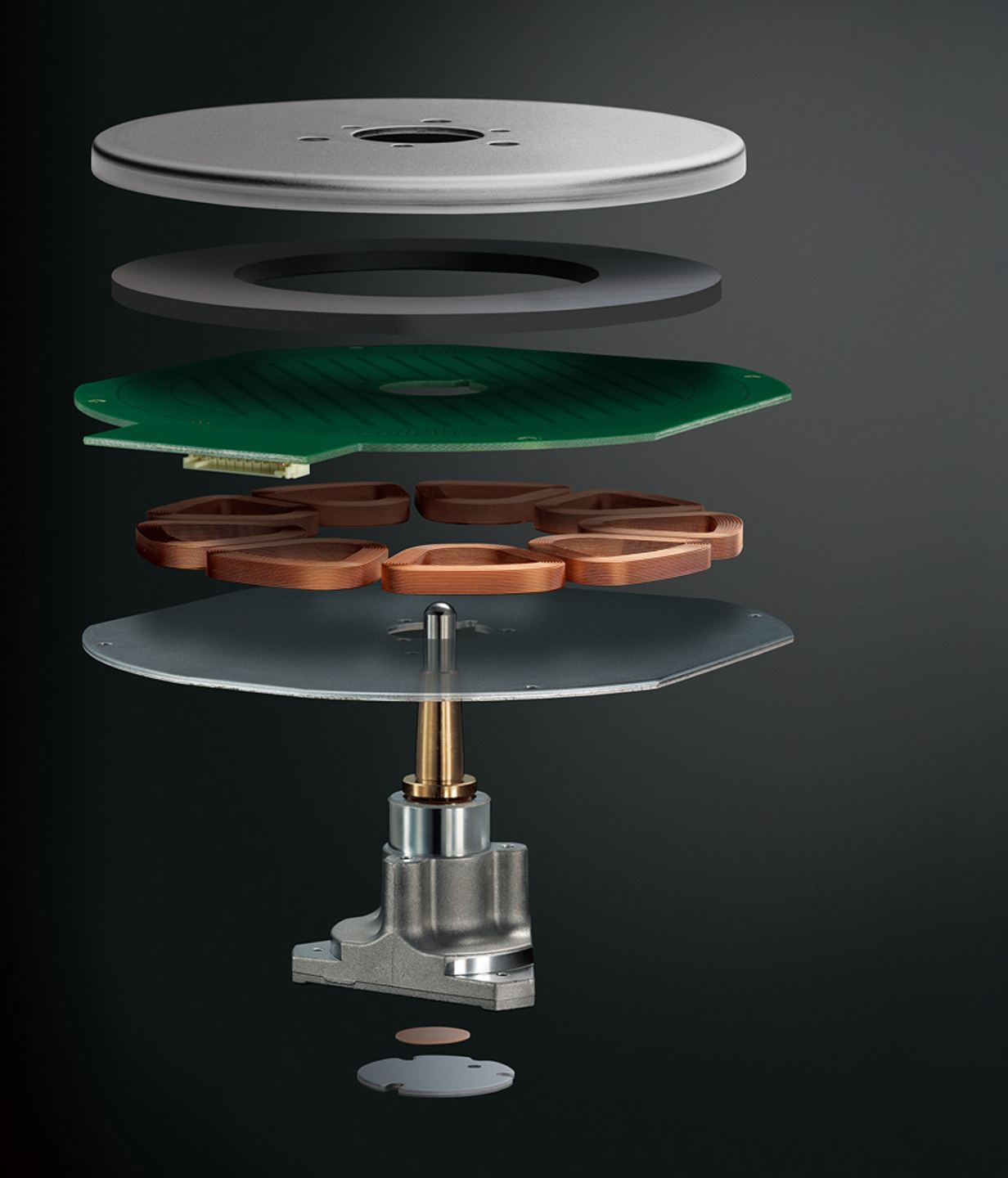
A coreless motor derived from the SL-1200 series
The motor is a single-rotor, brushless, coreless DC model. The absence of a core eliminates cogging, those tiny jerks caused by the attraction between coils and magnets that disrupt rotational consistency at low speed. Measured result: 0.025% weighted RMS wow and flutter.
Starting torque reaches 0.18 N·m, allowing the platter to go from standstill to 33 1/3 rpm in 0.7 seconds. Electronic braking handles stopping. There is no belt to monitor or replace: this is one of the long-term advantages of direct drive over belt-driven turntables in the same price range.
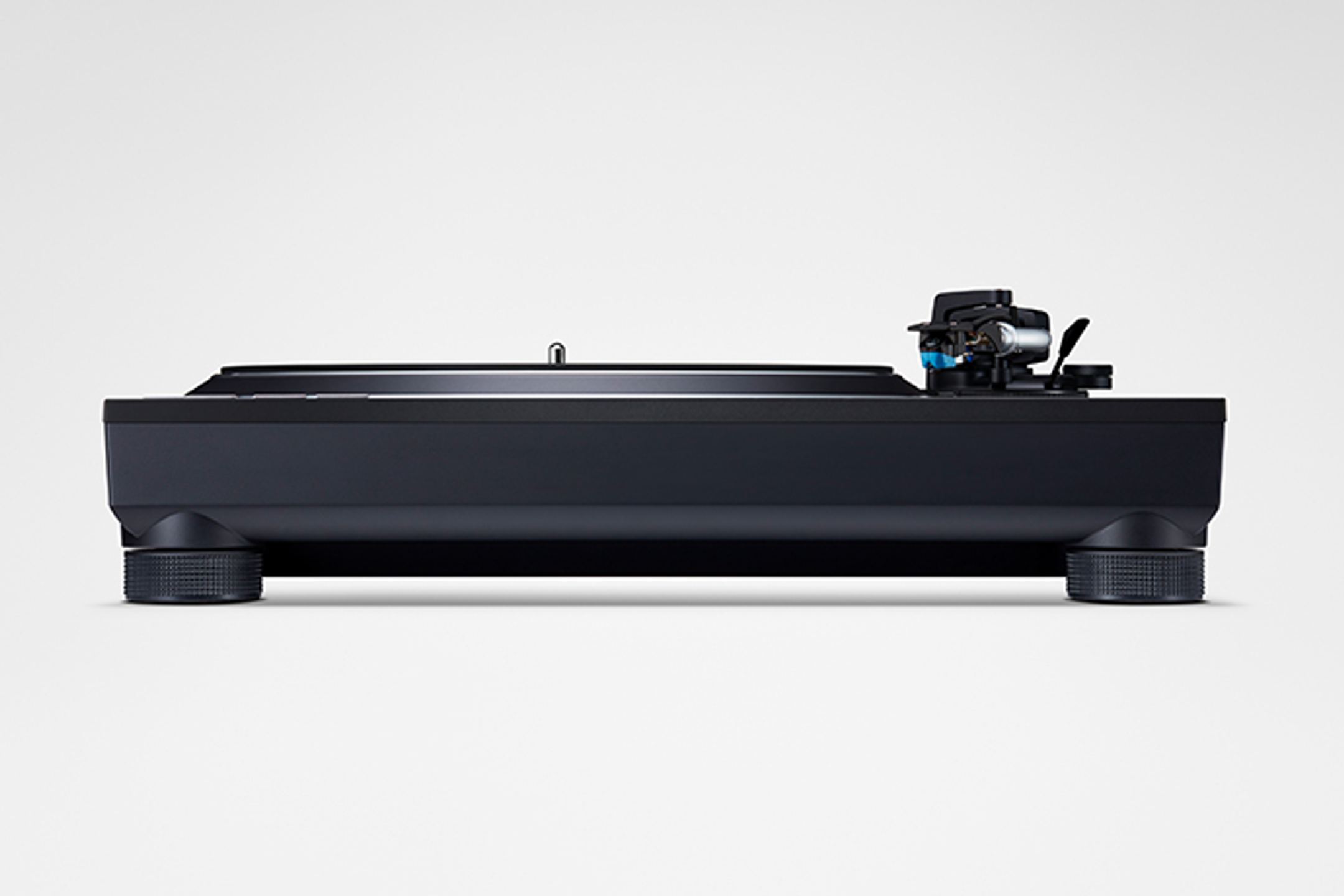
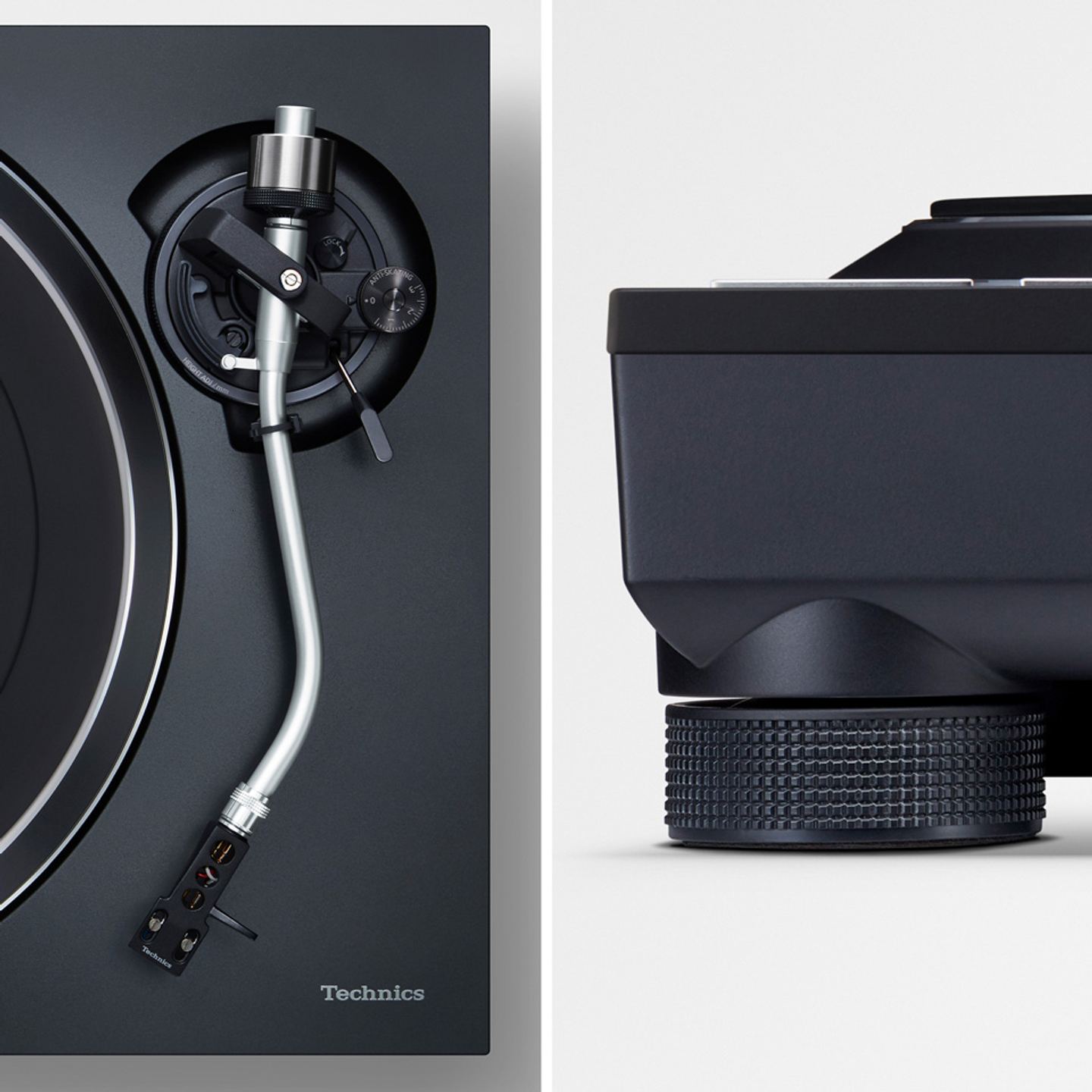
The die-cast aluminum platter measures 332 mm and weighs approximately 2 kg including the platter mat. The rubber applied across its entire surface damps resonances and improves coupling with the record. The chassis combines two layers, a die-cast aluminum base and a glass-fiber-reinforced ABS composite material, with the assembly resting on height-adjustable spring-and-rubber isolators. At 9.9 kg, the turntable requires a stable support, but it withstands floor vibrations better than a lightweight chassis.
The S-shaped tonearm and removable headshell
The statically balanced universal tonearm uses the gimbal suspension and bearing housing of the SL-1200. Its effective length is 230 mm, with a 15 mm overhang and a 22° offset angle, geometry that keeps tracking error below 2° 32′ at the outer groove of a 30 cm record and below 0° 32′ at the inner groove.
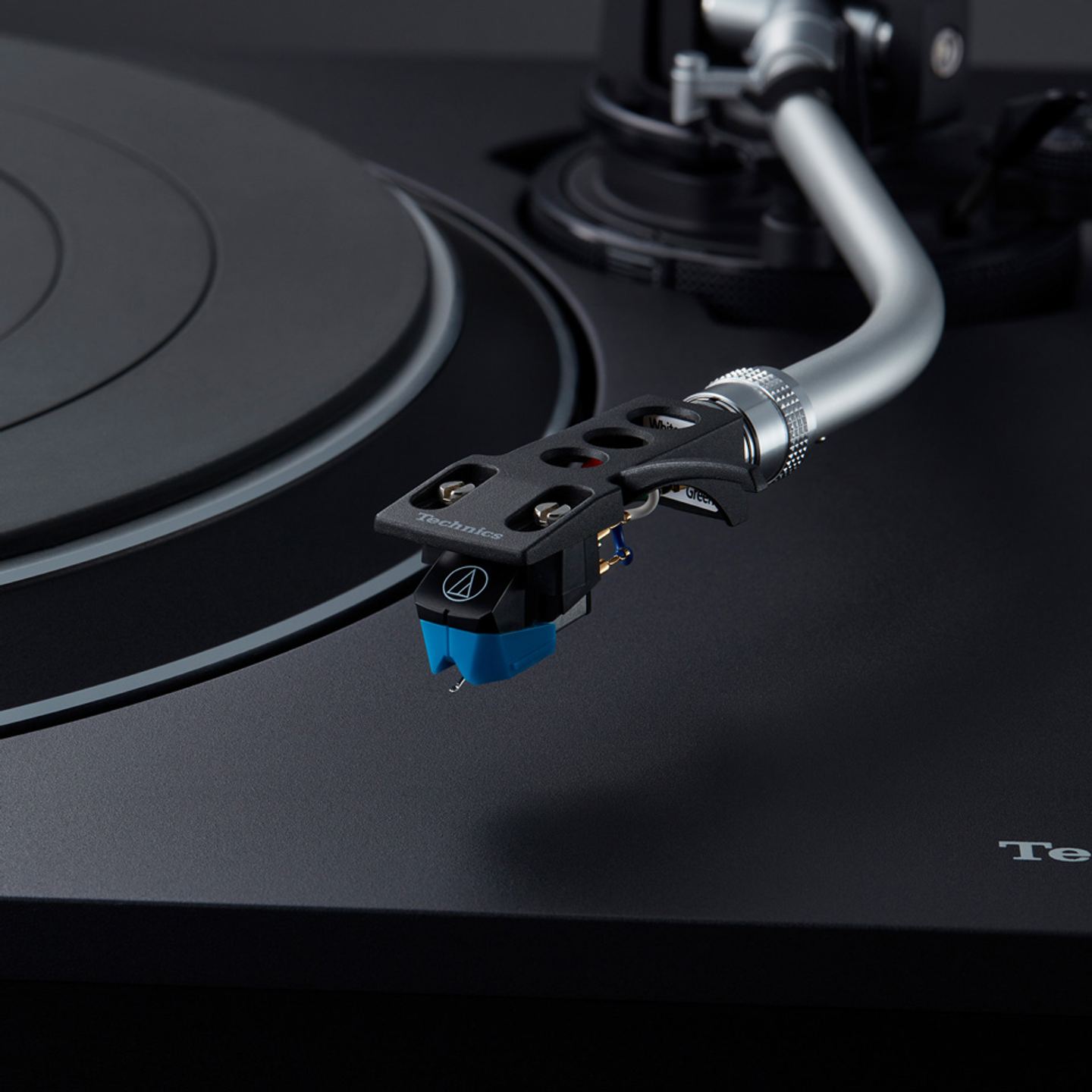
The headshell is removed via a universal bayonet mount, with half-inch cartridge mounting. It weighs 7.6 g. Changing cartridges, or alternating between two cartridges each fitted to its own headshell, takes just seconds without having to realign them. Tracking force is adjusted by direct reading from 0 to 4 g on the counterweight, and tonearm height can be adjusted over 6 mm: this adjustment is made by pulling or pushing the arm by hand, rather than using the rotating ring found on SL-1200 models, due to the cueing mechanism housed in the base.
The phono cable is not permanently attached to the chassis. Two RCA sockets and a ground terminal occupy the rear panel, allowing the supplied cable to be replaced with a low-capacitance cable better matched to the cartridge.
Differences from the SL-1500C
The two turntables share the motor, platter, chassis and tonearm. Three differences set them apart. The SL-1500C includes a switchable MM phono preamp, which is absent here: the SL-100CEG-K connects to the phono input of an amplifier or to a separate phono preamp. It comes with an Audio-Technica AT-VM95C, whereas its sister model receives an Ortofon 2M Red. Finally, the auxiliary counterweight supplied with the SL-1500C is not included in the SL-100CEG-K box.
This last point matters when upgrading the turntable. Without this counterweight, the tonearm accepts cartridges weighing from 5.6 to 12.0 g, or 14.3 to 20.7 g including the headshell and mounting hardware. The auxiliary counterweight shifts the range to 10.0 to 16.4 g. Common moving magnet cartridges work without issue; heavier models require the accessory, sold separately.
The lack of an integrated preamp is not merely a cost saving. It leaves the choice of impedance and load capacitance presented to the cartridge, two parameters that affect high-frequency response and that an integrated stage fixes.
The AT-VM95C cartridge and its interchangeable styli
Factory-fitted, the AT-VM95C is a dual moving-magnet cartridge with a bonded conical stylus on an aluminum cantilever and an output level of approximately 4 mV, compatible with all MM inputs. The conical stylus remains the entry-level profile: it tracks the groove with less precision than an elliptical or MicroLine stylus, and end-of-side distortion is more noticeable on densely cut records.
This is where Technics’ choice makes sense. The entire VM95 series shares the same cartridge body, and the styli clip into it without desoldering or realignment: elliptical, nude elliptical, MicroLine or Shibata. Moving up to a superior profile costs the price of a stylus rather than a cartridge, and requires no tools. The tonearm also accepts a moving coil cartridge for those wishing to change cartridge types, provided they have the corresponding preamp.
Three speeds and the question of 78 rpm
The speed selector covers 33 1/3, 45 and 78 rpm at the push of a button, without handling a belt or pulley. The presence of 78 rpm requires clarification: shellac records have a wide groove that requires a 2.5 to 3 mil stylus. The 0.6 mil conical stylus supplied with the turntable, designed for microgroove records, sits too deeply in these grooves and does not play them correctly.
Audio-Technica offers a 3 mil stylus that fits the same cartridge body. Shellac collectors therefore have both the appropriate speed and stylus, while keeping a single cartridge body for both uses.
Tonearm lift at the end of a record
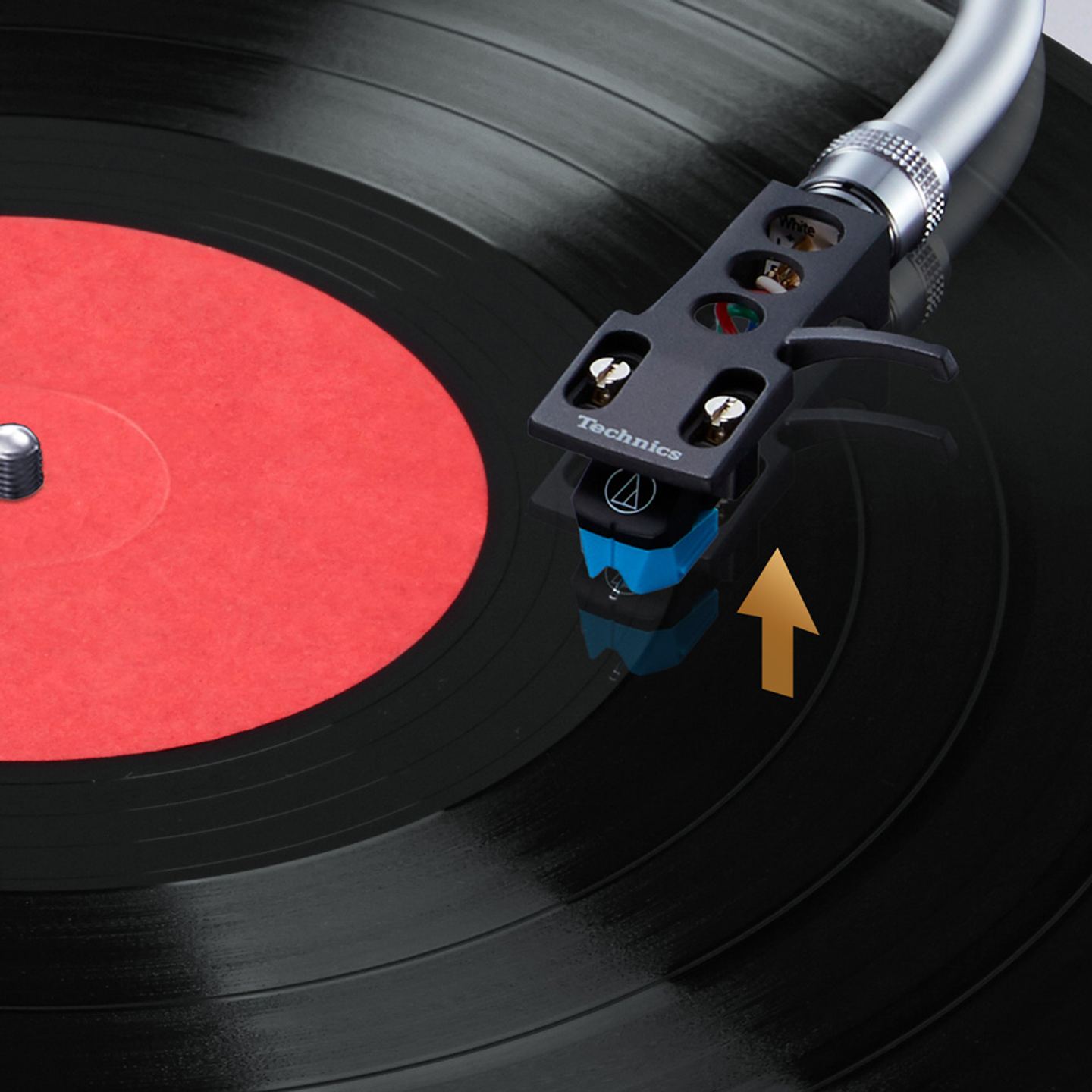
At the end of a side, the tonearm lifts automatically and the stylus leaves the run-out groove. The mechanism is housed in the tonearm base and operates without using the motor, a design choice that avoids introducing a source of vibration or electrical noise near the cartridge.
There are two details to note. This device raises the tonearm but does not return it to its rest, and the platter continues to rotate: the SL-100CEG-K is a manual turntable with tonearm lift, not a semi-automatic model. A rear-panel switch completely disables the function for those who prefer no mechanical element to touch the tonearm during playback.
Frequently asked questions
Can this turntable be connected directly to active speakers?
Only if the speakers have an MM phono input, which remains rare. In all other cases, a phono preamp must be placed between the turntable and the speakers, or the turntable must be connected through an amplifier with a phono input. The supplied ground wire must be connected to the designated terminal on the preamp or amplifier, otherwise hum may occur.
What tracking force should be used with the supplied cartridge?
Audio-Technica recommends 2 g for the AT-VM95C, with a tolerance of plus or minus 0.2 g. The tonearm counterweight is adjusted by direct reading: first balance the tonearm horizontally, return the graduated ring to zero, then turn it to the desired value. Set the anti-skating to the same value.
How long does the original stylus last?
Audio-Technica states approximately 500 hours for a conical stylus, compared with 300 hours for an elliptical stylus and up to 1,000 hours for a MicroLine stylus. This lifespan depends on record cleanliness, tracking-force adjustment and listening frequency. Inspection with a magnifier makes it possible to spot wear before it damages the grooves.
Is this turntable suitable for DJ mixing?
It has the torque, identical to that of the reference SL-1200 models, but not the equipment: no pitch control slider, strobe markings on the platter or tonearm light. The rubber mat grips the record instead of allowing it to slip, unlike the felt used on DJ models. Technics places the SL-100CEG-K in its hi-fi range, with its DJ catalogue offered separately.
Can the cover remain in place while listening?
It is hinge-mounted and can be raised or removed entirely. Keeping it closed during playback protects against dust, but the cover then acts as a resonating enclosure that picks up sound from the speakers. In a setup sensitive to acoustic feedback, listening with the cover open or removed delivers cleaner bass.
What should be checked during installation?
First, leveling: the isolators beneath the chassis are height-adjustable, and a small spirit level placed on the platter is sufficient to check that it is level. Then consider placement, away from speakers and, if possible, on a support isolated from the floor, as the turntable’s 9.9 kg are not enough to eliminate vibrations transmitted through wooden flooring. Finally, the power cable and phono cable should be routed separately to limit induced hum.