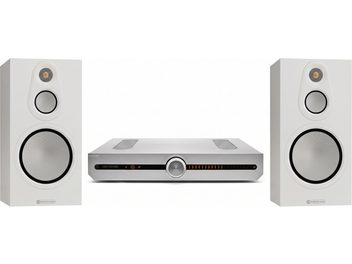
Roksan Attessa INT BluOS, connected integrated amplifier
A turntable, a TV, a CD player and streaming services can all run through a single unit just 7.6 cm tall. This stereo amplifier from Roksan combines 80 W per channel of Class AB amplification, a digital converter, a phono preamp and the BluOS network playback platform. All that remains is to connect two speakers. It can be controlled with a dial, a remote control or a phone.
A front panel pared down to a dial and four buttons
The folded, plated steel chassis features a machined, anodised aluminium front panel. At 43.2 cm wide, the Attessa stands just 7.6 cm tall yet weighs 10.48 kg. In the centre, a large dial handles almost everything. Turn it to adjust the volume. Turn it while holding it down to change sources, with light haptic feedback at each step. A short press mutes the sound. Four buttons sit alongside it (standby, previous track, play/pause, next track), next to a small OLED screen that switches off after two minutes without any input. The supplied infrared remote control duplicates these functions and provides access to the settings menu.
Nothing protrudes from the back. Bluetooth uses an integrated antenna developed for the unit, while Wi-Fi is handled by a dongle plugged into one of the two USB ports.
80 W into 8 ohms, 130 W into 4 ohms in Class AB
The power stage operates in Class AB. The output transistors remain slightly conductive at all times: they run hotter than in Class B, but the signal is not distorted as it passes from one transistor to the other. Roksan specifies 80 W per channel into 8 ohms and 130 W into 4 ohms, with both channels driven. This increase in power as impedance drops comes from the power supply, built around a 400 VA toroidal transformer derived from the one used in the Caspian series, the brand’s higher-end range. This reserve is sufficient for bookshelf speakers as well as floorstanding speakers of average sensitivity in a typical living room.
The preamplifier uses fully balanced circuitry to lower the noise floor. Frequency response extends from 5 Hz to 50 kHz at -3 dB, well beyond the range of human hearing, and the signal-to-noise ratio exceeds 98 dB (A-weighted) at 75 W into 8 ohms. The Attessa has neither bass nor treble controls. Balance can be adjusted by ±3 dB, and the line input sensitivity offers three settings to prevent volume jumps when switching sources.
BluOS for music, MaestroUnite for the unit
Two apps share the workload. MaestroUnite configures the amplifier: Wi-Fi connection, advanced settings, updates and pairing with the CD player from the same range. BluOS handles playback: streaming services, Internet radio, music shared over the local network or files on a USB drive plugged into the back. These two functions use two separate Wi-Fi modules.
BluOS provides access to Qobuz, Deezer, Amazon Music and HighResAudio. With Spotify Connect and TIDAL Connect, playback starts directly from the service’s app. TuneIn, iHeartRadio and Radio Paradise provide radio stations. AirPlay 2 connects the Attessa to iPhone, iPad and Mac. Thanks to Roon Ready certification, a Roon server recognises the amplifier without any configuration. Network playback supports up to 192 kHz in FLAC, WAV, AIFF or ALAC, and MQA files are decoded.
With other BluOS devices, the Attessa can play the same music in other rooms, or each room can listen to something different, across up to 64 zones. Three presets appear directly in the source list. They recall a playlist, a radio station or a favourite input without having to reach for a phone. Bluetooth (SBC, AAC, aptX) remains available for guests or for apps that BluOS does not support, with quality limited to 16-bit/48 kHz.
Turntable, TV, CD player: rear-panel connections
The phono input accepts moving magnet (MM) cartridges, the most common type found on turntables, with three gain settings to suit the cartridge’s output voltage. A moving coil (MC) cartridge requires an external phono preamp connected to a line input. There are two RCA line inputs. The second detects an incoming signal and also supports AV Bypass mode for integration into a home cinema system.
On the digital side, two coaxial inputs accept PCM up to 24-bit/192 kHz and two optical inputs up to 24-bit/96 kHz. One of the optical inputs is labelled TV in the source list. There is no HDMI socket: the TV connects via optical and transmits PCM stereo sound. One coaxial input is reserved for the Attessa CD Transport. Once the two units are paired in MaestroUnite, the amplifier’s remote control also operates the player over a Bluetooth Low Energy connection.
The RCA preamp output, also labelled SUB, feeds an active subwoofer or a power amplifier. Speakers connect to a single pair of binding posts per channel, with no bi-wiring. A 12 V trigger input and output switch connected devices on and off together, and a wired infrared input receives remote control commands when the amplifier is housed in a closed cabinet. On the front panel, the 3.5 mm headphone socket delivers up to 7.5 V RMS, enough for high-impedance headphones, with three sensitivity settings. Plugging in headphones mutes the speakers and lowers the volume. Headphones with a 6.35 mm jack require an adapter.