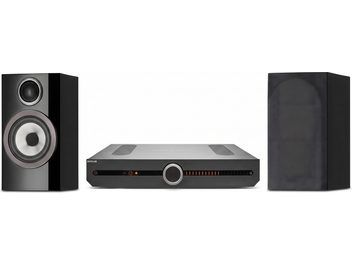
The Attessa INT is built around a sturdy steel chassis with a 5-millimetre-thick anodised aluminium front panel, with no visible screws to create a perfectly uniform surface. This carefully engineered construction demonstrates particular attention to both structural rigidity and clean aesthetics. The design is characterised by the complete absence of external antennas, with the engineers opting to integrate all wireless reception components inside the chassis.
The central control knob visually dominates the front panel, providing subtle haptic feedback during use. Turning it adjusts the volume, pressing it activates the mute function, and pressing then turning it allows you to navigate between sources. This single tactile interface is accompanied by two orange OLED display areas: on the left, illuminated icons indicate the selected source, while on the right, a horizontal indicator displays the volume level as progressive bars. The 3.5 mm headphone output, located at the far right of the front panel, delivers an output of 7.5 V RMS suitable for all impedance levels.
The internal layout reveals meticulous organisation, with each component positioned according to a circuit separation strategy. The digital section occupies the right-hand side of the chassis, physically separated from the analogue circuits to minimise electromagnetic interference. A 400 VA toroidal transformer powers the entire unit, ensuring substantial current reserves even during the most demanding dynamic passages. The heat sinks, accessible through ventilation grilles on the top panel, efficiently dissipate the heat generated by the power stages.
Innovative amplification and conversion technologies
The Euphoria amplification architecture is the beating heart of the Attessa INT. This intelligent Class AB topology separates the power supplies dedicated to the voltage and current circuits, allowing each section to operate under optimal conditions without unwanted interactions. The voltage section boosts the signal to the level required to drive the speakers, while the current section handles low-impedance demands. This approach maintains constant intermodulation distortion across the entire frequency spectrum and regardless of load, ensuring remarkably pure sound reproduction.
The digital-to-analogue converter was designed entirely in-house by Roksan’s electronic engineering team in the United Kingdom. It processes PCM signals up to 24-bit/192 kHz via the coaxial inputs and up to 24-bit/96 kHz via the optical inputs. Its signal-to-noise ratio of 106 dB (A-weighted) and distortion of 0.001% reflect a very low noise floor, preserving the fine details and depth of recordings.
The preamplifier section is fully balanced. It uses a multilayer printed circuit board with an optimised layout and star grounding: all grounds meet at a single point, limiting unwanted noise and hum. The MM phono preamplifier uses premium polypropylene capacitors at the most sensitive points in the circuit. The MaestroUnite app lets you choose between three gain levels, suited to cartridges with outputs of 3, 6 or 12 mV.
Modern connectivity and practical features
The Attessa INT has two coaxial digital inputs that accept signals up to 24-bit/192 kHz and two optical inputs supporting up to 24-bit/96 kHz. The built-in Bluetooth module supports SBC, aptX and AAC codecs, with a typical range of 15 metres in an open space, for wireless music playback from a smartphone or tablet.
On the analogue side, the amplifier offers two RCA line inputs, one of which automatically detects the presence of a signal for AV mode, as well as an MM phono input with RIAA equalisation. An RCA output serves as either a preamplifier output or a subwoofer output. It allows an external power amplifier or an active subwoofer to be added later. On the rear panel, a 12 V trigger input on a mini-jack switches the amplifier on or puts it into standby at the same time as another device. A wired infrared input facilitates integration into a remotely controlled installation. The speaker terminals accept bare wire, spade connectors or 4 mm banana plugs, the latter being the manufacturer’s recommended option.
The MaestroUnite app turns a smartphone into a sophisticated control centre, providing access to settings unavailable from the front panel. The sensitivity of each input can be adjusted individually, as can the phono stage gain and headphone output sensitivity. Left/right balance, normally accessible only via the supplied remote control, can also be adjusted from the app. Firmware updates are performed wirelessly (OTA), ensuring feature enhancements and fixes for potential bugs without physical intervention on the device.
The Standby Plus function enables automatic standby after twenty minutes of inactivity, a setting that can be changed from the app. Seamless synchronisation with the Attessa CD transport, when the two devices are used together, creates a unified system controllable from a single remote. Source icons can be customised to reflect the equipment actually connected, simplifying everyday navigation.
Performance in the service of music
The amplifier covers a bandwidth of 5 Hz to 50 kHz (at -3 dB), well beyond the limits of hearing, ensuring good extension in both the bass and treble. Total harmonic distortion plus noise remains below 0.02% at 1 kHz for 1 watt into 8 ohms, guaranteeing faithful signal reproduction. Channel separation exceeds 75 dB at 10 kHz for precise stereo imaging, and the level difference between left and right remains below 0.5 dB.
The phono stage presents a load of 47 kilohms and 56 picofarads, the values expected by moving-magnet cartridges. With its three gain levels, it allows a turntable to be connected directly to the amplifier and the level to be adjusted to the cartridge used, without an external preamplifier.
Output power with total harmonic distortion plus noise (THD+N) < 1%, both channels driven:
Into 8 Ω: 80 W RMS per channel
Into 4 Ω: 130 W RMS per channel
THD+N: < 0.02% (1 kHz, 2 channels, 1 W into 8 Ω, A-weighted)
Gain: 29 dB
Channel matching: < 0.5 dB
Signal-to-noise ratio: > 80 dBA at 1 W / 8 Ω, > 98 dBA at 75 W / 8 Ω
Channel separation: > 75 dB at 10 kHz
Frequency response: 5 Hz to 50 kHz (−3 dB)
Transformer rating: 400 VA
Preamplification and phono stage
Fully balanced design with star grounding
Channel matching: < 0.25 dB
THD+N: 0.002% (1 kHz, 2 V RMS at preamplifier output)
Signal-to-noise ratio: > 104 dB (unweighted)
Built-in moving magnet (MM) phono preamplifier:
Load: 47 kΩ / 56 pF
3 gain levels for 3, 6 and 12 mV cartridges
Digital-to-analog conversion
Built-in high-performance digital-to-analog converter (DAC), developed in-house
Supported format: PCM
Sampling rate: up to 24-bit / 192 kHz
THD+N: 0.001% (1 kHz, 2 V RMS at preamplifier output)
Signal-to-noise ratio: 106 dB (A-weighted)
Wireless connectivity
Bluetooth:
Audio profile: A2DP
Codecs: SBC, aptX, AAC
Resolution: 16-bit / 48 kHz
Typical line-of-sight range: 15 m
Connections
Analog inputs:
2 stereo RCA line inputs, including 1 with signal detection for audiovisual (AV) mode
1 MM phono input (RIAA)
Digital inputs:
2 coaxial inputs, up to 24-bit / 192 kHz
2 optical inputs, up to 24-bit / 96 kHz
Outputs:
1 pair of speaker binding posts
1 RCA preamplifier / subwoofer output
1 front-panel 3.5 mm mini-jack headphone output: 7.5 V RMS, compatible with all headphone types, including high-impedance models
Control connections:
1 12 V trigger input via 3.5 mm mini-jack, for on / standby control
1 wired infrared input via 3.5 mm mini-jack
Power supply: 3-pin IEC mains inlet with fuse holder
Interface and system management
Haptic feedback control dial for volume and source selection
Buttons: standby, back, play / pause, next track
MaestroUnite:
System creation and control
Advanced system settings
Wireless updates via Wi-Fi
Supplied accessories
Infrared remote control
Construction, dimensions and weight
Robust steel and aluminum construction, with no visible antennas
Dimensions (W × H × D): 432 × 76 × 373 mm
Depth excluding dial and connectors: 346 mm
Weight: 10.37 kg
Frequently asked questions
What is the difference between the Attessa INT and the Attessa Streaming?
+
The Attessa Streaming integrates the BluOS module for high-resolution multiroom streaming and compatibility with over twenty online music services. It also provides two USB-A ports for file playback from external media and supports Roon Ready, AirPlay 2, and MQA. The Attessa INT retains all other features including the DAC, Bluetooth, and Euphoria amplification, but without network streaming capabilities.
Can you use an MC cartridge with the phono input?
+
The Attessa INT’s phono input is designed exclusively for moving magnet (MM) cartridges with a 47 kOhm input impedance. To use a moving coil (MC) cartridge, you’ll need an external step-up transformer or a separate MC phono preamp connected to one of the line inputs. The phono stage gain can be adjusted via the MaestroUnite app across three levels to suit different MM cartridges on the market.
How does synchronization with the Attessa CD transport work?
+
When the Attessa CD transport is connected to the amplifier via the dedicated coaxial input (D4/CD), the MaestroUnite app allows them to be configured as a single system. Both devices can then be controlled with one remote, and switching to the CD source occurs automatically when a disc is played. The transport also passes MQA-encoded streams from MQA CDs, which are decoded by the amplifier’s DAC.
What is the actual power available into different loads?
+
The Attessa INT delivers 80 watts RMS per channel into 8 ohms with both channels driven, rising to 130 watts into 4 ohms. Total harmonic distortion remains below 1% under these conditions. The amplifier maintains its performance with complex loads thanks to its generous 400 VA power supply and substantial current reserves, enabling it to drive the majority of speakers on the market effectively.
Is the MaestroUnite app essential?
+
While the amplifier is perfectly usable without the app thanks to the central control knob and the supplied remote, MaestroUnite unlocks advanced features otherwise inaccessible. Adjusting input sensitivity, phono gain, left/right balance, and performing firmware updates requires the app. It also enables input icon customization and control of the automatic standby mode.
User reviews
Review highlights
Buyers are unanimously enthusiastic about the sound, describing it as faithful, clear, and precise, with excellent detail and natural musicality.
Five reviews praise the amplifier’s dynamics and power: it excels at high volumes without distortion and easily drives floorstanding speakers.
Three customers highlight a wide, well-spaced soundstage with clearly separated instruments.
Three reviews consider its value for money outstanding, worthy of true hi-fi.
Its careful finish and appealing design also impress three buyers.
Based on reviews from customers who purchased this product, summarised by AI
Nicolas
At this price, nothing to complain about: faithful, airy sound, great dynamics. Very happy with this purchase.
Comment from 7 September 2026 — Experience from 27 August 2026
Automatically translated — Show original (French)
A ce prix rien a lui reprocher écoute fidèle et aérée belle dynamique très content de cet achat
Daniel
Regarding Jean-Philippe’s July 2026 post: you should check the output level of your source or sources. Most likely that of your PC. The amp does not lack sensitivity (adjustable if you understand what you are doing), nor punch at low volume!
To return to the Attessa, I would say that at its new retail price (€1,000), it is IMPOSSIBLE to find anything better. Even at its former price (+/- €1,500), it was still a bargain. And for good reason, it offers everything one expects from a good amp: - total transparency, - dynamics and power on tap, - true 3D soundstage, - attractive and well finished.
Very comprehensive as well, connectable if desired via the proprietary app, it also offers a top-notch headphone output (3.5mm rather than 6.35mm unfortunately)! My Sennheiser HD600 has never been driven so well since I sold my high-end headphone amp, which I did not use enough.
Today, it is the Caspian power amp that I have my eye on! To be seen later…
PS: one small flaw nonetheless, probably due to its design not being dual mono (understandable for the price!), a slight hum (with your ear against the speaker) on the right channel and almost absent on the left. In 20 years of audiophilia, this is obviously not the first time I have noticed this phenomenon, with no real consequences for the sound…
Comment from 18 August 2026 — Experience from 25 January 2026
Automatically translated — Show original (French)
À l'adresse de Jean-Philippe de juillet 2026 : il faudrait vérifier le niveau de sortie de votre ou vos sources. Celle de votre PC sans doute. L'ampli ne manque pas de sensibilité (réglable si l'on comprend ce que l'on fait), ni de pêche à bas volume !
Pour en revenir à l'Attessa, je dirai que pour son nouveau prix de vente (1.000€), il est IMPOSSIBLE de trouver mieux.
Et même à son ancien prix (+/- 1.500€), il restait une affaire. Et pour cause, il offre tout ce que l'on attend d'un bon ampli :
- transparence totale,
- dynamique et puissance au rdv,
- spatialisation en 3D réelle,
- beau et bien fini.
Très complet qui plus est, connectable si on le souhaite via l'application propriétaire, il offre aussi une sortie casque (3,5mm et non 6,35mm malheureusement) de haut vol ! Mon Sennheiser HD600 n'a jamais été aussi bien piloté depuis la revente de mon ampli casque HDG que je n'utilisais pas assez.
Aujourd'hui, c'est l'ampli de puissance Caspian que je lorgne ! À voir plus tard…
PS : un petit défaut tout de même, sans doute due à sa conception qui n'est pas en double mono (normale pour le prix !), un bourdonnement léger (oreille collée au HP) sur la voie droite et quasi absente sur la gauche. En 20 ans d'audiophilie, ce n'est évidemment pas la première fois que je constate ce phénomène, sans véritables conséquences sur le son…
Jean philippe
What a disappointment upon startup—no punch at all. Then you have to adjust the output level of the inputs, and it already gets much better. Next, I bought a digital-to-analog converter to output from my PC (with Tidal), used the optical connection, and finally got to enjoy the built-in DAC, and that’s much better. One last thing: a small (basic) adjustment with a PC equalizer, and it’s magical. Finally, I changed the position of my speakers to achieve a sound that suits me 90%. There you have it: an excellent amplifier with plenty of power, but below 5 volume bars it sounds empty (my biggest disappointment is the lack of smoothness and definition at low volume). On the other hand, the higher you turn up the volume, the better it gets, without distortion—it’s truly incredible. Second drawback for me: no bass and treble adjustment. Otherwise, nothing to complain about; as it breaks in, it gets even better than at the beginning. In short, for the price, you really enter the world of hi-fi rather than “noise”. Kind regards
Comment from 16 July 2026 — Experience from 5 July 2026
Automatically translated — Show original (French)
Quelle déception à la mise en route, pas de pêche rien, ensuite il faut aller régler la puissance de sortie des entrées et ça va déjà beaucoup mieux, ensuite j'ai pris un convertisseur analogique numérique pour sortir de mon pc (avec tidal) et utilisé la prise optique et enfin profiter du dac intégré et la ça va beaucoup mieux , dernière chose un petit réglage (succinct) avec un égaliseur du pc et la c'est magique, et enfin changement de position de mes enceintes pour arriver a un son qui me convient a 90%.
Voila un excellent ampli qui a du répondant mais au dessus de 5 barres de volume en dessous c'est vide (ma plus grosse déception c'est le manque de fluidité et de définition a bas volume) par contre plus vous montez le volume meilleur c'est et sans saturation là c'est vraiment incroyable. Second défaut pour moi pas de réglage basse et aiguë, pour le reste rien à dire , le rodage se faisant c'est encore meilleur qu' au début. Bref pour le prix on entre vraiment dans de la hifi et plus dans du "bruit".
Cordialement
To better understand our visitors, measure marketing effectiveness and personalise ads, we and our partners use cookies and mobile advertising identifiers on your device. This data makes it possible to display personalised and non-personalised ads and measure their performance. Some cookies, which are technically necessary, are exempt from consent. You can accept those that require your consent, refuse them by clicking “Reject”, or customise your choices via “More options”.
To find out how Google uses the data collected once you have given your consent, see Google’s Business Data Responsibility site (opens in a new window).
You can change or withdraw your consent at any time via the “Cookies” link. Your choices will apply on our site for 12 months.