

Van den Hul The Tide XLR 1.2m
Overview
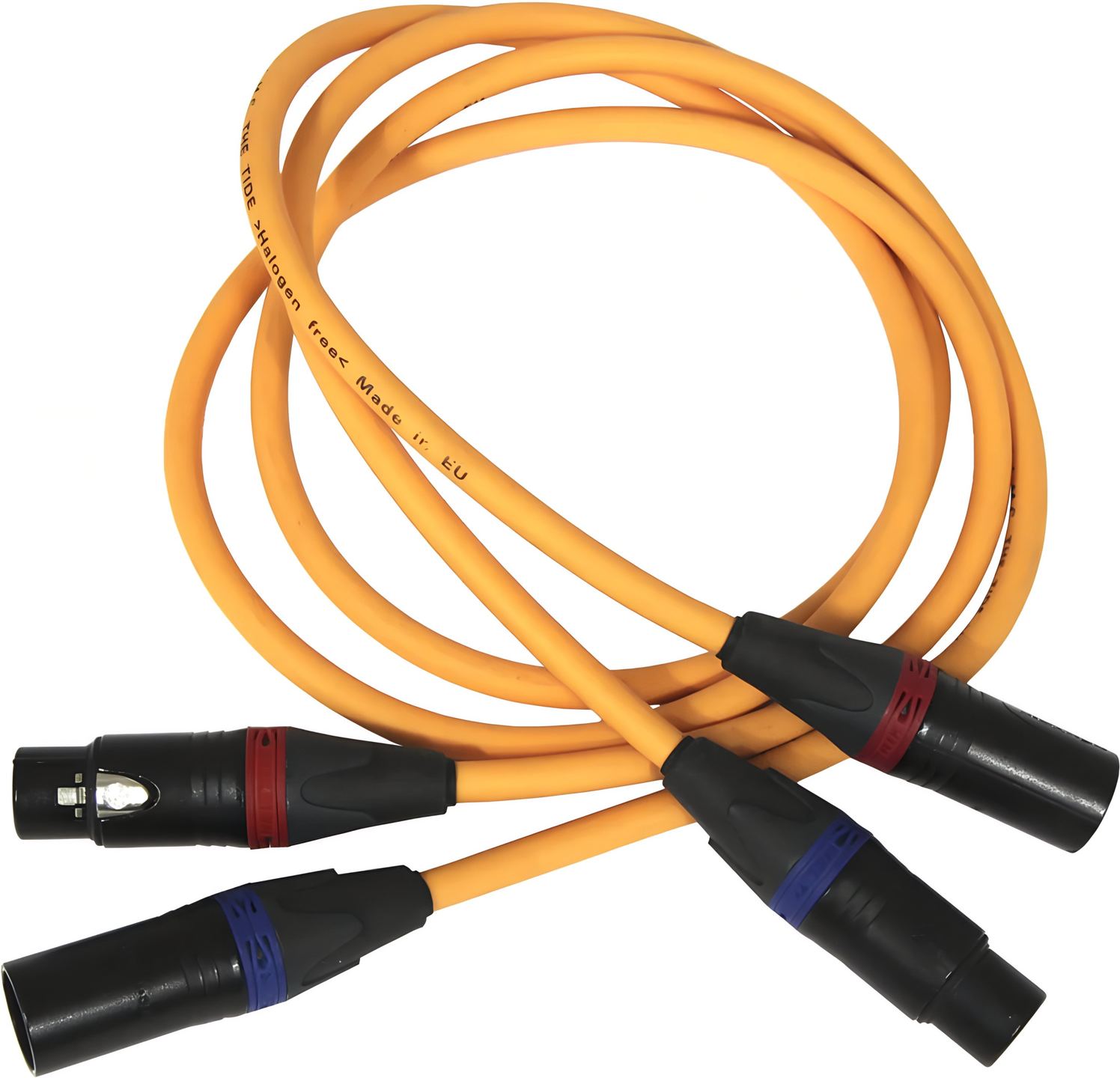
With its bright orange sheath and meticulous construction, this balanced interconnect cable embodies the pragmatic approach of the Dutch manufacturer: offering their most advanced in-house technologies in an accessible format. The Tide stands out as the first model in the Van den Hul range to feature LSC (Linear Structured Carbon) hybrid shielding at this price point, a technology previously reserved for higher-end references.
A construction designed for versatility
The Tide uses a twin-core architecture that allows for both balanced (XLR) and unbalanced (RCA) connections. Each conductor is made of multi-strand OFC (Oxygen Free Copper) with large crystals, coated with a dense layer of silver plating. This surface treatment improves conductivity while protecting the copper from long-term oxidation. The chosen gauge, 24 AWG for an effective diameter of 0.52 mm, offers a resistance measured at 0.085 Ω/m, low enough to preserve signal integrity.
The conductors are insulated with polyethylene foam, which helps maintain a particularly low parasitic capacitance: just 44 pF/m. This value, lower than that of many cables on the market, is of real interest for high-impedance sources. Dynamic microphones, phono preamps, or electric guitar pickups will find in it a partner that will not “load” their signal or alter their sonic character.
LSC hybrid shielding in action
Van den Hul developed Linear Structured Carbon (LSC) as an alternative and complement to traditional metallic shields. This material, made of aligned and individually insulated carbon fibers, offers electrical and mechanical properties that remain stable over time. In The Tide, an LSC-impregnated layer doubles a dense metal braid, forming a two-level hybrid shield.
This combination works on several fronts: the braid provides effective rejection of high-frequency electromagnetic interference, while the carbon layer attenuates lower-frequency disturbances and helps reduce background noise phenomena. The shielding resistance, measured at 0.017 Ω/m, is a testament to the quality of the grounding. In practice, this cable is very comfortable in electrically “polluted” environments – near dimmers, chargers, or digital devices.
Hulliflex: robustness and environmental awareness
The distinctive yellow-orange sheath of The Tide uses Hulliflex, a polymer developed in-house by Van den Hul. This halogen-free material has replaced PVC since 1990, when the manufacturer decided to eliminate chlorinated compounds from its production. Beyond its ecological aspect, Hulliflex offers excellent resistance to chemicals and UV, ensuring enhanced durability even under intensive use.
The generous thickness of this sheath (overall cable diameter: 7 mm) provides solid mechanical protection while maintaining appreciable flexibility. The cable is easy to handle, withstands repeated runs through conduits, and resists bending stress without developing an annoying memory effect.
Neutrik connectors and implementation
The XLR version of The Tide is equipped with Neutrik connectors, a benchmark in the professional world for their reliability and machining precision. The positive locking of the XLR connectors ensures a stable connection, particularly appreciated in home-studio setups or when the cable is frequently handled.
The 0.8-meter length is suitable for installations where the source and amplifier are close to each other – typically a CD player or DAC placed on the same rack as a preamplifier. For longer distances, the cable is also available in 1.0 m, 1.2 m, and 1.5 m versions.
Wide-ranging use cases
While The Tide naturally finds its place in a home hi-fi system between a digital source and a preamplifier, its construction also makes it relevant in other contexts. In balanced XLR configuration, it can serve as a microphone cable in an amateur recording setup, taking advantage of its low capacitance to preserve the high frequencies of condenser microphones. Musicians will see in it an instrument cable capable of faithfully conveying the nuances of an electric guitar pickup or an active bass.
In in-car systems (car hi-fi), the robustness of the Hulliflex sheath and the shielding’s effectiveness against electrical interference are tangible assets. The cable withstands temperature variations and vibrations without degrading its performance.
Technical specifications
Conductor construction
- Multi-strand OFC copper (oxygen-free copper) with large crystals
- Gauge: 24 AWG (American Wire Gauge)
- Conductor diameter: 0.52 mm
- Coating: dense silver plating
- Pure, transparent sound transmission
- Maximum durability
Electrical properties
- Capacitance: 44 pF/m (picofarads per meter)
- Exceptionally low value reducing the load on high-impedance sources
- Preserves signal fidelity for microphones and guitar pickups
- Conductor resistance: 0.085 Ω/m
- Shield resistance: 0.017 Ω/m
Shielding and protection
- Double hybrid shielding
- Dense braid
- Special Linear Structured Carbon (LSC®) layer
- Efficient elimination of electromagnetic interference
- Ensures a clean, noise-free signal
Jacket and mechanical protection
- Material: yellow-orange Hulliflex
- Thickness: extra-thick
- Exceptional flexibility for easy handling
- High mechanical strength
- Maximum protection against wear
Dimensions
- Overall cable diameter: 7.0 mm
- Conductor diameter: 0.52 mm
Connectors
- Cable type: balanced analog interconnect cable
- Available versions: RCA, XLR
Recommended applications
- Home and car high-fidelity systems
- Musical instrument cable
- Microphone cable
- High-impedance sources
Frequently asked questions
What is the difference between the RCA and XLR versions of The Tide?
The base cable is identical; only the end connectors differ. The XLR version uses Neutrik connectors and carries the signal in balanced mode, which improves interference rejection over long distances. The RCA version is suitable for consumer devices without balanced inputs/outputs.
Is a break-in period necessary for this cable?
Van den Hul recommends a few hours of use before the cable reaches optimal operation. This time allows the various materials to stabilize electrically. In practice, the changes remain subtle and do not require special attention.
Is The Tide suitable for connecting a phono preamp to an amplifier?
Yes, its low capacitance (44 pF/m) makes it a suitable choice for this type of connection, where signal levels are low and impedances sometimes high. The effective shielding also protects against hum and noise.
Can this cable be used in a studio or live setup?
Absolutely. Its robust construction, Neutrik connectors, and high-performance shielding qualify it for semi-professional use. It withstands frequent handling and electrically noisy environments.
- Eco-contribution included in the sale price.
- GTIN / EAN: 8718058014420