

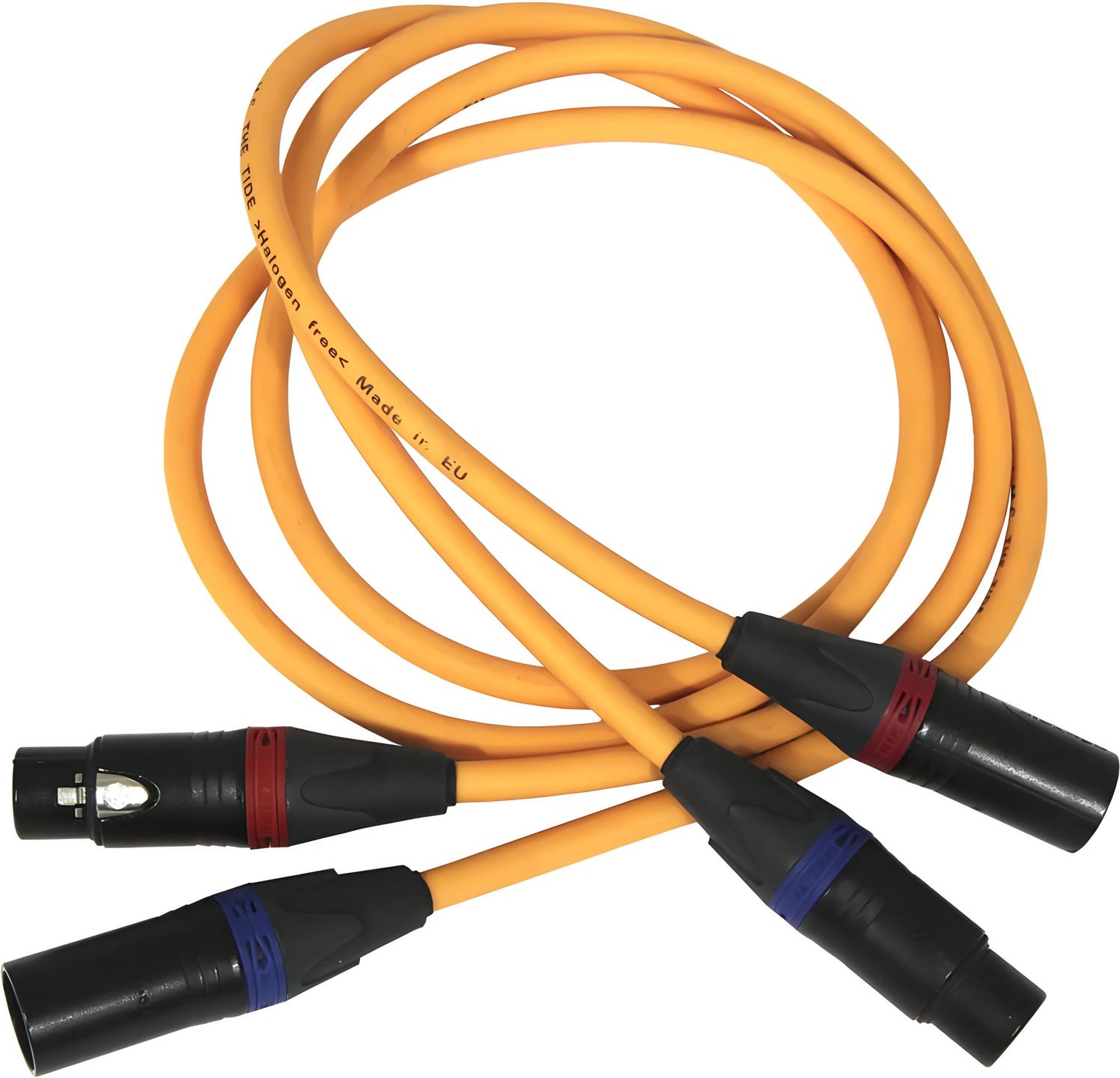
Van den Hul The Tide XLR 1m
Overview
With its bright orange sheath and meticulous construction, this balanced interconnect cable embodies the pragmatic approach of the Dutch manufacturer: offering its most advanced in‑house technologies in an accessible format. The Tide stands out as the first model in the Van den Hul range to incorporate LSC (Linear Structured Carbon) hybrid shielding at this price point, a technology previously reserved for more high‑end references.
A construction designed for versatility
The Tide uses a twin‑core architecture that supports both balanced (XLR) and unbalanced (RCA) connections. Each conductor is made of multi‑strand, large‑crystal OFC (Oxygen Free Copper), coated with a dense silver plating. This surface treatment improves conductivity while protecting the copper from oxidation over the long term. The chosen gauge, 24 AWG for an effective diameter of 0.52 mm, delivers a resistance of 0.085 Ω/m, low enough to preserve signal integrity.
Conductor insulation is provided by polyethylene foam, which helps maintain a particularly low parasitic capacitance: just 44 pF/m. This value, lower than that of many cables on the market, is of real interest for high‑impedance sources. Dynamic microphones, phono preamps, or electric guitar pickups will find in it a partner that will not “load” their signal or alter their sonic character.
LSC hybrid shielding in action
Van den Hul developed Linear Structured Carbon (LSC) as an alternative and complement to traditional metallic shielding. This material, made of aligned and individually insulated carbon fibers, offers electrical and mechanical properties that remain stable over time. In The Tide, an LSC‑impregnated layer doubles up with a dense metal braid, forming a two‑stage hybrid shield.
This combination works on several fronts: the braid provides effective rejection of high‑frequency electromagnetic interference, while the carbon layer attenuates lower‑frequency disturbances and helps reduce background noise. The shielding resistance, measured at 0.017 Ω/m, attests to the quality of the grounding. In practice, this cable is perfectly at ease in electrically “polluted” environments – close to dimmers, chargers, or digital devices.
Hulliflex: durability and environmental awareness
The distinctive yellow‑orange sheath of The Tide uses Hulliflex, a polymer developed in‑house by Van den Hul. This halogen‑free material has replaced PVC since 1990, when the manufacturer chose to eliminate chlorinated compounds from its production. Beyond the ecological aspect, Hulliflex offers excellent resistance to chemical agents and UV, ensuring enhanced durability even under intensive use.
The generous thickness of this sheath (overall cable diameter: 7 mm) provides strong mechanical protection while maintaining appreciable flexibility. The cable is easy to handle, copes well with repeated runs through conduits, and resists bending stress without developing an annoying memory effect.
Neutrik connectors and implementation
The XLR version of The Tide is equipped with Neutrik connectors, a benchmark in the professional world for their reliability and machining precision. The positive locking of the XLR connectors ensures a stable connection, which is particularly welcome in a home‑studio setup or whenever the cable is handled frequently.
The 0.8‑meter length is suitable for installations where the source and amplifier are close to each other – typically a CD player or DAC placed on the same rack as a preamplifier. For longer distances, the cable is also available in 1.0 m, 1.2 m, and 1.5 m versions.
A wide range of use cases
While The Tide naturally finds its place in a home hi‑fi system between a digital source and a preamplifier, its construction also makes it relevant in other contexts. In balanced XLR configuration, it can be used as a microphone lead in an amateur recording setup, taking advantage of its low capacitance to preserve the high frequencies of condenser microphones. Musicians will appreciate it as an instrument cable capable of faithfully transmitting the nuances of an electric guitar pickup or an active bass.
In in‑car systems (car hi‑fi), the robustness of the Hulliflex sheath and the shielding’s effectiveness against electrical interference are tangible assets. The cable withstands temperature variations and vibrations without degrading its performance.
Technical specifications
Conductor construction
- Multi-stranded OFC copper (oxygen-free copper) with large crystals
- Gauge: 24 AWG (American Wire Gauge)
- Conductor diameter: 0.52 mm
- Coating: dense silver plating
- Pure, transparent sound transmission
- Maximum durability
Electrical properties
- Capacitance: 44 pF/m (picofarads per meter)
- Particularly low value that reduces the load on high-impedance sources
- Preserves signal fidelity for microphones and guitar pickups
- Conductor resistance: 0.085 Ω/m
- Shield resistance: 0.017 Ω/m
Shielding and protection
- Double hybrid shielding
- Dense braid
- Special Linear Structured Carbon (LSC®) layer
- Effective elimination of electromagnetic interference
- Ensures a clean, noise-free signal
Jacket and mechanical protection
- Material: yellow-orange Hulliflex
- Thickness: extra-thick
- Exceptional flexibility for easy handling
- High mechanical strength
- Maximum protection against wear
Dimensions
- Overall cable diameter: 7.0 mm
- Conductor diameter: 0.52 mm
Connectors
- Cable type: balanced analog interconnect cable
- Available versions: RCA, XLR
Recommended applications
- Home and car high-fidelity audio
- Musical instrument cable
- Microphone cable
- High-impedance sources
Frequently Asked Questions
What is the difference between the RCA and XLR versions of The Tide?
The base cable is identical; only the end connectors differ. The XLR version uses Neutrik connectors and carries the signal in balanced mode, which improves interference rejection over long distances. The RCA version is suitable for consumer devices without balanced inputs/outputs.
Is there a burn‑in period required for this cable?
Van den Hul recommends a few hours of use before the cable reaches optimal performance. This time allows the different materials to stabilize electrically. In practice, the changes remain subtle and do not require any special attention.
Is The Tide suitable for connecting a phono preamp to an amplifier?
Yes, its low capacitance (44 pF/m) makes it a suitable choice for this type of connection, where signal levels are low and impedances sometimes high. The effective shielding also protects against hum and other unwanted noise.
Can this cable be used in studio or live sound configurations?
Absolutely. Its robust construction, Neutrik connectors, and high‑performance shielding qualify it for semi‑professional use. It withstands frequent handling and electrically noisy environments.
- Eco-contribution included in the sale price.