Audioquest JAWS C19 2m
Overview
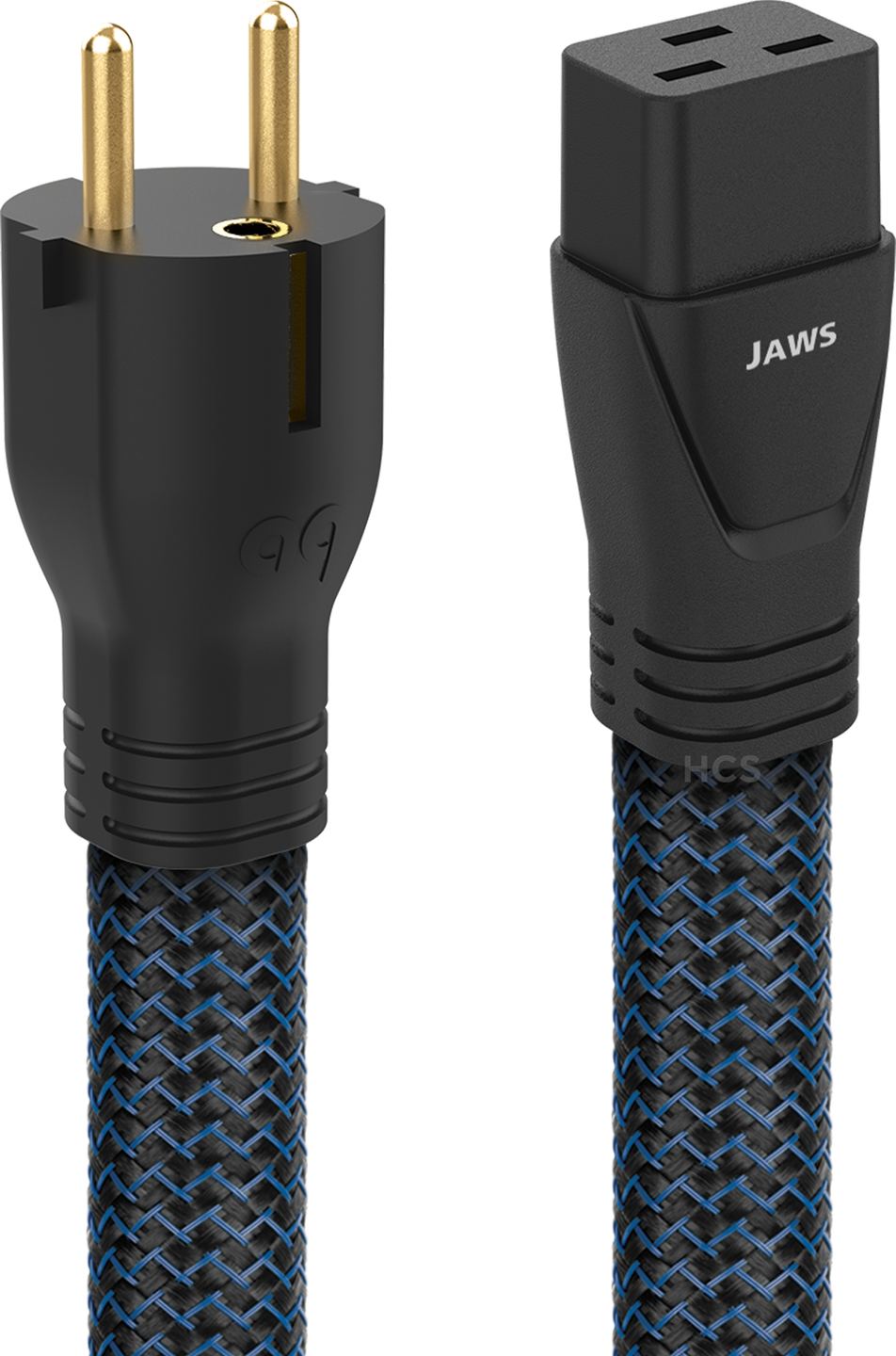
Successor to the Monsoon, long the best-selling power cable in AudioQuest’s Wind Series, the JAWS follows the same philosophy, one step further. The move to conductors made entirely of PSC+ copper and the addition of graphene-based shielding redefine the Californian brand’s approach to ground-noise treatment. In the C19 version, this one-meter cable targets high-consumption devices: amplifiers, power distributors, active subwoofers.
From Monsoon to JAWS: what changes
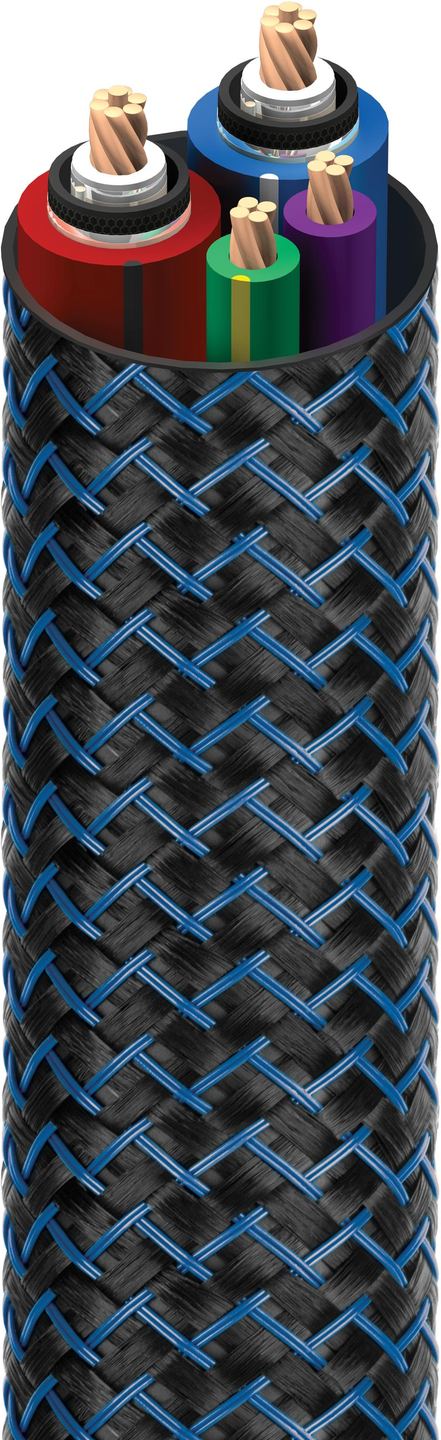
The Monsoon used a mixed concentric structure: PSC+ copper on the outer layer, with a Long-Grain Copper (LGC) core. The JAWS drops LGC and moves to 100% PSC+ copper across the entire conductor. This copper, treated using a proprietary AudioQuest process to achieve the smoothest possible surface, reduces grain discontinuities responsible for micro-distortions. The use of solid conductors (rather than stranded) limits strand interaction, a known source of transient intermodulation distortion.
The cross-sections have been carefully calibrated: 2 × 3.31 mm² for live and neutral, 1 × 2.08 mm² for ground. The cable handles 20 A RMS at 120 V (50/60 Hz), giving it comfortable headroom to absorb the transient current demands of power amplifiers, often several times higher than their average consumption.
Four layers of shielding and graphene against ground noise
A power cable’s ground wire protects against electrical faults, but it also acts like an antenna. High-frequency noise picked up by this conductor bypasses the power supply of the devices and couples directly into the most sensitive audio circuits.
The JAWS addresses this problem with AudioQuest’s GND (Ground Noise Dissipation) technology, here strengthened compared with the Monsoon. The shielding consists of four distinct layers, one of which incorporates graphene. Thanks to its conductivity and absorption properties, graphene dissipates high-frequency interference before it reaches the layer connected to the device ground. The expected result: a lower noise floor, and better intelligibility of fine detail in dense or complex passages.
ZERO-Tech and RF/ND-Tech: two complementary technologies
Most power cables focus on DC resistance to ensure current delivery. AudioQuest considers the cable’s characteristic impedance to be just as decisive. ZERO-Tech technology cancels this characteristic impedance, so current transients are neither compressed nor slowed. For an amplifier that must draw brief but very high current peaks during dynamic passages, this approach offers a direct benefit.
RF/ND-Tech (Radio-Frequency Noise Dissipation) technology completes the system. It uses a common-mode phase-cancellation network, combined with proprietary dielectric materials, to filter induced radio-frequency noise over a wide bandwidth. The RF drain wires, whose orientation is controlled, evacuate residual noise to ground via the third pin of the plug, away from the audio circuits.
Directional conductors: a deliberate choice by AudioQuest
Any drawn metal conductor has an asymmetric, and therefore directional, crystal structure. AudioQuest tests each batch of copper by listening to determine the optimal direction, then marks the direction on the connectors using arrows. This orientation is intended to drain RF noise in a preferred direction, from the audio circuit to ground. It is a principle AudioQuest applies across its entire range, and the JAWS is no exception.
Physical design and connectors
The JAWS has an outer diameter of 18 mm, making it a robust and relatively stiff cable. Its internal geometry has been optimized to limit electrostatic fields between conductors, a parameter that affects the linearity of RF noise dissipation.
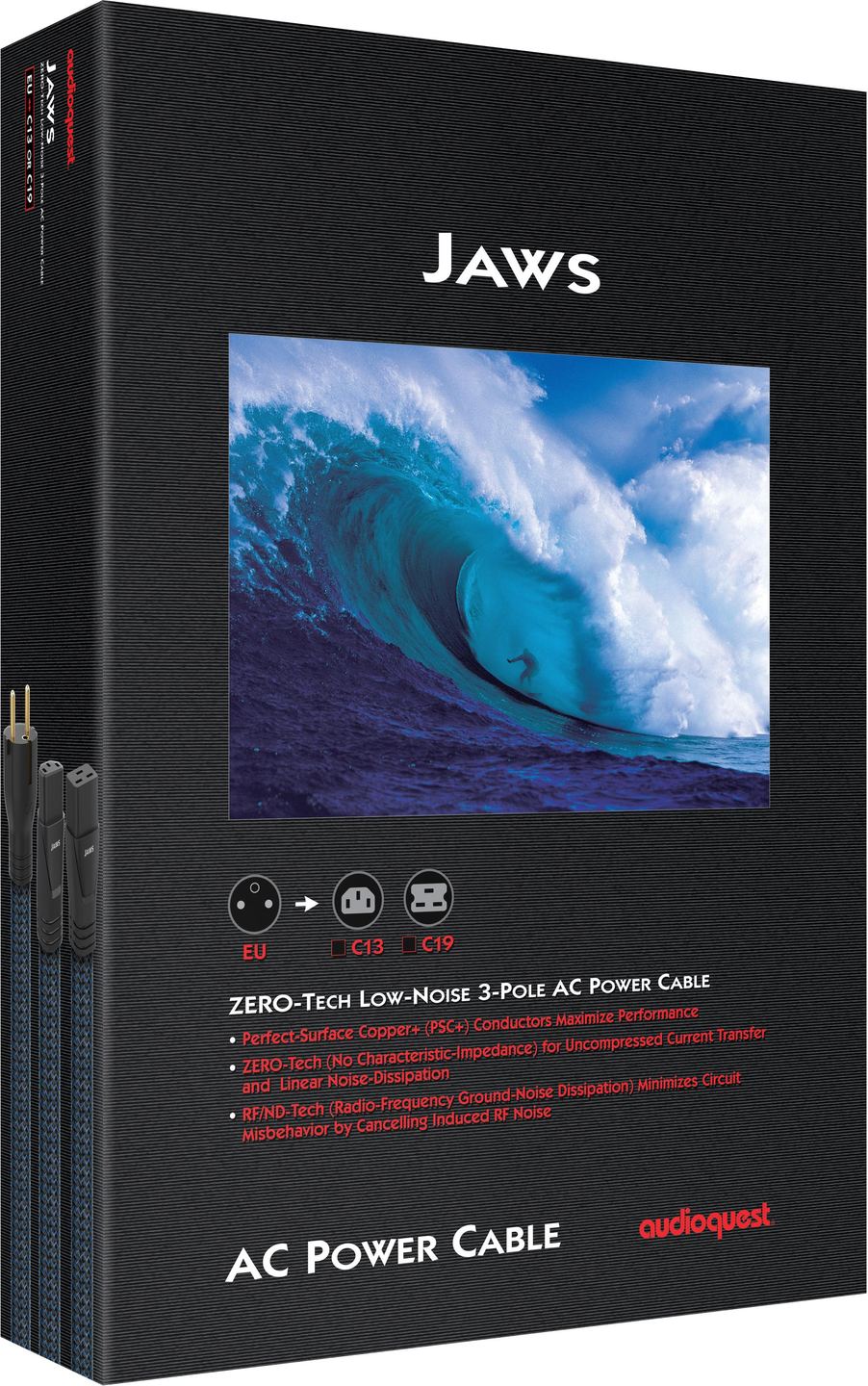
This version is terminated with a Schuko (EU) plug on the wall side and an IEC C19 connector on the device side. The C19, with contacts larger than the standard C13, is required by certain amplifiers, power distributors, and power conditioners that require a 20 A connector. Before purchase, you should check the type of IEC inlet on the back of the device: C20 inlets (which accept C19) and C14 inlets (which accept C13) do not have the same physical format.
Where to place this cable in a system
A power cable at this level delivers its most noticeable effects on the most sensitive or most power-hungry components. Three typical use cases: powering a power amplifier, connecting a power conditioner (such as AudioQuest Niagara) to the wall, or equipping a high-end integrated amplifier. On a low-consumption digital source, the benefit will be less pronounced, and the C13 version of the JAWS will generally be more suitable.
One meter in length suits most installations where the device is near the wall outlet or distributor. For greater distances, other lengths are available.
Technical Specifications
Design and Conductors
- Solid PSC+ (Perfect-Surface Copper+) copper conductors
- Solid conductor structure limiting interactions between strands
- Reduction of dynamic distortion
- Ultra-high-purity copper for improved RF noise dissipation
- Optimized cross-sections
- Live and neutral: 2 x 3.31 mm²
- Ground: 1 x 2.08 mm²
Proprietary Technologies
- ZERO-Tech (zero characteristic impedance)
- Elimination of impedance mismatch effects for uncompressed current transfer
- RF / ND-Tech (Radio-Frequency Noise Dissipation)
- Radio-frequency interference dissipation system across a wide bandwidth
- Ground Noise Dissipation (GND)
- Multi-layer shielding system (4 layers including graphene) to effectively reduce ground noise
- Directional conductors and RF drain wires
- Controlled conductor orientation to channel interference away from sensitive circuits
Connectors and Power
- High-quality mains connectors: EU Schuko to C19
- Supported current: 20 A RMS at 120 V (50 / 60 Hz)
Construction and Dimensions
- Outer diameter: 18 mm
- Optimized geometry to minimize internal electrostatic fields
- High-performance insulation for mains signal stability
Audio Benefits
- Significant reduction in background noise
- Improved dynamics and micro-detail retrieval
- Better power signal stability
- Cleaner and more precise soundstage
Frequently asked questions
What is the difference between the C19 version and the C13 version of the JAWS?
The C19 connector is physically larger than the C13 and accepts a 20 A rated current. It matches the C20 inlets found on certain power amplifiers, power conditioners, and distributors. The more common C13 plugs into the C14 inlets found on most hi-fi and home theater devices. Both versions share the same internal design.
Can the JAWS be used with an AudioQuest Niagara power conditioner?
Yes, and it is even one of the recommended use cases. AudioQuest designs its Wind Series and Storm Series cables to work in synergy with Niagara products, with conductor directionality aligned with the conditioners’ noise-dissipation system.
Does the JAWS replace the Monsoon in the AudioQuest range?
The JAWS is the direct successor to the Monsoon within the Wind Series. It stands out with its 100% PSC+ conductors (versus a PSC+/LGC mix for the Monsoon) and its reinforced GND shielding with graphene.
Is the JAWS compatible with European 230 V electrical networks?
Yes. The EU version is equipped with a grounded Schuko plug, compatible with French, German wall outlets, and a large part of continental Europe. The cable works on both 50 Hz and 60 Hz networks.
- Eco-contribution included in the sale price.
- Manufacturer reference: JAWSEU0220A
- GTIN / EAN: 92592198821