

FiiO Warmer R2R silver


Specifications and features


Overview
Making digital sound like analog: that’s what FiiO aims to achieve with this desktop converter. It brings together two ingredients rarely found at this price point: a discrete resistor R2R conversion stage and a four-tube buffer. The stated goal is a warm tone and organic texture, whether in a hi-fi system or at the end of a computer connected to active speakers.
R2R conversion with a resistor ladder
The conversion is based on an R2R network designed by FiiO, rather than an off-the-shelf delta-sigma chip. The digital signal is reconstructed by a resistor ladder: 192 thin-film resistors, distributed across four channels of 48, with 0.1% tolerance and thermal drift limited to 30 ppm. The precision of these components directly determines conversion linearity; this is the crux of the matter with this type of circuit. FiiO announces a fully differential 24-bit structure, the same conversion board as the K13-R2R, but with a revised implementation that gives the Warmer R2R a slightly different signature.
Four JJ tubes to shape the texture
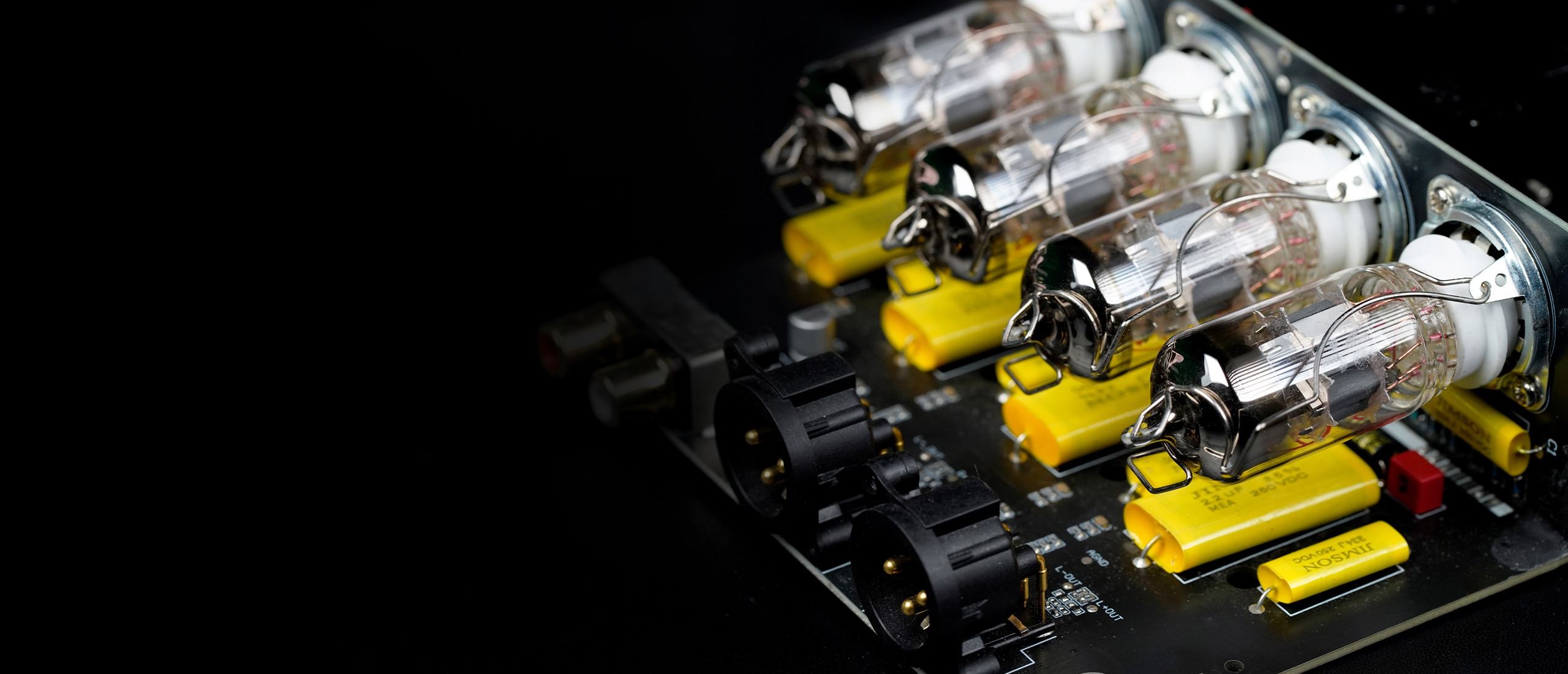
The warm tone comes from the stage following conversion. Four JJ Electronic E88CC tubes, manufactured in Slovakia, form a buffer powered at ±28 V. A buffer does not amplify the level (its gain is 1): it adapts the output impedance while adding a harmonic imprint, especially even-order harmonics, those associated with the warm texture of tubes. FiiO gives these tubes a lifespan of around 10,000 hours. One practical point to keep in mind: four tubes and a linear power supply generate real heat; the electronics warm up during listening.
NOS or OS, two ways to filter
A selector lets you choose between two digital filtering modes. In NOS (non-oversampling), samples are converted as they are, for a more direct presentation with an analog character. In OS (oversampling), the stream is raised to 384 kHz, which tends to smooth and densify the sound. Neither mode is inherently superior to the other; the right setting depends on the rest of the system and the track being played.
A source, not an amplifier
The Warmer R2R is a source, not an amplifier. It has neither a headphone output nor volume control: it delivers a tube-colored line signal, leaving it to the next stage to set the level. It can therefore be connected to active speakers, an integrated amplifier or a headphone amplifier.
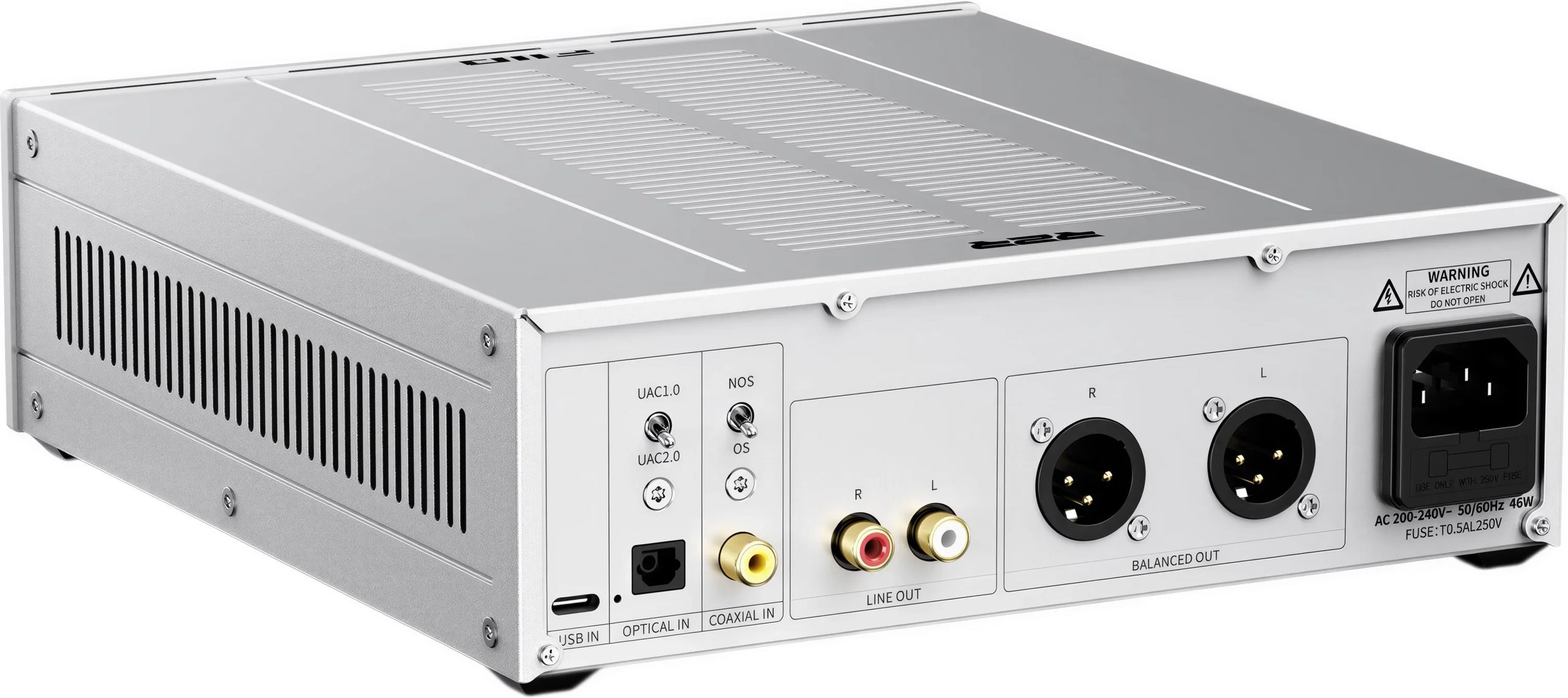
On the input side, USB-C accepts PCM up to 32-bit/384 kHz and DSD256, the coaxial input goes up to 24-bit/192 kHz and optical Toslink up to 24-bit/96 kHz. UAC 1.0 and UAC 2.0 modes are both available, ensuring compatibility with older sources or those without a dedicated driver.
Two outputs are available simultaneously: one unbalanced RCA and one balanced XLR. The fully differential XLR connection delivers the best measurements: 3.3 Vrms, a signal-to-noise ratio of at least 114 dB and a dynamic range of 105 dB, versus 1.8 Vrms, at least 112 dB and 98 dB via RCA. Distortion (THD+N) remains close to 0.05% on both outputs, and frequency response extends from 20 Hz to 45 kHz.
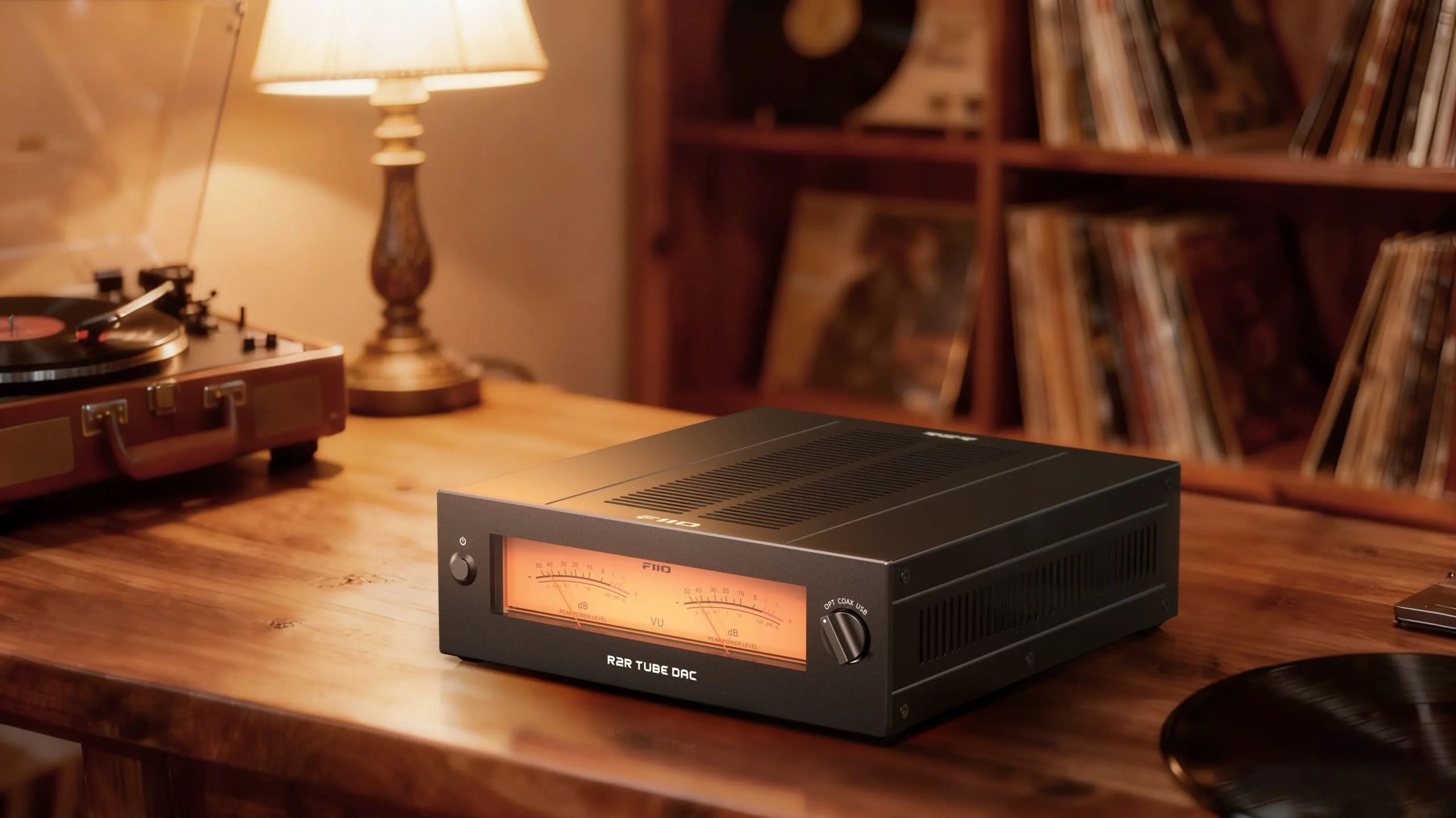
An aluminum chassis and its VU meters
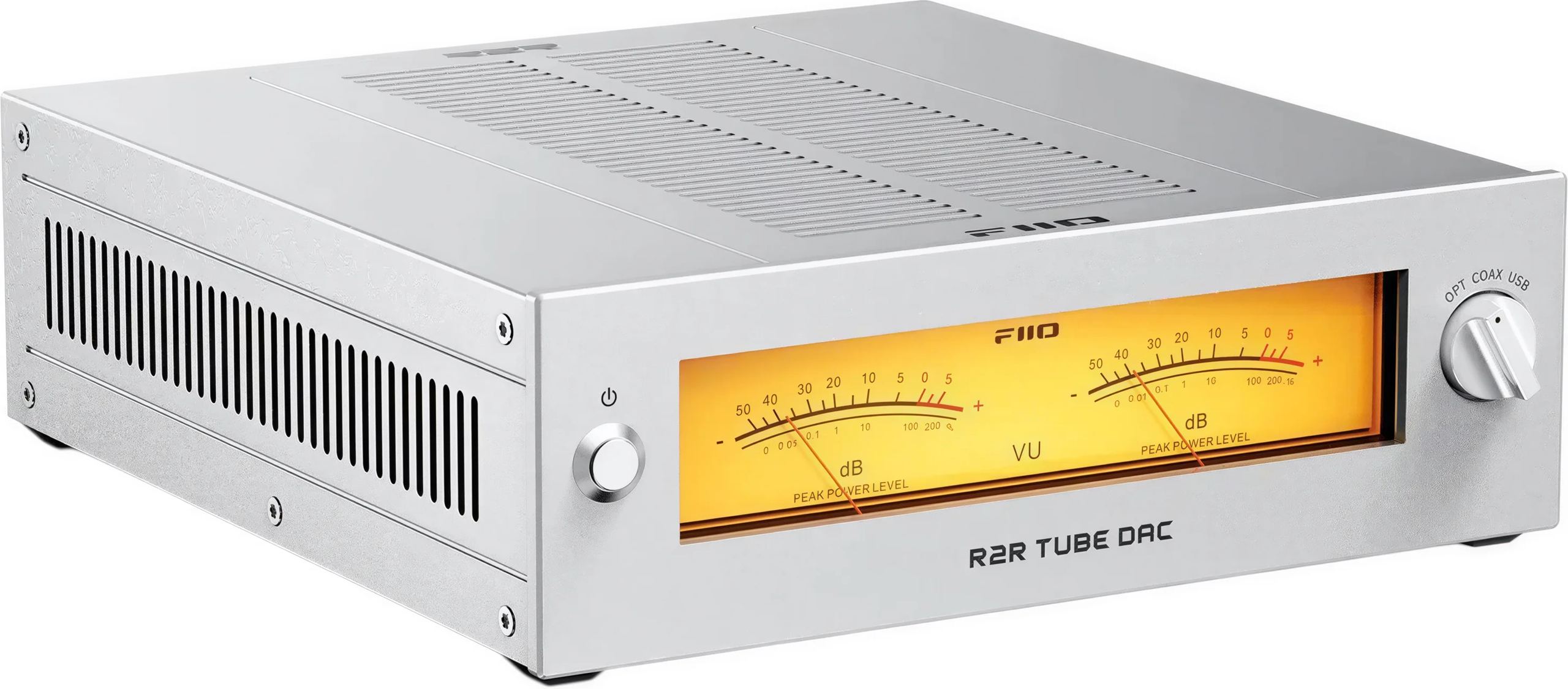
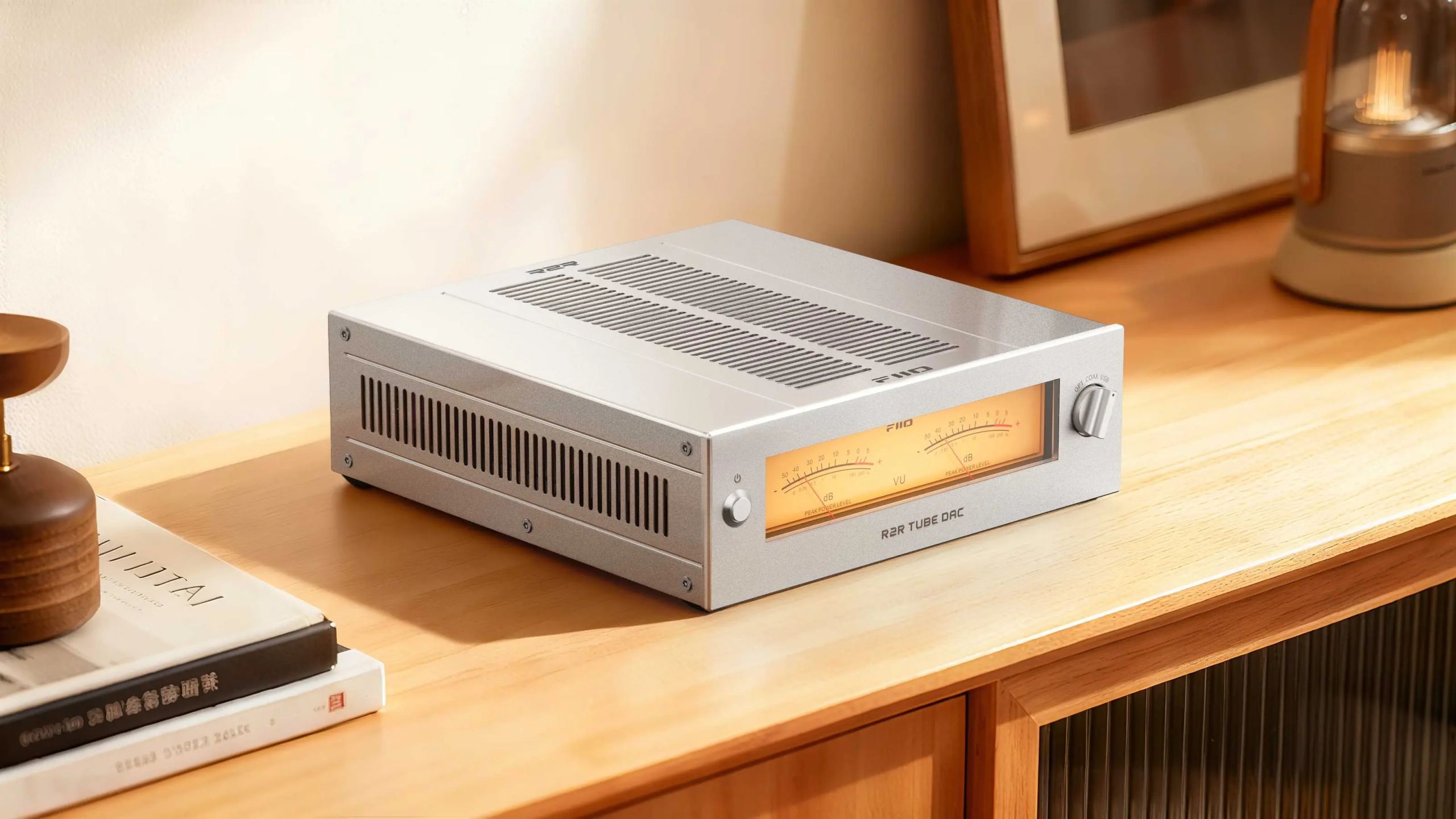
The aluminum enclosure adopts the simultaneously angular and rounded styling of FiiO’s K series, with a perforated grille that helps dissipate heat. On the front panel, two warm-toned backlit analog VU meters swing in time with the music, driven by a dedicated circuit. It is an aesthetic choice, a nod to electronics of the past, with no effect on sound but one that creates an atmosphere. Compact (223.5 × 66.8 × 213 mm) and lightweight for a device with tubes and a toroidal power supply (2.8 kg), it fits equally well on a desk or in a hi-fi cabinet.
Technical specifications
Digital / analog conversion
- Passive R2R DAC architecture with 192 resistors (4 channels)
- PCM compatibility up to 32 bits / 384 kHz
- DSD256 compatibility (USB)
- Two conversion modes: NOS (Non-Oversampling) and OS (Oversampling)
Analog stage
- Output stage with 4 JJ Electronic E88CC tubes
- Tube analog buffer
Power supply
- Linear power supply
- 46 W toroidal transformer
Audio performance
- RCA output
- Frequency response: 20 Hz to 45 kHz (±2.4 dB)
- THD+N: 0.052%
- Signal-to-noise ratio: ≥ 112 dB
- Dynamic range: 98 dB
- Output level: 1.8 Vrms
- XLR output
- Frequency response: 20 Hz to 45 kHz (±2.4 dB)
- THD+N: 0.053%
- Signal-to-noise ratio: ≥ 114 dB
- Dynamic range: 105 dB
- Output level: 3.3 Vrms
Supported formats
- USB-C: PCM up to 32 bits / 384 kHz, DSD256
- Coaxial: PCM up to 24 bits / 192 kHz
- Optical: PCM up to 24 bits / 96 kHz
- UAC 1.0 and UAC 2.0 compatibility
Connectivity
- 1 USB-C input
- 1 Toslink optical input
- 1 coaxial input
- 1 stereo RCA output
- 1 balanced XLR output
Construction
- Aluminum chassis
- Dual backlit analog VU meters on the front panel
Dimensions and weight
- Dimensions (W × H × D): 223.5 × 66.8 × 213 mm
- Weight: 2.8 kg
Frequently Asked Questions
What sets it apart from the FiiO K13-R2R?
Both share the same R2R conversion board. The K13-R2R is an all-in-one unit with a headphone amplifier, preamplifier, and volume control. The Warmer R2R follows a different approach: a pure converter paired with a tube buffer, with no headphone output or volume control, designed to add warm coloration to a system already equipped with an amplifier.
Do I need to install a driver to use it on a computer?
On macOS, Linux, and Android, UAC 2.0 mode works without a driver. On Windows, FiiO offers a USB driver that unlocks the highest sample rates and eliminates the slight startup delay sometimes observed during first playback. UAC 1.0 mode serves as a fallback for sources that do not support USB Audio Class 2.
Can the JJ E88CC tubes be replaced once they are worn out?
Yes. The E88CC (also known as 6922 or ECC88) is a common dual triode, socket-mounted. After several thousand hours, when the sound becomes dull or noise appears, the tubes are replaced with a new matched set of the same type or an equivalent, opening the door to tube rolling to adjust the tonal character.
How do you adjust the volume with this converter?
The level is adjusted downstream, since the Warmer R2R outputs at a fixed line level. In practice, the active speakers, integrated amplifier or headphone amplifier placed after it control the volume. It therefore cannot drive passive speakers directly, as they require an amplifier.
RCA or XLR: which output should you choose?
If the downstream device has balanced inputs, the XLR output is preferable: higher level and slightly better measurements. Otherwise, RCA does the job without reservation. Since both operate in parallel, nothing prevents you from feeding two devices at once.
Does the Warmer R2R get very hot?
It gets noticeably warm due to the four tubes and the linear power supply. It is best to leave some space above and on the sides, avoid enclosing it in a closed cabinet, and do not stack anything on top of it. Turning it off between sessions also helps extend the life of the tubes.
- Eco-contribution of €0.12 included in the sale price.
- Manufacturer reference: FIIWARR2RSR
- GTIN / EAN: 6953175711094




