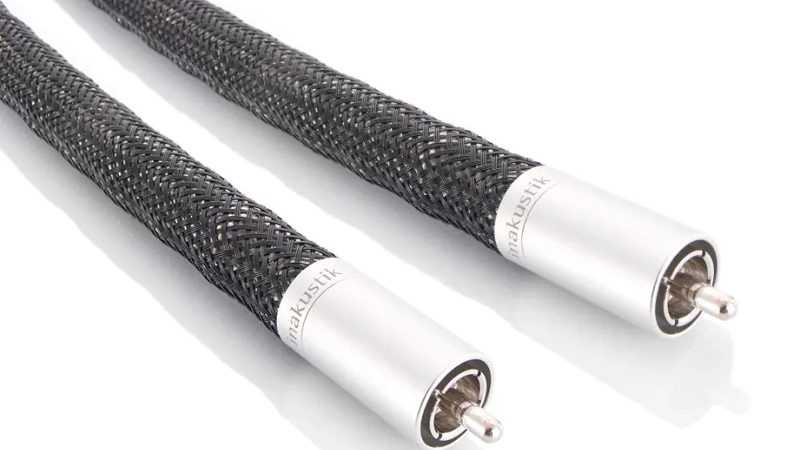
Inakustik Reference NF-1205 AIR | RCA 2m

Overview
An interconnect cable creates nothing; it loses. The whole challenge is to lose as little as possible between a source and an amplifier. in-akustik addresses the issue through subtraction: removing plastic insulation, removing solder, removing anything that stores energy along the way. The fifth generation of its AIR technology takes this reasoning down to the final centimeters, inside the plugs themselves.
Air as insulation, and almost nothing else
The capacitance of an interconnect cable matters more than on a speaker connection, because the signals travelling between two devices are weak and sensitive to the load imposed by the line. Conventional plastic insulation stores some of this energy and releases it with a slight delay. Air, on the other hand, adds no extra capacitance and generates no dielectric losses.
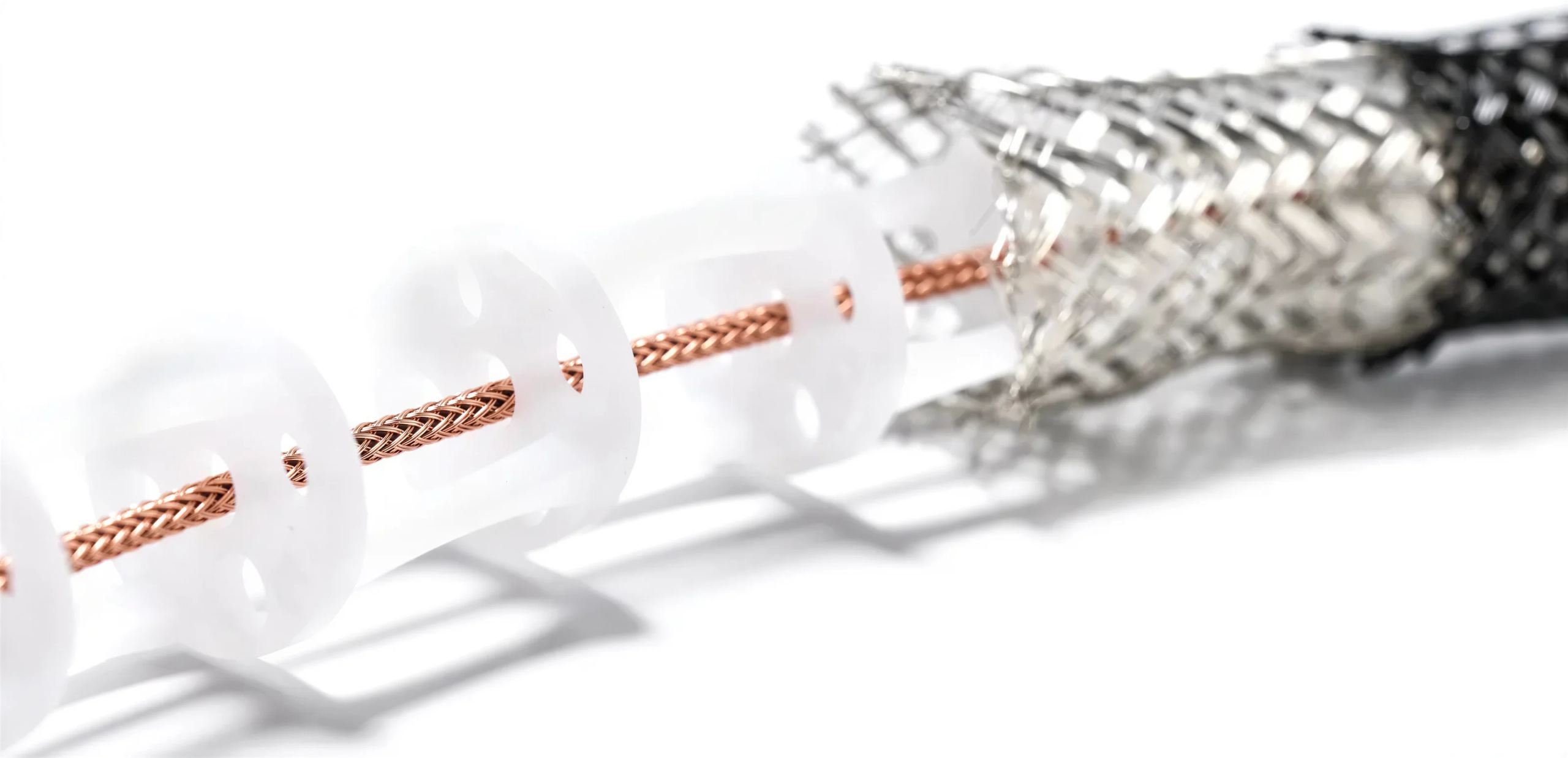
The challenge remains to keep the conductors apart without placing anything between them. in-akustik uses clips distributed at regular intervals along the entire length, holding the conductors in a helical arrangement and leaving them suspended in air. Two spacers connect the clips to each other and set their distance apart, preserving a degree of flexibility despite the assembly’s apparent rigidity. The jacket follows the same principle: no PVC, but a braid of polyethylene monofilaments that holds the conductors together, limits micro-vibrations and adds no insulating material around the signal. The final diameter reaches 13 mm, a direct consequence of this design.
Fifth-generation point-to-point design
On previous generations, the air helix stopped before the ends: the conductors left their clip structure to reach the plugs over the final centimeters, returning to conventional insulation in the process. The fifth generation, replacing the NF-1204 AIR, eliminates this break with transitions designed for each type of cable and connector. Air insulation now runs from one plug to the other.
The difference concerns only a few centimeters, which may seem anecdotal. Yet this is the area where material density is greatest and where the conductor comes closest to the connector’s metal masses.
A braided conductor against skin effect
The conductor is called the Cross Link Super Speed waveguide. It is based on a polyethylene core around which the strands are braided in a crown, with an effective cross-section that remains constant regardless of frequency. Each strand receives a varnish coating that insulates it from its neighbors and protects it against oxidation. The copper is high-purity OFC, batch-selected before wire drawing.
The stated argument is the fight against skin effect, the phenomenon that pushes current toward the conductor’s periphery as frequency rises. On an audio-frequency interconnect cable, this effect remains modest compared with its significance at radio frequencies. The braided structure primarily provides homogeneous conduction and good handling of current peaks, without emphasizing any particular part of the spectrum.
Two separate cables, one per channel
The construction is coaxial, with double-mono technology: the two channels share no conductors, each having its own complete cable. Higher-end models in the range, the NF-2405 AIR (25 mm) and NF-4005 AIR (40 mm), adopt a balanced design and take up considerably more space.
An RCA connection remains inherently unbalanced, making it dependent on the quality of its shielding to reject interference. in-akustik uses a dense copper braid here, tin-plated against oxidation. Electromagnetic interference generated by Wi-Fi networks and mobile phones has increased significantly in recent years, and a low-level analog connection is directly exposed to it.
RCA plugs assembled without solder
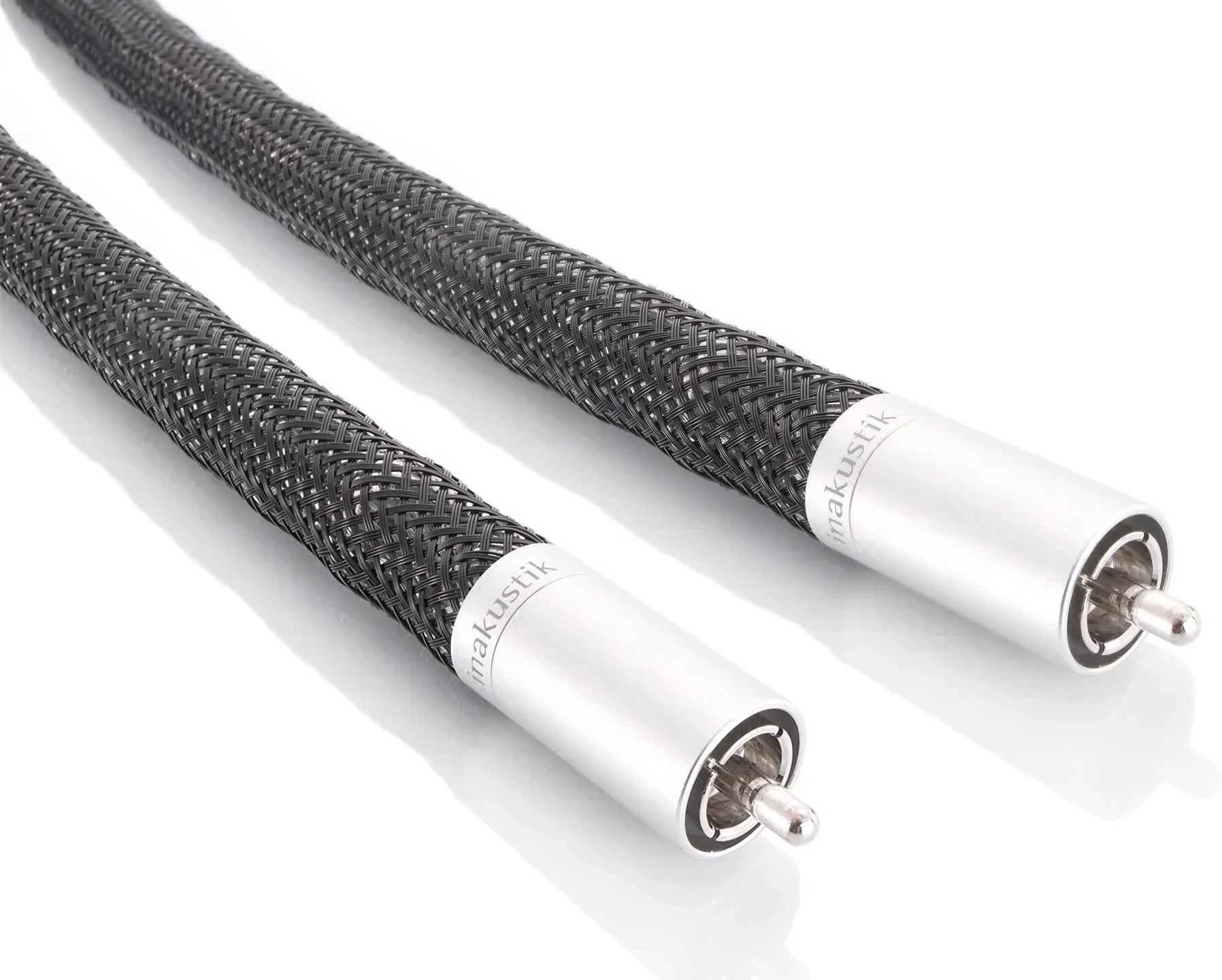
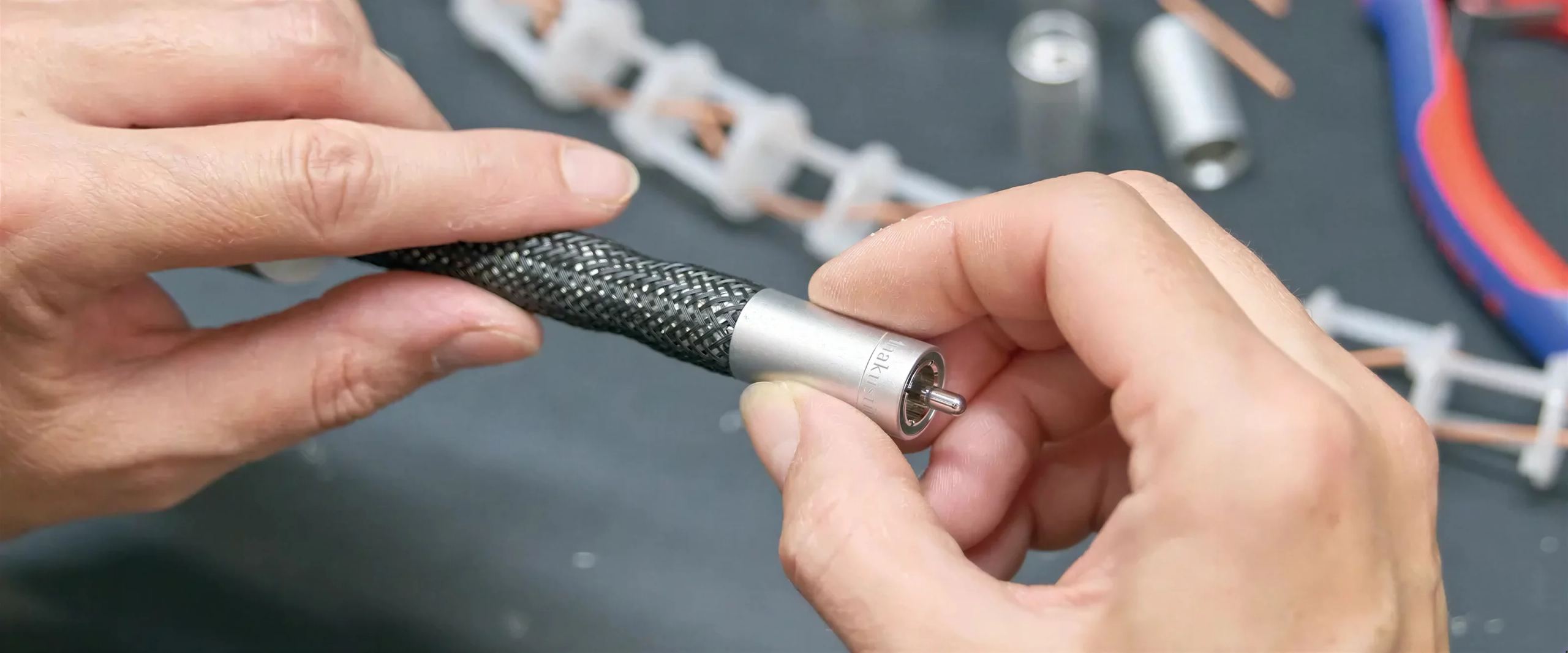
The RCA SL plug was developed for this cable and does without tin entirely. The varnish is first machine-stripped from the copper strands, then the tellurium-copper contact pin is crimped into the conductor under 1.5 tonnes of pressure. The shield connection is made by hermetic screw fastening. There is therefore no solder or intermediate crimp ferrule left in the signal path, reducing transition resistance accordingly. The trade-off is logical: a press-crimped termination cannot be redone at home; changing a plug requires workshop service.
Tellurium copper is a harder alloy than pure copper, which is too soft for a connector, while retaining conductivity superior to that of brass. The plating is rhodium rather than gold: gold conducts better, but wears more quickly on a contact frequently handled, whereas rhodium withstands connection cycles without deteriorating.
Assembly is done by hand in Ballrechten-Dottingen, Germany. The manufacturer counted the parts in a 1.5 m pair: 254 components, 855 m of copper wire, 334 m of polyethylene monofilament and 208 holes through which the conductors must be threaded one by one.
What to consider during installation
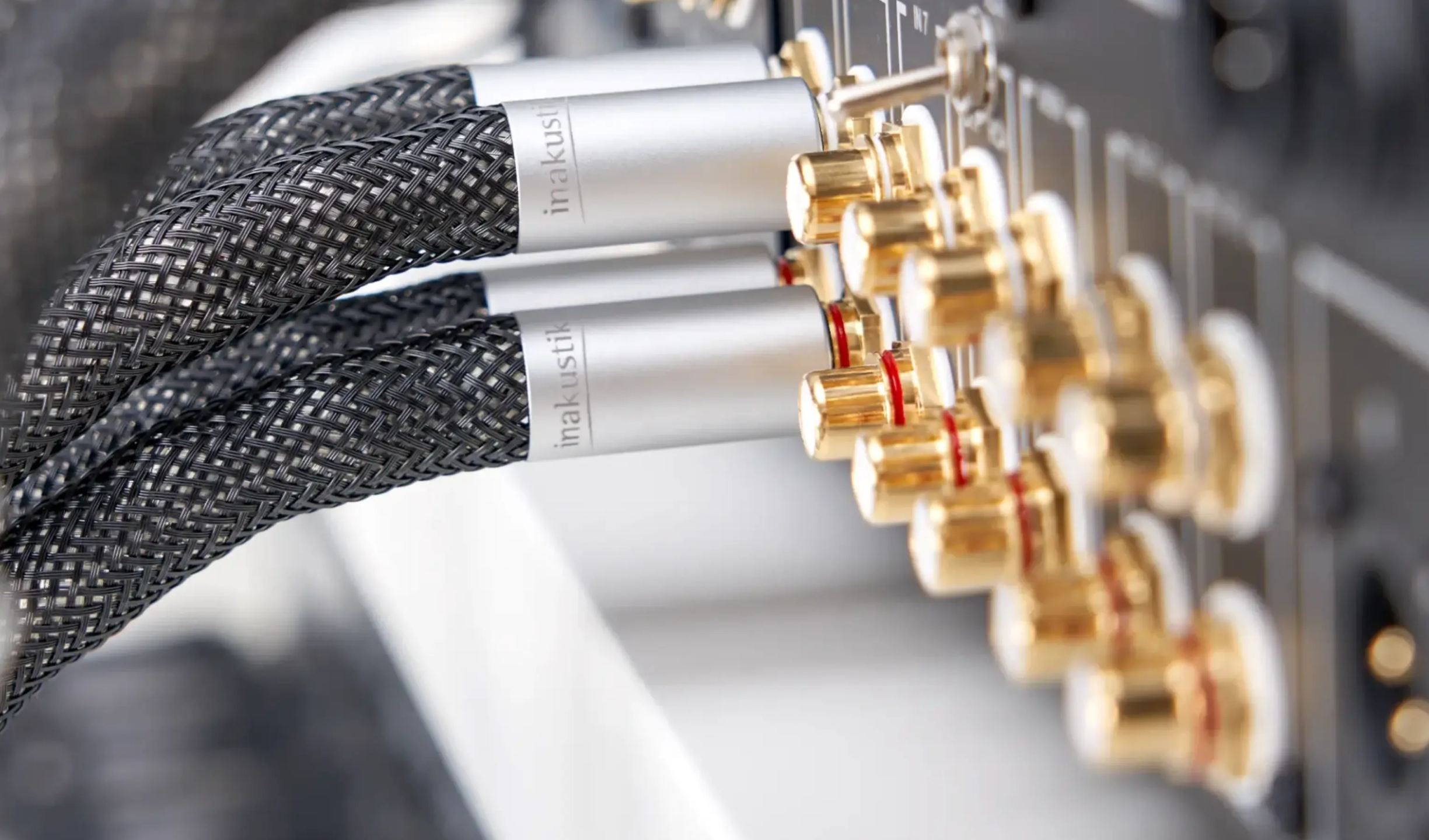
Thirteen millimeters in diameter and a firm jacket require room behind the furniture. It is best to check the available depth before ordering, allow for a generous bend radius and avoid placing the cable’s full weight on the RCA sockets of a lightweight device. Three lengths are listed in the catalog—1 m, 1.5 m and 2 m—with custom lengths available on request.
The benefit of reduced capacitance is most noticeable with sources having high output impedance, especially certain tube stages or phono preamplifiers, where the cable’s capacitive load directly affects frequency response. With a modern source featuring low output impedance and a short connection, the margin is narrower. Holger Wachsmann, who developed AIR technology at in-akustik, summarizes his goal in these terms: a good cable is not the one that extracts the most from a system, but the one that loses the least of the original signal.
Technical Specifications
Technologies
- AIR Helix Point-to-Point for authentic sound
- Air as the ultimate dielectric, minimizing capacitance
- Cross Link Super Speed waveguide for balanced sound
- Dual mono configuration
- Compliance: CE, REACH, RoHS
Cable Design
- Design: coaxial
- Cable diameter: 13 mm
- Dielectric: air
- Conductor structure: Cross Link Super Speed waveguide
- Conductor material: high-purity OFC copper
- Shielding: dense, tin-plated copper braid (protection against oxidation)
- Jacket: PE network jacket
Connectivity
- Connectors: 2 x RCA to 2 x RCA
- Key feature: RCA SL (solderless)
- Connector housing: solid metal
- Contact material: tellurium copper
- Contact treatment: rhodium-plated
- Connector assembly: contacts crimped under pressure with a force of 1.5 tonnes for a precision fit
Available Lengths
- Length: 1 m, 1.5 m, 2 m
Frequently asked questions
What is the difference compared with the NF-1205 AIR XLR version?
Same family, same generation, but a different connection. The XLR version features XLR 180° plugs developed by in-akustik, adjustable by plus or minus 45 degrees on either side, preventing the cable from being bent when the device sockets are poorly positioned. The choice between the two depends solely on your devices’ outputs and inputs, not on any quality hierarchy.
Can it be used as a coaxial S/PDIF digital cable?
No. It is an analogue cable: in-akustik does not assign it a 75-ohm characteristic impedance, which is essential for a coaxial digital connection to avoid reflections and jitter. The brand offers a separate range of digital cables for this purpose.
Is it suitable for connecting a tonearm to a phono preamp?
Neither, and the brand has planned a dedicated reference: the Phono-1205 AIR, with an SME connector on one side and two RCA connectors on the other, plus the ground connection required by a cartridge. The voltages involved in a cartridge are measured in thousandths of a volt, with inductive behavior that forms a resonant circuit with the cable’s capacitance.
Are there lengths other than 1, 1.5 and 2 m?
The catalogue stops at 2 m, but in-akustik produces custom lengths on request, to be ordered through the retailer. For an interconnect, this is mainly relevant in installations where the electronics are far apart, a configuration in which switching to balanced connections is worth considering.
Should it be kept away from mains cables?
This is good practice for any low-level analog connection, shielded or not. Cross cables at right angles rather than running them parallel over a long distance, and leave a few centimeters between them when the furniture allows.
Can the NF-1205 AIR be used as a subwoofer cable?
Technically, one of the two channels does the job, but you are paying for a pair while using only half of it, and a subwoofer placed far from the system often requires more than 2 m. A dedicated mono model is more suitable for this use.
- Eco-contribution included in the sale price.
- Manufacturer reference: 007185320
- GTIN / EAN: 4001985522620