FiiO Air Amp black


Specifications and features


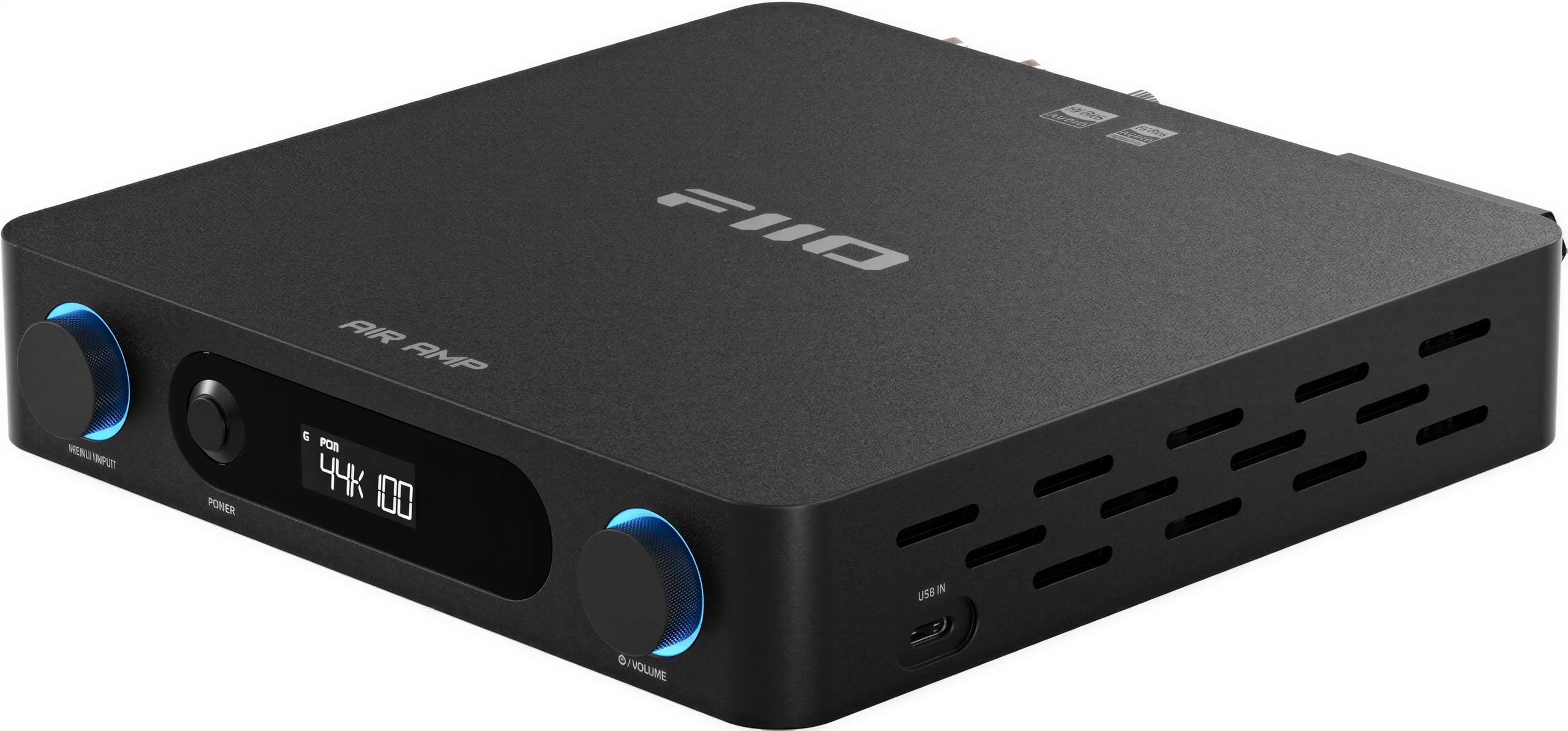
FiiO Air Amp, stereo streaming amplifier
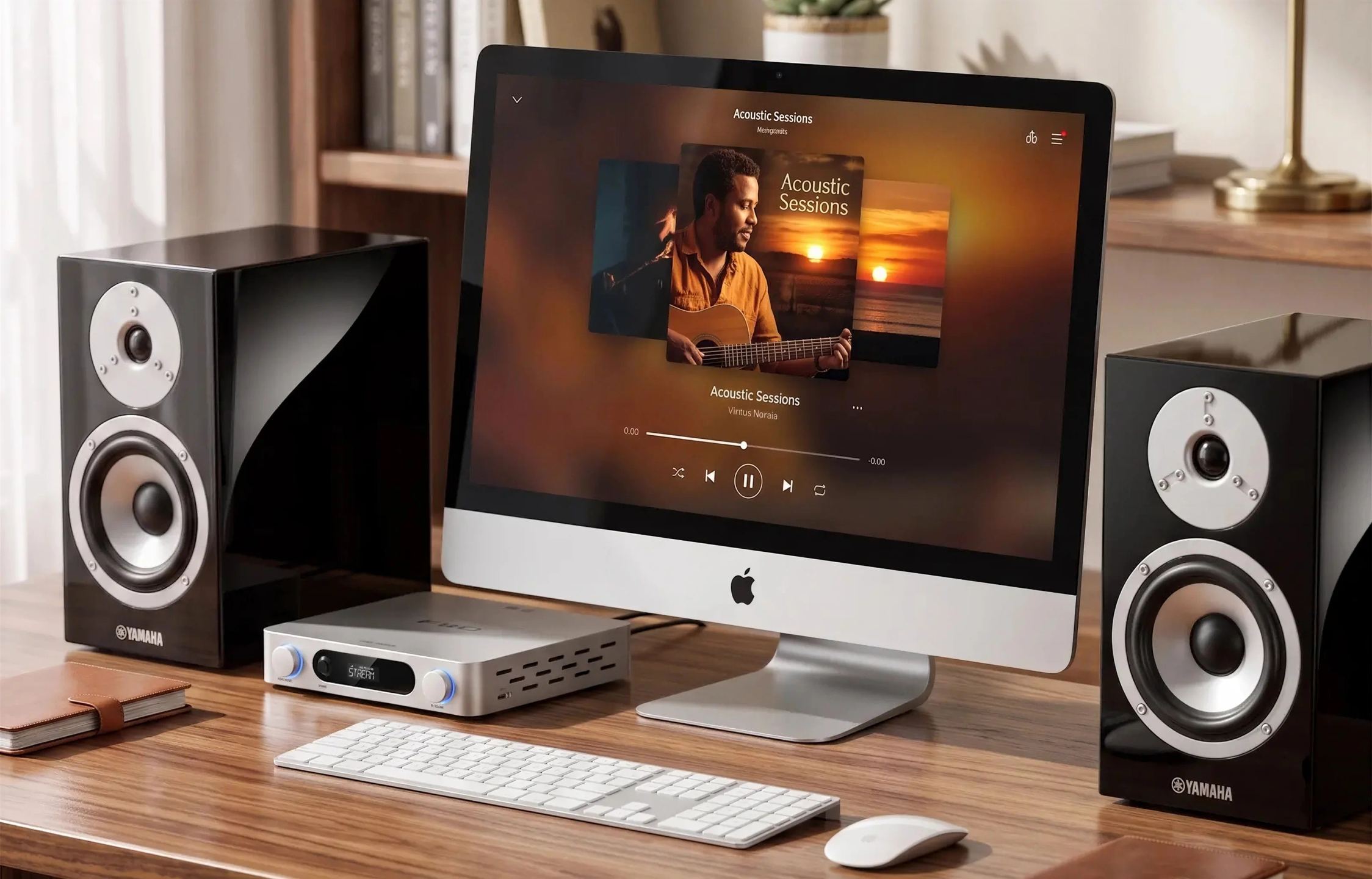
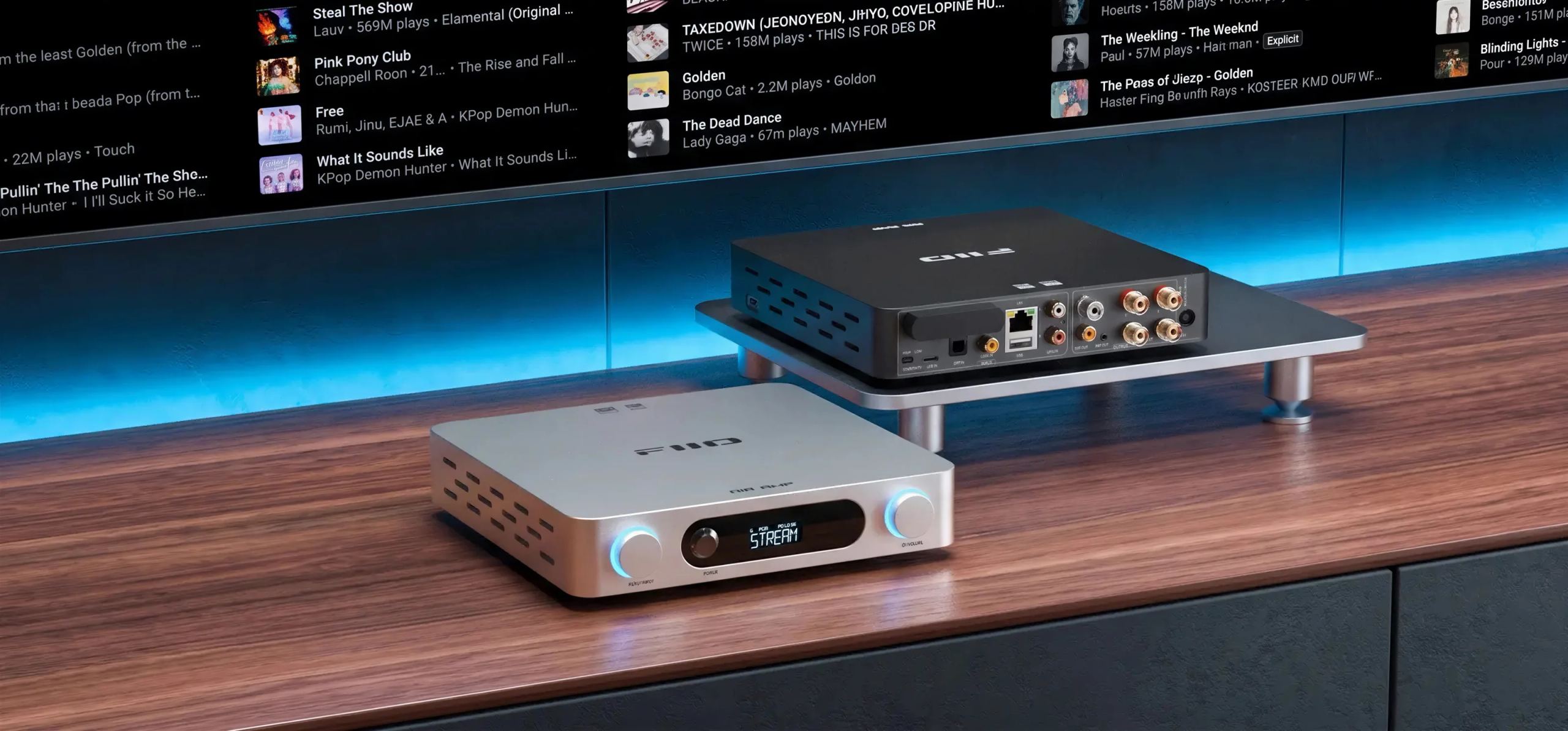
A pair of passive speakers, a network cable and a black or silver box, 4.2 cm high, sitting on a shelf: that’s the entire setup. FiiO brings together a network player, DAC and amplifier in a single chassis, controlled from a phone or remote. A pair of bookshelf speakers left in a cupboard or small floorstanding speakers in the living room become a complete, modern hi-fi system, without a stack of components or a tangle of cables behind the furniture.
One box between the network and the speakers
The network section is built around an X2000 processor. From an iPhone, iPad or Mac, music arrives via AirPlay; Roon users will find the Air Amp as a Roon Ready playback zone, and QPlay rounds out the options. For a personal library, a USB flash drive or portable hard drive plugs into the rear USB-A port, while files stored on a NAS on the home network can be browsed in the FiiO Control app. Connection is via Gigabit Ethernet for maximum stability, or dual-band 2.4 and 5 GHz Wi-Fi when no network socket is nearby. For both network and local playback, the unit accepts PCM up to 384 kHz / 32-bit and DSD256, covering all high-resolution files sold as downloads. A guest who wants to play a track from their phone can use Bluetooth 5.2, with the LDAC codec for Android smartphones that support it and SBC for the others.
From digital file to speaker signal
All digital music must be converted back into an electrical signal before it can be amplified. That job falls to an ESS ES9020Q chip, fed data by a sixteen-core XMOS XU316 USB interface when the Air Amp is used as a DAC for a computer: its two USB-C ports then support up to 768 kHz / 32-bit and accept native DSD512.
Amplification is class D, handled by a Texas Instruments TPA3255 chip. In this type of circuit, the output transistors switch very rapidly between two states instead of operating continuously, reducing heat loss and explaining why an amplifier this powerful weighs just 930 g. The trade-off lies in the output filter used to remove the residual effects of this switching: its behaviour varies with the impedance of the connected speaker. PFFB (post-filter feedback) takes its feedback signal after this filter, so it corrects the filter’s variations too, resulting in lower distortion and a response that stays the same from one speaker to another. The figures bear this out: total harmonic distortion plus noise below 0.0021% on the digital inputs and below 0.002% on the line input, a signal-to-noise ratio of at least 110 dB and a noise floor below 80 µV—quietness that matters when speakers sit on a desk, one metre from your ears. Output impedance stays below 0.1 Ω (damping factor of 80), helping keep bass controlled through bookshelf speakers, while selected audio capacitors filter the power supply.
How much power for which speakers
With the supplied 48 V / 5 A power adapter, the Air Amp delivers 120 W per channel into 4 Ω and 90 W into 8 Ω, measured at 1% distortion, regardless of the input used. It accepts speakers rated from 4 to 8 Ω, covering the vast majority of bookshelf models and small or medium-sized floorstanders in an average-sized living room.
A 48 V / 10 A adapter, sold separately, raises these figures, but they need a little care in interpretation. The 235 W into 4 Ω and 150 W into 8 Ω apply only to the analogue line input and are measured at 10% distortion—that is, at the clipping threshold, where the amplifier saturates; on the digital inputs, the same measurement yields 190 W and 100 W. At 1% distortion, both types of input deliver the same figures: 155 W into 4 Ω instead of 120, and still 90 W into 8 Ω. This more powerful adapter is therefore most useful with low-sensitivity 4 Ω speakers; with 8 Ω models, it mainly adds headroom for peaks.
TV, CD player, subwoofer: the connections
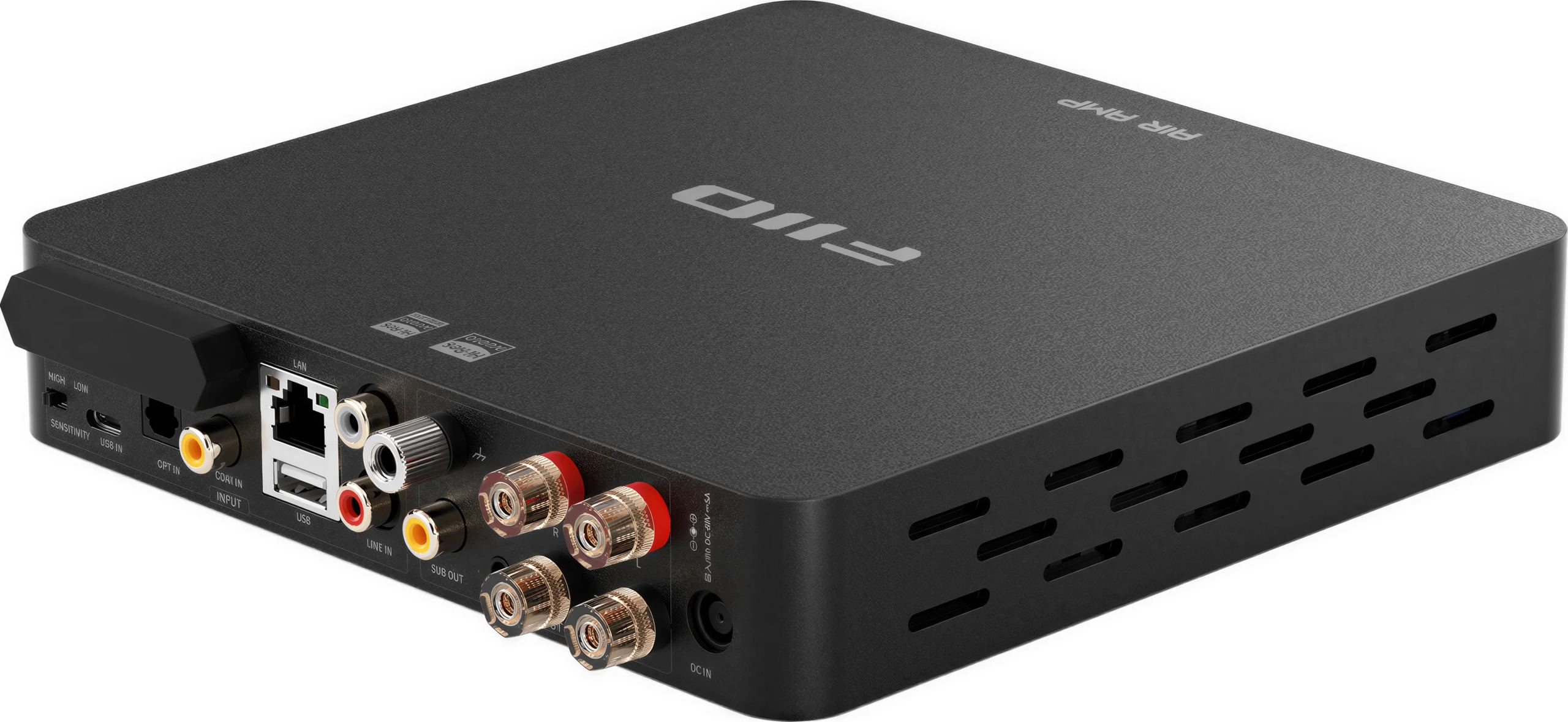
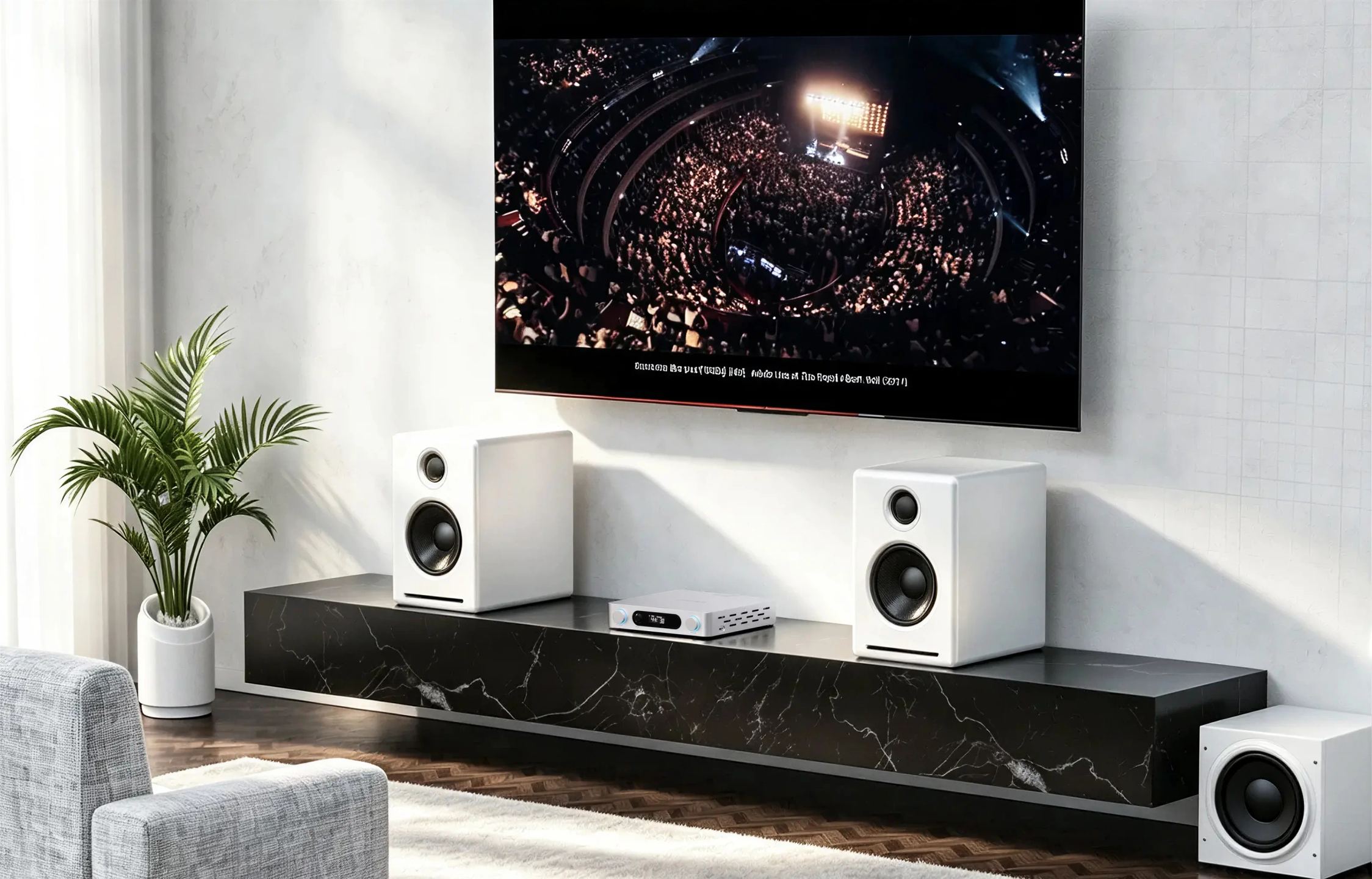
The optical input accepts a TV (up to 96 kHz / 24-bit), and the coaxial input a CD player or transport (192 kHz / 24-bit and DSD64). An analogue RCA input accepts any line-level source, with a two-position sensitivity switch that adjusts the gain for stronger or quieter sources; it affects only this input. On the output side, an RCA socket feeds an active subwoofer for a 2.1 setup, while a 3.5 mm mini-jack line output (2.5 V) sends the signal to another device. The speakers connect to terminals that accept both 4 mm banana plugs and bare wire, and a ground terminal on the rear helps eliminate hum when a nearby device has no earth connection.
Adjust the sound manually or through the app
Bass and treble can be adjusted independently, as can left-right balance, directly on the unit. For finer control, a 10-band parametric equaliser, accessible in FiiO Control or through a web browser, lets you choose each frequency, its level and the width of its effect: enough to tame a room-induced bass peak rather than turning down the entire low end. Ten presets and ten user slots are provided, along with an AUTO EQ function that applies ready-made curves.
On the front, a 1.1-inch LCD screen displays the input, format and sampling rate. It is flanked by two clickable knobs, one for input selection and menus, the other for volume, standby and mute, with lighting whose colour and intensity can be changed at will. Power is controlled by a mechanical push-button switch, an infrared remote control is included, and the firmware can be updated online or from a local file.
Technical specifications
Overview
- Compact AIR AMP hi-fi amplifier with streaming and local playback.
- Decoding, amplification and streaming in a single device.
- Brings passive speakers up to date in a living room, library or office.
Playback and network connectivity
- Playback from a USB flash drive or portable hard drive (USB-A port, 1.3 A power supply).
- Playback from a NAS on the local network, controlled through the FIIO Control app.
- Streaming protocols: AirPlay, Roon Ready, QPlay.
- Gigabit Ethernet port for a stable wired connection.
- Dual-band 2.4 GHz and 5 GHz Wi-Fi.
- Bluetooth 5.2 reception with SBC and LDAC codecs (wireless high-resolution audio).
Audio processing and amplification
- X2000 main processor.
- XMOS XU316 USB interface.
- ES9020Q digital-to-analog converter.
- AP6256 Bluetooth module.
- Class D amplification using a TI TPA3255 chip.
- PFFB technology: less distortion and consistent sound regardless of speaker impedance.
- Premium capacitors for a cleaner power supply.
- Compatible speakers: 4 to 8 Ω (bookshelf speakers, small or medium floorstanding speakers).
- Damping factor: 80.
- Full MQA decoding.
Supported resolutions
- USB: up to 768 kHz / 32-bit and native DSD512.
- Local playback: up to 384 kHz / 32-bit and DSD256.
- Streaming: up to 384 kHz / 32-bit and DSD256.
- Coaxial: up to 192 kHz / 24-bit and DSD64.
- Optical: up to 96 kHz / 24-bit.
Speaker output with the supplied adapter (48 V / 5 A)
- Power into 4 Ω: 120 W + 120 W (THD+N < 1 %).
- Power into 8 Ω: 90 W + 90 W (THD+N < 1 %).
- Frequency response (digital inputs): 20 Hz to 20 kHz (attenuation < 0.4 dB), 20 Hz to 40 kHz (attenuation < 2.4 dB).
- Frequency response (line input): 20 Hz to 20 kHz (attenuation < 0.3 dB), 20 Hz to 45 kHz (attenuation < 2.4 dB).
- Distortion (THD+N): < 0.0021 % on digital inputs, < 0.002 % on the line input.
- Crosstalk: ≥ 83 dB on digital inputs, ≥ 78 dB on the line input.
- Dynamic range: ≥ 110 dB (A-weighted).
- Signal-to-noise ratio: ≥ 110 dB (A-weighted).
- Noise floor: < 80 µV (A-weighted).
- Output impedance: < 0.1 Ω.
Speaker output with an optional adapter (48 V / 10 A)
- Power into 4 Ω (THD+N < 1 %): 155 W + 155 W.
- Power into 8 Ω (THD+N < 1 %): 90 W + 90 W.
- Maximum power on digital inputs (THD+N < 10 %): 190 W + 190 W into 4 Ω, 100 W + 100 W into 8 Ω.
- Maximum power on the line input (THD+N < 10 %): 235 W + 235 W into 4 Ω, 150 W + 150 W into 8 Ω.
- Frequency response: identical to that obtained with the supplied adapter.
- Distortion (THD+N): < 0.0021 % on digital inputs, < 0.0022 % on the line input.
- Dynamic range: ≥ 110 dB (A-weighted).
- Signal-to-noise ratio: ≥ 110 dB (A-weighted).
- Noise floor: < 80 µV (A-weighted).
Line and subwoofer outputs
- Unbalanced line output (3.5 mm mini-jack): 2.5 V, signal-to-noise ratio ≥ 117 dB, distortion 0.0007 %.
- Subwoofer output (RCA): 4.7 V on digital inputs, 5 V on the line input, signal-to-noise ratio ≥ 123 dB.
Inputs, outputs and settings
- 7 inputs: USB-C (computer DAC), USB-A (storage), optical, coaxial, analog RCA line, Bluetooth, network.
- 3 outputs: speakers, subwoofer (RCA), line (3.5 mm mini-jack).
- Speaker terminals: 4 mm banana plugs or bare wire.
- Ground terminal on the chassis.
- 2-level sensitivity selector (active on the line input only).
- Independent bass and treble controls.
- Left-right balance (L20 to R20).
- 10-band parametric equalizer: 10 built-in presets and 10 custom settings.
- AUTO EQ automatic equalization via the FIIO Control app or Web interface.
- Driverless USB mode.
General specifications
- Dimensions: approximately 207 × 188 × 42 mm.
- Weight: approximately 930 g.
- Colors: black or silver.
- Display: 1.1-inch LCD.
- Controls: 2 clickable knobs (input and menus; volume, standby and mute), lighting adjustable in color and brightness.
- Mechanical push-button power switch.
- Infrared remote control.
- Power supply: 48 V, 5 A minimum (7909 DC connector).
- Firmware updates online or from a local file.
- Modes: USB, optical and coaxial decoding, line input, Bluetooth, streaming and local playback.
Included accessories
- AIR AMP.
- Infrared remote control.
- AC power cord.
- 48 V / 5 A adapter (7909 DC connector).
- Quick start guide.
- Warranty card.
Frequently Asked Questions
Can you connect a turntable directly?
Not without an additional device. The Air Amp has no phono input: a turntable without a built-in preamp requires an external phono preamp connected to the RCA line input. A turntable with a built-in preamp connects directly to that same input, with the sensitivity selector set according to its output level.
How do I connect a TV?
Via an optical cable, as the device does not have an HDMI port. Be sure to set the TV’s audio output to stereo PCM. The sound remains in two channels, with a subwoofer if needed.
Where do I plug in headphones?
The Air Amp does not have a headphone output. An external headphone amplifier can be connected to the 3.5 mm mini-jack line output.
How do I listen to Qobuz, Tidal, or Spotify?
From an Apple device, AirPlay streams playback from most streaming apps. Qobuz and Tidal integrate with Roon, which recognizes the Air Amp as a Roon Ready zone. From an Android smartphone, Bluetooth with the LDAC codec remains the simplest option.
Can I use a power supply other than the one provided?
Yes, provided it has a voltage of exactly 48 V, a current rating of at least 5 A, and a 7909 DC connector. A different voltage may cause abnormal operation.
What precautions should I take when connecting the speakers?
Connect the speakers with the unit turned off, then turn it on. A wire strand touching the chassis during connection can cause a popping sound through the speakers or trigger the “HOT” overheating warning. If using bare wire, twist the strands tightly before tightening the terminals.
Does the Air Amp play MQA files?
Yes, full MQA decoding is supported, as are PCM and DSD formats.
- Eco-contribution included in the sale price.