T+A G 2000 R silver


Overview
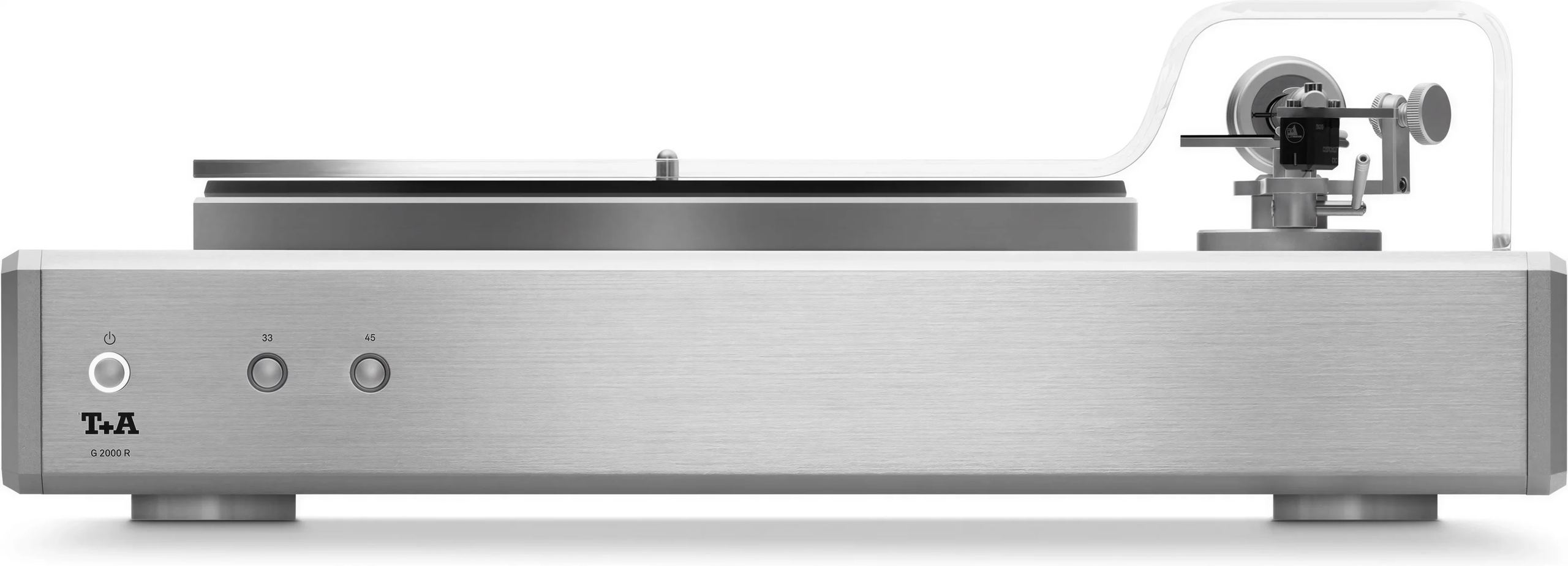
At T+A in Herford, electronics come first, and this belt-drive turntable shows it: rotational stability is entrusted to a processor that controls the motor, not just to the mass of the platter. It succeeds the G 1260 R and adopts the aluminium design of the R Series. It comes with a carbon-fibre tonearm and a moving-coil cartridge, already set up, and can accommodate an integrated phono preamp.
A synchronous motor corrected by a processor
The platter is driven by a precision-ground rubber belt stretched around the machined pulley of a quartz-controlled synchronous motor. This conventional arrangement usually allows small irregularities through: slight motor jerks and sensitivity to variations in mains frequency and voltage. On the G 2000 R, a digital signal processor (DSP) continuously shapes the voltage waveform sent to the motor coils. The motor then rotates smoothly, regardless of the quality of the incoming power. Wow and flutter, the speed fluctuations that cause the pitch of notes to waver, is ± 0.02 %, well below what the ear can detect on a sustained piano note.
The same electronics manage startup. Motor torque increases progressively to set the 3.8 kg platter gently in motion. The speed button stays red while the platter accelerates, then turns white when the nominal speed is reached. Switching from 33 ⅓ to 45 rpm takes a simple press, with no need to move the belt by hand. Pressing the illuminated button again actively brakes the platter to a stop.
Solid MDF chassis and decoupled platter
The entire mechanism is housed in a solid MDF enclosure, a material that absorbs vibrations well, itself supported by four dampers. The external aluminium parts use sandwich construction, and the aluminium cover is bonded to the body rather than simply screwed on: it therefore cannot vibrate freely like a sheet of metal. The rumble ratio of 82 dB reflects this work. Rumble is the low-frequency noise that the mechanism (motor, bearing) transmits to the stylus; the greater the difference, the more this noise remains buried beneath the music.
The die-cast aluminium platter is precision-turned, then placed on an inner zinc sub-platter. The large contact area between the two parts inhibits the propagation of vibrations. This sub-platter is machined again on a CNC machine after the spindle is fitted, so that the assembly rotates perfectly true. The hardened and polished steel spindle rotates in a brass bushing, with a tolerance of 5 µm. On top, a thick, soft silicone rubber mat dampens the remaining resonances and protects the record surface.
Clearaudio carbon-fibre tonearm and MC 2 cartridge
This version comes with a Clearaudio carbon-fibre tonearm, modified by T+A, and the MC 2 cartridge. In a moving-coil (MC) cartridge, tiny coils move within the field of a fixed magnet. The moving assembly is light, which favours fine tracking, but the output voltage is low: 0.75 mV, several times lower than that of a typical moving-magnet cartridge.
The Micro Line stylus has a fine, elongated profile. It follows the groove walls over a greater height than a conical or elliptical stylus, and tracks the closely spaced modulations of high frequencies and the last tracks on a record side more accurately. Frequency response extends from 20 Hz to 45 kHz at −3 dB, and channel separation reaches 30 dB at 1 kHz. The compliance of 9 µm/mN indicates a moderately flexible suspension, a typical value for an MC cartridge. Tracking force is 2 g.
The cartridge is mounted and aligned at the factory using the Baerwald method, which limits tracking error across the entire record surface. Only the counterweight, removed to protect the bearings during transport, needs to be screwed onto the rear of the tonearm. Once the tonearm is balanced, each forward turn adds 0.5 g: four turns therefore provide the 2 g required by the MC 2. Anti-skating is adjusted using a screw at the base of the tonearm, and a cueing lift allows the stylus to be lowered without any abrupt movement.
A phono preamp housed in the turntable
The recommended preamp is the PHE-G R MC module, installed in the turntable chassis. The 0.75 mV signal is amplified and equalised just a few centimetres from the cartridge, before any interconnect cable. RIAA equalisation restores the balance between bass and treble, deliberately altered when the record is cut. This module can only be fitted at the factory: it must therefore be selected when ordering, in either the MC (PHE-R MC) or MM (PHE-R MM) version.
With the module, the RCA outputs connect to a line input on the amplifier, like a CD player. Without it, they connect to an MC phono input, and the GND ground terminal connects to the amplifier. The MC module is adjusted using DIP switches accessible through openings in the base. Impedance ranges from 15 to 650 Ω and sensitivity from 100 to 2,000 µV. It is factory-set for the MC 2 and its 100 Ω load. These adjustments are therefore only needed if the cartridge is changed, but they then require access to the underside of a 14 kg turntable.
Controlled with R Series electronics
The R2-Link connection, with its supplied cable, links the G 2000 R to the PA 2000 R and PA 2500 R integrated amplifiers. Selecting the phono input (IN 4) on the amplifier switches on the turntable. Conversely, pressing the turntable’s power button switches on the amplifier, already set to the correct source. Switching off the system also switches off the turntable. With an amplifier from another brand, the G 2000 R operates normally, using its own power button. Its standby power consumption remains below 0.5 W.
The chassis measures 8.2 cm high (16 cm with the tonearm), with a footprint of 46 × 38 cm. It is clad in brushed anodised aluminium, in silver or black, like the other components in the series.
Setup requires a little patience
The bearing is lubricated during installation using a syringe containing a precisely measured amount of oil, which must be emptied completely into the housing. The clearance between the spindle and the bushing is so small that the spindle can take up to thirty minutes to settle fully, while the air escapes. The belt is then placed around the motor pulley and the drive wheel, without ever touching it with oily fingers.
The turntable requires a rigid, level support; stone, glass or metal are suitable. Around 10 cm of clearance must also be left around it. It plugs into an earthed socket. To minimise interference, the mains live conductor must connect to the contact marked with a dot on the inlet. The box contains the RCA cable, mains lead, R2-Link cable and bearing oil.
Documentation
Technical specifications
Design and drive
- Type: high-end belt-drive turntable
- Heavy chassis with structural vibration absorption and resonance isolation
- Quartz-controlled synchronous motor with digital signal processing (DSP) optimization
- Die-cast aluminum platter
- Mass: 3.8 kg
- Silicone rubber mat
- Bearing: hardened and polished steel spindle, tight-tolerance brass bushing
Speeds and rotational performance
- Rotational speeds: 33 ⅓ and 45 rpm, electronic selection
- Wow and flutter: ± 0.02 %
- Rumble signal-to-noise ratio: 82 dB
Cartridge and playback
- Cartridge: MC 2 moving coil
- Output voltage: 0.75 mV
- Channel separation: 30 dB at 1 kHz
- Frequency response: 20 Hz – 45 kHz (−3 dB)
- Load impedance: 100 Ω
- Compliance: 9 µm/mN
- Stylus type: Micro Line
- Tracking force: 20 mN (2 g)
- Cartridge mass: 8 g
Phono preamplification
- Recommended phono preamplifier: PHE-G R MC
- Optional phono module: PHE-R MM or PHE-R MC, factory installation only
Control and automation
- Control interface: R2-Link
- Automatic power-on: via a compatible amplifier
Power supply and consumption
- Power supply: 100 – 240 V, 50 – 60 Hz
- Maximum power: 40 W
- Standby consumption: < 0.5 W
Dimensions and weight
- Chassis dimensions (H × W × D): 8.2 × 46 × 38 cm
- Overall dimensions (H × W × D): 16 × 46 × 38 cm
- Weight: 14 kg
Frequently Asked Questions
Does the G 2000 R play 78 rpm records?
No, it only runs at 33 ⅓ and 45 rpm. 78 rpm records require a third speed and, in practice, a stylus with a larger tip radius than the MC 2’s Micro Line.
Can the built-in phono preamp be added after purchase?
No, the PHE-R module can only be installed at the factory. A turntable ordered without the module connects to a phono input capable of accepting a 0.75 mV MC cartridge, or to an external phono preamp.
Is a cover included?
The H 2000 dust cover, designed to match the turntable, is one of the accessories sold separately. It must be removed during listening.
Can a cartridge other than the MC 2 be fitted?
Yes. The cartridge is secured with two screws in the slots of the tonearm headshell, and the wires are connected according to a colour code: blue for left ground, white for left signal, green for right ground, red for right signal. You then need to readjust the balance, tracking force and alignment, and set the phono module’s DIP switches to suit the new cartridge. The G 2000 R is also available without a tonearm or cartridge, for those who want to install their own setup.
How do you maintain the mechanism?
If the sound starts to fluctuate, check for three possible causes: a bearing that needs oil, a worn belt that needs replacing, or a belt contaminated with oil. In the latter case, clean the belt, pulleys and platter rim with a cloth dampened with methylated spirits. Wipe the exterior surfaces with a soft, dry cloth, without solvent.
Which accessories improve everyday use?
T+A offers the PB 10 brush, useful for removing dust before each listening session, and the AG 10 record clamp, which holds a slightly warped record more firmly against the mat. Its Power Three mains cables and Power Bar power strip, equipped with a phase indicator, complete the setup.
What should I do if there is a hum in the speakers?
This hum is most often caused by a lack of grounding. First, check that the turntable and amplifier are plugged into grounded outlets, then add a ground wire between the turntable’s GND terminal and the amplifier’s GND terminal.
- Eco-contribution included in the sale price.