T+A Symphonia black


Specifications and features


Overview
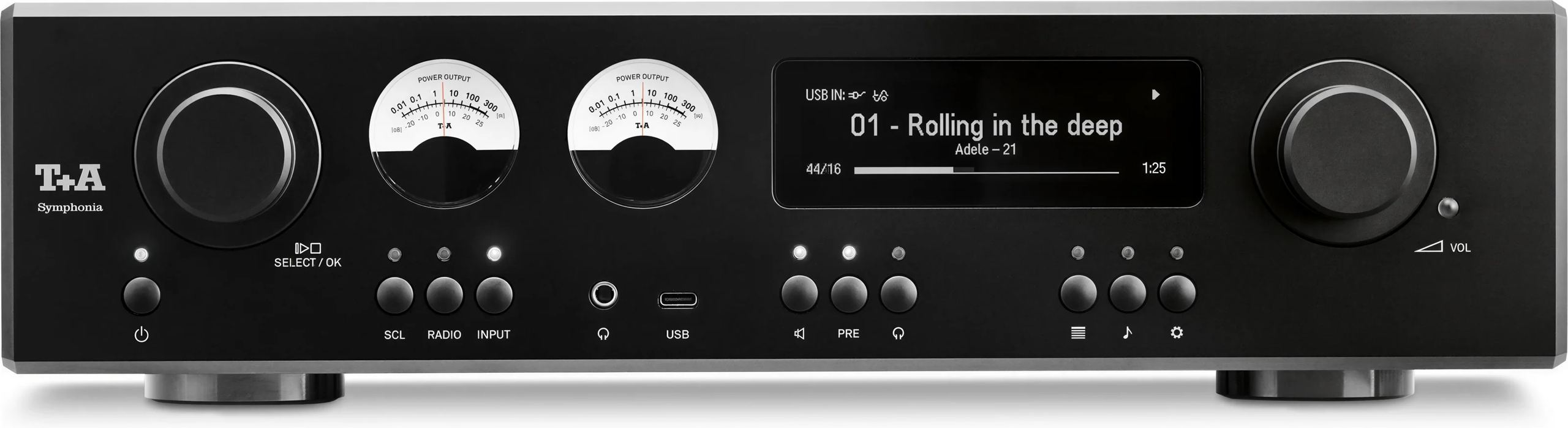
A network player, a converter and a stereo amplifier fit here into a single enclosure measuring 38 cm wide. T+A, a manufacturer based in Herford for nearly fifty years, has given them the look of its 1980s electronics: a beveled aluminum front panel, needle VU meters and just a few controls. Beneath this retro design lies the technology from its R and 200 series, brought together in a 6.2 kg chassis.
A front panel inspired by the 1980s
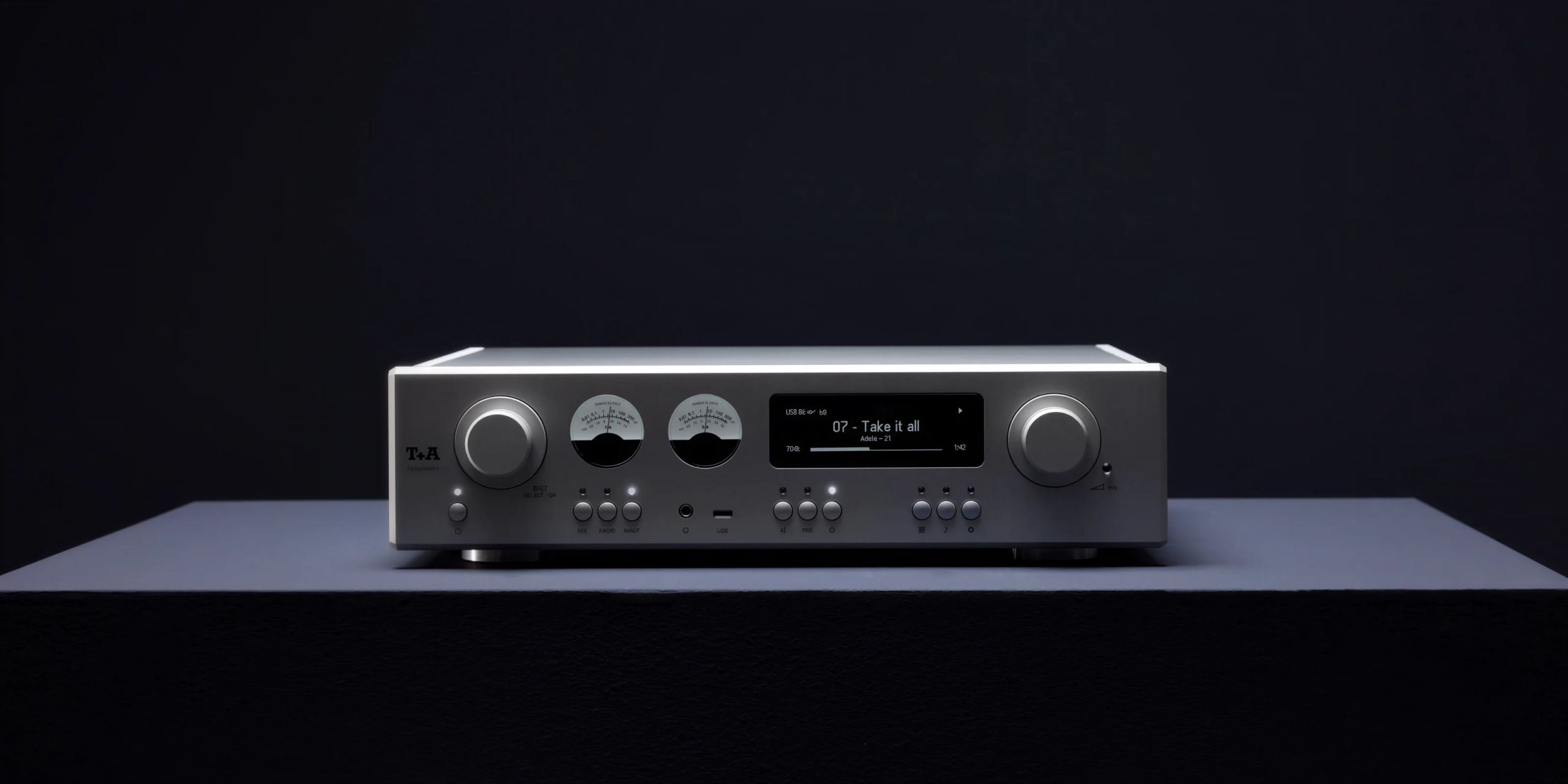
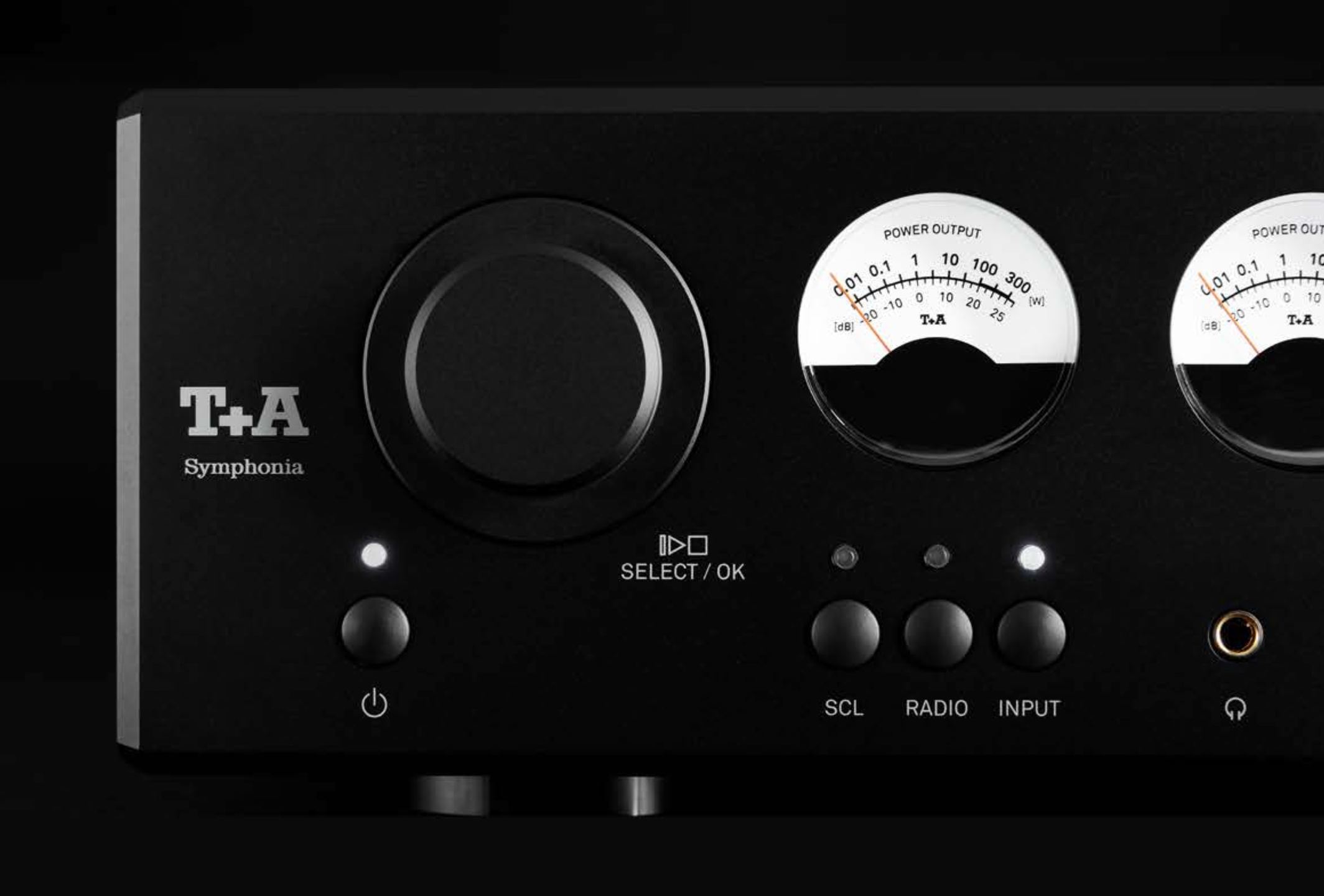
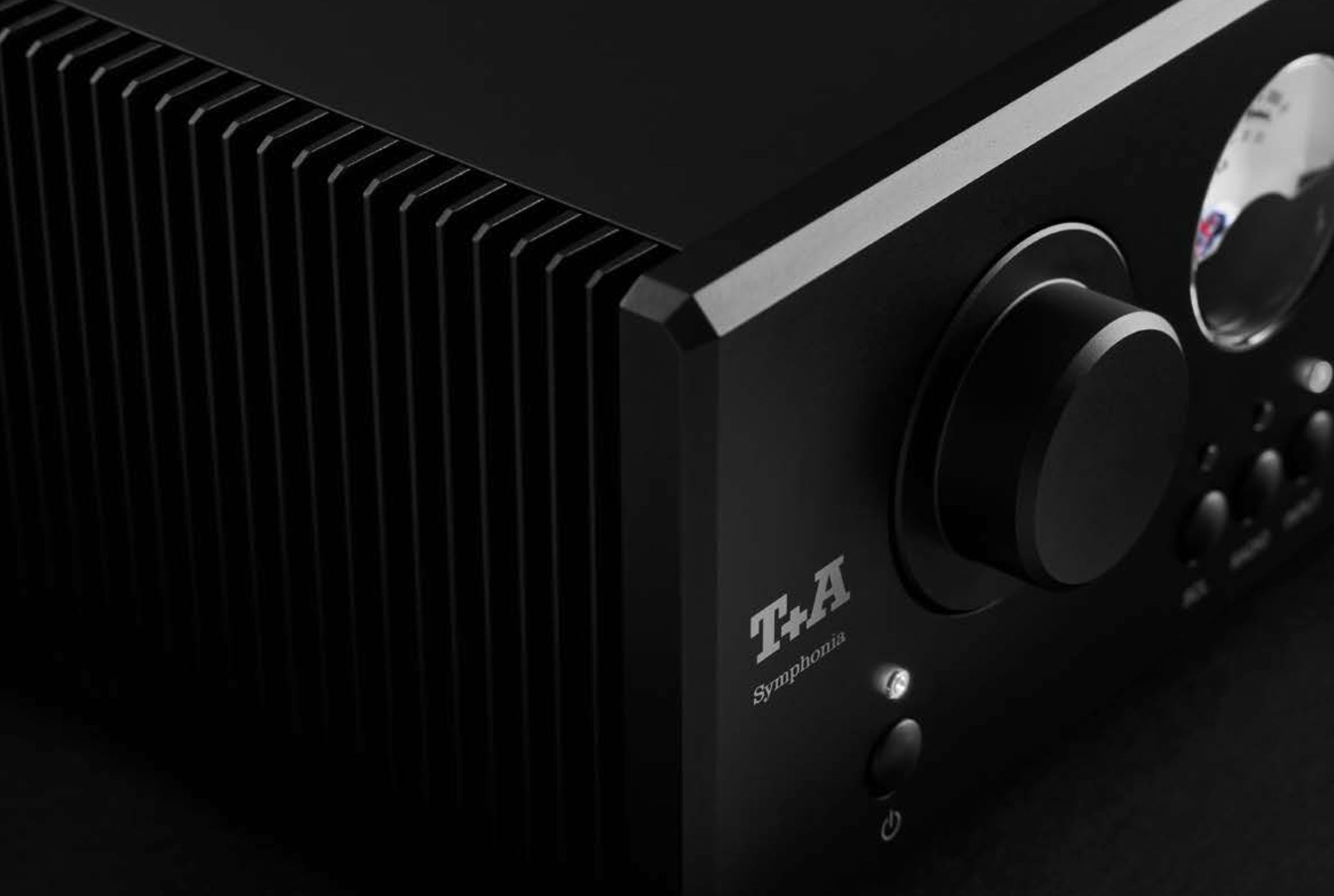
The Symphonia’s proportions echo those of the first series of T+A electronics, and its front panel borrows its lines from the R series, the brand’s longest-running range. The two hand-assembled analog VU meters display the average power delivered on each channel, with scales in watts and decibels. Their backlighting, like the color of the indicator lights, can be adjusted in the menus if the default white does not suit the room.
The front panel layout follows a simple logic. The left rotary knob is used to navigate and confirm, the right adjusts the volume in 1.5 dB increments, and between them, the buttons are grouped by function: selection of the source category (streaming, radio, inputs), activation of the outputs (speakers, preamp, headphones), then access to favorites, tone controls and settings. The central screen displays the current track title, with no provision for cover art, and can stay on, turn off after each operation or remain off. The SRC 2 remote control is included, and the T+A MusicNavigator G3 app (iOS and Android) provides all functions from a phone or tablet. Two finishes are available, silver or black anodized aluminum.
One converter for PCM, another for DSD
Most electronics entrust the two main families of digital files to a single chip. T+A separates the signal paths. PCM files (the format used by CDs, Qobuz or Tidal) pass through a double-differential converter that combines two 32-bit sigma-delta chips per channel; configured in opposition, they allow their common noise to be subtracted at the output. The signal is processed at 705.6 or 768 kHz after upsampling handled by an in-house processor.
This upsampling offers four filters with distinct characteristics: the long FIR prioritizes a perfectly linear frequency response, the short FIR handles transients better, the Bézier/IIR approximates the behavior of an analog circuit and the pure Bézier favors faithful rhythm and dynamics. Two NOS modes disable all processing, useful when computer software already handles upsampling.
DSD files, meanwhile, go to T+A’s True-1Bit converter, which reads them as they are, without intermediate conversion to PCM, up to DSD512. Two listening modes are available: the first uses sixteen conversion stages operating at 49.2 MHz, while the second splits the stream between two chains of eight stages running at half that frequency, for an even lower distortion rate. At the output, a linear-phase analog Bessel filter cuts off at 60 or 120 kHz. The wide setting is suitable when only the internal amplifiers are used; the normal setting protects a device connected to the preamp output that would not cope with ultrasonic frequencies.

Purifi amplification tuned in Herford
The power stage is based on Purifi Eigentakt modules, a Danish-designed class D technology that T+A calibrates itself. The Symphonia delivers 2 × 125 W into 8 Ω and 2 × 250 W into 4 Ω: power doubles when the speaker impedance is halved, a sign of a power supply that keeps up with current demand. The damping factor exceeds 800, a high value that reflects the amplifier’s ability to firmly control the speaker driver’s cone and stop unwanted movement in the bass. Class D efficiency also explains the unit’s modest weight relative to its power.
The Intelligent Safe Control system monitors operating parameters several times per second. In the event of overheating, a short circuit in the speaker cables or a power supply overload, it cuts the output and displays the cause on the screen. Each channel has only one pair of binding posts, ruling out direct bi-wiring from the amplifier.
Streaming and radio without an additional box
The network section runs on the ASA G3 platform, the third generation of streaming developed by T+A. Qobuz, Tidal, Deezer, Amazon Music and Highresaudio are integrated and can be browsed from the screen or app, while Spotify Connect, Tidal Connect, Qobuz Connect and AirPlay let the service’s app control playback. The Symphonia is recognized by Roon and Audirvana, and plays libraries stored on a UPnP or DLNA NAS. Resolution reaches 384 kHz for PCM and DSD256 for network playback.
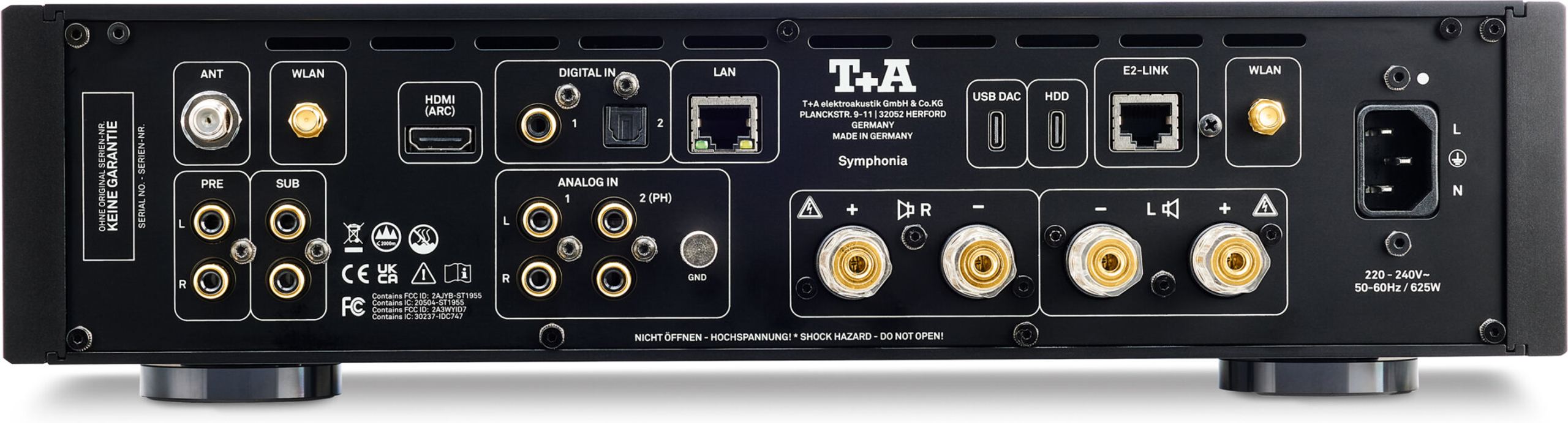
Connection is via Ethernet or dual-band Wi-Fi 6, with two included antennas that screw onto the rear. The wired port is capped at 100 Mbit/s, a limit with no practical impact: a 384 kHz/24-bit stereo stream uses less than 20 Mbit/s. For radio, the tuner receives FM with RDS, DAB+ and thousands of Internet stations via the airable service, which also provides podcasts. Each radio source retains its own preset list, and two buttons on the remote control store the most frequently used sources.
Connecting analog and digital sources
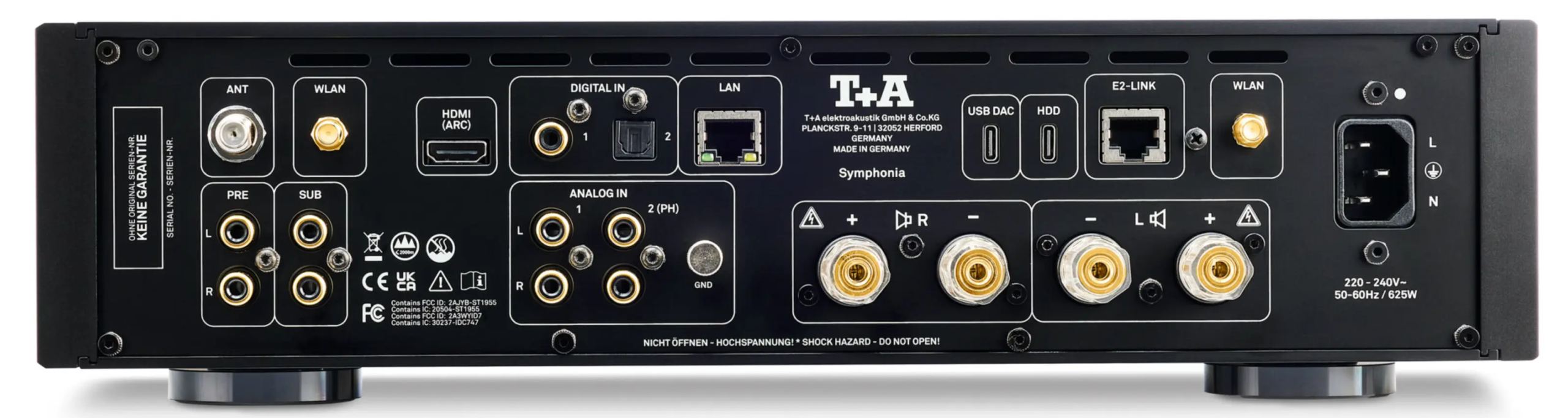
A turntable connects to the second RCA input, whose built-in phono preamp accepts moving-magnet cartridges (MM) and high-output moving-coil cartridges. A low-output MC cartridge will require a transformer or an external preamp. Together with the adjacent line input, the Symphonia has two analog inputs in total, with no XLR socket, and a “passthrough” mode fixes their level to integrate the unit into a home theater system.
The TV connects via HDMI ARC. Audio arrives as stereo PCM at up to 192 kHz; Dolby, DTS and multichannel streams are not decoded, so the TV’s audio output must be set to PCM. The coaxial and optical inputs accept PCM from 32 to 192 kHz and DSD64. The USB-C input in converter mode connects a computer using asynchronous transfer, at up to 768 kHz for PCM. Two USB-C ports, on the front and rear, read flash drives and hard drives.
Bluetooth works in both directions, using aptX HD, AAC or SBC: it receives music from a phone or sends it to wireless headphones. The two uses cannot operate simultaneously, and when transmitting, volume is adjusted on the headphones, not the amplifier.
Balanced headphone output and subwoofer expansion
The front headphone output uses a balanced 4.4 mm Pentaconn socket, with an output impedance of 6 Ω and compatibility from 16 Ω upward. An adapter to a 6.35 mm jack is listed in the T+A accessories catalog. Speakers, headphones and the preamp output can be activated independently from the front panel, avoiding the need to unplug anything when switching between them.
At the rear, a subwoofer output filtered at 240 Hz and a variable-level preamp output allow the system to be expanded with an active subwoofer, powered speakers or a power amplifier. The E2-Link connection links the T+A G 2000 R turntable for coordinated operation of the two units. The tone controls (bass and treble from −6 to +8 dB, bypassable), balance, phase inversion and adjustable loudness adapt the sound to the speakers and the room.
Technical specifications
Overview and controls
- Device type: connected stereo integrated amplifier combining an amplifier, a digital-to-analog converter and a network player
- Protection: Intelligent Safe Control (ISC) system, monitoring operating parameters several times per second
- Front panel: beveled aluminum, 2 hand-assembled analog VU meters, central display
- Front panel controls: rotary selector, volume knob, power / standby, SCL, radio, input, mute, preamplifier, headphones, menu, music, settings buttons
- Finishes: silver anodized aluminum, black anodized aluminum
Power amplifier
- Amplification: PURIFI Eigentakt modules calibrated by T+A
- RMS power per channel:
- 2 × 125 W into 8 Ω
- 2 × 250 W into 4 Ω
- Frequency response (+0 / −3 dB): 1 Hz to 60 kHz
- Damping factor: greater than 800
Preamplifier
- Frequency response (+0 / −3 dB): 0.5 Hz to 300 kHz
- Signal-to-noise ratio: 105 / 109 dB
- Harmonic distortion: less than 0.002%
- Intermodulation distortion: less than 0.002%
- Channel separation: greater than 90 dB
Digital-to-analog converter
- PCM conversion: T+A double-differential converter
- 2 32-bit sigma-delta chips per channel
- Conversion at 705.6 / 768 kHz
- DSD conversion: T+A True-1Bit converter
- Native DSD playback without PCM conversion
- Up to DSD512 (22.4 / 24.5 MHz)
- Oversampling: T+A processor, synchronous processing
- 4 selectable filters: short FIR, long FIR, Bézier / IIR, Bézier
- NOS mode without oversampling
- Analog output filter: 3rd-order linear-phase Bessel filter, cutoff frequency switchable to 60 or 120 kHz
- PCM frequency response: 2 Hz to 20 kHz (44.1 kHz), 22 kHz (48 kHz), 40 kHz (96 kHz), 80 kHz (192 kHz), 100 kHz (384 kHz), 120 kHz (768 kHz)
- DSD frequency response: 2 Hz to 44 kHz (DSD64), 60 kHz (DSD128), 80 kHz (DSD256), 100 kHz (DSD512)
Audio and video connections
- Analog inputs:
- 1 RCA line input: sensitivity of 250 mV to 4 V / 24 kΩ
- 1 switchable line / phono RCA input with ground terminal: sensitivity of 250 mV to 4 V / 47 kΩ for line, 5 mV for phono
- S/PDIF digital inputs: 1 coaxial, 1 optical Toslink
- Sampling rates: 32 to 192 kHz
- Resolution: 16 to 24 bits
- DSD64 over DoP
- USB input for the digital-to-analog converter: 1 USB-C, asynchronous transfer
- PCM up to 768 kHz
- DSD256 over DoP
- Native DSD512 with driver on Windows or Linux kernel 4.4 and later
- HDMI: 1 HDMI ARC for TV or console
- USB storage ports: 2 USB 2.0, including 1 on the front panel and 1 at the rear for a hard drive
- Preamplifier output: 1 RCA
- Nominal level: 1 V
- Maximum level: 9.5 V / 47 Ω
- Subwoofer output: 1 RCA
- Nominal level: 1.6 V
- Maximum level: 9.5 V / 47 Ω
- Low-pass filter at 240 Hz
- Headphone output: 4.4 mm balanced Pentaconn jack
- Output impedance: 6 Ω
- Speaker outputs: 1 pair of binding posts per channel
- Radio antenna socket: 1 FM / DAB socket
Network playback and streaming services
- Streaming platform: ASA G3, 3rd-generation audiophile streaming architecture
- Network connections:
- Ethernet 10/100
- Dual-band Wi-Fi 6 (802.11 a/b/g/n/ac/ax), 2.4 and 5 GHz
- Integrated services: Tidal, Qobuz, Deezer, Amazon Music HD, Highresaudio, airable radio stations and podcasts
- Connect and streaming services: Tidal Connect, Spotify Connect, Apple AirPlay
- Software compatibility: Roon, Audirvana
- Media servers: UPnP 1.1, UPnP AV, DLNA, Windows Media Connect
- Supported formats: MP3, AAC, OGG Vorbis, FLAC, WAV, AIFF, ALAC, DFF, DSF
- Network playback resolution:
- PCM: 32 to 384 kHz / 16 to 24 bits
- DSD: DSD64, DSD128, DSD256
- Features: automatic network configuration, automatically updated Internet radio database
Bluetooth
- Profiles: A2DP, AVRCP 1.4
- Codecs: aptX HD, AAC, SBC
Radio receiver
- Digital radio: DAB, DAB+
- Band III: 168 to 240 MHz
- Sensitivity: 2.5 µV
- FM radio: 87.5 to 108 MHz
- RDS: station name, radio text
- Sensitivity: 0.9 µV in mono, 40 µV in stereo
- Stereo separation: 50 dB
Included accessories
- Power cord, SRC 2 remote control, 2 Wi-Fi antennas, FM antenna
Power supply and consumption
- Power connector: IEC mains inlet
- Power supply: 220–240 V, 50–60 Hz
- Maximum power consumption: 800 W
- Standby power consumption: less than 0.5 W
Dimensions and weight
- Dimensions (W × D × H): 380 × 340 × 100 mm
- Weight: 6.2 kg
Frequently Asked Questions
Do you need a subscription to listen to Qobuz, Tidal or Deezer on the Symphonia?
Yes, each streaming service requires an account and, in most cases, a paid subscription with the provider. Authentication takes place in the T+A MusicNavigator G3 app via the secure OAuth protocol, without entering a password on the device. Internet radio, FM, DAB+ and playback from a NAS or USB drive remain free.
Can the Symphonia turn on and off with the TV?
Yes, via the HDMI-CEC function, which can be set to three levels: disabled, volume only (the TV remote adjusts the volume and the Symphonia switches to the HDMI input), or power on/off and volume. The latter mode requires using comfort standby rather than ECO standby. The behavior also depends on how each TV manufacturer implements the CEC standard.
What is the difference between ECO standby and comfort standby?
In ECO standby, power consumption remains below 0.5 W and the device automatically enters standby after 90 minutes without a signal or user input, but it can only be woken using its front panel or the remote control. Comfort standby consumes slightly more power and allows the device to be switched on from the app, as well as enabling CEC functions.
Can DSD512 be played from a Mac through the USB input?
No. macOS only transmits DSD in DoP format, which limits playback to DSD256. Native DSD512 requires a Windows PC with the T+A driver, downloadable from the brand’s website, or a Linux computer with kernel 4.4 or later. On macOS and Linux, no driver is required for the other formats.
Will an external hard drive without a power supply work on USB ports?
Yes, as long as its power consumption stays within the USB standard, meaning a maximum of 1.5 A: standard 2.5-inch drives connect directly. A more power-hungry model will require its own power supply. The drive can be formatted as FAT16, FAT32, exFAT, NTFS, ext2, ext3 or ext4.
What precautions should be taken when installing the Symphonia in a cabinet?
Leave 10 cm of clearance all around the unit for heat dissipation and do not block the vents. If stacked with other components, the Symphonia must be placed on top, with nothing placed on its cover. The operating temperature range is 10 to 35 °C.
How are software updates performed?
Via the Internet, from the Device Information menu on the screen, the remote control or the app. The process takes a few minutes depending on the connection, then the device restarts automatically. A check is recommended when first connecting to the network, and it is best to update the other T+A devices in the system at the same time.
- Eco-contribution included in the sale price.