T+A A 3100 HV silver


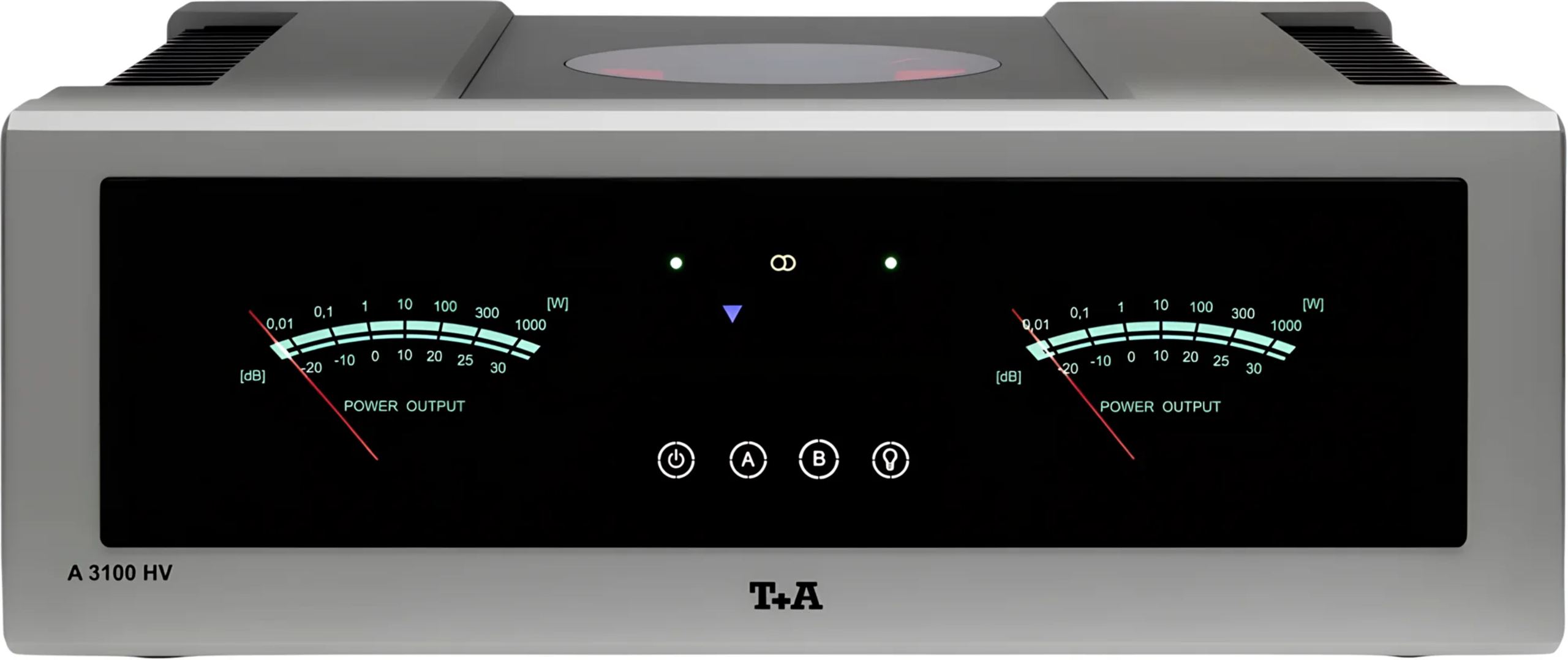
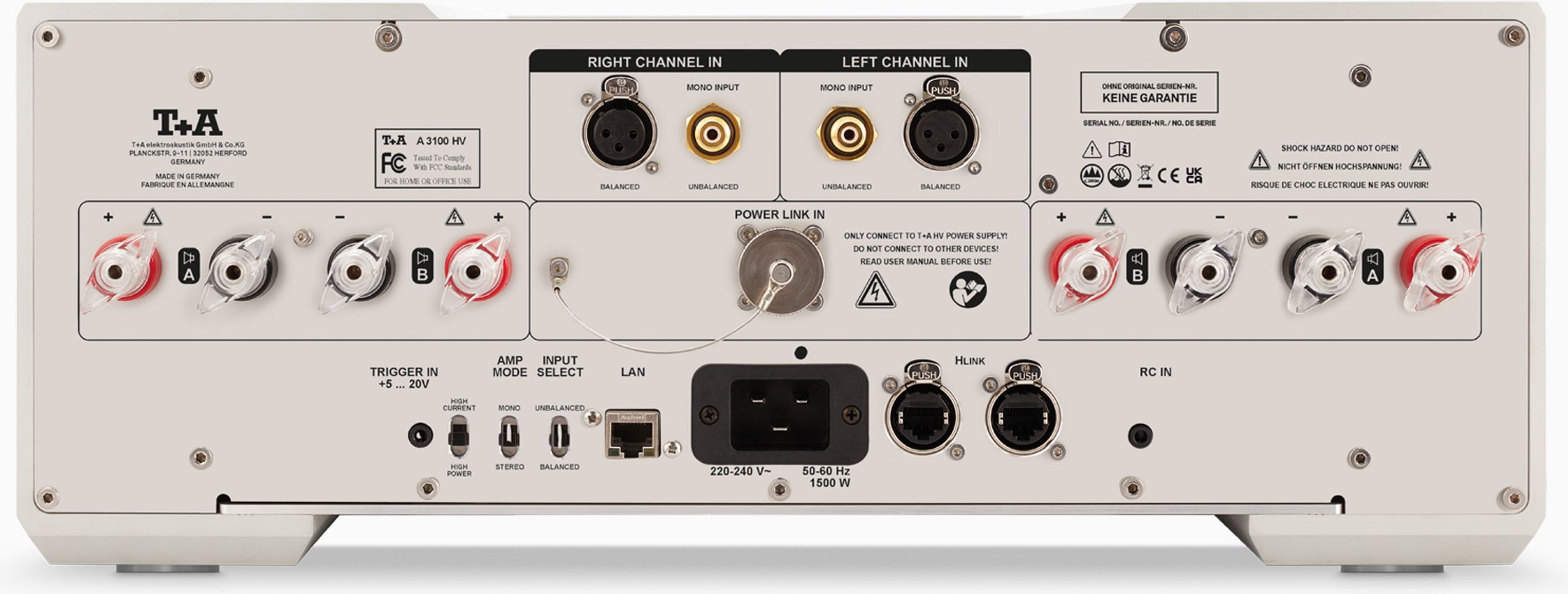
T+A A 3100 HV, stereo power amplifier from the HV series
Ten years separate this power amplifier from the A 3000 HV it replaces at the top of T+A’s HV series. The 38 kg aluminium enclosure retains its two needle VU meters and understated appearance, but the electronics have undergone more than 270 revisions. The most telling new feature is a rear-panel switch: depending on the speakers, the unit delivers up to 500 W per channel or stays in pure Class A up to 75 W.
The HV series updated, ten years after the A 3000 HV
The series takes its name from a principle that the A 3100 HV retains: amplification is handled by two separate stages. A voltage stage, powered at high voltage (HV stands for High Voltage), shapes the signal on its own, then a current stage supplies the current the speaker drivers need without affecting the amplitude. The first combines a cross-coupled cascode differential amplifier with a single-ended Class A large-signal stage; the second, fully symmetrical, uses MOSFET drivers and bipolar output transistors. The two channels remain separate right through to the connections, arranged as mirror images on either side of the chassis centreline (dual-mono construction).
The revisions focus on the behaviour of the output stages and the power supply. The quiescent current, which flows continuously through the output transistors even when no music is playing, has been tripled, keeping the amplifier in Class A over a wider power range. As this operating point varies with temperature, thermal tracking diodes and redesigned circuit boards stabilise the system once it is warm. The transformer, filter capacitors and internal partitioning are new, and High Current mode, previously reserved for the brand’s monoblocks, now appears on a stereo amplifier. Rated power remains unchanged: 2 × 300 W into 8 Ω and 2 × 500 W into 4 Ω, as on the A 3000 HV.
Two operating modes to suit the speakers
In the High Power position, the output stages receive their highest supply voltage. The A 3100 HV then operates in Class AB at its maximum power ratings, with peak output of up to 380 W and 700 W per channel into 8 and 4 Ω, enough to drive low-sensitivity speakers in a large room or maintain high listening levels.
In the High Current position, the voltage is lowered and the quiescent current pushed to its maximum. The amplifier remains in pure Class A up to around 75 W, then switches to Class AB up to around 140 W. In Class A, the output transistors conduct continuously and never hand over between the positive and negative halves of the signal, eliminating the crossover distortion inherent to Class AB; the trade-off is lower efficiency and more heat. This mode suits high-efficiency speakers, listening at reasonable levels and speakers whose impedance drops below 2.5 Ω, which primarily require current. If the clipping indicator lights up red at high volume, switching back to High Power restores headroom.
The mode is changed with the unit switched off, and a front-panel icon indicates High Current operation. With two A 3100 HV units, in mono or bi-amplification, both units must be set to the same mode.
An oversized power supply isolated from the signal
Power comes from a completely redesigned 1,000 W toroidal transformer, hermetically sealed and magnetically shielded: its stray fields are contained at the source and do not reach the audio circuits. It feeds twelve filter capacitors with a total capacitance of 120,000 µF, chosen for their low equivalent series resistance (ESR). The lower this internal resistance, the faster the capacitors release their energy on a sudden attack, a bass drum hit or an orchestral tutti.
Inside, a 10 mm-thick solid aluminium partition separates the power circuit, which carries high currents, from the voltage amplification stage. The enclosure, milled from aluminium, uses only non-magnetic metals and shields against external interference. It is available in a silver or titanium finish.
In High Power mode, the external PS 3100 HV power supply can supplement the system via the Power Link socket. The internal power supply continues to serve the signal and driver stages, while the PS 3100 HV handles the high currents of the output stages, limiting interactions between the two. It remains inactive in High Current mode, for which the built-in power supply is sufficient. The Power Link socket also accepts the previous-generation PS 3000 HV, and a front-panel icon confirms the presence of the external power supply.
Parallel mono rather than bridged operation
Two A 3100 HV units can operate as monoblocks, one per speaker. The usual method, bridging, runs the two channels in opposite phase with the speaker connected between them: each channel then sees half the actual impedance, placing heavy demands on the output stages. Here, the outputs of the two channels are connected in parallel. They reproduce the same signal and combine their current, the load seen by each remains unchanged and the current capacity doubles.
The power increase remains modest into 8 Ω (380 W versus 300 W in stereo), since the available voltage does not change; it becomes significant into 4 Ω, with 650 W and 800 W peak. Mono therefore mainly benefits current-hungry speakers or those with an uneven impedance curve, rather than serving a race for watts.
Switching to mono is done using the AMP MODE switch, followed by powering off for around thirty seconds. The signal then enters through the left socket, via RCA or XLR, and both VU meters display the same value. Two units in stereo also allow passive bi-amplification: the speakers’ bass and midrange/treble sections each receive their own channel, once the jumpers have been removed.
VU meters, binding posts and home automation control
The touch-sensitive buttons are limited to power, speaker outputs A and B, and lighting. The VU meters indicate the average power delivered. Their scale switches to 1:10 with a long press on button B (a reading of 100 W then corresponds to an actual 10 W), useful at moderate volume when the needles barely move, and returns to 1:1 with a long press on A; their lighting can be adjusted through seven levels down to off. A row of icons provides information on the unit’s status: clipping, operating mode, active RCA input, external power supply, output stage temperature and protection activation.
The two pairs of rhodium-plated brass binding posts are used for bi-wiring (bass on A, midrange/treble on B) or to drive two pairs of speakers in two rooms. Input is via RCA or balanced XLR, selected using a switch. For control, the H LINK socket connects the amplifier to a T+A preamplifier such as the P 3100 HV or the SDX 3100 HV, which switches it on and into standby; the 5 to 20 V trigger input does the same with other brands, and the RC IN input accepts the optional E2000 infrared receiver. The Ethernet port is used for diagnostics and integration into a Crestron or AMX home automation system.
Documentation
Technical specifications
Overview and architecture
- Model: T+A A 3100 HV
- Device type: stereo power amplifier, HV series
- Dual-mono construction: left and right channels separated right through to the connections, symmetrical layout
- HV technology: separate voltage and current amplification stages, precision thermal stabilization
- Enclosure: non-magnetic metals
- Manufacture: Germany
- Protection: short circuits, overheating, overload
Operating modes and power
- Switch-selectable modes: maximum power (High Power), maximum current with extended Class A (High Current)
- High Power mode:
- RMS power per channel: 2 × 300 W into 8 Ω, 2 × 500 W into 4 Ω
- Peak power per channel: 2 × 380 W into 8 Ω, 2 × 700 W into 4 Ω
- RMS power in mono: 380 W into 8 Ω, 650 W into 4 Ω
- Peak power in mono: 430 W into 8 Ω, 800 W into 4 Ω
- High Current mode:
- Principle: reduced supply voltage, maximum quiescent current
- Class A: up to 75 W
- Class AB: up to 140 W
- Recommended uses: high-efficiency speakers, listening at moderate levels, very low-impedance speakers (less than 2.5 Ω)
- Mono operation: outputs of both channels connected in parallel, not bridged, with two A 3100 HV units required for a stereo setup
- Bi-amplification: possible with two A 3100 HV units
Audio performance
- Frequency response (+0 / -3 dB): 0.5 Hz to 180 kHz
- Power bandwidth: 1 Hz to 150 kHz
- Distortion: less than 0.03%
- Slew rate: 60 V/µs
- Damping factor: greater than 65 into 4 Ω
- Signal / noise ratio: greater than 115 dB
- Input sensitivity for 25 V output: 600 mV via RCA, 1200 mV via XLR
- Input impedance: 25 kΩ via RCA, 50 kΩ via XLR
- Gain: 32.4 dB via RCA, 26.5 dB via XLR
- Speaker impedance: 4 Ω minimum according to the DIN standard, minimum permitted load of 2 Ω
Controls and display
- Front-panel touch-sensitive buttons: on / standby, speaker output A, speaker output B, illumination
- Power indicators:
- 2 meters indicating the average level
- Switchable scale: 1:1 or 1:10
- Illumination adjustable through 7 levels down to off
- Indicators: clipping, High Current mode, stereo, output stage temperature, RCA input, PS 3100 HV power supply connected, protection
- Rear switches: stereo / mono, RCA / XLR input, High Current / High Power
Connections and integration
- Audio inputs: 1 RCA pair, 1 balanced XLR pair, switch selection
- Speaker outputs: 2 pairs of rhodium-plated binding posts (A and B), for bi-wiring or two listening zones
- Control:
- Trigger input via 3.5 mm jack: 5 to 20 V
- H LINK input
- RC IN input for optional T+A E2000 infrared receiver
- Network: Ethernet port for diagnostics and home automation, Crestron and AMX compatible
- Mains connection: IEC inlet
Power supply and consumption
- Internal power supply:
- Sealed, magnetically shielded toroidal transformer
- 12 filter capacitors with low equivalent series resistance (ESR)
- Total capacitance: 120000 µF
- External power supply: compatible with the optional T+A PS 3100 HV, connection via Power Link In socket, active only in High Power mode
- Mains supply: 220–240 V, 50/60 Hz
- Maximum power consumption: 1500 W
- Standby power consumption: less than 0.5 W
Included accessories
- Mains cable, H LINK cable, manual
Dimensions, weight and installation
- Dimensions (W × D × H): 460 × 460 × 170 mm
- Weight: 38 kg
- Recommended clearance: 20 cm on the sides, 40 cm above
Frequently Asked Questions
Do you need a preamplifier to use the A 3100 HV?
Yes. The amplifier has neither a volume control nor a source selector: it requires a line-level signal from a preamplifier, a network player with variable output level or a converter with a volume control. The supplied H LINK cable synchronizes power-on with a T+A preamplifier.
Is it better to connect via RCA or XLR?
With a preamplifier featuring balanced outputs, XLR is preferable. The gain differs between inputs, 32.4 dB for RCA versus 26.5 dB for XLR, to compensate for the level typically being twice as high with a balanced connection. Only one input is active at a time, depending on the position of the INPUT SELECT switch.
Which speakers can be connected?
The impedance must be at least 4 Ω according to the DIN standard, meaning an actual minimum above 3.2 Ω, and this rule applies to each speaker when two pairs are connected to outputs A and B. The output stages can handle a 2 Ω load, but prolonged listening at very high volume with such a low load may trigger thermal protection. Cables must have a cross-sectional area of at least 2.5 mm², preferably terminated with spade connectors.
How long should you wait after switching it on?
At power-up, the speaker output buttons flash while the stages reach their operating point, then the outputs return to the state they were in at power-off. An icon then indicates whether the output stages are still warming up or have reached their ideal temperature.
How do you install a device weighing 38 kg?
It requires two people to carry it and should be transported in its original packaging. At 460 × 460 × 170 mm, it requires a stable piece of furniture, ideally with a stone, glass or metal surface, with 20 cm of clearance on each side and 40 cm above. In a stack of equipment, it goes on top, with nothing placed on its cover.
What does it mean when the protection indicator lights up?
The circuit cuts off the output in the event of overheating, overload or a short circuit, and the A and B buttons start flashing. After overheating, the unit must remain switched off long enough to cool down. If the indicator remains on afterwards, lowering the volume resolves an overload; if the amplifier does not restart, a short circuit in the speaker cables is likely, often caused by an exposed wire strand touching the adjacent terminal.
- Eco-contribution included in the sale price.