

Leica Cine Play 1 Plus
Complementary product
Specifications and features


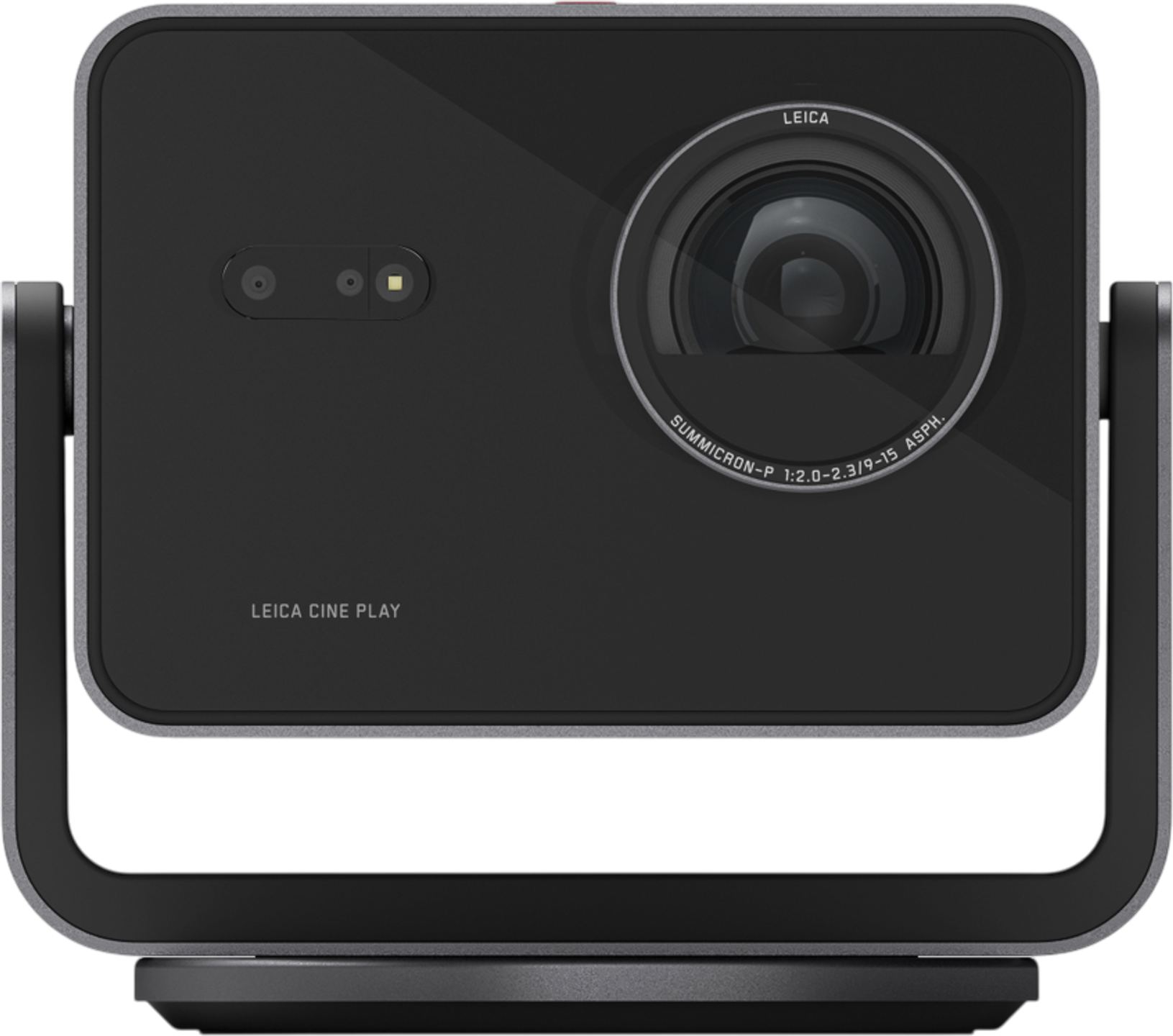
Leica Cine Play 1 Plus, compact 4K laser projector
Three red, green and blue lasers, a Summicron zoom lens and a 6.7 kg aluminium housing that fits into its own carrying case. The successor to the Cine Play 1 keeps the same form factor, but Leica claims 40% more light output, delivering 4,200 ANSI lumens in Ultra mode. This keeps the image watchable in a room that is not completely dark. It projects images up to 300 inches and provides access to streaming apps and AirPlay without any external box.
A block of aluminium that travels in its own case
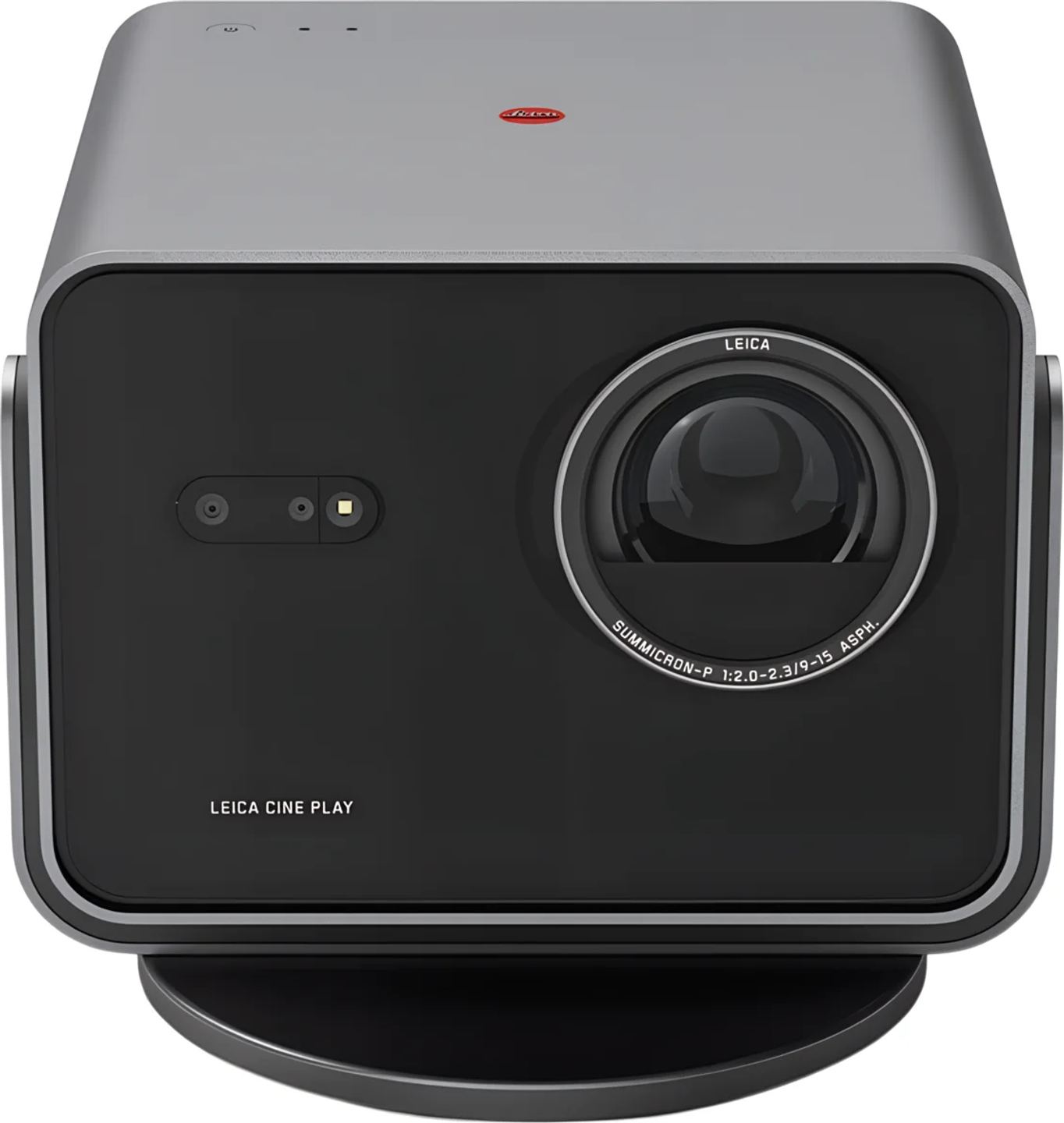
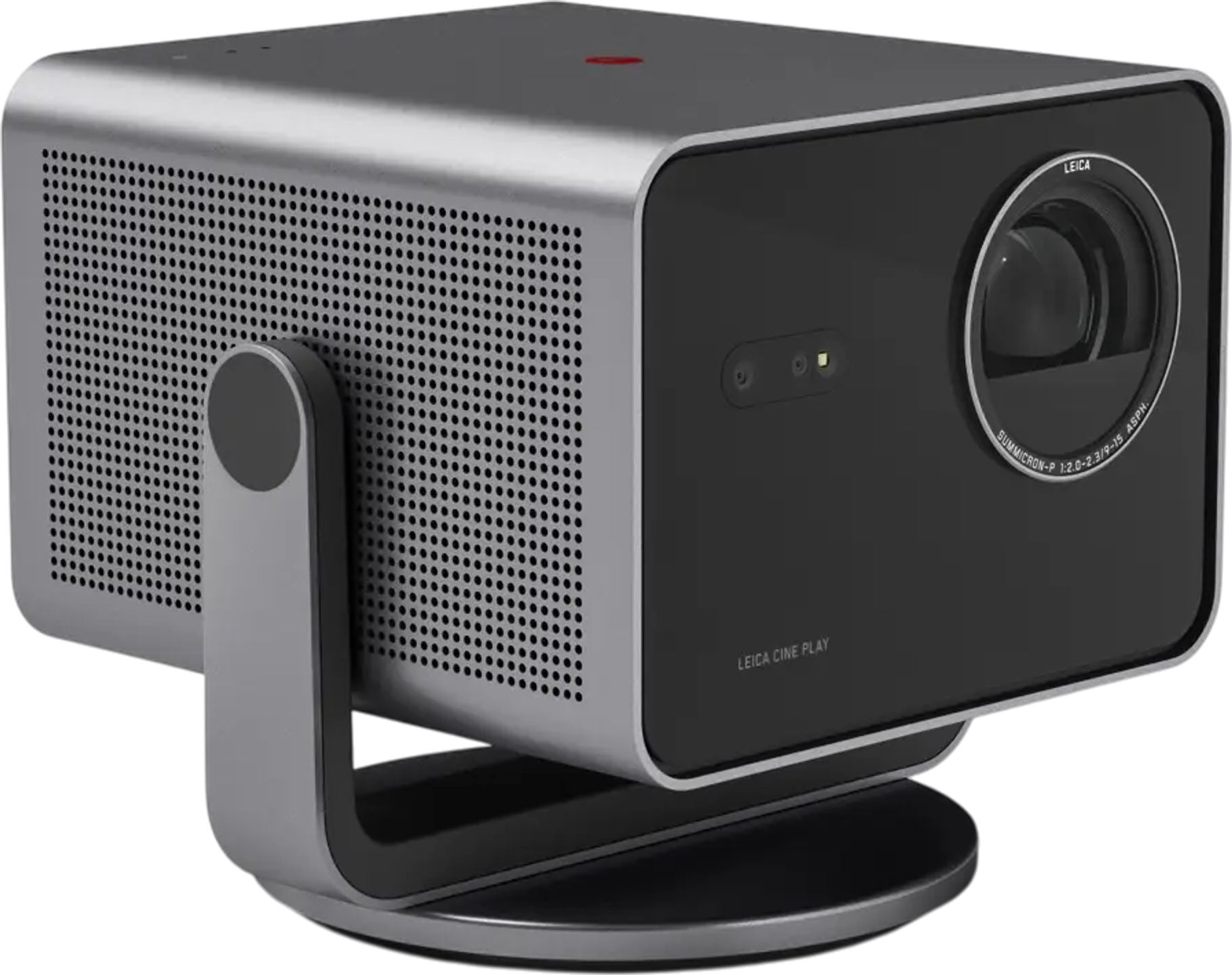
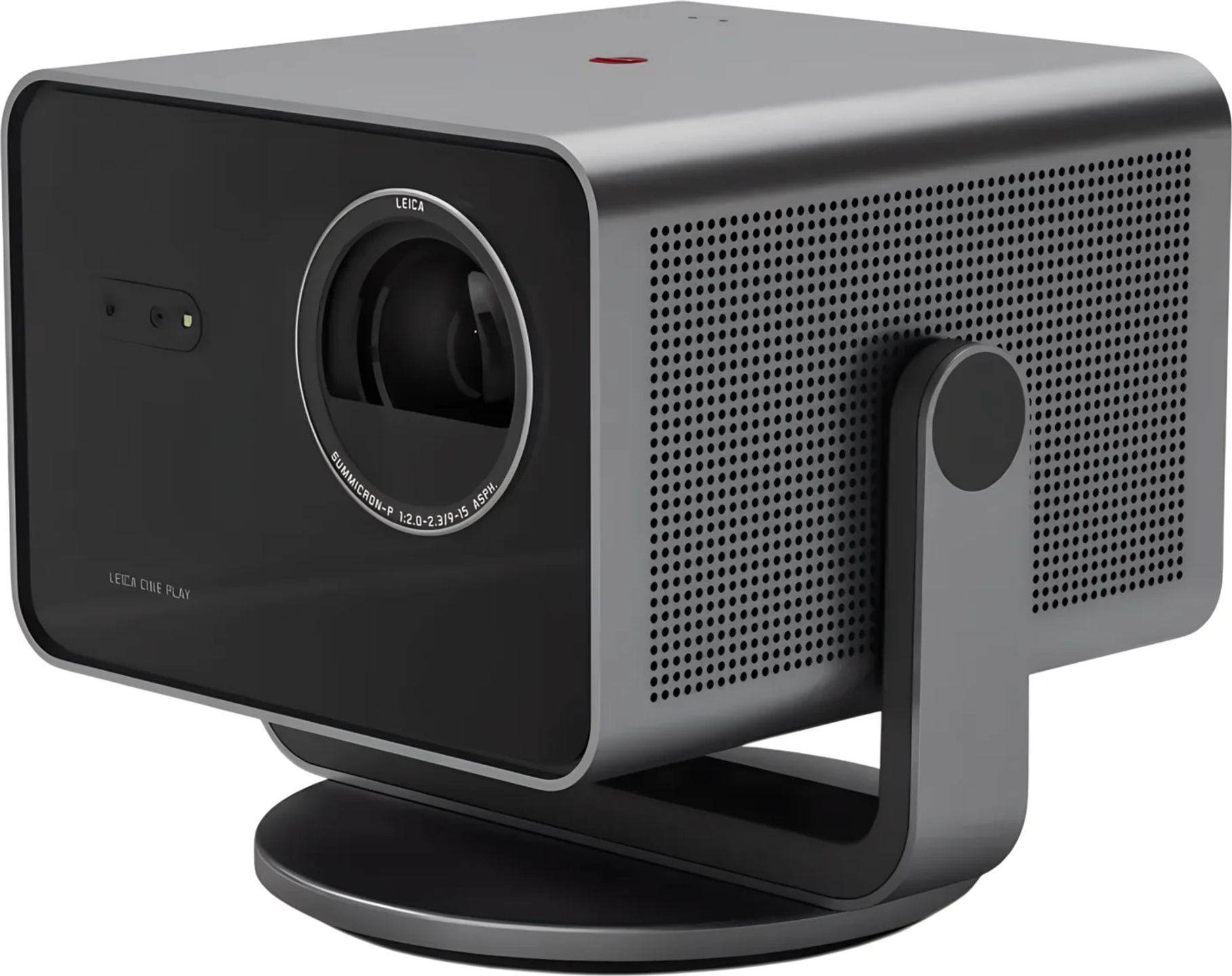
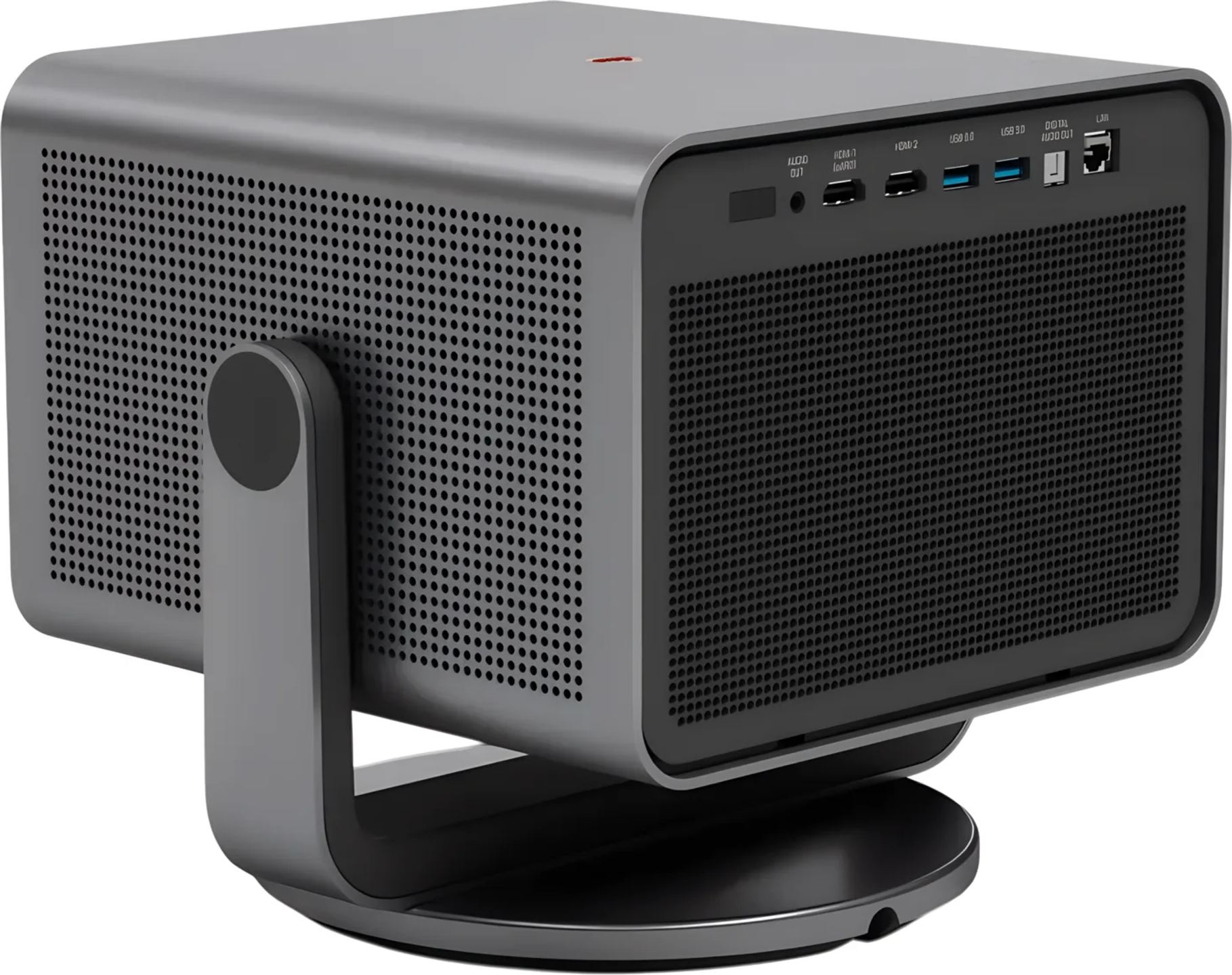
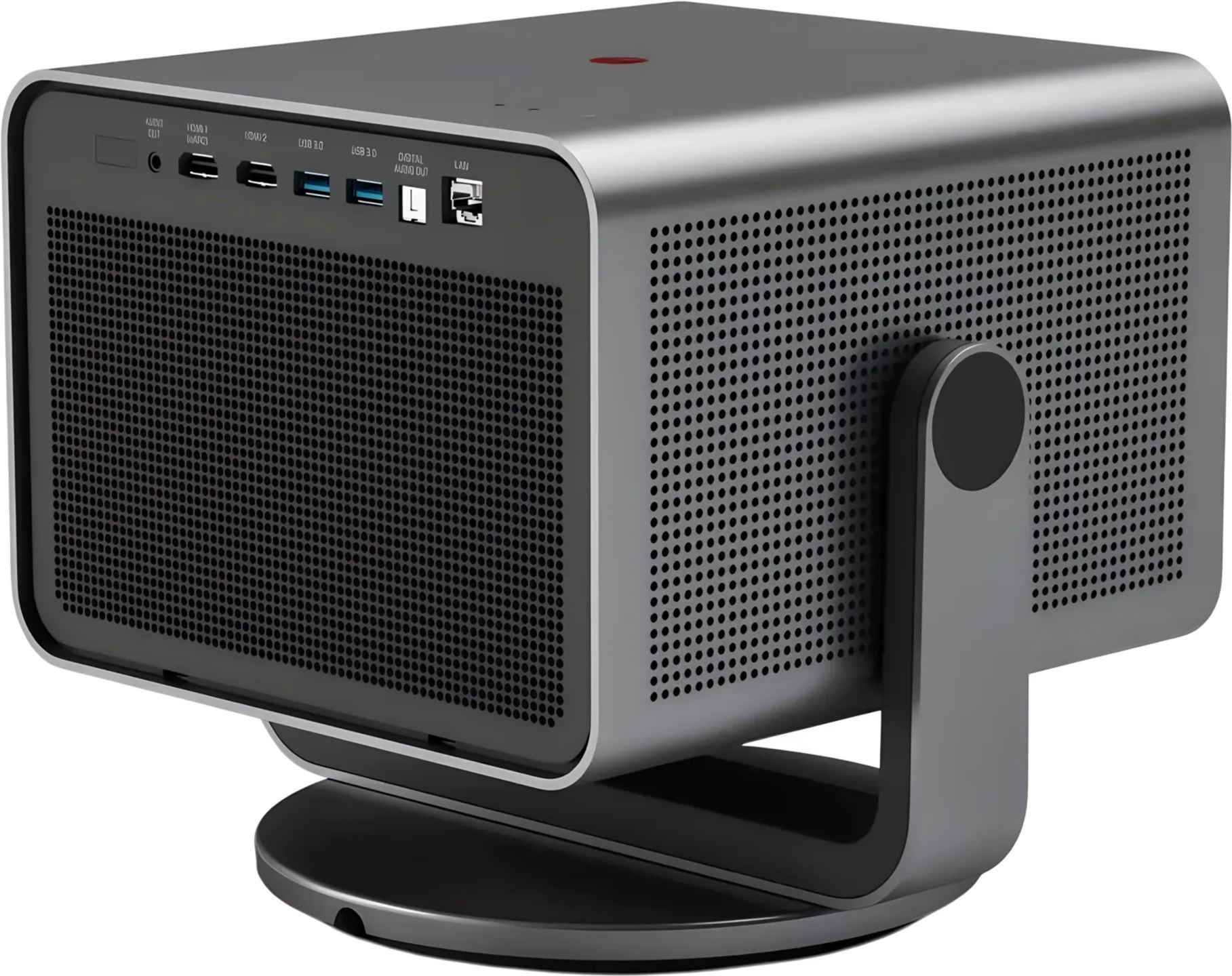
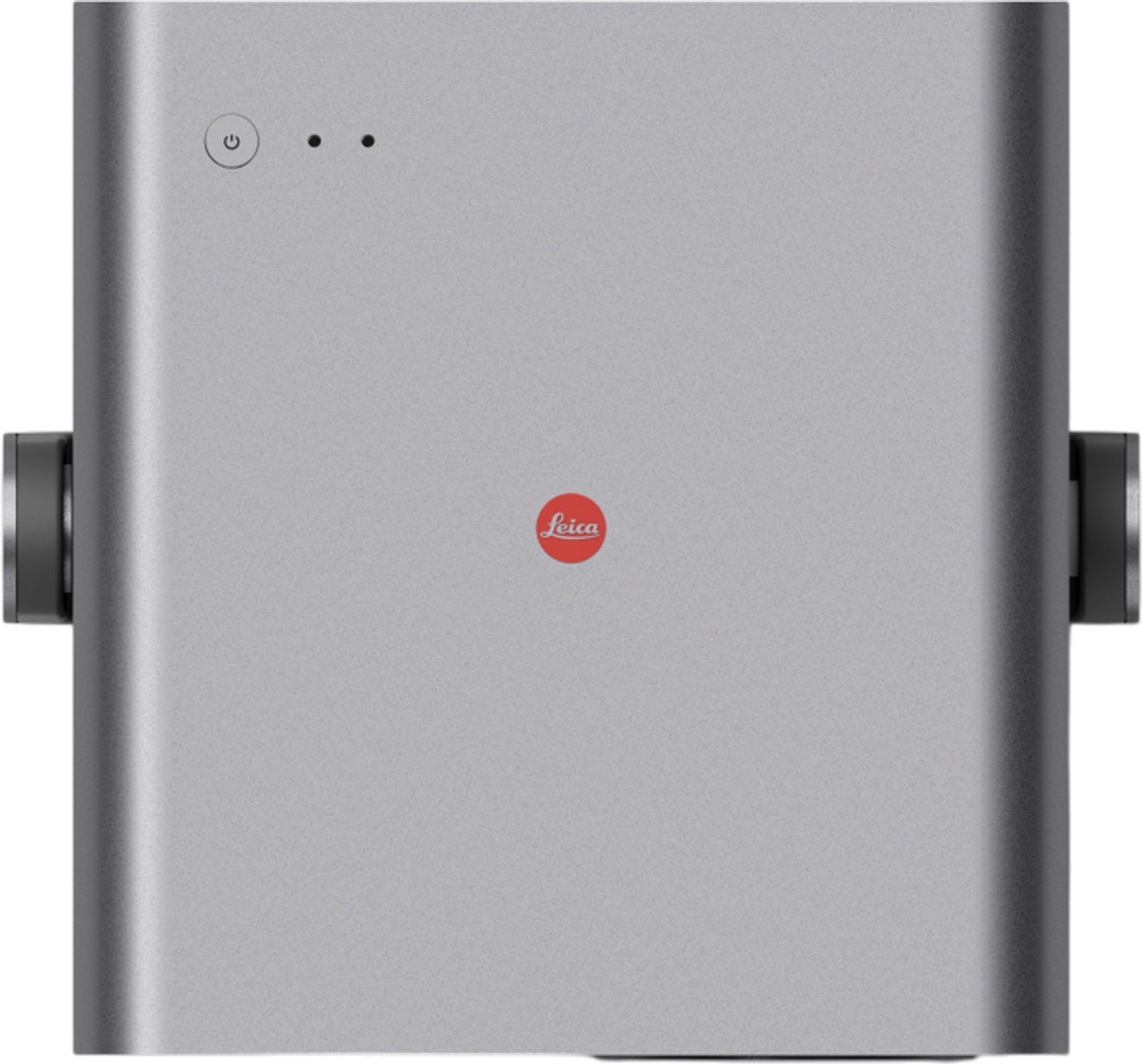
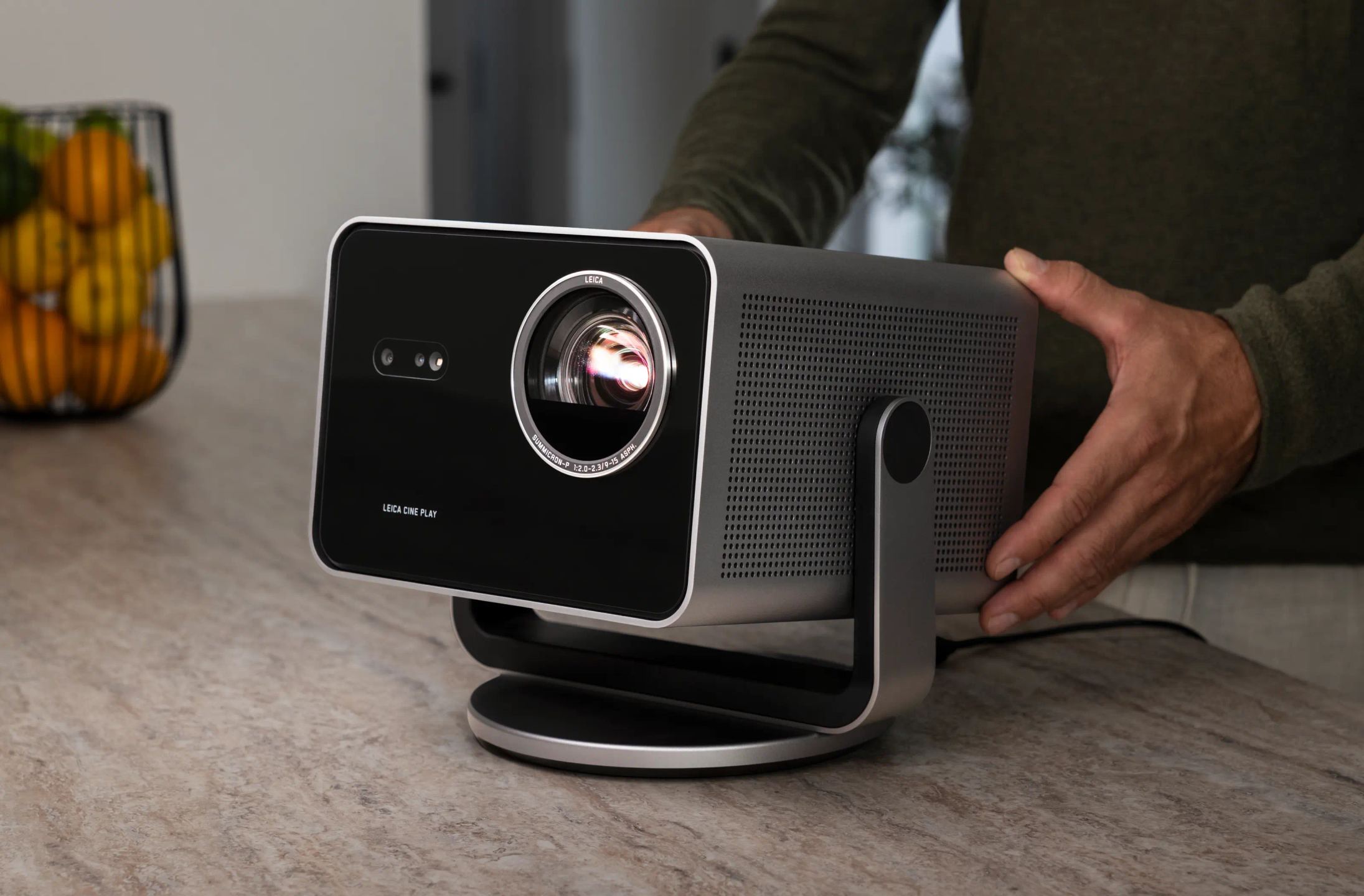
The housing is a single piece of machined aluminium with a metallic grey finish. It has a glass front and an aluminium rear panel that dissipates heat. The design reflects the geometric simplicity of the Bauhaus, a reference dear to the brand: clean shapes, no decoration and a lens centred on the front. Measuring 24.2 cm wide, 26.1 cm deep and 22.9 cm high, it fits on a coffee table, a shelf or the corner of a sideboard.
This Plus introduces a carrying case made from expanded polypropylene (EPP), a lightweight material that absorbs shocks and that Leica says is fully recyclable. It is included in the box. It is used for transport, from the bedroom to the living room or from the living room to the terrace, and protects the projector the rest of the time. The operating temperature range is 5 to 35°C, which covers a summer evening outdoors but rules out a garden shed in winter.
Three lasers and 4,200 lumens for the image
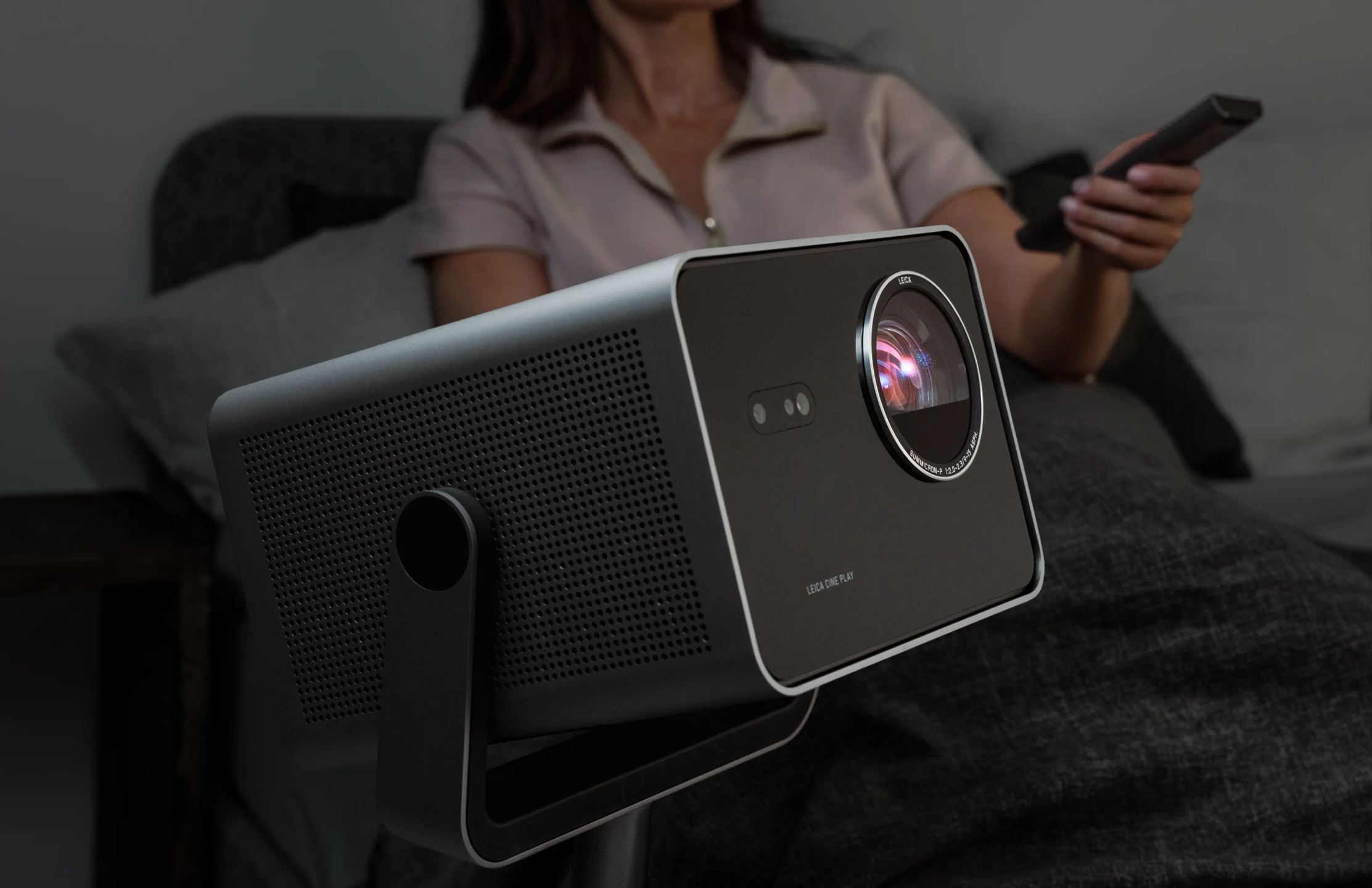
The light source is a direct RGB triple laser: each primary colour has its own diode, with no colour wheel or phosphor to produce green and red from a blue laser. This design provides access to a very wide colour gamut. Leica claims coverage exceeding 100% of Rec. 2020, the Ultra HD colour standard that very few displays achieve. The lifespan exceeds 25,000 hours.
The 4,200 ANSI lumens correspond to Ultra mode, the brightest setting. Modes calibrated for cinema sacrifice some of this light output for colour accuracy. Native contrast increases to 2,000:1. Laser modulation, which reduces its intensity in dark scenes, raises dynamic contrast to 2 million:1. The projector decodes the three common HDR formats, Dolby Vision, HDR10+ and HLG. It is therefore compatible with Dolby Vision films on streaming platforms as well as HLG sports broadcasts.
The 0.47-inch (1.19 cm) DLP chip uses XPR technology. It shifts the image several times per displayed frame to recreate the 8.3 million pixels of Ultra HD (3,840 × 2,160 pixels). This is the method used by the vast majority of 4K projectors of this size. The proprietary Leica Image Optimization (LIO) processing handles colour and sharpness, while MEMC motion interpolation smooths out panning shots and sports for those who enjoy it. 3D is supported with DLP Link active glasses.
Positioning the image with the Summicron zoom
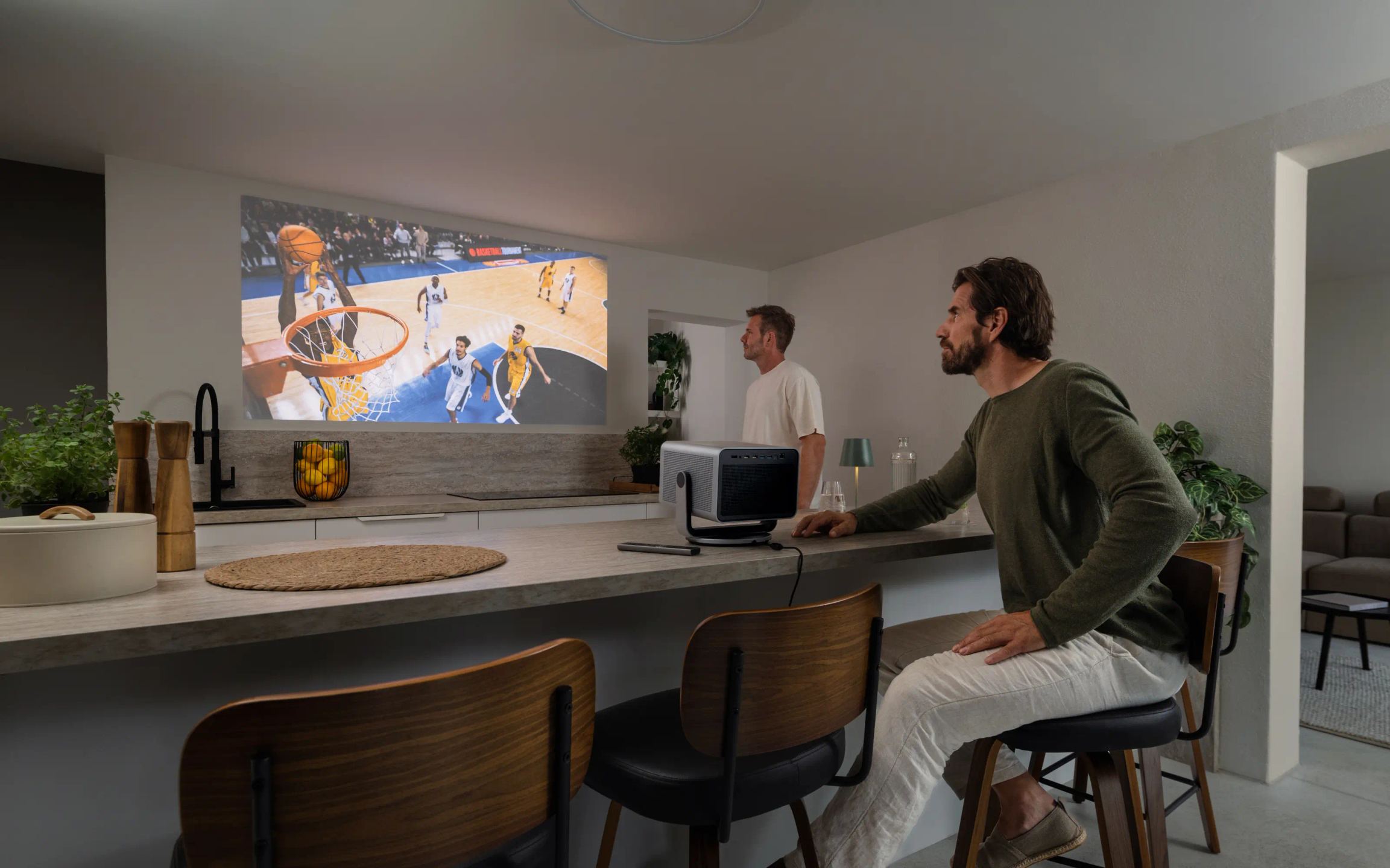
The Summicron zoom lens varies the throw ratio from 0.9 to 1.5. For a 100-inch image (2.54 m diagonal, approximately 2.21 m wide), the projector is positioned between 2 and 3.3 m from the screen. This flexibility allows it to sit on an existing piece of furniture rather than requiring the room to be rearranged around it. Image size ranges from 65 inches (1.65 m) to 300 inches (7.62 m).
Beyond a ratio of 1.5, a digital zoom takes over up to 3.0. It reduces the image by using only part of the chip: effective resolution and brightness decrease accordingly. It is best kept as a temporary solution rather than for a permanent installation. Focus and geometry correction are adjusted automatically at startup. Even when placed at an angle on a garden table, the projector produces a sharp, rectangular image within seconds.
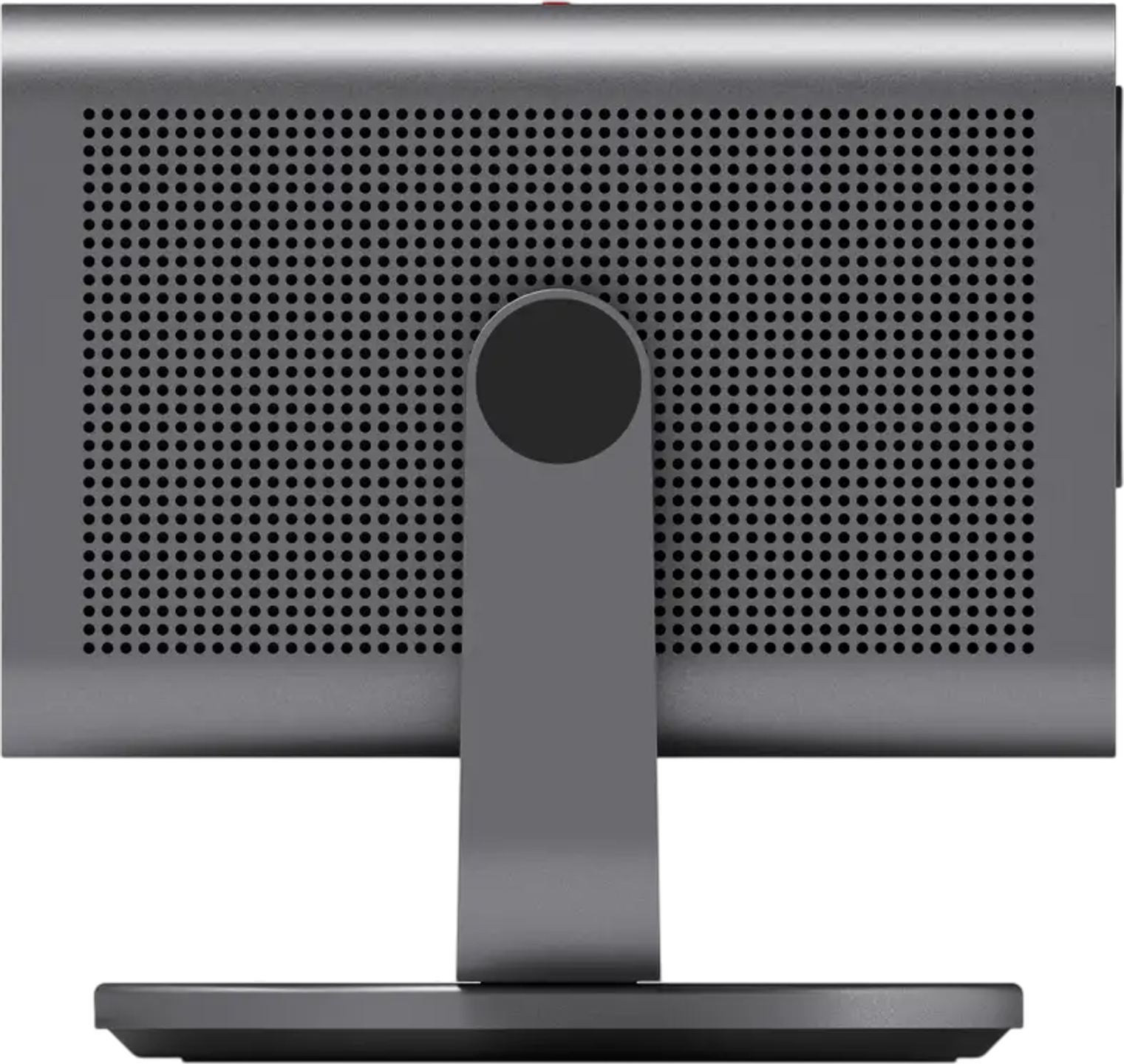
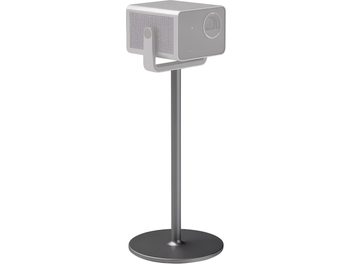
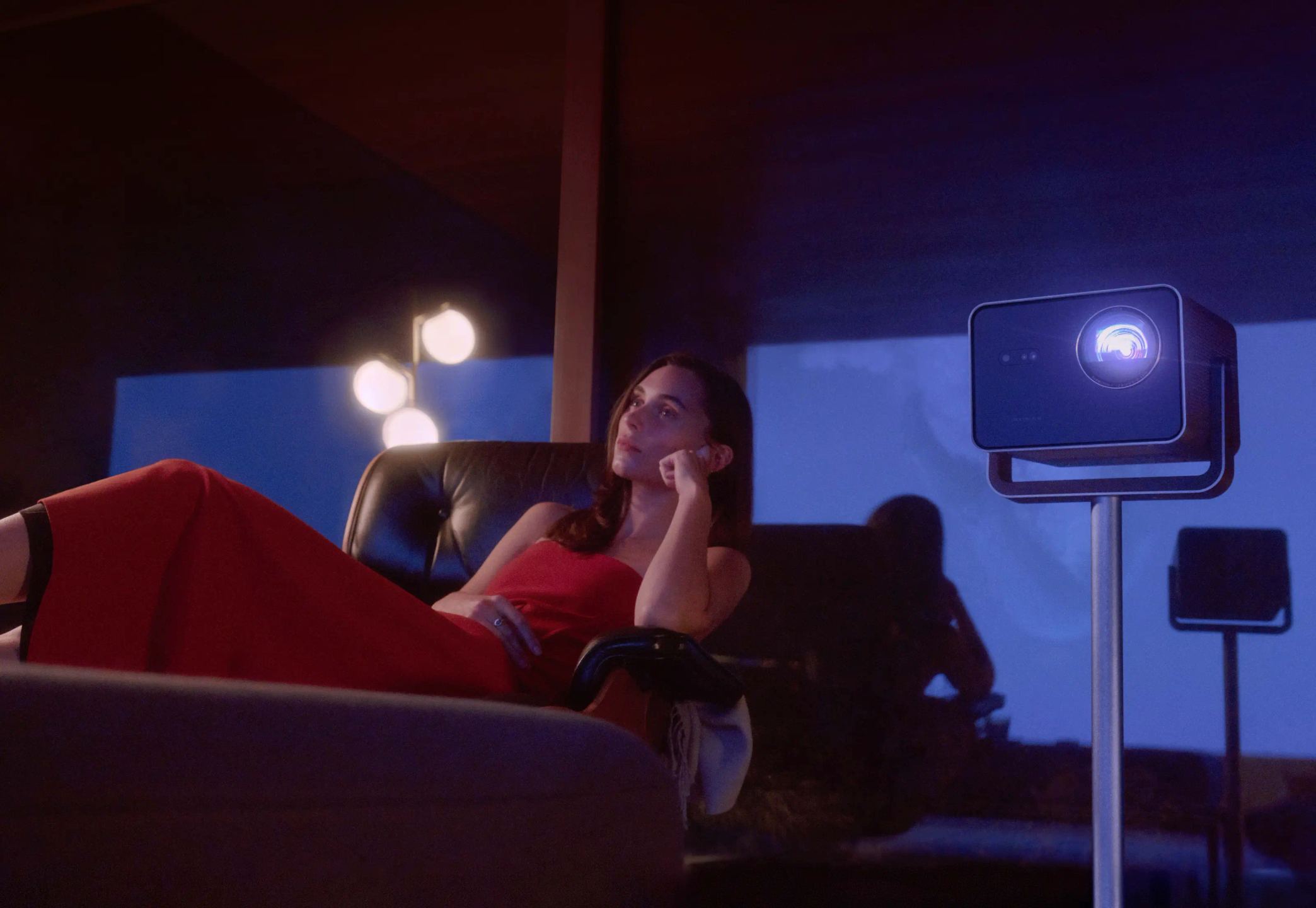
The Leica Floor Stand 1, sold separately, allows the projector to be placed in the middle of a room. Its contact-pin power supply system routes power through the stand itself, with no visible cable.
More light and contrast than the Cine Play 1
Compared with the Cine Play 1, brightness increases from 3,000 to 4,200 lumens thanks to new laser diodes, and native contrast rises from 1,500:1 to 2,000:1. Dimensions and weight remain unchanged. The increase in light output comes at the cost of power consumption: 247.8 W in standard mode, compared with 180 W for the previous model. The power supply is also new and more powerful.
The Plus adds compatibility with Apple Home and Control4 home automation installations, as well as the included EPP case. Image processing, connectivity and the lens are carried over from the Cine Play 1.
Gaming at up to 240 Hz
Game mode brings latency below 12 ms at 1080p and 120 Hz. This delay is imperceptible between pressing a button on the controller and the action on screen. The two HDMI 2.1 inputs accept 4K at 60 Hz for the most detailed games, and go up to 240 Hz at 1080p for PC shooters and racing games. Home consoles, limited to 120 Hz, benefit from the 1080p at 120 Hz mode.
Built-in speakers and outputs for an audio system
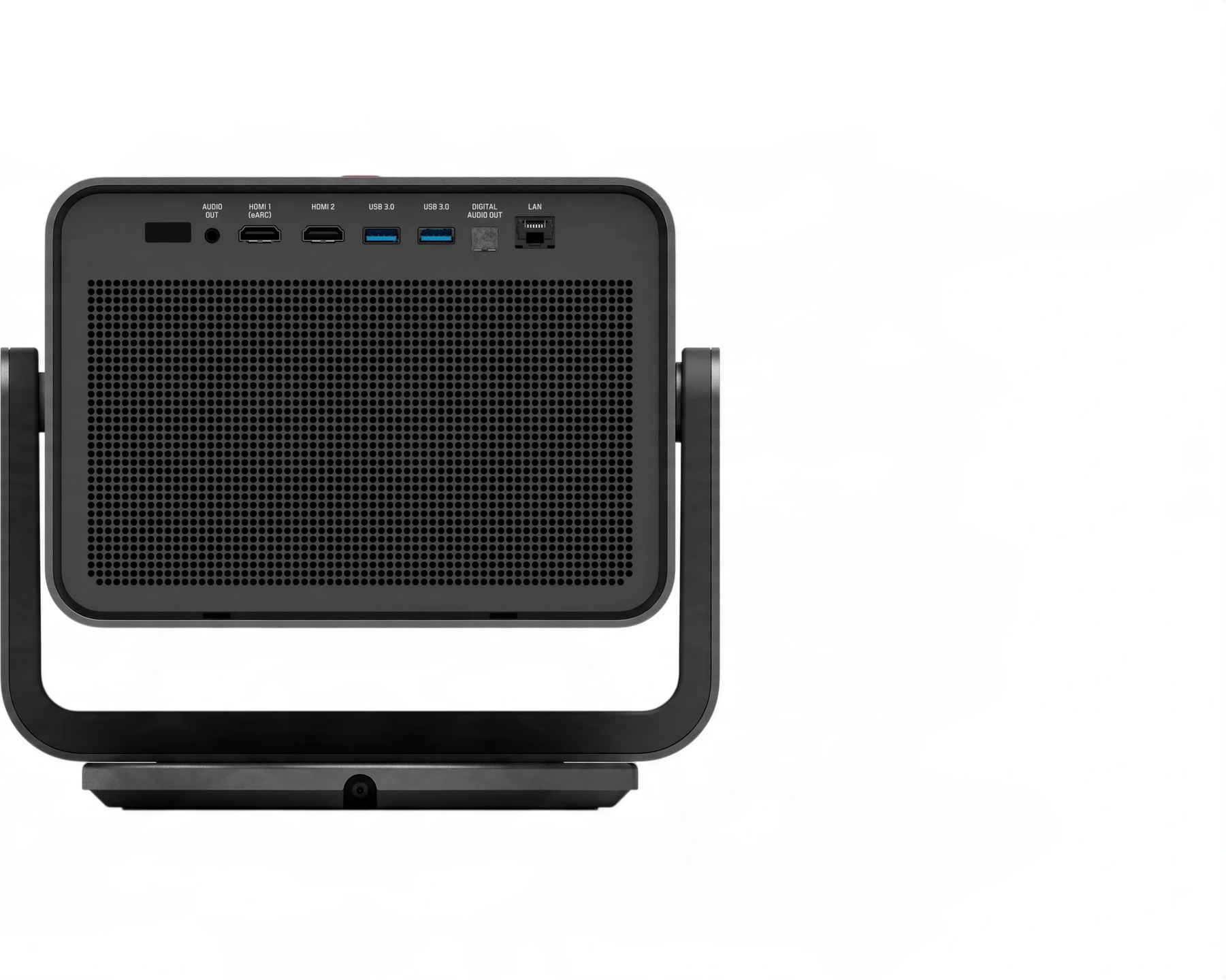
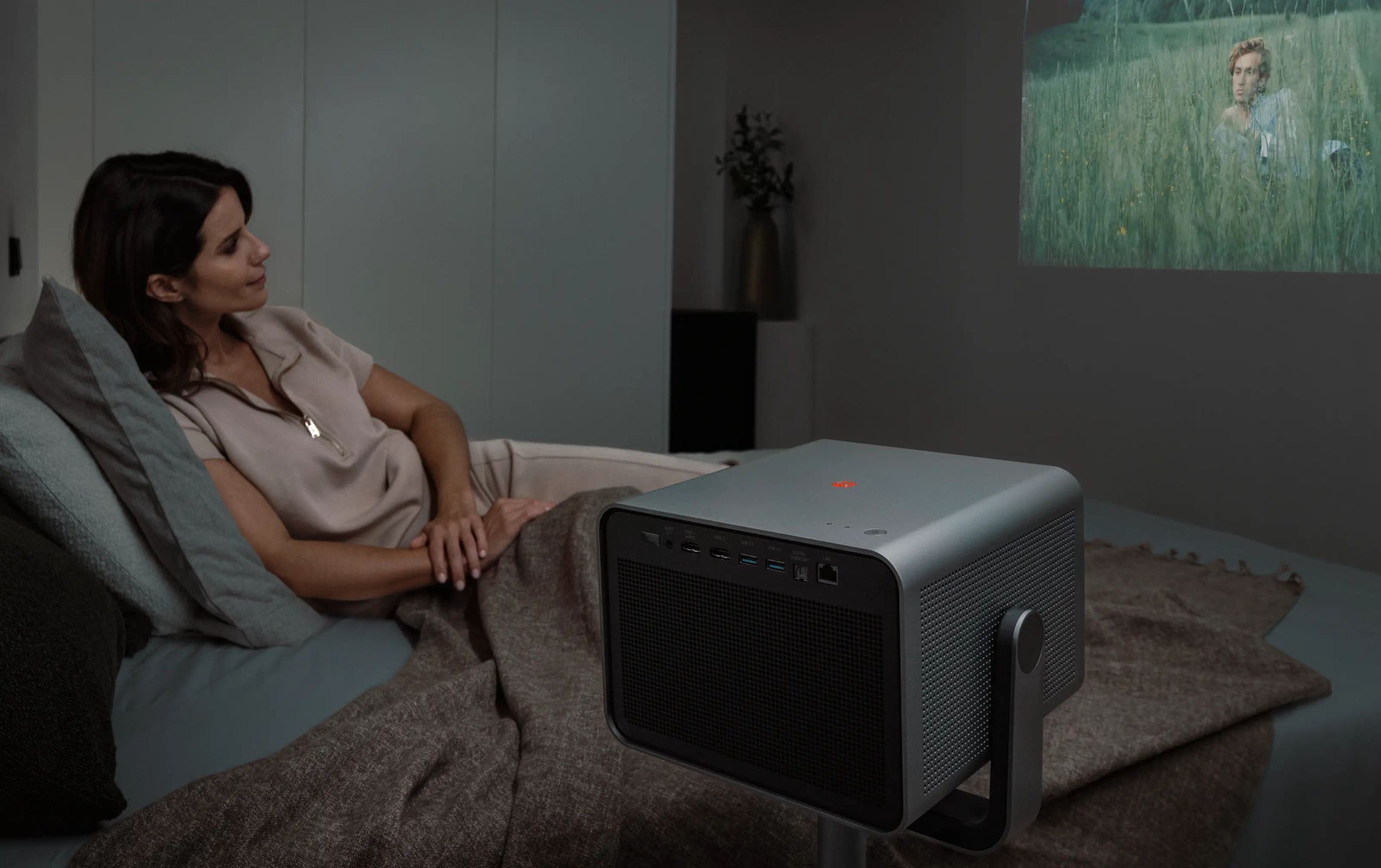
Two 10 W speakers, housed in an internal enclosure with a volume of 1.25 litres, deliver stereo sound. DTS Virtual:X processing widens the soundstage, and Dolby Audio decoding handles streaming platform soundtracks. For a Saturday-night film on a 100-inch screen, the mismatch between the size of the image and that of the speakers becomes noticeable. The connections therefore allow for an upgrade. One of the two HDMI ports supports eARC and sends sound to a soundbar or home cinema receiver. An optical Toslink output and a headphone or analogue audio output complete the setup.
VIDAA, AirPlay and the connected home
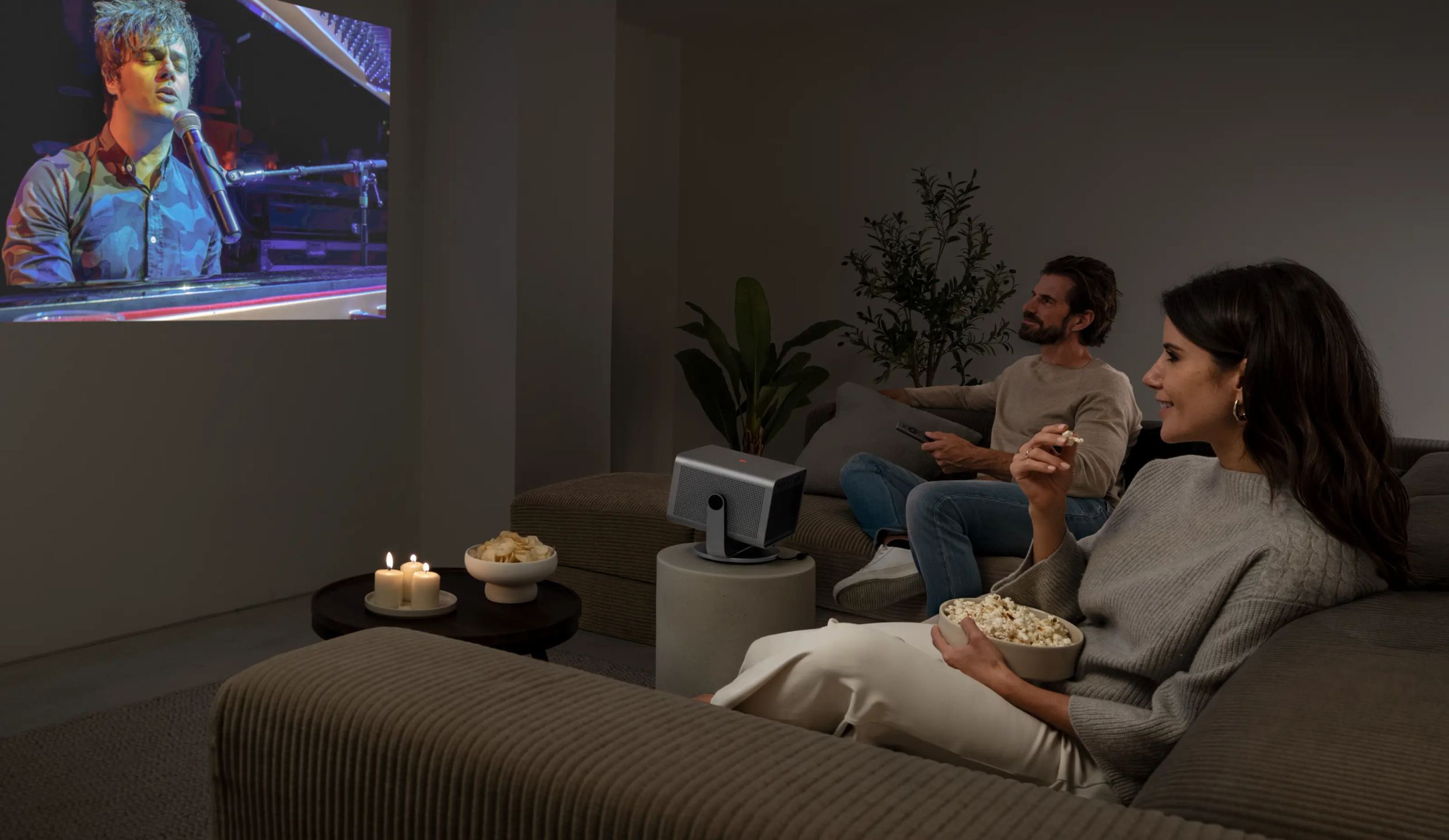
The VIDAA 9.6 system provides access to more than 400 preinstalled apps, including Netflix, Prime Video, Disney+ and YouTube, each with its own shortcut button on the remote control. It also offers free TV channels streamed over the Internet, a web browser, a children’s area with parental controls and a karaoke function. The Bluetooth and infrared remote control has an aluminium housing and a microphone for voice search. Software updates arrive over the Internet.
For wireless connectivity, Wi-Fi 6E and Bluetooth 5.4 are joined by AirPlay for streaming from an iPhone, iPad or Mac, and screen sharing for other devices. An RJ45 Ethernet port provides a more stable connection for 4K films. The two USB 3.0 ports play videos, music and photos from a USB stick or hard drive, supporting MKV, MP4, MOV, AVI or WebM for video and FLAC, WAV or MP3 for audio.
Documentation
French
Technical specifications
Projection and image quality
- Projection size: 165.1 to 762 cm
- Technology: 1.19 cm DLP XPR
- Resolution: 3840 × 2160 px (4K)
- Light output: up to 4200 lm in Ultra mode
- Contrast ratio: up to 2000:1
- Dynamic contrast: up to 2 million:1
- Rec. 2020 color space coverage: > 100%
- HDR formats: Dolby Vision, HDR10+, HLG
- 3D mode: yes, active-shutter DLP Link
- LIO image processing (Leica Image Optimization, Leica image optimization): yes
- MEMC motion compensation: yes
- Throw ratio:
- Optical: 0.9 to 1.5
- Digital: 1.5 to 3.0
- Light source: direct triple RGB laser
- Light source lifespan: > 25000 h
Display performance and gaming
- Latency: < 12 ms in game mode, at 1080 px and 120 Hz
- Refresh rates:
- 4K at 60 Hz
- 2K at 240 Hz
- 2K at 120 Hz
Interfaces and controls
- HDMI: 2 HDMI 2.1 ports, including 1 with eARC support
- USB: 2 USB 3.0 ports
- Ethernet LAN: 1 RJ45 port
- S / PDIF: 1 Toslink optical output
- Headphone / audio output: 1
- Physical on / off button: yes
Audio
- Dolby Audio: yes
- Output power: 2 × 10 W
- Channels: 2.0
- DTS Virtual X®: yes
Wireless connectivity
- Wi-Fi 6E: IEEE 802.11 a / b / g / n / ac / ax
- Apple AirPlay compatibility: yes
- Bluetooth: yes, version 5.4
- Screen sharing: yes
- AirPlay is a registered trademark of Apple Inc. in the United States and other countries.
Smart features
- Operating system: VIDAA
- Apps with direct access buttons on the remote control: Netflix, Prime, Disney, YouTube
- Web browser: yes
- Child lock: yes
- Over-the-air software updates (OTA): yes
Remote control
- Bluetooth / infrared remote control with aluminum housing and microphone
- Voice assistant: yes
Supported file formats
- Audiovisual containers: AVI, MP4, MKV, TS, FLV
- Video: AVI, WMV, MP4, MOV, MKV, MPG, MPEG, FLV, WebM
- Audio: WMA, WAV, FLAC, MP3
- Image: JPEG, BMP, PNG, GIF
Power supply and consumption
- Mains voltage: 100 to 240 V
- Power consumption:
- Standard mode: 247.8 W
- Standby: 0.5 W
- Network standby: 2 W
- Automatic standby without signal: after 15 minutes
Operating conditions and noise level
- Operating temperature: +5 °C to +35 °C
- Storage temperature: −20 °C to +65 °C
- Noise emissions: < 32 dB(A) at +25 °C
- Quiet mode: yes
Dimensions and weight
- Dimensions L × W × H (width × height × length): 242 × 261 × 229 mm
- Projector weight only: approximately 6.7 kg
Frequently asked questions
Can the Cine Play 1 Plus power supply be used with a Cine Play 1 or a Cine Compact 1?
No. The Cine Play 1 Plus power supply delivers a higher output voltage than those of the other two models, and Leica warns that it would damage them. You should not connect the old power supply to the Plus either. In a home with several Leica projectors, it is best to label each power supply.
Which screen should you choose for an RGB triple laser source?
Highly pure RGB lasers can produce a slight shimmering on some screens, known as speckle. Smooth white screens with a moderate gain of around 1.0 reduce it. However, beware of heavily textured ambient light rejecting (ALR) screens designed for long-throw lamp or blue laser projectors: check their compatibility with triple laser before purchasing. With a throw ratio of 0.9 to 1.5, an ultra-short-throw ALR screen is not suitable.
Can you project onto a white wall?
Yes, automatic focus and correction adapt to any flat surface. A wall painted matte white produces a decent image. A tensioned screen provides deeper blacks, a perfectly flat surface, and better uniformity at larger image sizes.
Are 3D glasses included?
No. 3D works with DLP Link-compatible active shutter glasses, sold separately. They generally charge via USB and synchronize without an external transmitter.
What does a light source lifespan of 25,000 hours mean?
At four hours a day, every day, that adds up to just over seventeen years of use. A laser light source does not go out suddenly like a lamp: its brightness gradually decreases over the years. It requires neither replacement nor maintenance.
Is it noisy during a movie?
Leica claims less than 32 dB(A) at 25 °C, equivalent to a quiet library. A quiet mode further reduces fan noise by limiting brightness, which is sufficient in a dark room.
What's in the box?
The projector, the aluminium remote control with its two AAA batteries, the power supply and its mains cable, a quick start guide and the EPP carrying case. The Floor Stand 1 floor stand and the projection screen are sold separately.
- Eco-contribution included in the sale price.


