

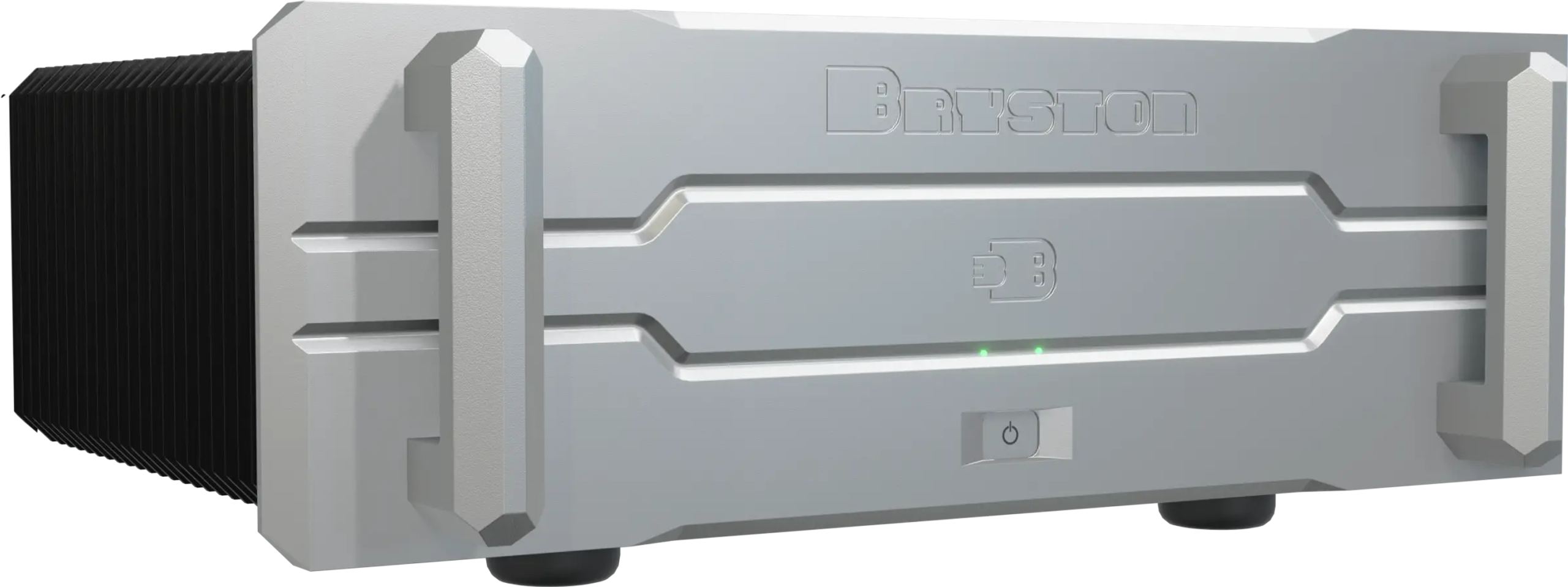
Bryston 3B³ 2.0 silver



Overview
In 1973, engineer Chris Russell presented his PRO 3 prototype to a Toronto recording studio and left with an order for two units. The 3B is the direct successor to that amplifier. This 2.0 version uses the electronics from the Cubed series, with two independently powered channels and 200 W per channel, in a shallow chassis. It fits into cabinets or racks too tight for large amplifiers.
Two channels that do not share a power supply
The 3B³ 2.0 features a dual-mono design. Each channel has its own transformer and power supply, like two mono amplifiers housed in a single enclosure. When a bass-heavy passage demands power from the left channel, the right channel retains its full energy reserve. This complete separation, rare at this price level, is found in all Bryston Cubed amplifiers.
Power output reaches 200 W per channel into 8 ohms and rises to 300 W into 4 ohms. This increase as impedance drops shows that the power supply delivers the current demanded by more challenging speakers. A speaker rated at 4 ohms often dips lower at certain frequencies, and the amplifier must keep up without limiting its output. With 200 W available, a floorstanding speaker with modest sensitivity, around 85 dB, can play in a large living room without pushing the amplifier to its limits.
The Salomie circuit, exclusive to the Cubed series
The Cubed generation takes its name from a patented input stage developed with engineer Ioan Alexandru Salomie. This circuit uses twelve active components and provides the first 6 decibels of gain. Highly linear, it accommodates almost any preamplifier without matching issues. The output stage operates in class AB, in a four-complementary-transistor configuration that Bryston calls Quad-Complementary. It greatly reduces higher-order harmonics, which the ear perceives as harsh. The residual distortion is distributed as it would be in a class A amplifier, but at a much lower level.
Measurements confirm this. Total harmonic distortion plus noise (THD+N, meaning everything the amplifier adds to the original signal) remains below 0.005% from 20 Hz to 20 kHz. This figure is measured at full power into 8 ohms, a far more demanding condition than a measurement at 1 W. Bandwidth extends from below 1 Hz to 100 kHz at -3 dB, well beyond audible frequencies: the upper end of the spectrum passes through without attenuation or phase shift. The signal-to-noise ratio exceeds 106 dB at the RCA input and 111 dB at the XLR input. At idle, no hiss can be heard from the tweeters, even with your ear right up against the speaker.
Adjustable gain to suit the preamplifier
On the rear panel, a selector sets the gain to 23 or 29 dB. Gain indicates how much the amplifier increases the level it receives. With a preamplifier or home theater processor that delivers a high voltage, the 23 dB setting provides a wider volume adjustment range and an even lower noise floor. With a passive preamplifier or a source with a low output level, the 29 dB setting avoids having to turn the volume all the way up to reach a normal listening level.
Inputs are available in balanced XLR and unbalanced RCA formats. A balanced connection rejects interference picked up by long cables and delivers the best noise figures. It is therefore preferable whenever the preamplifier has XLR outputs, or when the amplifier is installed near the speakers, far from the rest of the system.
27 cm deep and no fan
The amplifier measures 45.7 cm wide, 15.2 cm high and 27.3 cm deep, or 32.4 cm with the front handles. It weighs 15.9 kg. Its shallow depth sets it apart within the Bryston range: it uses the technology of the bulkier 4B and fits into a TV cabinet, a standard shelf or a shallow equipment rack.
Cooling relies solely on convection: the heatsinks dissipate heat into the surrounding air, without a fan. No mechanical noise is added to the music, even at low volumes and during near-field listening. However, air must be able to circulate around the chassis. A class AB amplifier generates heat even at idle, and an enclosed compartment is not suitable.
The chassis and front panel are made from machined, anodized aluminum. Version 2.0, introduced for Bryston’s 50th anniversary, features a new look shared across the entire 2.0 range and the brand’s class D amplifiers. Several stacked units therefore form a visually consistent system. The front panel can be removed for easier maintenance. Four configurations are available: a consumer front panel with or without handles, and a PRO front panel for 19-inch rack mounting, also with or without handles.
Gradual power-up and trigger control
At switch-on, an amplifier of this size briefly draws a high current while its capacitors charge and its transformers magnetize. This inrush current can trip a circuit breaker, especially when several devices switch on at the same time. The microprocessor-controlled SoftStart system raises the voltage gradually and limits this peak.
A trigger input receives the DC voltage sent by a compatible preamplifier or processor. The amplifier then switches on and off with the rest of the system, without using its power switch. In standby, it consumes less than 500 mW.
Technical specifications
Overview
- Type: stereo power amplifier
- Dual mono architecture (Dual Mono)
- Two channels with fully independent power supplies
- Dedicated transformers for each channel
- Compact model in the Cubed range, incorporating its key technologies
- Reduced depth for easy integration, particularly suited to installations with limited space
Output power
- 200 W per channel into 8 Ω (2 × 200 W)
- Up to 300 W per channel into 4 Ω (2 × 300 W)
Amplification technologies
- Patented Salomie circuit, shared with amplifiers in the Cubed series
- Switchable gain: 23 dB, 29 dB
Connectivity
- Balanced XLR inputs
- Unbalanced RCA inputs
Technical performance
- Frequency response: below 1 Hz – 100 kHz (-3 dB)
- Total harmonic distortion + noise (THD+N): less than 0.005%
- Measurement: 20 Hz – 20 kHz at rated power into 8 Ω
- Signal-to-noise ratio (values transcribed as stated in the manufacturer’s specification sheet)
- RCA: greater than 106 dB
- XLR: greater than 111 dB
- Input impedance
- RCA: 7.5 kΩ
- XLR: 30 kΩ + / 6 kΩ -
Power supply and start-up
- Standby power consumption: less than 500 mW
- Microprocessor-controlled SoftStart system
- Gradual start-up
- Inrush current limiting
- Prevents nuisance tripping of circuit breakers
- DC Trigger input for automatic power-on and shutdown
Cooling
- Cooling entirely by natural convection
- No fan
- Silent operation
Construction and finish
- Machined and anodized aluminum chassis and front panel
- Robust construction, designed for long-lasting use
- Front panel options: four configurations available
- Consumer front panel without handles
- Consumer front panel with handles
- Rack-mountable PRO front panel
- Rack-mountable PRO front panel without handles
Musical impressions
- Points highlighted in testimonials published by Bryston
- Outstanding robustness and substantial power reserves
- Precise reproduction, with finesse approaching surgical precision
- Sound described as smooth and warm, while remaining neutral
- Excellent low-level detail resolution
- Particularly refined high frequencies without harshness
- Good ability to pair with different types of speakers
Warranty and manufacturing
- Manufacturer’s warranty: 10 years
- Made in Canada
- Design drawing on Bryston’s long-standing experience in professional and high-fidelity amplification
Dimensions and weight
- Width: 45.7 cm
- Height: 15.2 cm
- Depth
- Without handles: 27.3 cm
- With handles: 32.4 cm
- Weight: 15.9 kg
Frequently asked questions
Can a source be connected directly to the 3B³ 2.0?
It has neither a volume control nor an input selector. It must be placed after a component that controls the volume: a preamplifier, DAC or network player with a variable output, or a home theater processor. A CD player with a fixed output connected directly would play at maximum volume at all times.
What has changed compared to the previous-generation 3B³?
The electronics remain unchanged: the same Salomie circuit, the same dual-mono power supply, the same power output. Version 2.0 introduces the brand’s new 50th-anniversary styling, shared with the other 2.0 amplifiers and the Class D series, along with a removable front panel.
Is a tube preamplifier suitable?
It’s possible, but you need to check its output impedance. The RCA input on the 3B³ 2.0 has an impedance of 7.5 kΩ, which is fairly low. Some tube preamplifiers have a high output impedance, resulting in a loss of bass and dynamics. For a safe match, the preamplifier’s output impedance should be approximately ten times lower than the input impedance. The XLR input, at 30 kΩ on the hot pin, provides more leeway when the preamplifier has balanced outputs.
Can it power the front channels of a home theater system?
Yes. It connects to the preamp outputs of a receiver or processor to drive the front left and right speakers, with far more power than a home theater receiver’s amplifier section. The trigger input turns it on along with the processor. The 23 dB gain setting is often the most suitable, as these devices deliver high output levels.
What is the difference between consumer and PRO faceplates?
Only the front panel changes. The PRO version has mounting ears for a 19-inch rack, as used in studios and equipment racks. The consumer version is designed for shelf placement. In both cases, the handles are optional and add approximately 5 cm to the depth.
How should it be installed to keep it as cool as possible?
As it has no fan, leave space for airflow above and on both sides. Avoid placing another device directly on its top cover. In a cabinet, choose a compartment with an open back. In a rack, leaving one empty rack unit above the amplifier helps heat dissipate.
- Eco-contribution included in the sale price.


