

Bryston 3B³

Overview
In 1973, a young Canadian engineer named Chris Russell presented his prototype amplifier to Eastern Sound, a renowned recording studio in Toronto. He walked out with an order for two units. Fifty years later, that amplifier, now known as the 3B, has never left the Bryston catalog. The 3B³ represents its fifth generation, incorporating the patented Salomie circuit that built the reputation of the Cubed series. Twice as powerful as the original and noticeably more refined, it preserves the DNA of the founding model while benefiting from half a century of improvements.
A no‑compromise dual‑mono architecture
The 3B³ is built as two independent mono amplifiers sharing only their power cord. Each channel has its own toroidal transformer and dedicated power supply, a configuration that eliminates interaction between channels, even during asymmetrical musical passages or with difficult loads. When one channel is working hard, the other retains its full resources.
This strict separation is reflected in the measurements: the signal‑to‑noise ratio reaches –111 dB at the balanced XLR input, a level that places the noise floor well below the threshold of audibility. The Quad‑Complementary output stage, used by Bryston for several decades, delivers a harmonic distribution similar to that of a class A amplifier, but with much lower distortion and greater energy efficiency.
The Salomie circuit: a measurable advance
At the heart of the Cubed series is the input circuit developed in collaboration with Dr. Ioan Alexandru Salomie, an engineer with a PhD in electronics. This patented circuit uses twelve active elements in a unique configuration that provides the first 6 dB of gain while accommodating virtually any preamplifier. Its measured distortion drops below 0.0001%, i.e. one thousandth of a percent.
Compared with the previous generation (3B‑SST2), Bryston reports a noise reduction of around 20 dB at the input stage. The circuit also offers better common‑mode noise rejection and increased immunity to electromagnetic and radio‑frequency interference, improvements that are particularly valuable in urban environments or near digital equipment.
Power and flexibility of use
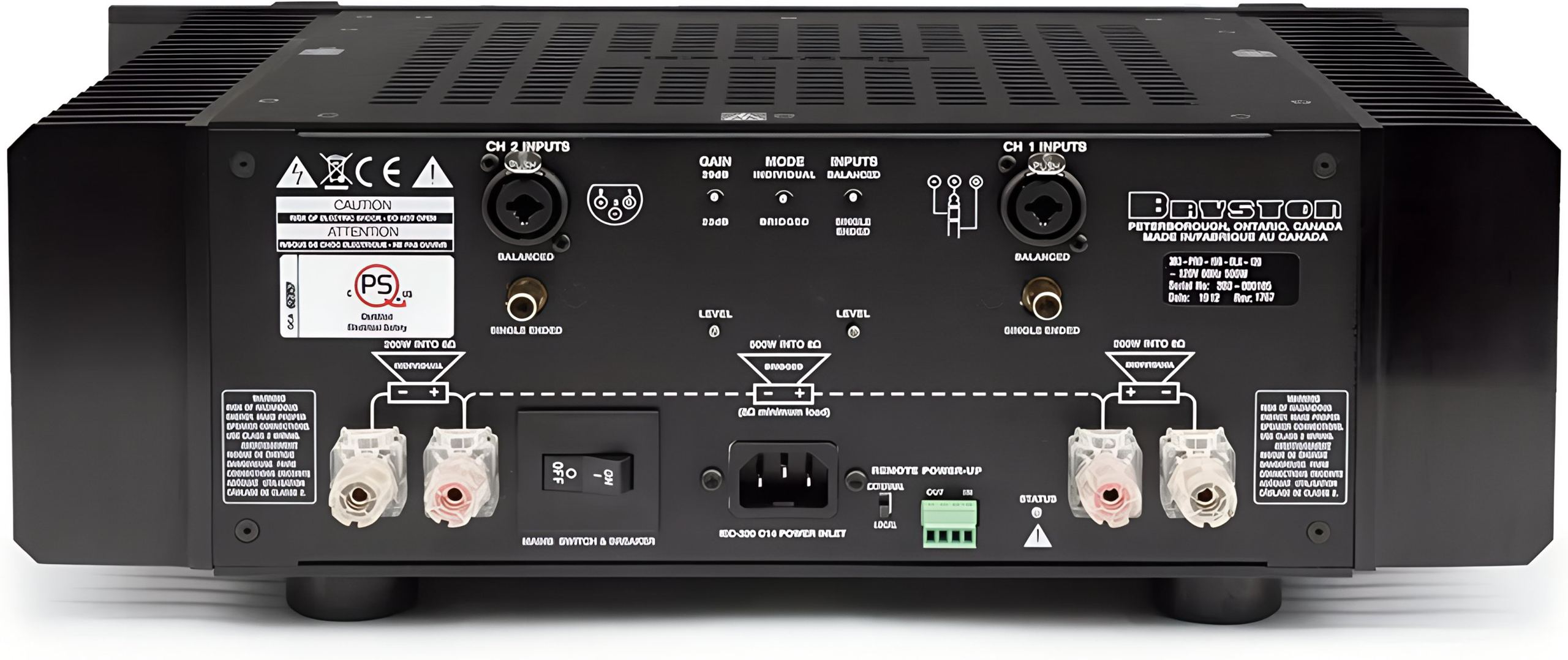
The amplifier delivers 200 watts per channel into 8 ohms and 300 watts into 4 ohms, with a bandwidth extending from below 1 Hz to 100 kHz at –3 dB. Gain is switchable between 23 dB and 29 dB via a rear‑panel switch, allowing optimization of matching with different preamplifiers or processors.
A switch also allows operation in bridged mono mode, where the two channels work in series to deliver 500 watts into 8 ohms. This configuration is useful for driving a demanding center speaker in a multichannel system, or for creating a pair of mono blocks from two 3B³ units.
The inputs accept either balanced cables (XLR or 6.35 mm TRS jack) or unbalanced (RCA), selectable via a switch. The 12V trigger input simplifies integration into an automated system where multiple devices need to turn on and off together.
Construction and passive cooling
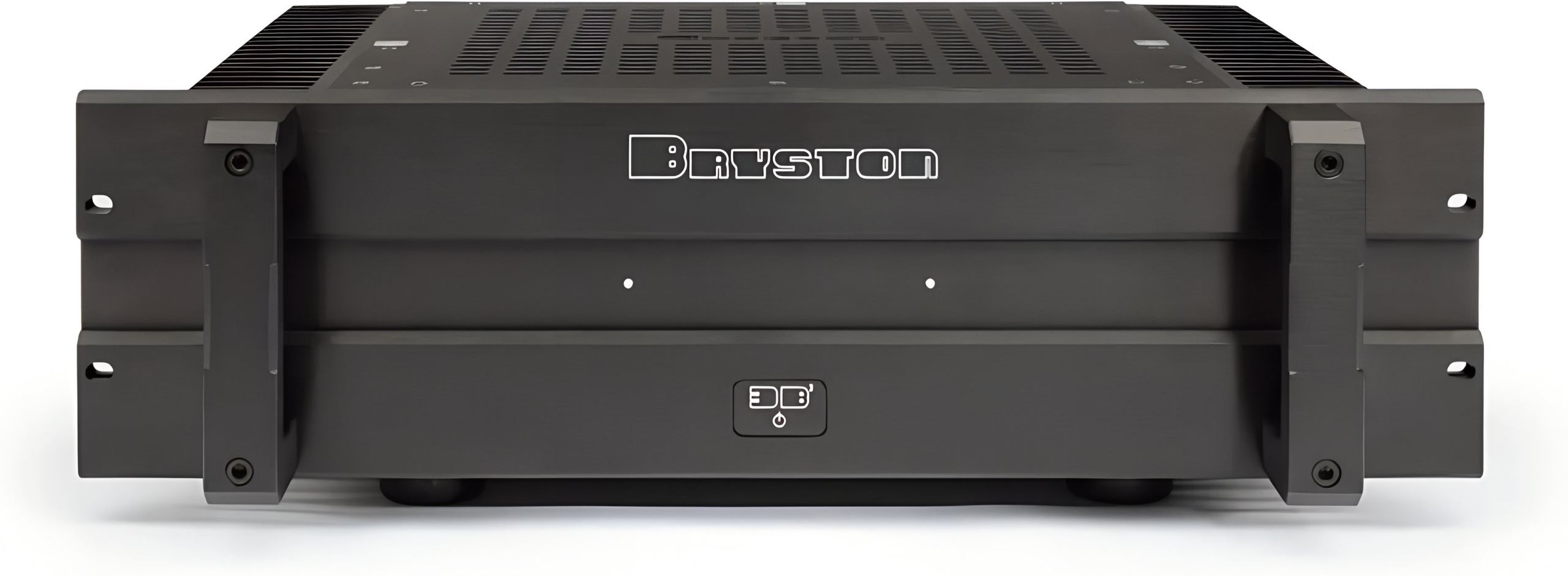
The machined, anodized aluminum chassis serves as both structure and heatsink. The 3B³ operates entirely by natural convection, without any fan, which makes it perfectly silent, even at full load. This absence of moving parts also contributes to its longevity.
The 12 mm‑thick front panel is available in black or silver finish, in 17‑inch or 19‑inch width. The 19‑inch version includes front handles for rack installation. A PRO version also exists, with a 19‑inch black front panel and level adjustment potentiometers per channel (–14 dB to 0 dB) accessible on the rear.
The SoftStart circuit controls the power‑on sequence to avoid inrush currents that could trip sensitive electrical installations. In standby, power consumption drops below 500 mW.
A compact format for varied installations
With a depth of 27 cm (around 33 cm with handles on the 19” version), the 3B³ remains one of the most compact amplifiers in the Bryston range for its power. This feature makes it easier to integrate into standard‑depth hi‑fi cabinets or into tight spaces where a larger amplifier would not fit.
The 3B³ inherits the same technology as the 4B³, the brand’s flagship model, but in a more compact format and with 100 watts less per channel. This positioning makes it a relevant choice for medium‑sized rooms or speakers with reasonable sensitivity, where the extra power of the 4B³ would not be fully utilized.
Documentation
Technical specifications
Performance
- Output power per channel
- 200 W into 8 Ω
- 300 W into 4 Ω
- Frequency response: < 1 Hz – 100 kHz (–3 dB)
- Total harmonic distortion + noise: < 0.005% (20 Hz – 20 kHz at rated power, 8 Ω)
- Signal-to-noise ratio
- RCA input: < –106 dB
- XLR input: < –111 dB
- Stable, silent operation, even at low volume
- Excellent control of complex loads
Connectivity and settings
- Inputs: balanced XLR, unbalanced RCA
- Input impedance
- Unbalanced: 7.5 kΩ
- Balanced: 30 kΩ+ / 6 kΩ–
- Switchable gain: 23 dB / 29 dB
- DC Trigger
Design and construction
- High-end audiophile stereo amplifier
- Two channels with fully independent power supplies (dedicated transformers)
- Patented Salomie circuit (Cubed series)
- Machined and anodized aluminum chassis
- 100% passive cooling (silent)
Dimensions and weight
- Dimensions (W x H x D)
- 17-inch version: 43.2 cm x 20.6 cm x 27.3 cm
- 19-inch version: 48.3 cm x 20.6 cm x 32.4 cm (with front handles)
- Weight: 16 kg
Features
- SoftStart gradual power-up
- Ultra-low standby consumption: < 500 mW
Available options
- Front panel width: 17 inches, 19 inches (non-rack-mountable version – 19 inches with handles
Frequently Asked Questions
Can the 3B³ drive low‑impedance or complex‑load speakers?
The architecture with separate power supplies per channel and the Quad‑Complementary output stage allow the 3B³ to maintain stable behavior with difficult loads. Power increases into 4 ohms (300 W versus 200 W into 8 ohms), a sign of a power supply capable of delivering the required current. Electrostatic or highly variable‑impedance speakers remain demanding, and a more powerful amplifier such as the 4B³ will offer greater headroom.
What is the difference between the standard 3B³ and the PRO version?
The PRO version adopts a 19‑inch black rack‑mount front panel and adds level adjustment potentiometers per channel on the rear, adjustable from –14 dB to 0 dB. These controls simplify precise level balancing in a multichannel or studio installation, without touching the preamplifier or processor.
Is bridged mono mode compatible with all speakers?
In bridged mode, the minimum recommended impedance is 8 ohms. Connecting a 4‑ohm load in bridged mono places excessive stress on the amplifier and may trigger protection circuits. This mode is suitable for a center speaker of moderate sensitivity or for doubling the available power on one channel in a bi‑amping configuration.
How do I choose between the 17" and 19" front panels?
The 17‑inch version fits standard hi‑fi furniture and has a more domestic appearance. The 19‑inch version, with its integrated handles, is designed for rack installation or for users who appreciate easier handling. Depth increases slightly with the handles (around 4 cm extra).
Does the switchable 23 dB / 29 dB gain change the sound character?
The gain setting adjusts input sensitivity without altering the sonic character of the amplifier. The 23 dB mode is suitable for high‑output preamplifiers and offers better noise immunity. The 29 dB mode increases sensitivity for lower‑output sources or to reach full power with less upstream gain.
Does the 3B³ work with a home theater processor?
The amplifier integrates easily into an audio‑video system. The 12V trigger input allows automated power‑on controlled by the processor, and the balanced XLR inputs ensure optimal connection over long cable runs. In a stereo configuration, it can drive the main left and right speakers; two units can cover four channels.
What is the difference in sound between the 3B³ and the 4B³?
The 4B³ offers 100 additional watts per channel and a slightly fuller, more authoritative bass, especially noticeable with large speakers or at high volume. The 3B³ is often described as slightly livelier and more agile in the midrange. Both models share the same Cubed technology and the same build quality; the choice depends mainly on the required power and space constraints.
- Eco-contribution included in the sale price.




