

Which projector should you choose for gaming?
31 July 2025

Contents
Big-screen gaming is gaining popularity with the democratization of high-performance projectors. Unlike TVs, which are limited by their physical dimensions, projectors can turn any room into a large gaming surface. However, not all models are suitable for video games. Input lag, refresh rate, and display technologies determine whether your future projector will support your performance or hold you back.
Input latency: the decisive technical criterion
Input latency, known as “input lag,” is the most critical factor for any gaming projector. It measures the delay between pressing a button and the corresponding action appearing on screen. This value, expressed in milliseconds, directly affects accuracy in competitive games.
For optimal gaming, aim for latency under 20 milliseconds. Current gaming models such as the BenQ X3100i and BenQ X500i reach 4.2 ms at 1080p/240Hz and 16.7 ms at 4K/60Hz. The Epson LS12000B also maintains latency below 20 ms thanks to its 3LCD technology. These values match those of high-end gaming TVs. Avoid any projector with latency above 30 ms, a threshold beyond which delay becomes noticeable in FPS and fighting games.
Most manufacturers offer “Gaming” modes that disable unnecessary image processing to reduce latency. These modes sometimes slightly compromise image quality but ensure maximum responsiveness. Some projectors include automatic detection of gaming signals (Auto Low Latency Mode or ALLM).

Refresh rate and motion smoothness
Refresh rate, measured in hertz, determines how many images are displayed per second. The arrival of the PlayStation 5 and Xbox Series X has popularized higher refresh rates. A modern gaming projector should support 120 Hz in 4K and ideally 240 Hz in Full HD.
This capability is especially important for fast-paced games. FPS titles, for example, benefit from high refresh rates that reduce motion blur and improve visual accuracy. Racing and sports games likewise gain in smoothness at these higher frequencies.
The projectors in our selection support these high refresh rates: the BenQ X3100i and BenQ X500i reach 240 Hz in 1080p and 60 Hz in 4K, while the Epson LS12000B uses its HDMI 2.1 ports to deliver 4K at 120 Hz. The Hisense PX3 Pro, optimized for Xbox Series X, also handles these refresh rates thanks to its advanced HDMI 2.1 connectivity.

Projection technologies and light sources
Three main technologies dominate the market: DLP, 3LCD, and LCoS. Each has specific characteristics for gaming.
DLP: speed and contrast
DLP (Digital Light Processing) technology uses millions of moving micro-mirrors to create the image. This approach offers fast response times, high contrast that enhances detail in dark areas, and robust construction that limits color convergence issues.
DLP projectors are well suited to games with dark atmospheres, revealing hidden elements in the shadows. The high contrast also improves the readability of user interfaces and HUD elements. Some sensitive users may perceive a rainbow effect during rapid eye movements, especially on models with a single color wheel.
3LCD: natural colors
Epson’s 3LCD technology splits light into three components (red, green, blue) processed by dedicated LCD panels. This approach produces natural, bright colors without rainbow effects. 3LCD projectors are ideal for colorful games, RPGs with rich environments, and adventure titles that prioritize visual quality.
Contrast is generally lower than on DLP, although the latest laser-lit generations are closing the gap. Models such as the Epson EH-LS12000 compete with DLP solutions.
Light sources: lamp, LED, and laser
The light source affects gaming usage. Traditional lamps offer high brightness at a lower cost, but require periodic replacement (2,000 to 5,000 hours) and generate heat and fan noise.
LED sources last longer (20,000 hours and more) and operate quietly but achieve limited brightness, usually insufficient for lit environments. They are suitable for gamers who prefer sessions in complete darkness.
Laser sources combine long life (20,000 hours), high brightness, instant start-up, and wide color gamuts. The BenQ X3100i and X500i use 4LED systems that provide a strong alternative to laser, while the Epson LS12000B uses a laser light source to deliver its 2,700 ANSI lumens. The Hisense PX3 Pro uses a triple RGB laser system delivering 3,000 lumens and color coverage close to 100% DCI-P3.

Resolution and gaming image quality
Native resolution determines how fine the details on screen can be. For modern gaming, you should choose at least Full HD (1920 x 1080 pixels), the native resolution of many consoles and sufficient for screens up to 100 inches diagonally.
4K: the new standard
4K resolution (3840 x 2160 pixels) is gradually becoming the gaming benchmark. PlayStation 5 and Xbox Series X support this resolution, many modern PC games adopt it, and it enables very large screen sizes without loss of sharpness. Current 4K projectors also handle intelligent upscaling of lower-resolution content.
Be careful with labels such as “4K compatible” or “4K enhanced”: they often hide lower native resolutions enhanced by digital processing. For best quality, look for “native 4K” or “True 4K.” DLP 0.47” chipsets offer an interesting intermediate resolution (2716 x 1528) on more affordable models.
HDR and wide gamuts
HDR (High Dynamic Range) improves gaming by extending the range of brightness and colors. HDR10 and HDR10+ formats are supported by most recent consoles and games. Dolby Vision, which is more advanced, is still less common in gaming.
A good gaming projector must support these HDR formats and cover at least 90% of the Rec.709 color space. High-end models reach 95% of DCI-P3, the cinema standard offering more saturated colors. This wide coverage is particularly beneficial for games with colorful worlds.
Connectivity and console compatibility
Connectors are a crucial aspect. A modern gaming projector requires at least two HDMI 2.0b ports, the standard needed to carry 4K at 60 Hz with HDR. To fully exploit the capabilities of next-gen consoles, choose models equipped with HDMI 2.1.
HDMI 2.1: the future of gaming
This standard enables 4K at 120 Hz and even 8K at 60 Hz. It includes advanced features such as VRR (Variable Refresh Rate), which dynamically adjusts the display frequency to the game’s frame rate, eliminating stutter and screen tearing.
ALLM (Auto Low Latency Mode) automatically detects gaming signals and activates low-latency mode. QFT (Quick Frame Transport) and QMS (Quick Media Switching) reduce delays. PlayStation 5 and Xbox Series X make use of these capabilities.
Among our reference models, the Epson LS12000B and Hisense PX3 Pro include full HDMI 2.1, allowing you to fully exploit next-gen consoles. The BenQ X3100i and X500i, equipped with HDMI 2.0b, make up for it with extensive gaming optimizations and very low latency. HDMI 2.1 is gradually becoming more common, but HDMI 2.0b remains sufficient for the majority of current gaming uses.

Installation and space constraints
Installation has a direct impact on gaming usage. Unlike TVs, projectors require a throw distance between the device and the screen, which varies depending on the lens.
Three solutions based on your space
Standard lenses: 3 to 4 meters of throw distance for a 100-inch image. This is an economical solution but restrictive for small spaces. The Epson LS12000B, despite its traditional lens, compensates with very flexible installation thanks to motorized zoom and lens shift.
Short-throw lenses: only 1.5 to 2 meters for the same diagonal. The BenQ X3100i and X500i use this technology to fit into medium-sized rooms, eliminating cast shadows and freeing up central space.
Ultra-short throw: placed just a few centimeters from the wall, they function like a giant TV. The Hisense PX3 Pro and Awol Vision 3500 Pro use this approach with a throw distance of 24 cm, but they require perfectly flat surfaces and often specialized ALR screens for optimal results.

Usage environment and brightness
The installation environment determines your brightness requirements. Brightness, measured in ANSI lumens, must match your intended viewing conditions.
For gaming in complete darkness, 1,500 to 2,500 ANSI lumens is sufficient. This configuration maximizes contrast and protects visual comfort during long sessions. It’s ideal for horror games, contemplative titles, or evening gaming sessions with friends.
Semi-dark environments (curtains drawn, low ambient lighting) require 2,500 to 3,500 ANSI lumens. This range covers most home uses and lets you keep some functional lighting.
For playing with normal lighting or daytime use, aim for at least 3,500 ANSI lumens. Very bright models such as the Optoma UHD38x (4,000 lumens) or the ViewSonic PX701-4K (3,200 lumens) keep the image readable even in unfavorable conditions, at the cost of higher power consumption and heat generation.

Comparison of benchmark gaming models
Five projectors currently stand out as the best gaming options, each with its own characteristics and price positioning.
BenQ X500i: the technical sweet spot

The BenQ X500i is positioned as the gateway to high-end gaming. Its 4LED technology delivers 2,200 ANSI lumens with color uniformity covering 95% of the Rec.709 space. Native 4K resolution (3840 x 2160) comes with latency of 4.2 ms at 1080p/240Hz and 16.7 ms at 4K/60Hz.
Its short-throw lens enables a 100-inch image from 1.5 meters, making it ideal for medium-sized rooms. Integrated Android TV eliminates the need for external devices for streaming. Multiple gaming modes adapt to different genres—FPS, RPG, Sports—each with specific optimizations.
Strength: well-balanced price-to-performance ratio for true 4K gaming with high-end performance.
→ Discover the BenQ X500i projector
BenQ X3100i: the technical benchmark

An evolution of the X3000i, the X3100i takes gaming performance to the next level. Its 3,300 ANSI lumens allow comfortable use even with ambient lighting, while the optimized 4LED technology ensures accurate colors over 20,000 hours without degradation.
Built-in artificial intelligence automatically adjusts settings according to detected content: movies, games, sports. Automatic correction features (keystone, focus) simplify installation, while integrated Dolby Atmos sound removes the need for external audio equipment for occasional use.
Gaming performance reaches benchmark levels: 4.2 ms at 1080p/240Hz, partial VRR support, and advanced HDR metadata management for real-time image optimization. Premium build quality and refined finish justify its higher price positioning.
Strength: complete versatility with cutting-edge gaming performance.
→ Discover the BenQ X3100i projector
Epson LS12000B: mature laser technology

The Epson LS12000B represents the culmination of 3LCD laser technology. Its 2,700 ANSI lumens are paired with a dynamic contrast ratio of 2,500,000:1, revealing details in both the darkest and brightest areas. This capability enhances horror games and titles with strong contrast atmospheres.
4K PRO-UHD resolution uses Epson’s pixel-shifting technology for high sharpness. The two HDMI 2.1 ports fully leverage next-gen consoles with native 4K at 120Hz, while sub-20 ms latency remains acceptable for all gaming genres.
The motorized lens system (zoom, focus, shift) simplifies installation in virtually any configuration, vertically or horizontally. The laser light source provides 20,000 hours of maintenance-free use—over ten years of heavy usage.
Strength: top-tier image quality with very flexible installation.
→ Discover the Epson LS12000B projector
Hisense PX3 Pro: ultra-short-throw gaming

The Hisense PX3 Pro adapts the gaming approach to space constraints with its ultra-short-throw lens. Placed just a few centimeters from the wall, it projects a 100-inch image while keeping the living space completely clear. This TV-like installation comes with very strong technical performance.
The triple RGB laser generates 3,000 lumens with color coverage close to 100% DCI-P3, surpassing many premium TVs. Xbox Series X certification guarantees optimal compatibility with the latest Microsoft games, including full support for VRR and Auto Low Latency Mode.
A Harman Kardon audio system is built in, removing the need for external equipment, while Google TV provides direct access to streaming platforms. The backlit remote and dedicated mobile app make control easier in the dark.
Strength: simplified installation combined with high-quality gaming performance and image.
→ Discover the Hisense PX3 Pro projector
Awol Vision 3500 Pro: ultra-short-throw innovation

The Awol Vision 3500 Pro pushes ultra-short-throw technology to the limit with advanced technical innovations. Its triple RGB laser system delivers 3,500 ANSI lumens, allowing comfortable use even in daylight. This brightness is paired with extended color coverage reaching 107% of the BT.2020 space, exceeding TV standards.
Native 4K resolution is supported by an advanced image processor that natively handles signals up to 4K/120Hz via its HDMI 2.1 ports. Gaming optimizations include full VRR mode, Auto Low Latency Mode, and presets tailored to different game genres. Input latency, kept under 15 ms, rivals dedicated gaming displays.
System integration reaches very high levels with Android TV 11, a dedicated processor, 4 GB of RAM, and 64 GB of internal storage. This setup enables native gaming apps, cloud gaming, and high-quality streaming. The integrated Dolby Atmos 2.2.2 audio system produces precise sound spatialization without external equipment.
Ultra-simplified installation requires only 24 cm of throw distance for a 100-inch image, turning any wall into a giant screen. Environmental sensors automatically adjust brightness, colors, and contrast according to ambient light, optimizing the image in real time.
Strength: cutting-edge technical performance with innovative installation and advanced smart features.
→ Discover the Awol Vision 3500 Pro projector
Choosing the right model based on your priorities
The BenQ X500i is the ideal entry point into high-end gaming. Its 2,200 lumens and 4.2 ms latency provide strong performance at a controlled price. Its short-throw lens suits most home setups without major constraints.
For a larger budget, the BenQ X3100i pushes technical excellence with its 3,300 lumens and advanced automatic features. This versatility makes it a long-term investment, as effective with the latest games as with 4K HDR movies.
The Epson LS12000B is the obvious choice when image quality takes priority over everything else. Its high contrast and mature laser technology reveal details invisible on other projectors, enhancing atmospheric games and cinematic blockbusters.
If space is limited, only ultra-short-throw models offer a truly viable solution. The Hisense PX3 Pro balances performance and price, while the Awol Vision 3500 Pro pushes all technical boundaries with its 3,500 lumens and advanced smart features.
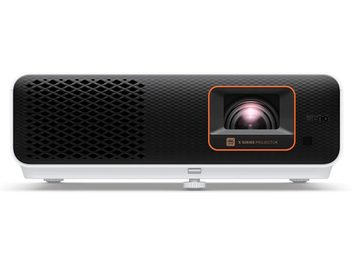
Featured products



You may also like to read
 Projector or OLED TV: which should you choose for a dedicated room in 2026?Comparisons and buying guides
 XGIMI or Hisense: which projector should you choose?Comparisons and buying guides
 Comparison of the 5 Xgimi Horizon Projectors: Find the Best One!Comparisons and buying guides
 Can a projector really replace a TV for everyday use?Comparisons and buying guides
 Epson EH-LS5000, LS6000, LS7000 and LS7500: 4K laser 3LCD drops below €3,000Hi-fi and home cinema news
 Tandem OLED: what is it and which TVs use it?Concepts and technologies


