

Can a projector really replace a TV for everyday use?
October 15, 2026
Contents
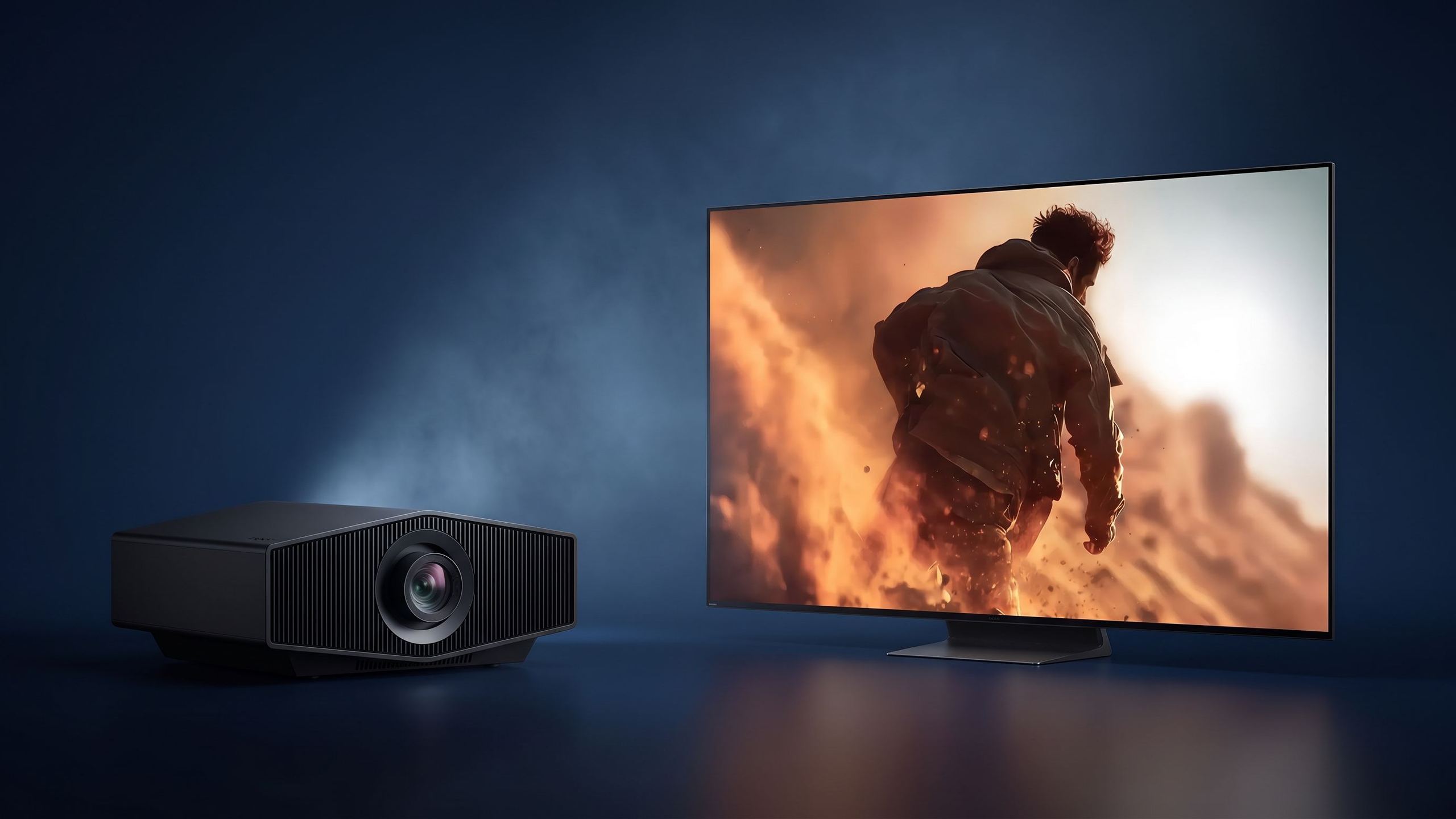
A 120-inch projection in a dark room always makes an impression. The real test comes the next morning, with the shutters open, when you want to watch the news while making coffee. That’s when a projector’s ability to replace a TV is decided—not in the dim light of a demonstration. A projector can take the place of a TV, but only under specific conditions that depend less on the device than on the room and how it’s used.
Ambient light decides almost everything
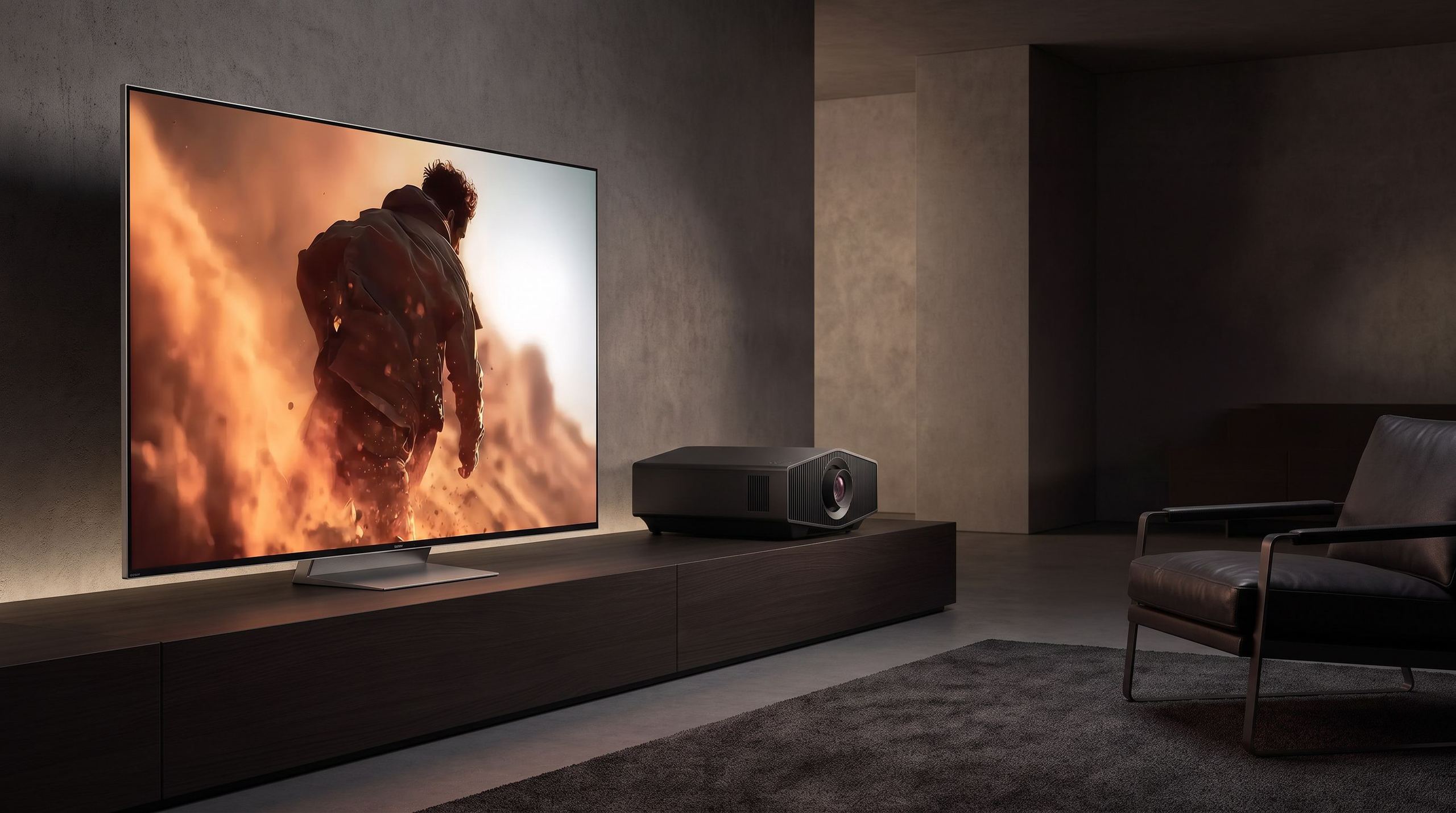
A television emits its own light. Each pixel of an OLED panel or a backlit LCD screen produces the photons it sends towards your eyes. A projector works the other way around: it projects a beam onto a surface, and that surface reflects the light back. That’s where the challenge lies. The screen reflects not only the projector’s beam, but also light from the ceiling fixture and the window.
The figures make the difference clear, provided you don’t compare them too simplistically. A TV is measured in nits (a measure of luminance), while a projector is measured in lumens (total light output). A recent TV exceeds 2,000 nits at peak brightness on mini-LED panels and maintains several hundred nits across the full screen. A good laser projector produces between 2,000 and 3,500 lumens, but those lumens spread across a 120-inch image before reflecting back towards the viewer. Expressed in the same unit as a TV, that works out to roughly 250 to 300 nits on a large screen. Comfortable in a room where light is controlled, but vulnerable as soon as the sun comes in.
Hence a simple rule: the room’s lighting matters more than the latest increase in the device’s brightness. Shutters, a dark wall around the screen and dimmable lighting do more to transform the image than a more expensive model.
Black levels: the other big divide
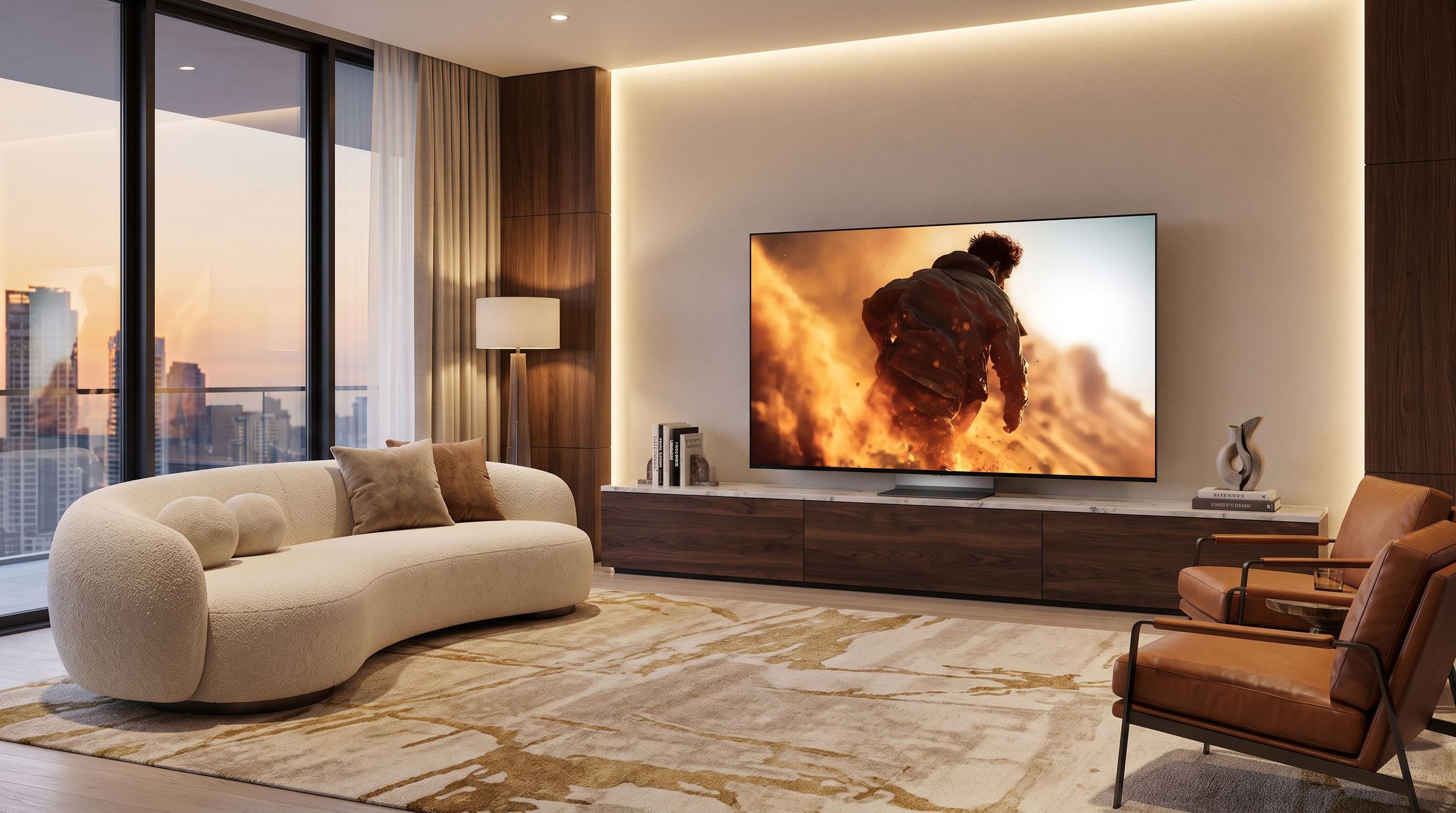
The second point clearly separates the two categories: the depth of black. An OLED panel switches off each pixel independently, producing perfect black and a contrast ratio measured in the millions. A projector cannot produce true black. Even in an image meant to be dark, some light always reaches the screen, turning black into grey. The best triple-laser ultra-short-throw models have a native contrast ratio of a few thousand to one, far behind self-emissive panels.
During a daytime football match or a brightly coloured cartoon, the difference is barely noticeable. In a night scene, a starry sky or a darkly graded film, it jumps out. The choice therefore depends as much on what you watch as on the time of day.
Ultra-short throw has brought the two worlds closer
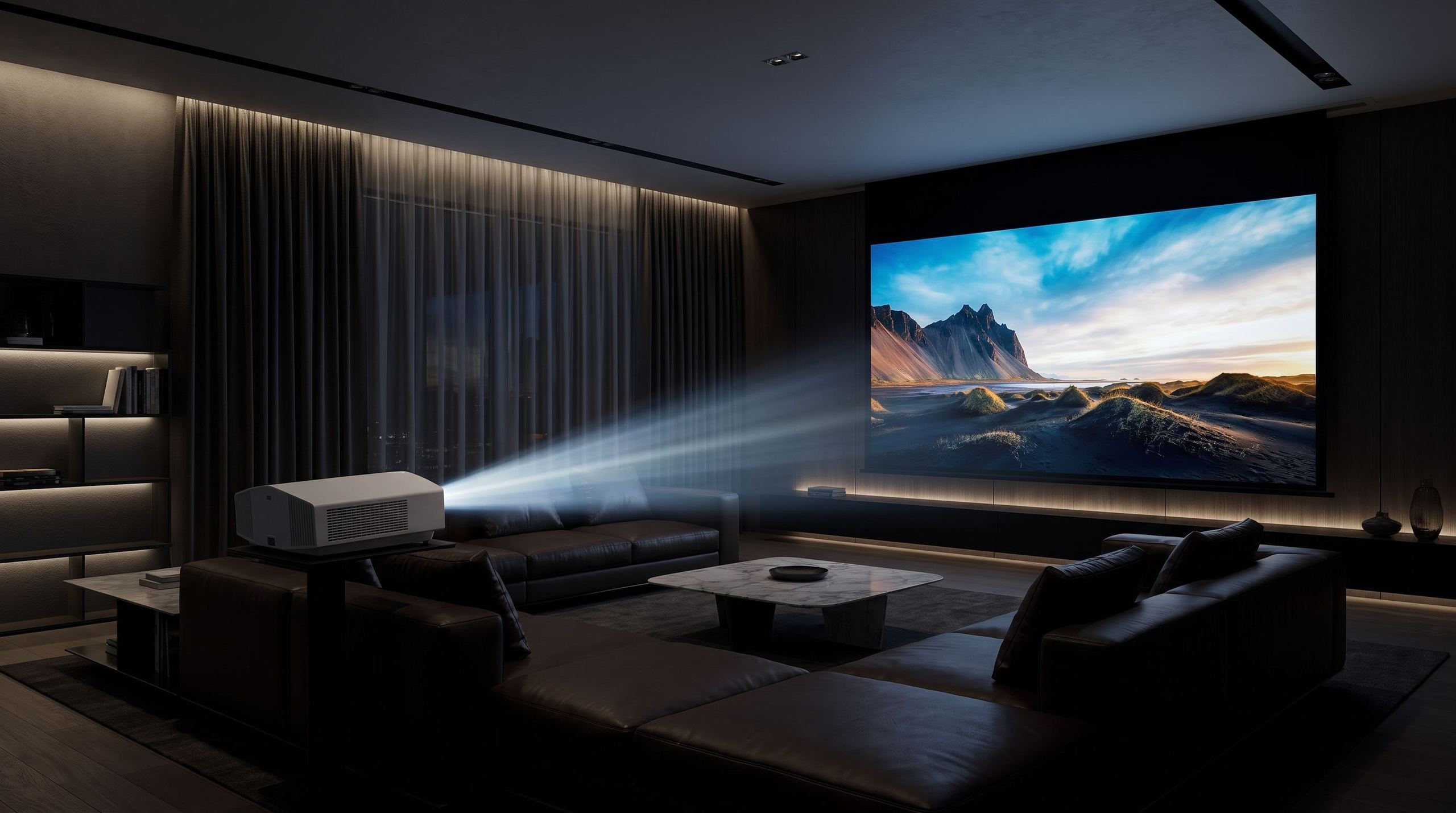
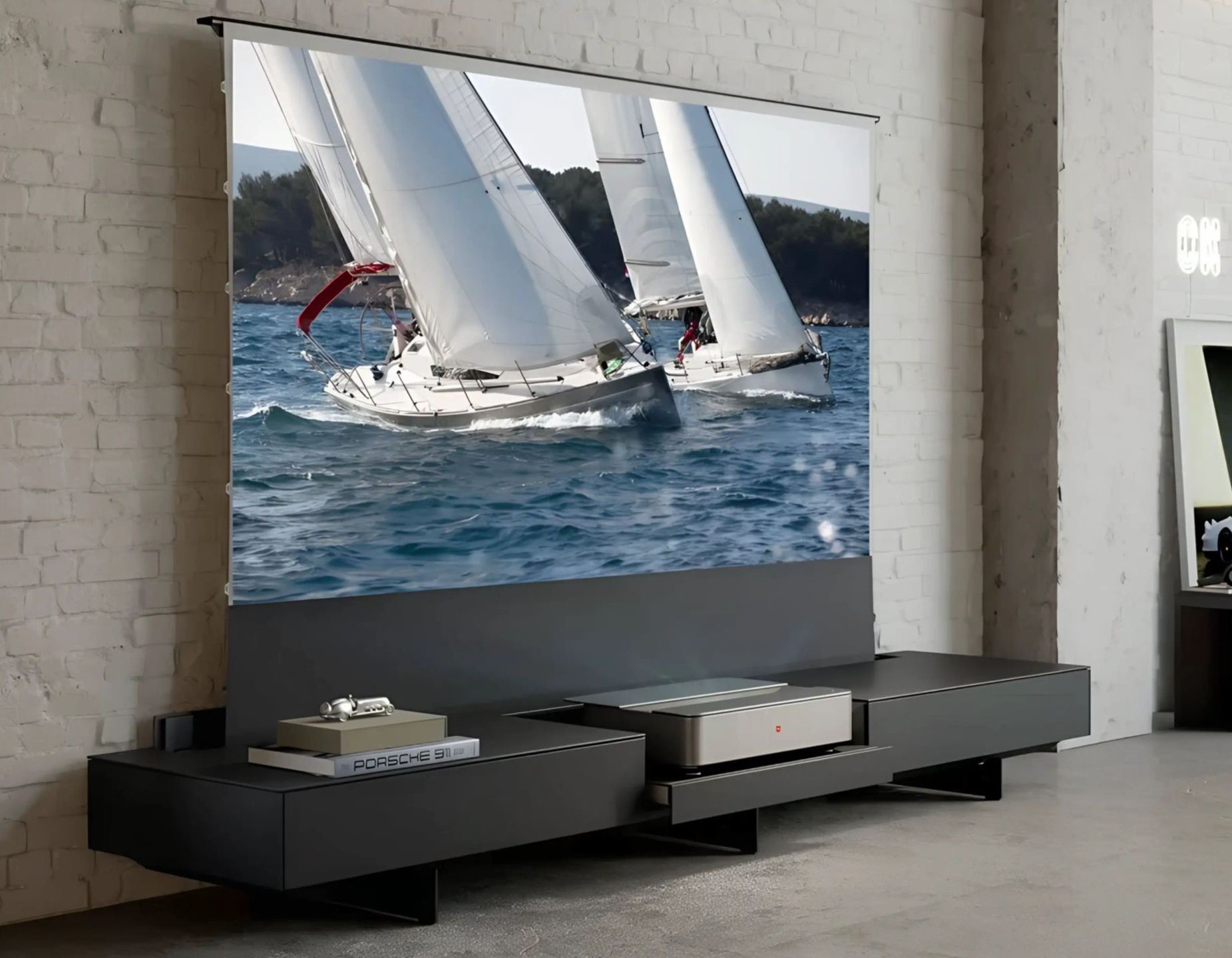
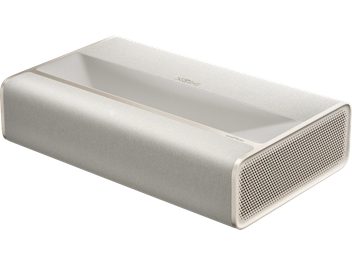
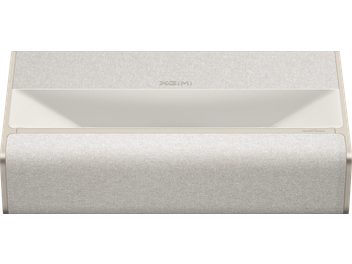
For a long time, a projector meant a substantial throw distance, holes in the ceiling and cables to run. Ultra-short throw has removed that constraint. These models, often called “Laser TVs”, sit on a low cabinet just a few centimetres from the wall and project a 100- to 130-inch image. A laser light source that switches on in a second or two, with no warm-up time, and a lifespan of 20,000 to 30,000 hours: at four hours of viewing a day, that’s more than fifteen years before any noticeable drop in brightness. An OLED TV lasts even longer, but that lifespan is more than enough for home use. The category includes devices such as the Hisense PX3-Pro and the XGIMI Aura 2, which simply need connecting to a power outlet and a source.
The screen does half the work, and it’s the part most often overlooked. A white wall reflects ceiling light in every direction and washes out contrast during the day. An ambient light rejecting (ALR) screen corrects this. Two designs coexist. A Fresnel lens screen, designed for ultra-short-throw projectors, rejects light from above and the sides: high gain at the centre, but a viewing angle limited to around 100°, which suits a few seats lined up facing the screen. A lenticular screen, known as CLR, rejects only light from the ceiling and widens the viewing angle to 170°, at the cost of more modest gain. The screen budget is no minor detail: in a living-room setup, it often matters as much as the choice of projector.
→ Explore ultra-short-throw projectors
Everyday use comes down to the details
A projector has no built-in TV tuner. To receive television broadcasts, you need a source: a provider’s set-top box, a streaming stick or box, or an external tuner. Most Laser TVs include Google TV or Android TV with the usual apps, which takes care of streaming, but terrestrial or satellite reception requires another device.
Then there’s sound. A Laser TV’s built-in speakers are adequate in a pinch, but rarely more. Because the device sits away from the listener, below the screen or at the back of the room, a soundbar or a multichannel system becomes almost essential for sound that matches the image. A TV raises the same question, but its built-in speakers often do better with everyday content.
Video games deserve a mention. Recent TVs support 4K at 120 Hz, variable refresh rate (VRR) and very low display latency (“input lag”). Projectors, including Laser TVs, still lag behind here: input lag is higher and motion is less smooth. For a racing or sports game on a large screen, the drawback is minor. For a competitive shooter where every millisecond counts, the TV retains the advantage.
That leaves noise and power consumption. A laser light source switches on without delay, but the cooling fan runs throughout viewing. Placed near the sofa, it can be heard during quiet passages. Neither side wins outright on electricity use: it all depends on screen size, the brightness setting and how long the device stays on. A large TV set to high brightness can consume as much as a projector, but people are more likely to switch on a TV out of habit than a projector.
The living room matters more than the spec sheet
Let’s lay it out plainly. A projector can replace a TV for everyday use when the room is suited to it and the setup is planned as a whole. A room where light can be controlled, or one fitted with a suitable ALR screen, a source for television and a decent sound system: in those conditions, a permanent 100- to 120-inch image can replace a 65-inch screen with no regrets, while being far less conspicuous when everything is off.
The picture changes in a brightly lit living room with several windows, where the screen is used throughout the day for everyday viewing and several people switch it on without a second thought. There, a TV remains simpler, brighter at any hour and more forgiving. Many households settle the question without choosing one over the other: a TV for everyday viewing and a projector for movie nights, each in its element.
The question, then, is not whether a projector can replace a TV. It can. The question is whether your room and your habits give it a chance to do the job well.
Popular products

You may also like to read
 PROJEO: how to choose your projection screen according to ambient light and the type of projectorComparisons and buying guides
 JVC vs Sony comparison: which high-end home theater projector should you choose?Comparisons and buying guides
 Best ultra short throw projectors 2025: comparison of the must‑know modelsComparisons and buying guides
 Long Throw, Short Throw, Ultra Short Throw: Which Projector Is Right for Your Room?Comparisons and buying guides
 Comparison of the 5 Xgimi Horizon Projectors: Find the Best One!Comparisons and buying guides
 Sony launches its first True RGB TVs with the Bravia 9 II and 7 IIHi-fi and home cinema news
 TCL TVs 2026: SQD-Mini LED, a new alternative to RGB Mini LEDHi-fi and home cinema news
 Sony Bravia 3 vs TCL C7K: which 65-inch TV should you choose under €1,000?Comparisons and buying guides
 What size 4K TV should you choose based on your viewing distance?Tutorials and practical guides
 Improve your TV’s picture in minutes without spending a centTutorials and practical guides








