Phono Cartridges Under €500: 2026 Comparison Guide
12 February 2026
Contents
Five hundred euros for a phono cartridge is a lot of money. It is also the threshold at which diminishing returns begin to set in. Below that, every euro invested delivers an audible improvement. Above it, differences become subtler and more dependent on the rest of the system.
Today’s market is crowded. Between MM, MC and a few moving-iron models, the choice of phono cartridge for a turntable has never been so wide below this price point. You still need to know what will work with your system.
→ Find the perfect cartridge for under €500
MM or MC cartridge for your turntable: what really matters
The distinction between MM cartridges and MC cartridges remains relevant, but it is often overemphasized. A well-designed MM cartridge, properly installed on a suitable tonearm and fed by a decent phono preamp, can outperform a poorly matched MC cartridge. Setup (alignment, tracking force, anti-skating, tonearm, record cleanliness) matters more than the logo on the body.
MC cartridges generally offer lower moving mass, resulting in better transient tracking. But they require a compatible phono preamp (sufficient gain, adjustable load impedance), which can add extra cost. High-output MC cartridges partly overcome this issue by remaining compatible with an MM phono stage.
MM cartridges have a practical advantage: the stylus is replaceable. A stylus wears out after 500 to 1,500 hours depending on its profile and record maintenance. Being able to change the stylus without removing the cartridge or sending it back to the factory is a strong argument.
Stylus profile, an often underestimated criterion
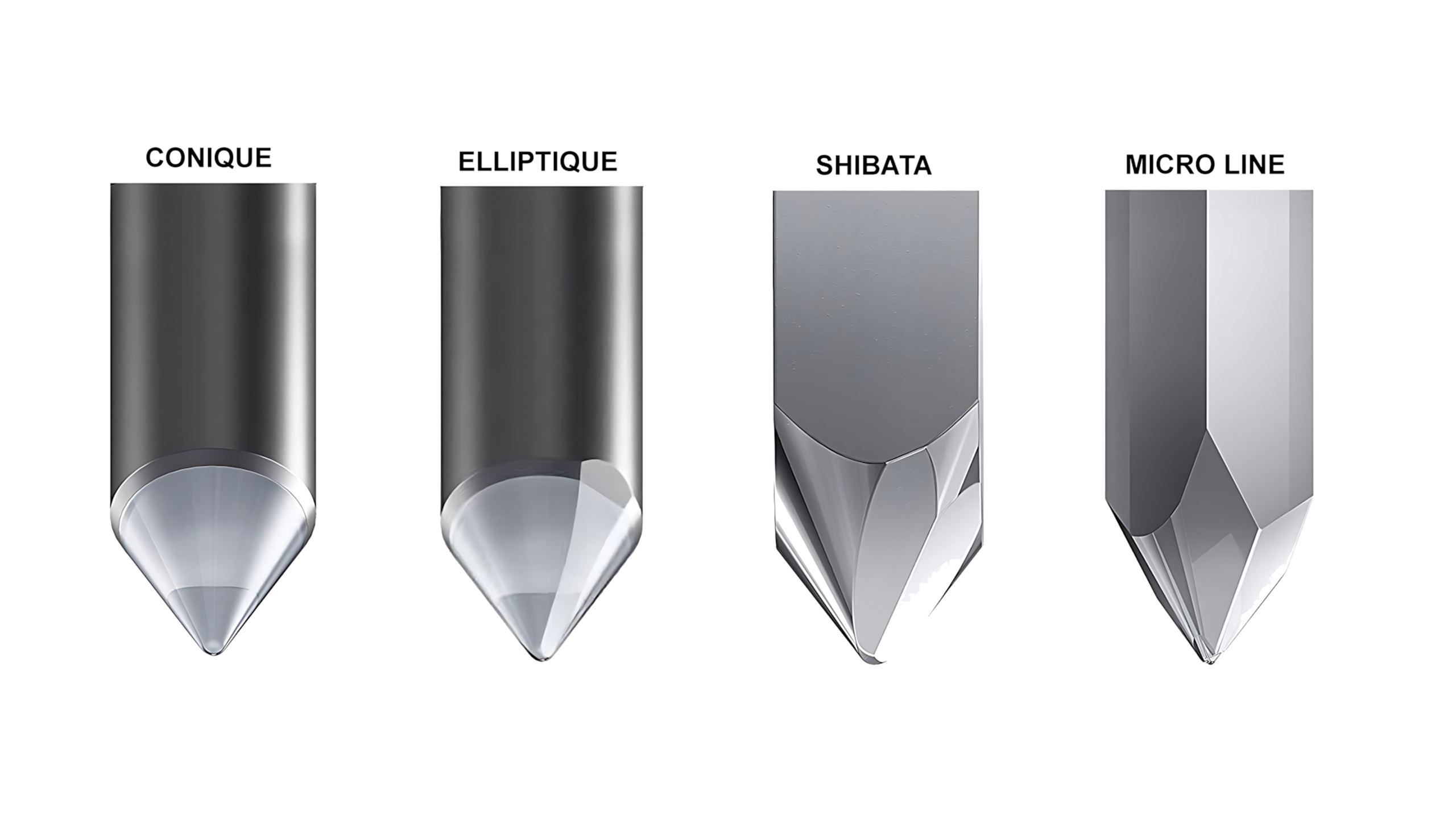
More than the generator type, it is the stylus profile that determines how much information is extracted from the groove. From conical (the least precise) to elliptical, then Shibata, MicroLine, Fine Line and Line Contact, each profile increases the contact area and improves tracking of high-frequency modulations.
For under €500, advanced profiles are available on quality phono cartridges: Shibata from Audio-Technica, Fine Line from Ortofon, MicroLine from Audio-Technica, nude elliptical from Nagaoka and Sumiko. The improvement over a bonded elliptical is real: better channel separation, reduced distortion, reduced record wear.
Reference MM cartridges under €500
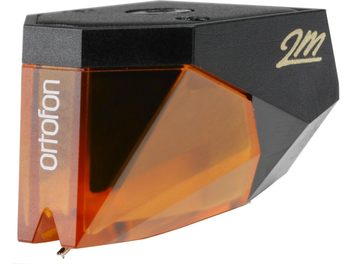
Ortofon 2M Bronze (€399)
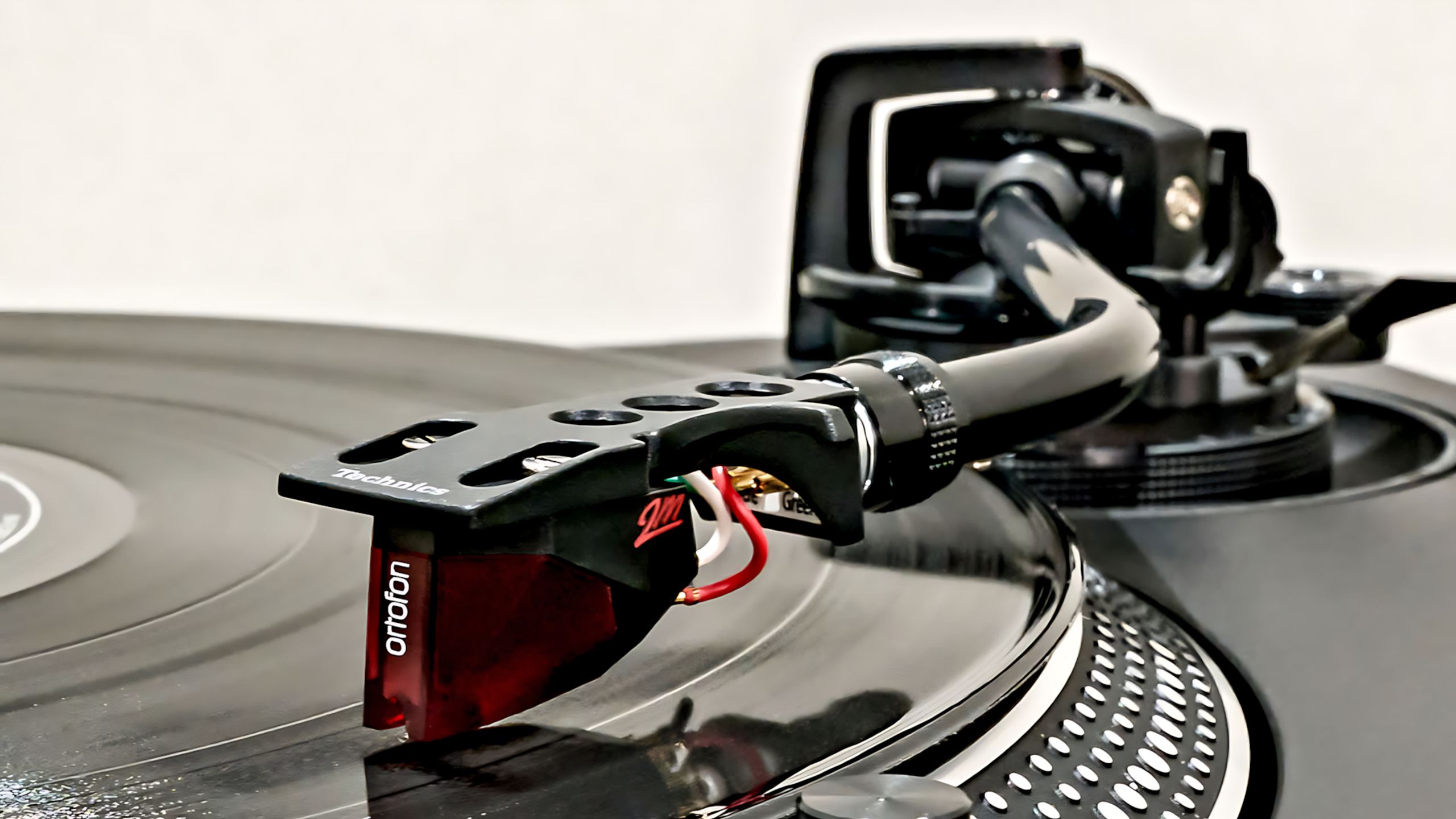
Ortofon’s 2M range is a reference for MM cartridges, and the 2M Bronze is its sweet spot. It shares its improved engine (split pole pins, silver-plated copper wire) and Lexan body with the 2M Black, which costs twice as much. Only the stylus differs: nude Fine Line for the Bronze, Shibata for the Black.
The sound is detailed without harshness, with firm bass and extended treble. The cartridge does not draw attention to any frequency range, making it versatile across all genres. Weight of 7.2 g, compliance of 22 µm/mN, tracking force of 1.5 g: compatible with the vast majority of light- to medium-mass turntable tonearms. A 2M Black stylus can be fitted for a future upgrade.
Audio-Technica VM750xSH (€379)
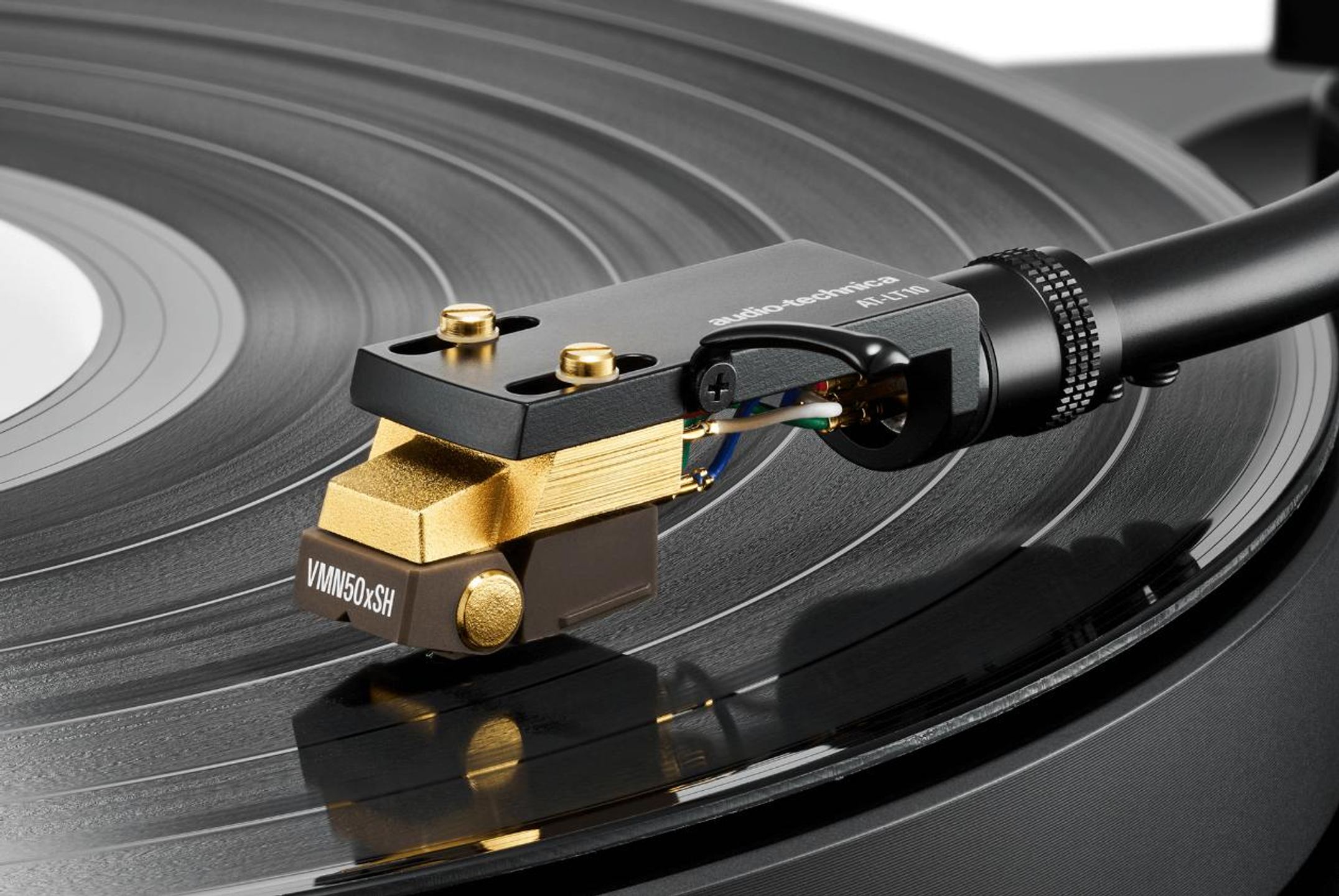
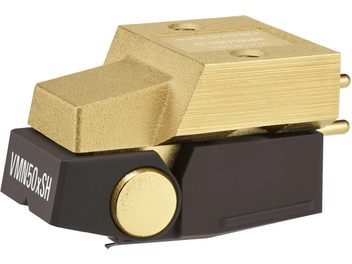
Audio-Technica has been manufacturing phono cartridges since 1962. The VM750xSH uses a nude Shibata stylus on an aluminium cantilever, in a die-cast aluminium alloy body. The dual V-magnet system ensures 28 dB channel separation at 1 kHz.
The sound character is precise and analytical, with very extended treble. Compared with the VM740xML (around €270, MicroLine stylus), the VM750xSH is more balanced in the upper range. With a tracking force of 2 g and moderate compliance, it is an easy cartridge to fit to modern tonearms. The VM540ML (around €260) features the MicroLine stylus in a polymer body, a solid option for tighter budgets.
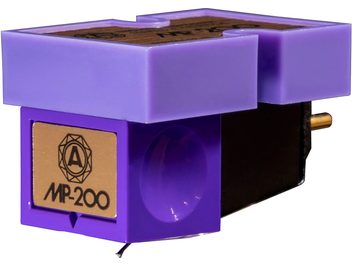
Nagaoka MP-200 (€479)
Nagaoka, a Japanese manufacturer active for 85 years, uses a moving permalloy (MP) principle: a nickel-iron alloy magnetic core with very high permeability, technically close to MM.
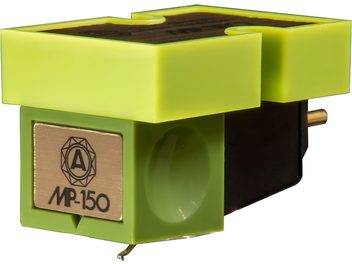
The MP-200 stands out for its boron cantilever, lighter and more rigid than aluminium. This rigidity shifts the cantilever’s resonant frequency beyond the audible range, for more neutral reproduction. Superfine elliptical stylus (0.4 × 0.7 mil). The sound is rich and organic, with a full midrange and articulate bass: a phono cartridge suited to jazz, classical music and vocals. The MP-150 (around €380, hardened aluminium cantilever) is a more affordable entry point into Nagaoka.
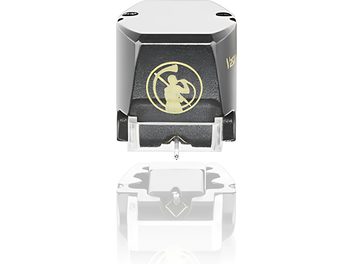
Gold Note Vasari gold (€419)
Gold Note, an Italian brand founded in 2011, uses on the Vasari Gold a superfine elliptical stylus (7.5 × 15.5 µm) on an aluminium cantilever. The machined solid duralumin body provides rigidity and damping. Output of 4 mV, compatible with standard MM phono preamps.
The sound character is open, transparent and rich in detail, with remarkable clarity. Frequency response of 15 to 25,000 Hz, channel separation above 22 dB at 1 kHz. With a tracking force of 2 g and moderate compliance, it is easy to fit to modern tonearms. The Vasari Red (polymer body, conical stylus) offers a more accessible entry-level option.
MC cartridges under €500: entering the moving-coil world
Hana EH / EL (€449)
Hana cartridges are made by Excel Sound in Japan, a workshop founded by Masao Okada with half a century of experience. The E series uses Alnico magnets, 4N copper coils, an aluminium cantilever and an elliptical stylus.
The Hana EH (high output, 2 mV) works with an MM preamp. The Hana EL (low output, 0.5 mV) requires an MC phono stage, but offers a slightly more open sound when loaded at 400-600 Ω. The sound character is natural and fluid, focused on timbre. At €450, it is a convincing MC phono cartridge, even if MM cartridges at the same price equipped with Shibata or MicroLine profiles will extract more detail.
Sumiko Blue Point No. 3 (€469)
A high-output MC cartridge (2.5 mV), compatible with MM preamps. Updated in 2021, the Blue Point No. 3 has an organic, rhythmic character, with airy treble and substantial bass. It is easy to fit to most turntables thanks to its redesigned body.
Grado Opus 3: the moving-iron route (€349)
Grado, a Brooklyn-based manufacturer, uses moving-iron (MI) technology that loads like an MM cartridge (47 kΩ). It is an iron piece that moves within the magnetic field, with a recognizable sound signature: present, textured midrange, warm vocals and punchy bass. The upper range is smoother than with Ortofon or Audio-Technica. Please note: Grado cartridges are sensitive to stray electromagnetic fields. Some turntables with poorly shielded motors cause hum. Check compatibility before purchasing.
Phono preamp and tonearm compatibility: common pitfalls
Fitting a €400 phono cartridge to a basic integrated preamp means wasting its potential. On a tight budget, it can sometimes be better to choose a €300 cartridge and invest the difference in a dedicated phono preamp (Pro-Ject Phono Box S2, Cambridge Audio Alva Solo, iFi Zen Phono 3).
Cartridge compliance must match the effective mass of your turntable’s tonearm. A high-compliance cartridge on a heavy tonearm will produce poorly positioned resonance in the frequency range, degrading tracking. Most of the phono cartridges mentioned here have medium compliance, compatible with common tonearms (9 to 12 g effective mass). Another useful rule: do not spend more on the cartridge than on the turntable.
Comparison table of phono cartridges under €500
| Cartridge | Type | Stylus | Approx. price | Character |
|---|---|---|---|---|
| Ortofon 2M Bronze | MM | Nude Fine Line | €400 | Balanced, detailed, versatile |
| Audio-Technica VM750xSH | MM | Nude Shibata | €380 | Precise, extended, analytical |
| Nagaoka MP-200 | MP | Superfine elliptical | €480 | Rich, organic, boron cantilever |
| Nagaoka MP-150 | MP | Superfine elliptical | €380 | Solid, fluid, aluminium cantilever |
| Gold Note Vasari gold | MM | Superfine elliptical | €420 | Open, transparent, clear |
| Hana EH | High-output MC | Elliptical | €450 | Natural, fluid, musical |
| Hana EL | Low-output MC | Elliptical | €450 | Natural, open, nuanced |
Frequently asked questions
What is the difference between an MM cartridge and an MC cartridge?
An MM cartridge has a high output level, works with any standard phono preamp, and allows stylus replacement. An MC cartridge offers lower moving mass for better detail tracking, but requires a compatible MC phono preamp. The stylus is generally not replaceable on an MC cartridge.
Is a specific phono preamplifier required for an MC cartridge?
Low-output MC cartridges (0.5 mV) require an MC phono preamp with sufficient gain. High-output MC cartridges (2 mV and above), such as the Hana EH or Sumiko Blue Point No. 3, work with a standard MM preamp.
How long does a phono cartridge stylus last?
Between 500 and 1,500 hours depending on the stylus profile and record care. An elliptical stylus lasts an average of 500 to 800 hours. Playing clean records and cleaning the stylus regularly extends its lifespan.
Which cartridge should you choose to get started?
An MM cartridge is highly recommended for beginners because it is easy to install, requires simpler maintenance, and works with most phono preamps. Popular models include the Ortofon 2M Red and the Audio-Technica VM95E.
Featured products




You may also like to read
 DJ Cartridge vs Hi-Fi Cartridge: Stylus, Tracking Force, and Sound Quality ExplainedComparisons and buying guides
 Clearaudio, Okki Nokki, Enova: how to clean your vinyl records effectivelyComparisons and buying guides
 Ortofon 2M: find the cartridge that suits youComparisons and buying guides
 Enova HIFI: a complete range for storing and setting up your turntableComparisons and buying guides