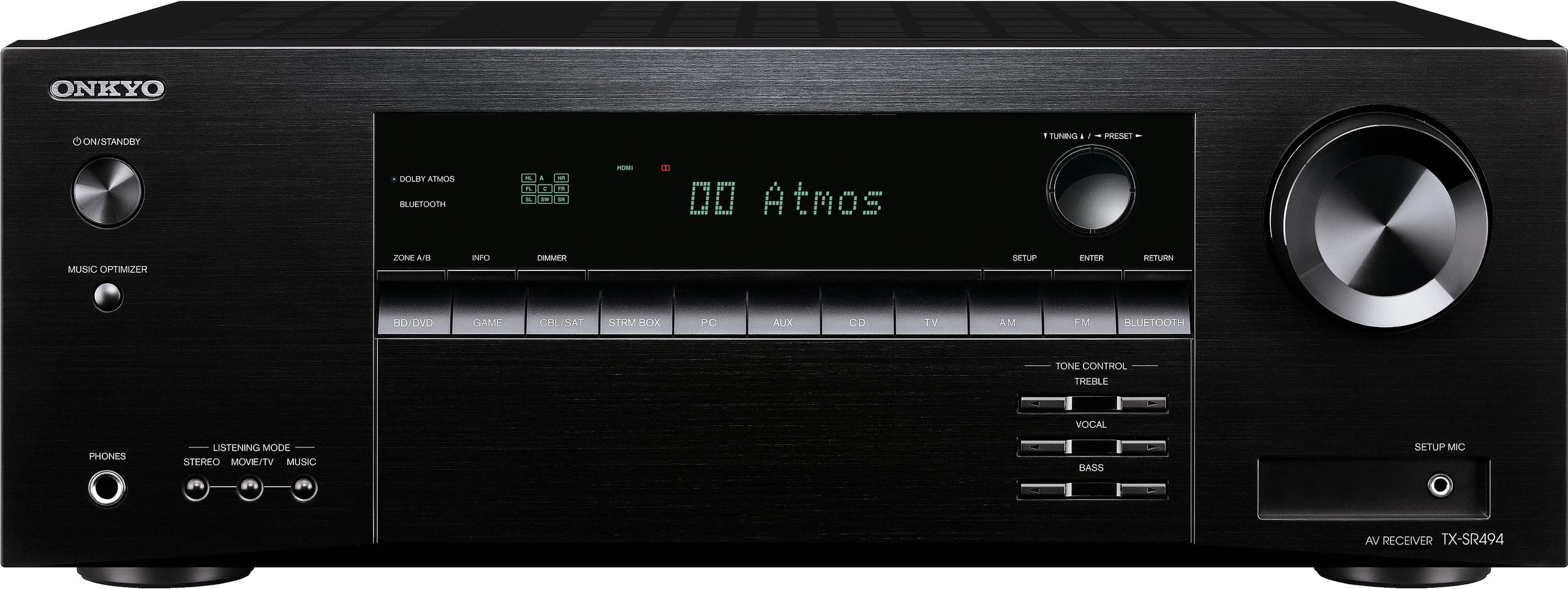
Setting up a multi-channel home cinema system without a specialist’s budget — that’s the territory of entry-level AV receivers. This one decodes Dolby Atmos and DTS:X, drives up to seven speakers and two subwoofers, and passes 4K HDR video through to the TV. Enough to move from a living room with a soundbar to a full surround setup, with room to expand later.
Seven channels, several possible configurations
Seven amplification channels — that’s the starting point for what the TX-SR494 can do, and more importantly, the freedom it offers in speaker placement. Two main layouts are possible. The first stays in the horizontal plane: two front speakers, one centre, two side surrounds and two rears, giving a 7.2 configuration where sound wraps around the sofa. The second reassigns the last pair upward, to ceiling speakers or modules placed on top of the front speakers, for a 5.1.2 setup (five floor-level speakers, one or two subwoofers, two height channels).
It’s this second option that adds the vertical dimension. Dolby Atmos and DTS:X no longer distribute sound through fixed channels but through objects: a helicopter, a downpour, a voice each receive a precise position in space, which the AV receiver sends to the nearest speaker, including overhead. The two dedicated subwoofer outputs serve to balance bass across the room, or to power two subwoofers for more consistent low-end from one listening position to another.
Understanding the rated wattage
Power figures require a little reading, as they can easily mislead. The 160 W per channel corresponds to a measurement on a single channel, at 1 kHz, with 10% distortion — a level at which the signal is already noticeably degraded. The 135 W figure, measured to the IEC standard at 1% distortion, is also obtained on an isolated channel. In real-world use, with five to seven speakers driven simultaneously across the full frequency range, per-channel power drops below these values.
That said, nothing disqualifying here. In a living room, with speakers of typical sensitivity, the headroom allows for comfortable listening levels, including on the peaks of an action film soundtrack. The AV receiver accepts speakers from 4 to 16 ohms, covering almost the entire market, and its 109 dB signal-to-noise ratio keeps background noise well at bay.
4K HDR video through to the TV
Positioned between sources (Blu-ray player, console, set-top box) and the TV, the TX-SR494 passes video through untouched. It handles 4K at 60 frames per second and supports the most common HDR formats — Dolby Vision, HDR10 and HLG — along with the extended BT.2020 colour space and 4:4:4 chroma sampling for accurate colour reproduction. HDCP 2.2 compatibility unlocks playback of protected 4K content, from UHD Blu-rays to video streaming services.
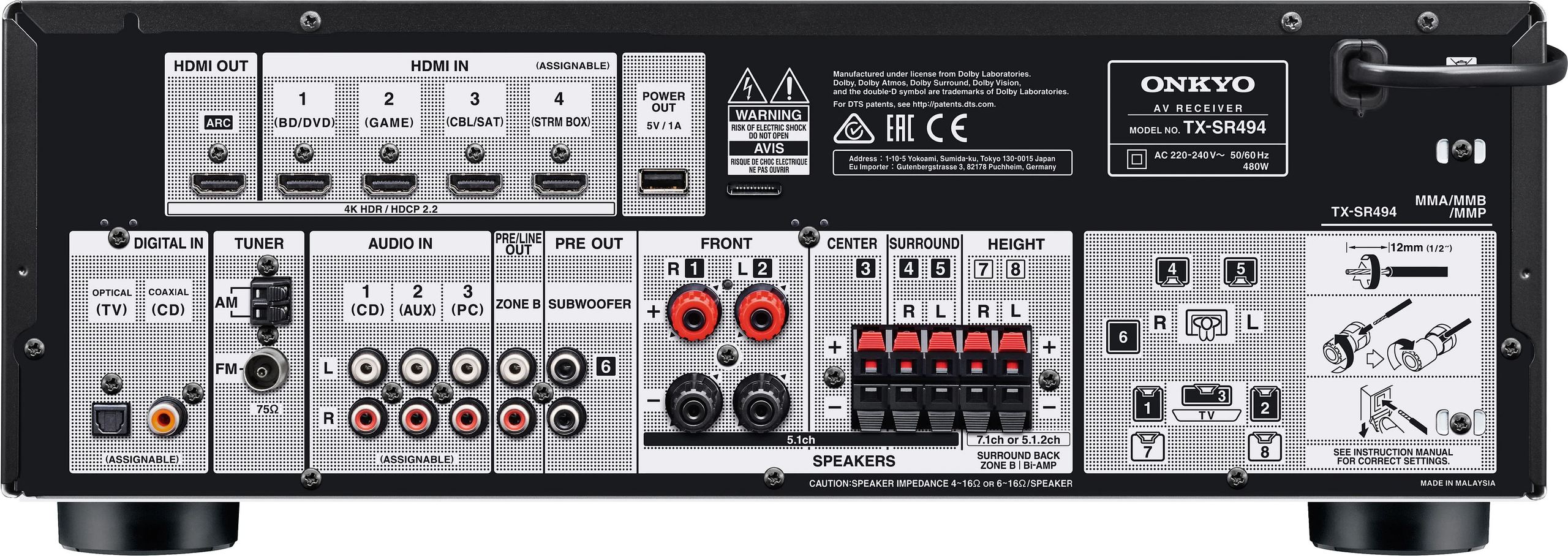
Four HDMI inputs accept sources, and one output connects to the TV. This output supports ARC (Audio Return Channel): sound from the TV’s apps is sent back to the AV receiver via the existing HDMI cable, with no separate audio connection required. An internal upscaler can convert a 1080p image to 4K resolution. The video section is limited to the HDMI 2.0 standard: 4K at 120 frames or 8K bandwidth is not supported — a coherent choice given its home cinema purpose and the TVs it is most commonly paired with.
Audio decoding and music listening
Music is not an afterthought. An AKM converter, capable of handling files up to 32-bit/384 kHz, supports high-resolution recordings and SACD playback via HDMI. Direct mode bypasses unnecessary processing to stay as close as possible to the original signal, while Advanced Music Optimizer takes the opposite approach, attempting to restore some of the detail lost by heavily compressed files and Bluetooth streaming.
Dolby TrueHD and DTS-HD Master Audio soundtracks are decoded without re-compression, at disc-quality level. Without ceiling speakers, Dolby Atmos Height Virtualizer and DTS Virtual:X recreate some of the height and envelopment effects using only the speakers already in place. The Dolby Surround and DTS Neural:X upmixers spread a stereo or 5.1 source across all connected speakers. A tone control and the Vocal Enhancer function — which boosts dialogue levels when they get lost in the action — round out the feature set.
Automatic system calibration
The success of a multi-channel system depends greatly on speaker calibration, a step that often puts people off at the outset. The TX-SR494 comes with a microphone and the AccuEQ system: placed at the listening position, the microphone captures a series of test tones, and the AV receiver determines the distance, level and frequency response of each speaker, then corrects any discrepancies. This version also calibrates subwoofer volume — something that ear-based adjustment frequently gets wrong.
Everything else is designed for simplicity. A connection guide printed on the rear panel identifies each terminal, a direct power-on restores the last used source, and a sleep timer switches everything off after a chosen delay. In standby, power consumption drops to 0.2 W.
Connections and wireless streaming
Wireless connectivity is handled by Bluetooth, which receives audio from a phone, tablet or computer. The TX-SR494 has no Wi-Fi or network streaming: no built-in Spotify, TIDAL or Qobuz, and no multiroom functionality. To listen to a streaming service, the options are Bluetooth or an external source connected to one of the inputs.
The remaining connectivity covers everyday needs: optical and coaxial digital inputs for a TV or console, three stereo analogue inputs, a 6.35 mm headphone jack on the front panel, and a pre-amplified line output for a second stereo zone, listened to independently of the main system. An AM/FM tuner with RDS and forty presets, along with a powered USB port on the rear, complete the package. Front speakers connect via screw terminals; the remaining speakers use lever-type connectors.