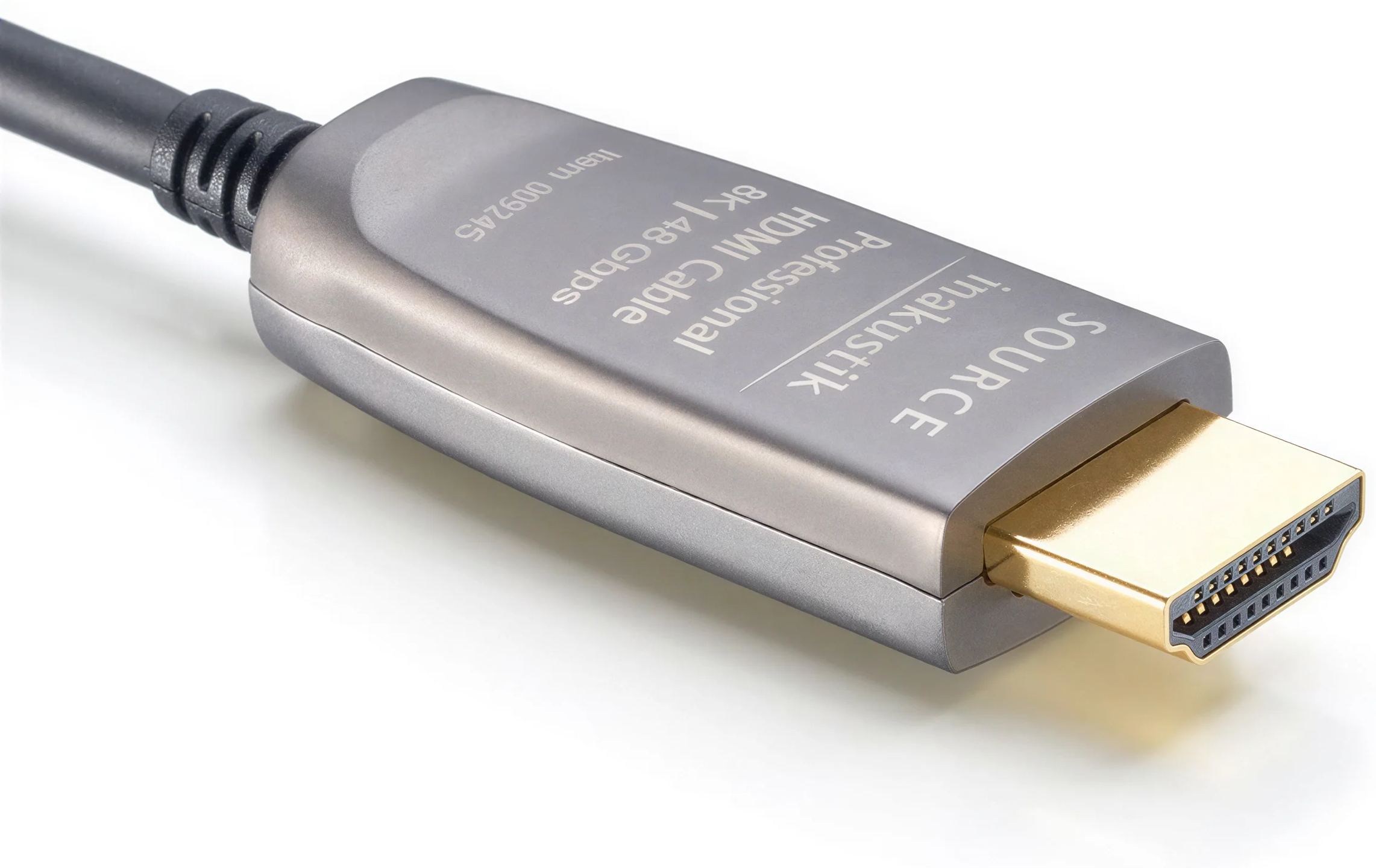
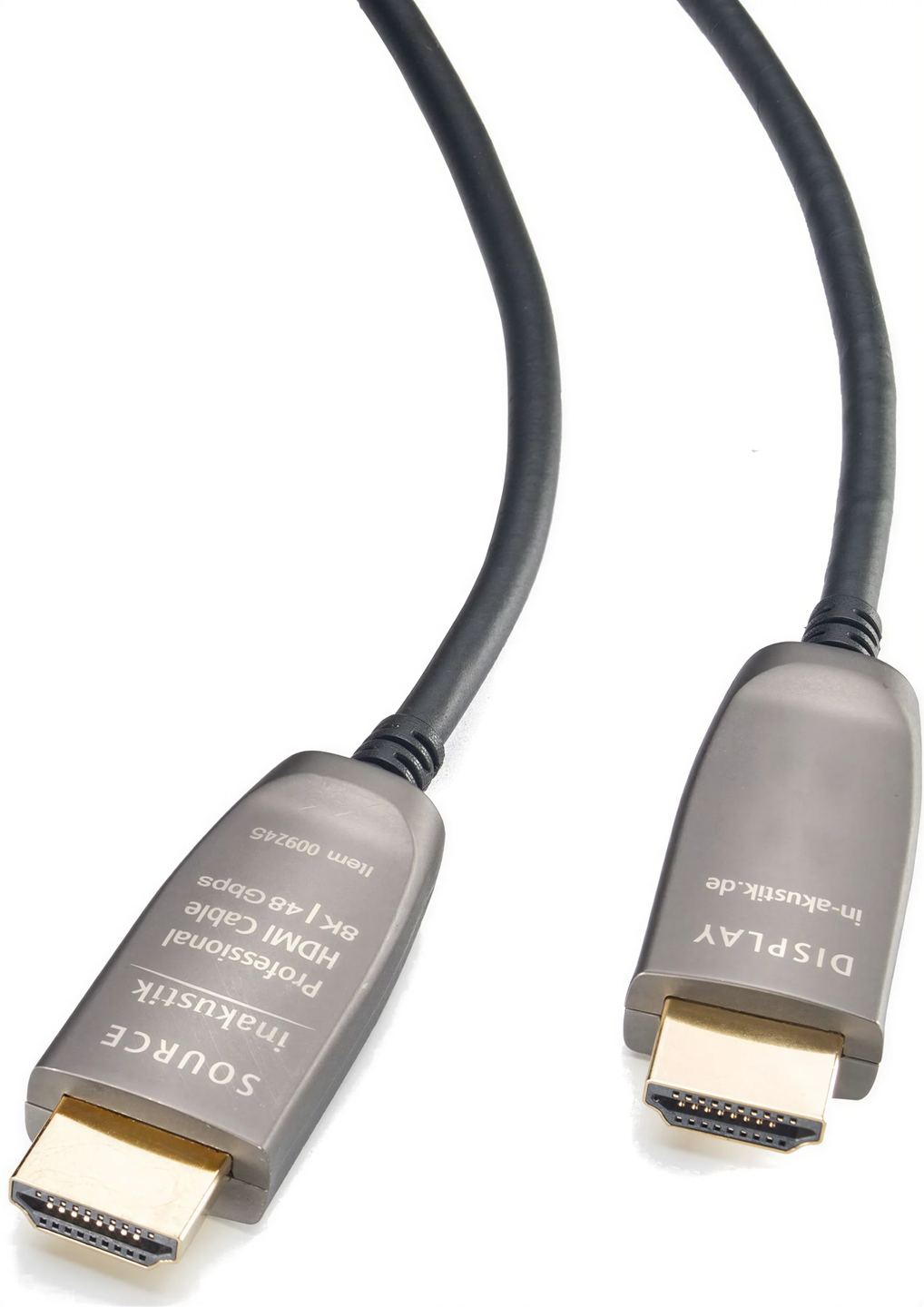
With 46 years of experience in designing high-performance cables, Inakustik offers the Optical HDMI 2.1 PRO cable. This cable uses optical fiber and complies with the HDMI 2.1 standard, enabling the transmission of audiovisual signals over long distances while maintaining signal integrity.
Optical fiber: a technological breakthrough in HDMI transmission
The Optical HDMI 2.1 PRO cable abandons traditional copper conductors in favor of a fully fiber-optic architecture. This radical approach converts electrical signals into light pulses that travel through ultra-thin glass fibers. With a remarkably slim cable diameter of just 4 mm, this solution is paradoxically more robust in transmission than conventional HDMI cables, while maintaining exceptional flexibility that greatly facilitates installation in existing conduits.
The cable’s construction is based on all-metal connectors that ensure a stable and durable connection. A direction indicator is integrated to prevent any installation errors, a practical detail that reflects the attention paid to user experience. This directional design is inherent to the integrated electronics that handle the conversion of optical signals.
Power for the system is drawn directly via the HDMI interface itself, eliminating the need for a bulky external power supply that often complicates professional installations. This feature greatly simplifies deployment, particularly in setups where access to power outlets is limited or where installation aesthetics are paramount.
Technical capabilities and transmission performance
The Optical HDMI 2.1 PRO cable achieves staggering data rates of up to 48 Gbps, enabling video formats up to 10K at 120 Hz. This substantial bandwidth paves the way for resolutions that far exceed current standards, including native support for 8K at 60 Hz and 4K at refresh rates up to 240 Hz. Compatibility with HDR (High Dynamic Range) in its various forms ensures faithful reproduction of the most demanding content in terms of color dynamics.
Support for DSC (Display Stream Compression) deserves special attention. This visually lossless compression technology, developed by VESA, optimizes the use of available bandwidth. DSC compresses video data at ratios of up to 3:1 while maintaining image quality indistinguishable from the original to the human eye. This compression is performed in real time with negligible additional latency of around 0.5 microseconds, enabling the transmission of ultra-high-definition content even in scenarios where bandwidth would otherwise be insufficient.
Support for different chroma subsampling formats (4:4:4, 4:2:2, 4:2:0) offers maximum flexibility according to the specific needs of each installation. The 36-bit color depth (3 × 12 bits per channel) guarantees remarkably fine color transitions, essential for professional applications where color accuracy is critical.
Advanced audio technologies and eARC
The implementation of eARC (enhanced Audio Return Channel) is one of the most sophisticated features of this cable. Unlike standard ARC, which is limited to around 1–3 Mbps, eARC provides 37 Mbps of audio bandwidth, sufficient to transmit uncompressed 7.1-channel audio streams, or even up to 32 channels according to the specifications. This capability enables full support for high-resolution audio formats up to 192 kHz at 24-bit, including the most demanding codecs such as Dolby TrueHD and DTS-HD Master Audio.
Transmission range varies depending on the mode used: standard ARC can operate up to 50 meters, while eARC, which is more bandwidth-intensive, maintains perfect transmission up to 30 meters. This technical distinction allows integrators to choose the appropriate mode depending on the setup and distances involved.
Automatic lip-sync built into eARC eliminates delays between picture and sound, a recurring issue in complex installations. This feature is particularly valuable in high-end home cinema configurations where multiple processing devices can introduce cumulative latencies.