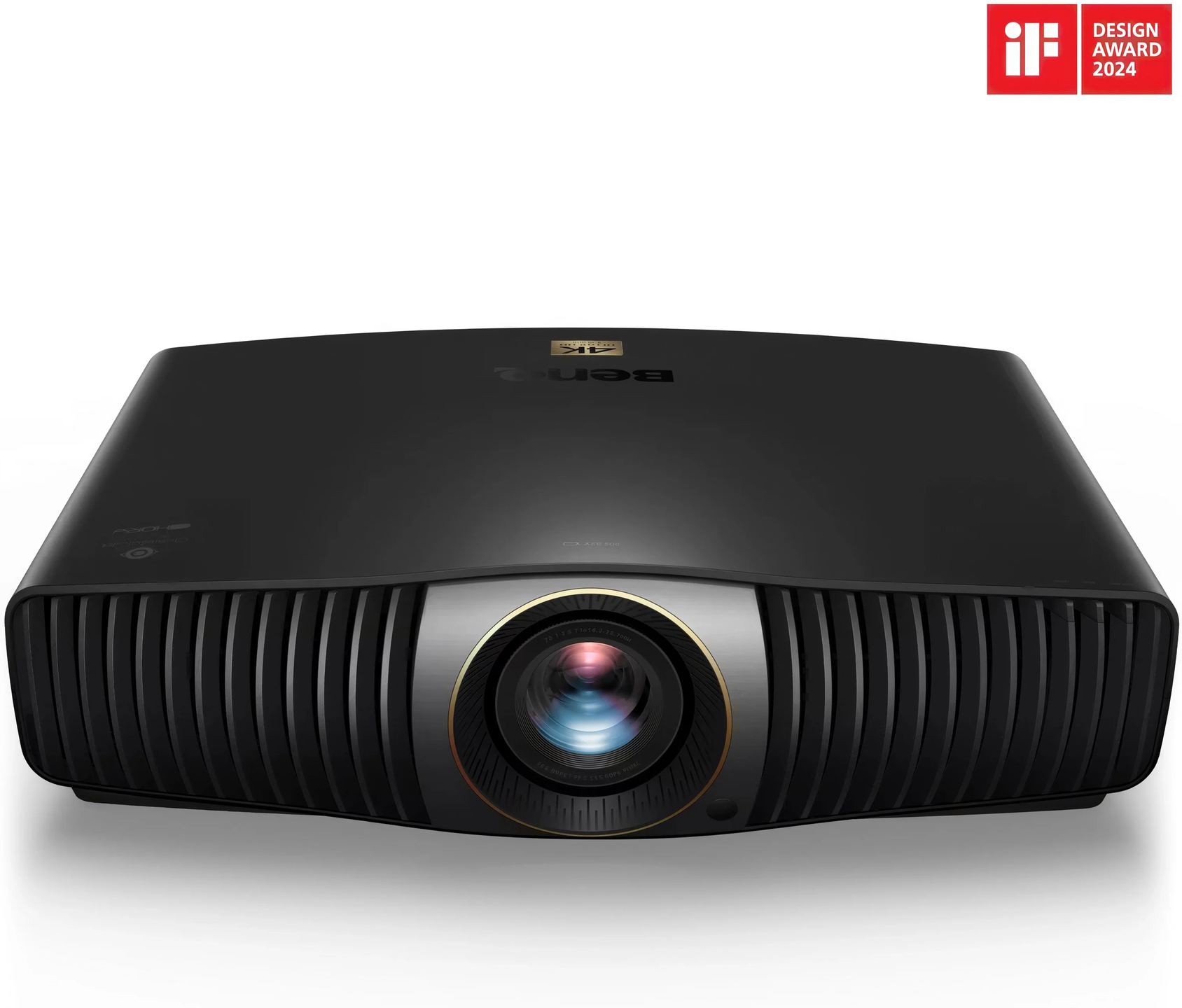
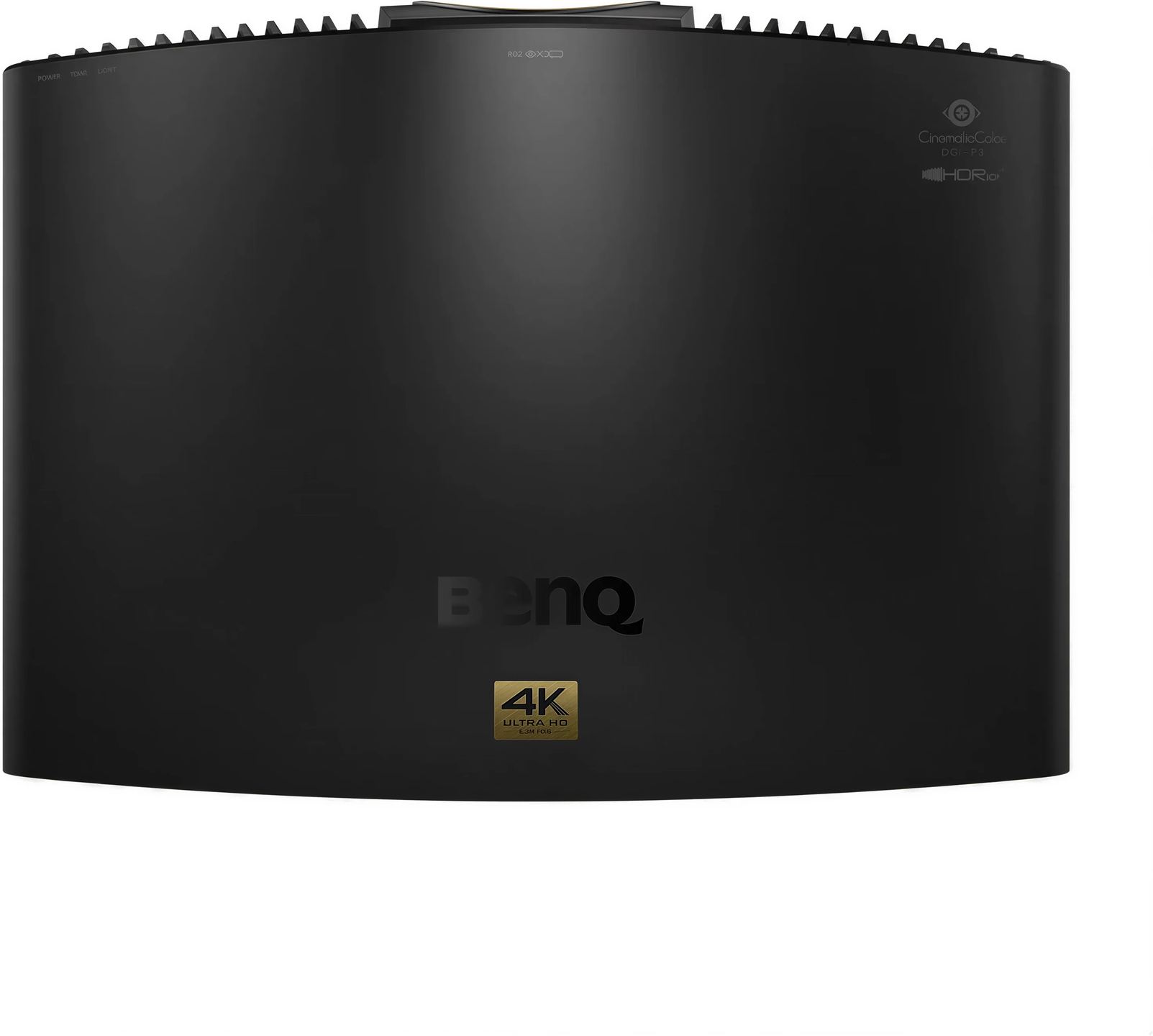
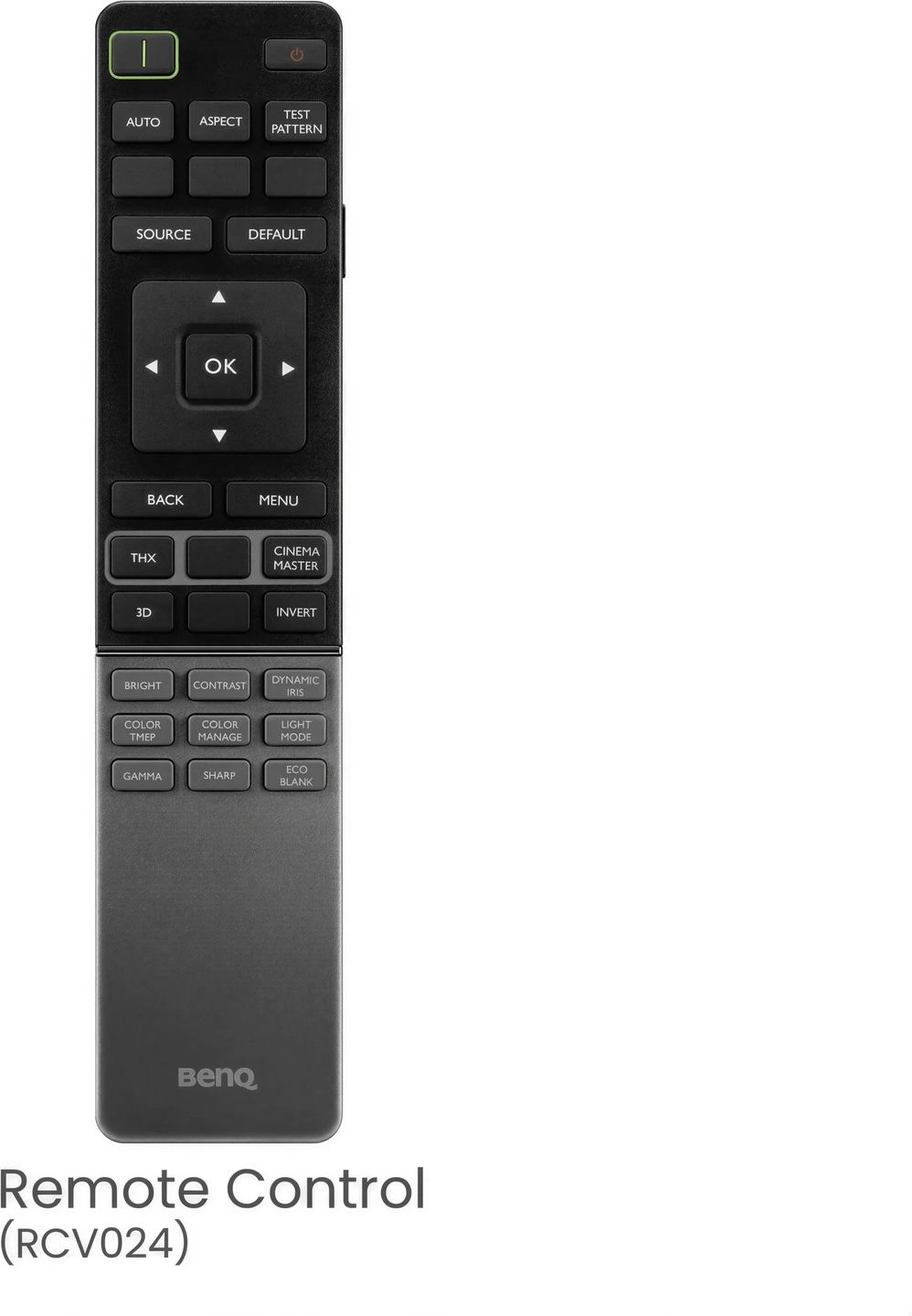
A dark room, a screen more than three metres wide and films in 4K HDR: this is where this DLP projector belongs. It replaces the lamp of its predecessor, the W5700, with a 2,600-lumen laser source, leaves the factory calibrated with its own measurement report and lets you adjust zoom, focus and lens shift from the remote control. It has neither speakers nor a streaming system: the picture comes from your HDMI sources, while the sound goes to your amplifier.
A laser source instead of a lamp
The W5700 used a 1,800-lumen lamp that needed replacing over the years. The W5800 switches to laser and increases output to 2,600 ANSI lumens, with a lifespan stated by BenQ of 20,000 hours in normal mode and 25,000 hours in economy mode. At four hours of film each evening, normal mode covers more than thirteen years of use without a wear part to replace.
Those 2,600 lumens correspond to the brightest modes. In Cinema mode, when the W5800 covers the entire DCI-P3 colour space, BenQ states up to 1,700 lumens: that is the price of extended colour, and it remains more than enough for a large screen in a dark room.
The image is formed by a Texas Instruments DLP chip that displays 3,840 × 2,160 pixels through very rapid pixel shifting, with 30-bit colour encoding (1.07 billion shades). This prevents visible steps in sky gradients or fades to black.
Colours measured individually at the factory
Every W5800 is calibrated before shipping and supplied with its individual calibration report. In it, BenQ guarantees a colour error (Delta E) of less than 1 across the Rec.709 colour space, used for Blu-ray and television, and less than 2 on the greyscale. Below these values, the eye struggles to distinguish the displayed colour from the reference colour. Coverage reaches 100% of DCI-P3, the colour space for 4K HDR films, and 100% of Rec.709: BenQ brings this work together under the name CinematicColor.
Filmmaker mode disables processing that alters the image (motion smoothing, sharpening, HDR post-processing) and respects the aspect ratio and colour rendition chosen during filming. The W5800 is also ISFccc certified: its two modes, ISF Day and ISF Night, can be readjusted and locked by a certified calibrator once the screen is installed and the room lighting has been taken into account. For those making their own adjustments, white balance can be corrected at 11 brightness levels, allowing a colour cast in the midtones to be corrected without affecting the highlights.
HDR processing that adapts to every scene
An HDR film is graded for displays capable of peak brightness levels that no projector can achieve. The image therefore needs to be recalculated to fit within what the device can display: this is tone mapping. BenQ’s HDR-PRO technology does this in two stages to preserve detail in both bright skies and dark areas.
With HDR10+, the film transmits its own metadata frame by frame, and the W5800 continuously adjusts this calculation rather than applying an average setting to the entire film. HDR10 and HLG (used in television) are also supported.
Two processing features work on contrast. Local Contrast Enhancer divides the image into more than 1,000 zones whose gamma is adjusted separately, adding depth to scenes that combine light and dark areas. Dynamic Black modulates laser power according to the content to deepen blacks in night scenes.
Fully motorised optics with 14 lens elements
The lens combines 14 glass elements, arranged in 7 groups and treated with low-dispersion materials, limiting colour fringing around edges. Its inner ring is ridged to absorb stray light that would wash out blacks.
The 1.6× optical zoom has a throw ratio of 1.52 to 2.45: the image can stay the same size with the projector positioned closer to or further from the screen, without losing resolution. Lens shift moves the image by ± 50% of its height and ± 21% of its width without tilting the projector. Zoom, focus and lens shift are motorised, so they can be adjusted from the remote control once the W5800 is ceiling-mounted. Keystone correction of ± 35° is available on both axes, but it digitally distorts the image and reduces resolution: lens shift is the right method, while keystone correction is a fallback.
For 2.35:1 CinemaScope screens, the W5800 can accommodate an external anamorphic lens, which stretches the image horizontally and avoids projecting black bars at the top and bottom.
Installing 10.5 kg on the ceiling or a shelf
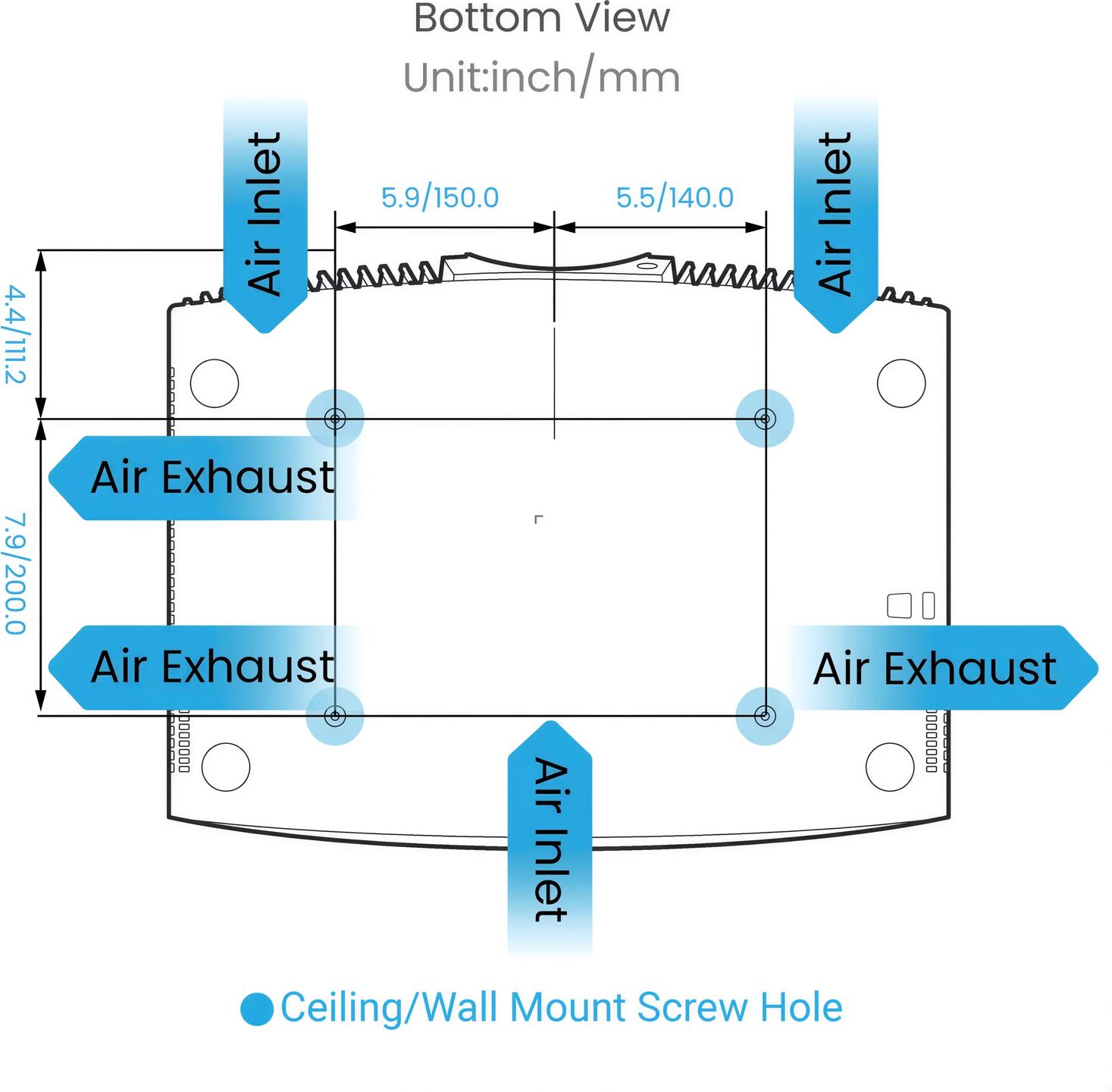
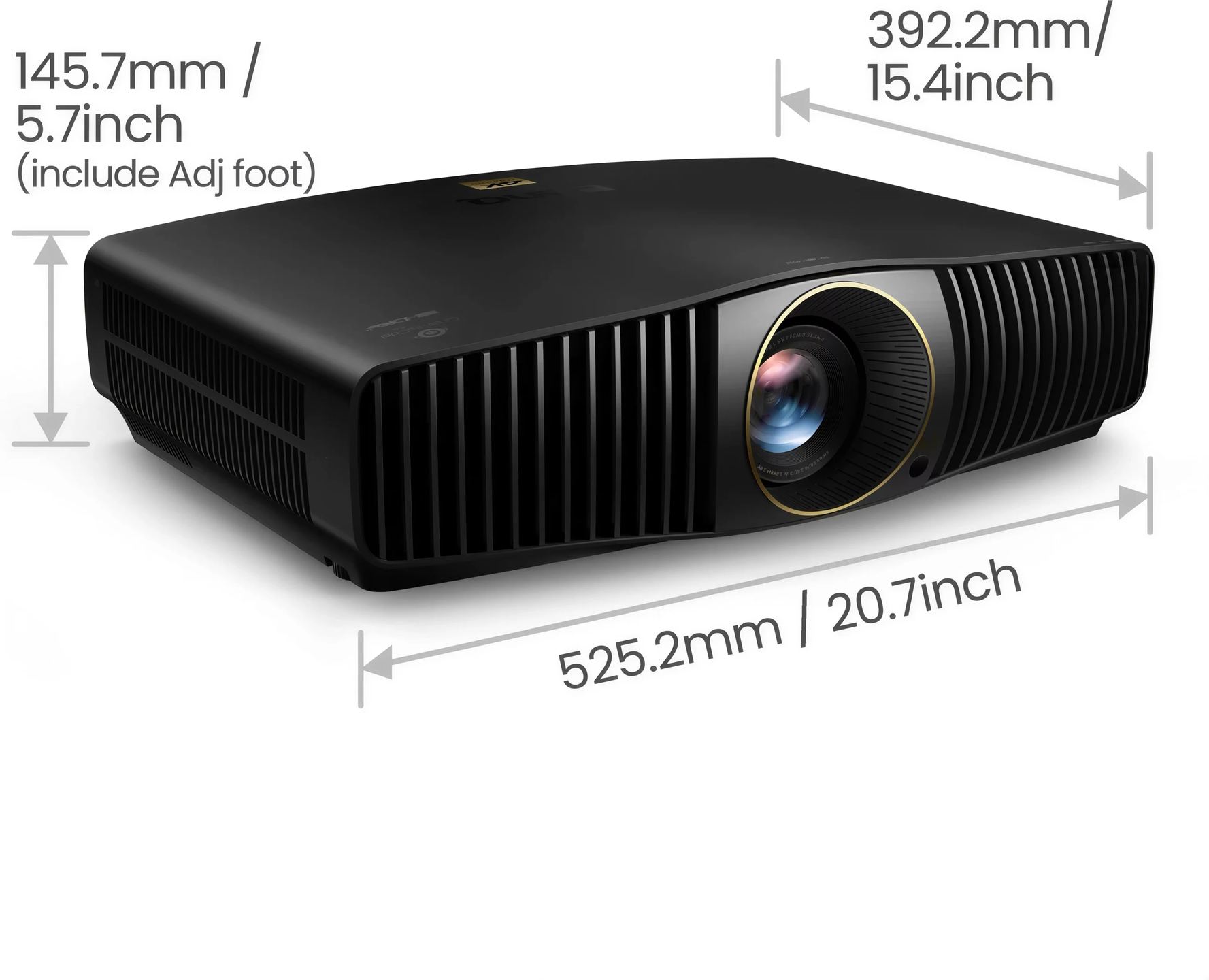
At 52.5 cm wide, 39.2 cm deep, 14.6 cm high and 10.5 kg, the W5800 is a dedicated-room projector, not something you bring out on a Saturday evening. Ceiling mounting requires a bracket rated for this weight and some clearance behind it for cables.
Cooling is provided through vertical grilles that hinder dust build-up. The stated noise level is 30 dB in normal mode and 27 dB in economy mode: if the W5800 is directly above the sofa, economy mode makes it even quieter, at the cost of a less bright image. Power consumption is 380 W in normal mode and 240 W in economy mode, dropping below 0.5 W in standby.
Connections that leave external sources in control
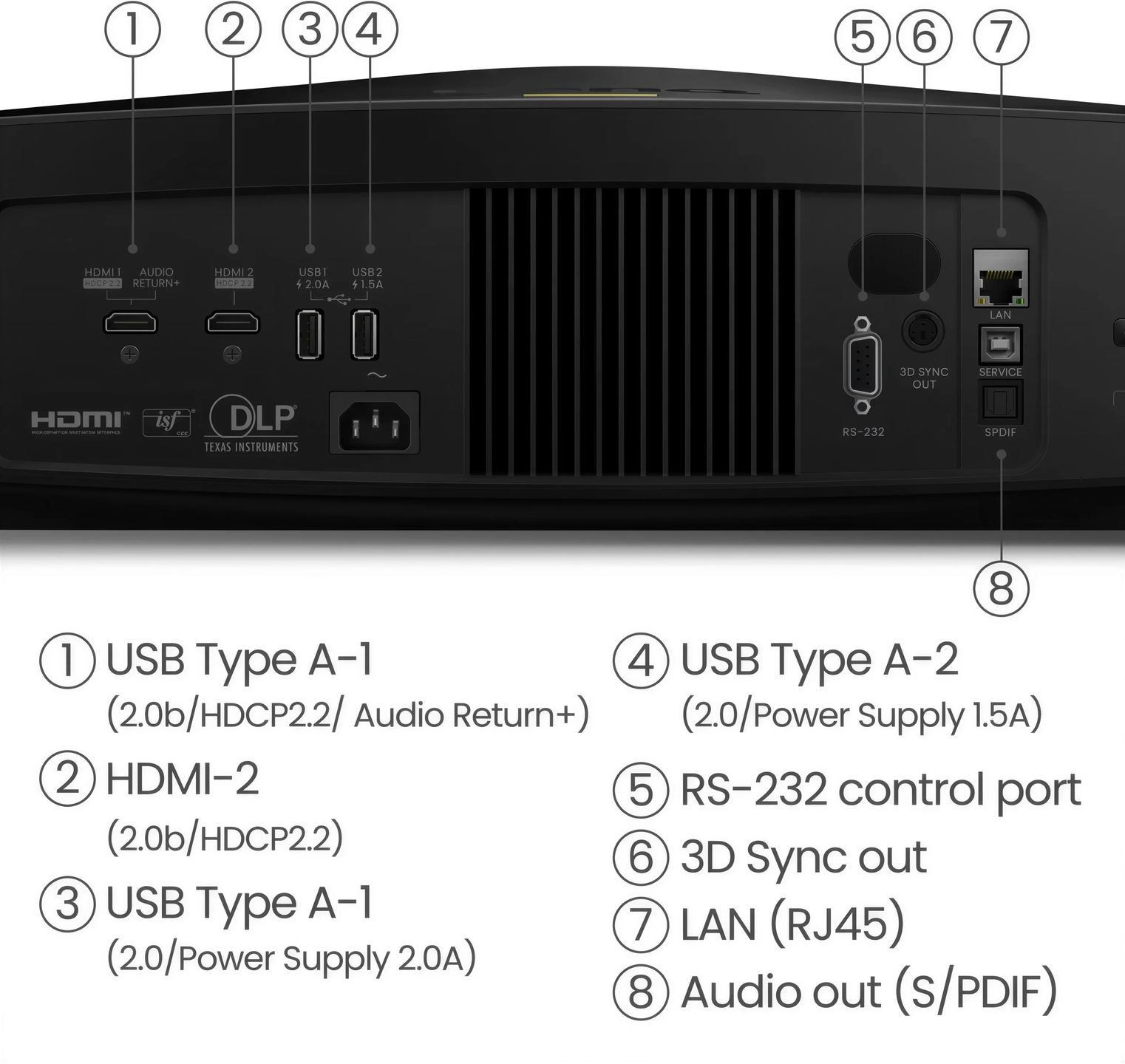
The two HDMI 2.0b inputs (HDCP 2.2) accept 4K at up to 60 frames per second, and HDMI input 1 supports eARC: it sends sound from sources connected to the projector back to a home cinema amplifier, in up to 7.1 channels and Dolby Atmos. An S/PDIF (digital) output takes over for an older amplifier, in stereo or compressed multichannel audio.
The W5800 has no built-in speaker: you will need a soundbar or a home cinema system. For integration into an equipped room, an RJ45 network socket and an RS232 port allow control by a home automation system, while a VESA 3D sync output connects a transmitter for 3D projection.
The box contains the RCV024 remote control with batteries, a 3 m HDMI cable, a 1.8 m power cable, a lens cap and the quick start guide.