Audioquest Angel RCA/RCA DBS 2m
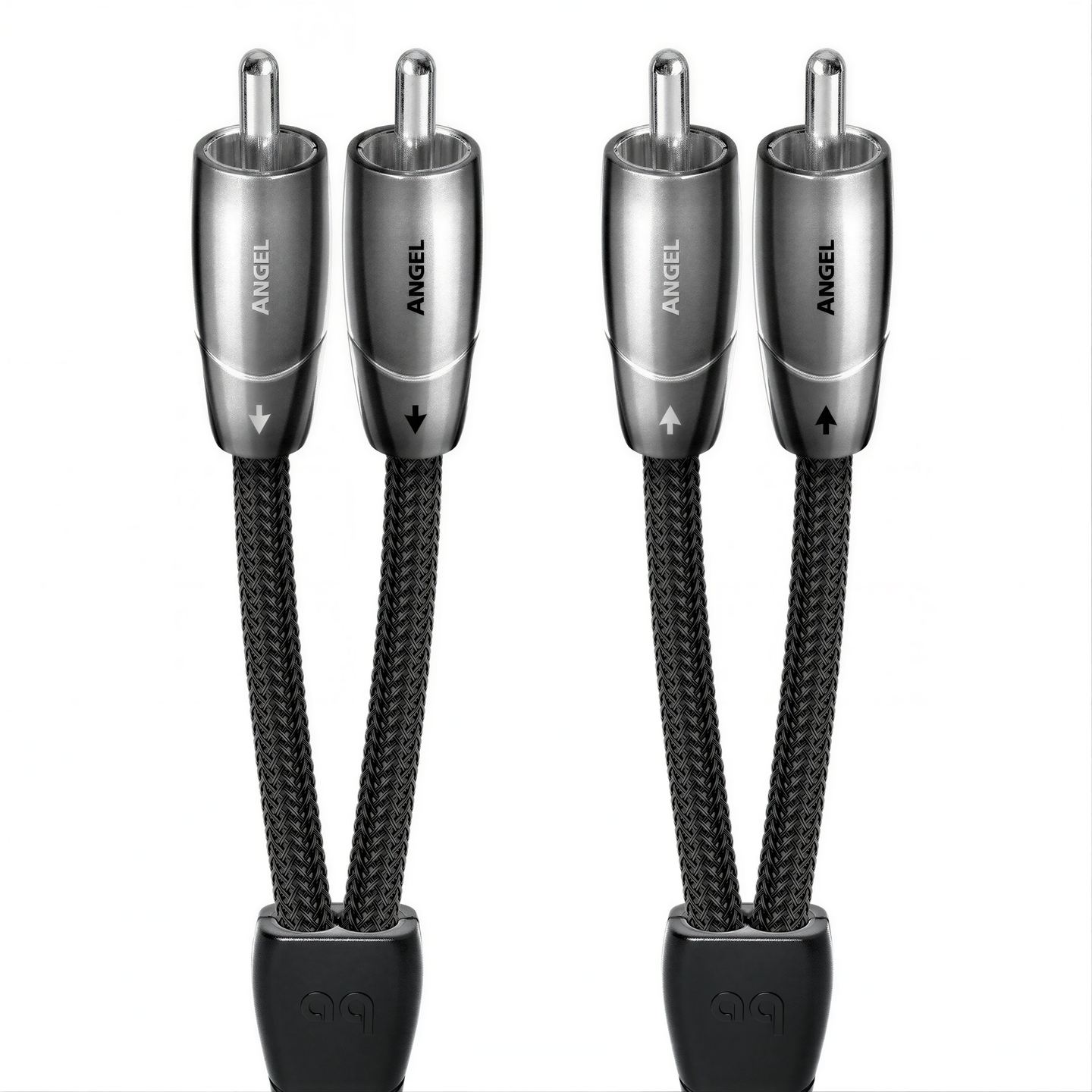

AudioQuest Angel RCA/RCA DBS: the pinnacle of the Bridges & Falls series
This RCA cable is the highest-end model in the Bridges & Falls series, the only one in this range to use solid silver conductors. AudioQuest designed this analog interconnect for systems where every detail matters, combining its proprietary technologies in a compact, flexible format.
Perfect-Surface silver conductors
Solid Perfect-Surface Silver (PSS) conductors eliminate strand interaction, a major source of distortion in twisted cables. High-purity silver also minimizes disruptions caused by grain boundaries present in any metal conductor. In practical terms, Perfect-Surface technology applied to very pure silver reduces sonic harshness compared with OFHC, OCC, or 8N copper.
This solid (non-stranded) structure transmits low-level signals more efficiently than a multi-strand cable. The difference is audible from the very first seconds: the system sounds more present, more alive.
The 72-volt DBS system, an AudioQuest patent
The 72 V DBS (Dielectric-Bias System) saturates and polarizes the insulation, enabling clear, dynamic sound against a very quiet background. The principle is simple: any insulation slows the signal, but in a non-uniform way across frequencies when it is not polarized. These differences in time delay are problematic for a multi-octave audio signal that is highly time-sensitive.
The DBS creates a stable electrostatic field that organizes the molecules of the insulation. This minimizes both energy storage in the insulation and multiple non-linear time delays. The battery pack (included) lasts for several years and features a test button with LED to check its status. An RF trap, developed for AudioQuest’s Niagara power products, prevents radio interference from entering the conductors from the DBS elements.
FEP air-tube insulation
Any solid material adjacent to a conductor is part of an imperfect circuit: the insulation absorbs energy, stores some of it, then releases it as distortion. Air absorbs virtually no energy, and FEP (fluoropolymer) is the best available extrudable solid insulation.
The positive conductors benefit from nearly zero contact between the metal and their FEP insulation, which has a low dielectric constant and minimal interference with the signal. The negative conductors use deliberately “lossy” insulation: no air, no FEP, to optimize their different function in the circuit.
Three-layer NDS shielding
Three alternating layers of metal and carbon-loaded synthetics “shield the shield,” absorbing and reflecting most RF energy before it reaches the ground-connected layer. This carbon-based NDS (Noise-Dissipation System) prevents captured interference from modulating the component’s ground reference.
Asymmetrical double-balanced geometry
Designed for unbalanced (single-ended) applications, this geometry offers lower impedance on the ground for richer, more dynamic reproduction. While many unbalanced cables use a single path for ground and shielding, the double-balanced design separates them for cleaner, quieter performance.
The Bridges & Falls series houses the left and right channels in a single jacket, with asymmetrical double-balanced geometry and separate high-quality positive and negative conductors. This design allows for a thin, flexible, versatile cable.
Solder-free connectors
The RCA plugs are made of pure red copper with direct silver plating, assembled by cold welding. This design avoids conventional soldering, a frequent source of distortion. The ground shells are stamped rather than machined, allowing the metal to be chosen for its low distortion rather than its machinability.
Technical characteristics
Technical specifications
- Type: analog RCA cable with 2 male plugs
- Conductors: perfect-surface solid silver (PSS)
- Shielding: carbon-based noise-dissipation system (NDS)
- Insulation: FEP air tube
- Dielectric bias system: 72 V (DBS)
- Terminations: silver-plated pure red copper, cold-welded
- Geometry: asymmetrical double-balanced
Audio technologies
- PSS silver conductors
- Solid silver to limit electrical and magnetic interactions
- Reduced distortion and linear dissipation of RF noise
- Carbon + NDS noise dissipation
- Alternating layers of metal and carbon-loaded synthetics
- Shield protection and absorption of most RF noise before ground
- 72 V dielectric bias system (DBS)
- Dielectric stabilization to prevent phase shifts
- Built-in RF trap to prevent noise from being introduced into the signal
- US Patents No. 7,126,055 and 7,872,195 B1
- FEP air-tube insulation
- Positive conductors insulated by air for a clear signal
- Negative conductors with intentionally lossy insulation for a complementary role
- Asymmetrical double-balanced geometry
- Separation of shielding and ground for a cleaner signal
- Optimized impedance for richer, more dynamic sound
Key features
- Perfect-Surface Silver (PSS) conductors to minimize distortion
- FEP air-tube insulation to preserve dynamics and clarity
- 3-layer Carbon noise dissipation + 72 V DBS to reduce interference
- Asymmetrical double-balanced geometry for a cleaner, more dynamic signal
- Silver-plated pure red copper terminations, cold-welded
Audio performance
- High-fidelity audio transmission without loss
- Reduced noise and interference
- Clearer, more natural, more dynamic sound reproduction
Use
- Connect the cable’s RCA plugs to the outputs of the source device
- Plug the RCA plugs into the inputs of the playback device
- Compatibility: CD players, digital-to-analog converters (DACs), amplifiers, preamplifiers, and other devices equipped with RCA connectors
Frequently asked questions
How long do the DBS system batteries last?
AudioQuest indicates a battery life of several years for the DBS, similar to their shelf storage life. The pack includes a test button and an LED to check the charge status occasionally. In practice, expect 3 to 5 years before needing to replace them.
Does the cable work without the batteries?
Yes, the audio signal passes normally. The DBS acts only on the insulation, not on the signal itself. Without batteries, the cable simply loses the benefit of dielectric polarization.
Why do the positive and negative conductors have different insulation?
The positive conductors benefit from minimal contact with the FEP insulation to preserve the signal. The negative conductors use deliberately “lossy” insulation because their function in the circuit differs: they handle current return and grounding.
What is the advantage of silver over copper?
Silver offers higher electrical conductivity than copper. Combined with Perfect-Surface technology, it reduces distortion caused by grain boundaries in the metal. Compared with the Yosemite or Victoria models in the same series (which use copper), the Angel delivers a more refined, more airy rendering in the treble.
- Eco-contribution included in the sale price.
- Manufacturer reference: ANG02R
- GTIN / EAN: 92592075511