Furutech Lan-8 NCF Plus 5m
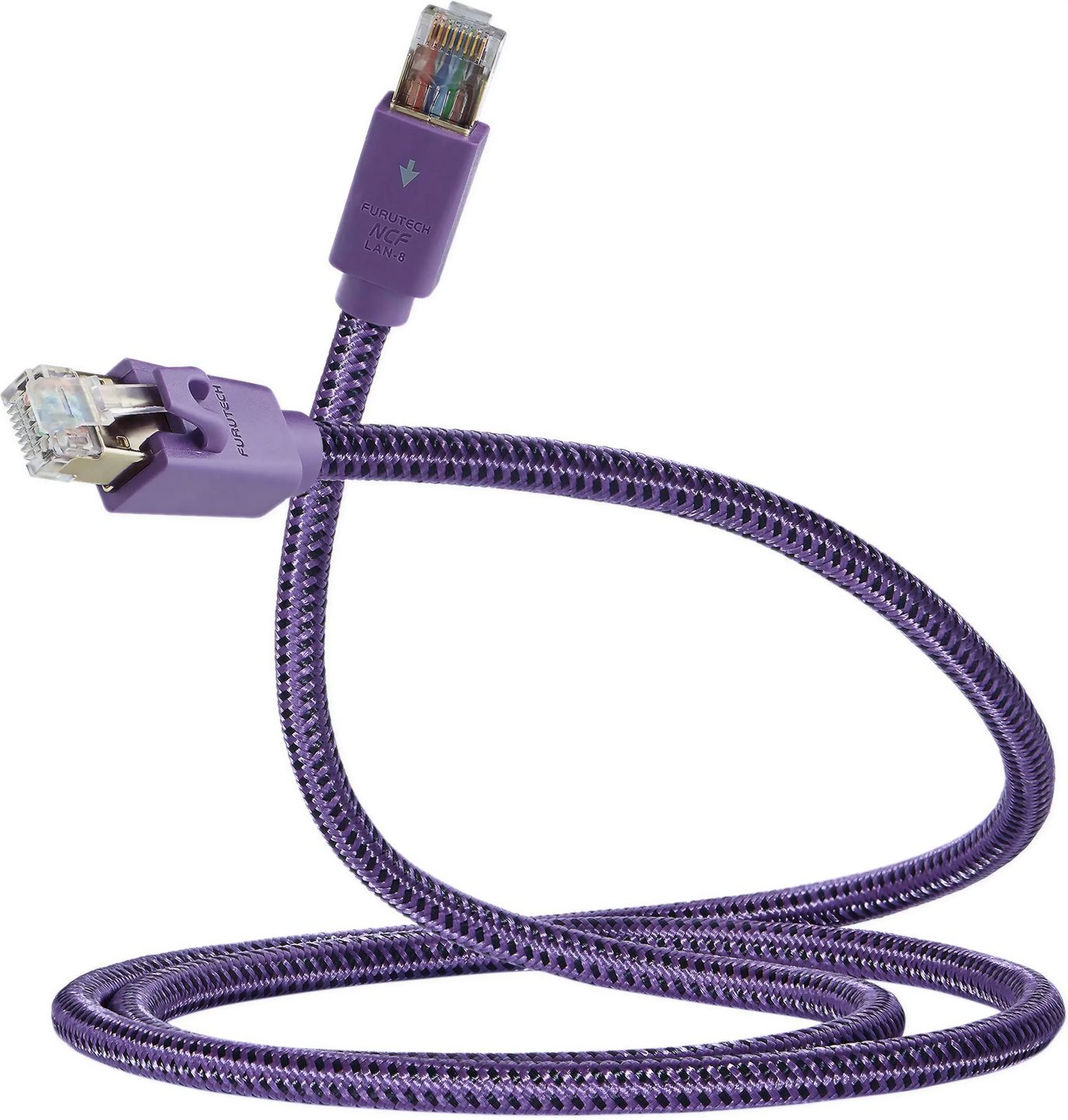
Furutech LAN-8 NCF Plus, Cat 8 audiophile network cable
Between the router, the switch and the network player, an Ethernet cable does not carry sound but data packets. Why, then, devote such elaborate construction to it? The answer lies not in throughput, which is more than sufficient on any cable, but in the noise that travels along the connection and disrupts the sensitive stages of a converter. The LAN-8 NCF Plus addresses this issue through materials and shielding rather than speed.
Throughput is not the real issue
Category 8 supports 40 Gb/s and bandwidth up to 2,000 MHz. A high-resolution audio stream, even multichannel or DSD, requires only a few megabits per second. The margin is therefore enormous, and it is not what sets this cable apart from an ordinary cable.
Ethernet works with packets, error detection and retransmission: data arrives intact, or is resent, regardless of the cable. What a shielded, non-magnetic and damped connection aims to contain is the high-frequency noise travelling alongside the signal: RF noise, electromagnetic interference, noise carried by the switching power supply of a switch or router. This noise can couple with the analogue circuits and clock of the network player, raise the noise floor and disrupt synchronisation during conversion. The extent of the audible improvement depends on the ability of the following component to reject this interference: a streamer that is already well isolated will show a subtler difference than more exposed electronics.
Silver-plated solid conductors
The key change compared with the original LAN-8 NCF is the move from stranded conductors to solid-core conductors, meaning solid wires. A solid core maintains its geometry better along its entire length and keeps a more consistent characteristic impedance, which matters at the high frequencies used by Category 8. Each conductor is 24 AWG (1/0.525), made from silver-plated α (Alpha) OCC copper. OCC refers to continuous casting, which limits grain boundaries in the copper.
Silver plating has a genuine benefit here: at Cat 8 bandwidth, close to 2 GHz, the skin effect concentrates current at the surface of the conductor, and this more conductive silver surface handles the fast components. This differs from analogue audio, where the skin effect remains marginal. The twisted pairs retain a calculated twist pitch to enhance RF rejection and limit crosstalk. The trade-off of the solid core is that the cable is stiffer than a stranded one, requiring care with its bend radius.
Three layers against interference
The construction is S/FTP type: foil around each pair and a braided shield around the whole assembly. The triple shielding combines aluminium foil and copper braid. The foil continuously covers high frequencies, while the braid handles lower-frequency electromagnetic interference, provides mechanical continuity and serves as a grounding path. This dual approach fulfils the two expected roles of a network cable in an audio environment: preventing external interference from entering and stopping internal noise from radiating toward neighbouring devices. Category 8 already requires complete shielding; here it is reinforced, in line with the increased diameter.
Non-magnetic connectors and NCF shell
The plugs are RJ45 in 8P8C format. The contacts use a non-magnetic α conductor with thick 24-carat gold plating, while the body is made from 24-carat gold-plated copper alloy with low magnetic properties. The non-magnetic choice addresses a specific issue: magnetic underlayers often found beneath gold plating can introduce distortion at the contact point through eddy currents and hysteresis. Avoiding them keeps the connection cleaner.
The connector shell uses NCF (Nano Crystal² Formula) material from Furutech, a hybrid multi-material construction. This crystalline compound has two properties: it generates negative ions that dissipate static charges, and it converts thermal energy into far-infrared radiation. Furutech combines it with nanometric ceramic particles and carbon powder for a piezoelectric damping effect. The role of this shell is to damp micro-vibrations and dissipate static charges where the cable joins the socket.
Nylon sleeve, diameter and flexibility
The outer jacket is made from flexible black PVC, UL/CL3 fire-rated (suitable for in-wall installation) and RoHS-compliant. Over it, a braided nylon sleeve protects the assembly and helps damp resonances. The outer diameter reaches approximately 8.0 ± 0.15 mm, compared with 7.0 mm on the previous LAN-8 NCF; this increased cross-section accommodates the reinforced shielding. With solid cores and this diameter, the cable remains fairly firm: it is best to allow some space behind the furniture and maintain a reasonable bend radius when connecting it.
Connection direction and lengths
The cable is directionally marked. An arrow indicates the input side, meaning the source: the arrow should therefore point toward the transmitting device, the router or switch feeding the player. Connecting the cable the other way round will not damage either the cable or the equipment, but the marked direction is the one selected for optimal performance. Standard lengths range from 0.6 m to 5 m (0.6 / 1.2 / 1.8 / 2.5 / 3.6 / 5 m), with 7.5 m and 10 m available on request. As the RJ45 plug is universal and Category 8 is backward-compatible with Cat 7 and Cat 6, the cable can be installed at any point in the network and works with any Ethernet equipment.
Technical Specifications
Overview
- Type: high-performance Ethernet cable
- Category: Category 8 (Cat 8)
- Purpose: designed for high-speed Ethernet networks and high-resolution digital audio systems
- Intended use: high-end Ethernet and audiophile installations
- Compatibility: backward compatible with Cat 7 and Cat 6 categories
- Compliance: RoHS
Transmission Performance
- Maximum data rate: up to 40 Gb/s
- Bandwidth: up to 2,000 MHz
- Solid-core construction for more stable transmission
- Reduced crosstalk and transmission noise
Architecture and Conductors
- Architecture: S / FTP twisted-pair cable
- Conductors: silver-plated α (Alpha) OCC copper
- Gauge: 24 AWG (1 / 0.525)
- Minimised transmission losses
- Furutech NCF (Nano Crystal² Formula) technology
- Mechanical damping
- Reduced static charges
Connectivity
- Connectors: RJ45 / 8P8C
- Non-magnetic α conductors
- Contact finish: 24-carat gold plating
- Connector bodies: 24K gold-plated copper alloy, with low magnetic properties
Shielding and Protection
- Triple shielding with aluminium foil and copper braid
- Enhanced protection against electromagnetic interference
- Reduced noise and crosstalk
Mechanical Construction and Sheathing
- Outer diameter: approximately 8.0 ± 0.15 mm (increased compared with the previous LAN-8 NCF)
- Outer jacket: flexible black PVC, UL / CL3 flammability rating
- Covering: nylon yarn braided sleeve contributing to resonance damping
- Insulation and damping: materials selected to reduce vibrations and internal resonances
Available Lengths
- Standard: 0.6 m, 1.2 m, 1.8 m, 2.5 m, 3.6 m, 5 m
- On request: 7.5 m and 10 m
Key Features
- 40 Gb/s and 2,000 MHz for very high-speed transmission
- Triple shielding for improved isolation against electromagnetic interference
- Silver-plated OCC conductors to minimise transmission losses
- 24K gold-plated RJ45 connectors
- NCF technology for mechanical damping and reduced static charges
- Solid-core construction improving transmission stability
- Diameter increased to 8 mm compared with the previous LAN-8 NCF
- Reduced crosstalk and transmission noise
- Braided nylon sleeve contributing to resonance damping
- Intended for high-end Ethernet and audiophile installations
Frequently Asked Questions
Where should it be placed in the network chain to get the most out of it?
The final segment before the network player is where conducted noise matters most, since that is where it can reach sensitive circuits. In practice, the link between the switch and the streamer is often the priority. Adding a carefully designed link further upstream, between the router and the switch, extends this approach without being a prerequisite.
Is it compatible with a network that is not Cat 8?
Yes. An Ethernet link operates at the lowest category in the chain, so when connected to a Cat 5e or Cat 6 network, it does not unlock Cat 8’s 40 Gb/s. However, its benefit in audio does not come from this speed: the shielding, conductors and connectors affect noise on the relevant segment, regardless of the negotiated data rate. Backward compatibility with Cat 7 and Cat 6 is ensured.
Does solid-core interfere with repeated connections?
A solid-core conductor withstands repeated bending less well than a stranded cable. In a fixed installation, this is not a problem. It is best to avoid unplugging and reconnecting it frequently, and bending it tightly near the plugs.
Does it connect directly between a streamer and a DAC?
Only if the converter has an RJ45 network input, which remains rare. Most connections between a network player and a DAC use USB, coaxial or optical. The LAN-8 NCF Plus belongs on the network side, between Ethernet devices.
What more does it offer than the original LAN-8 NCF?
Three changes: solid conductors instead of stranded ones, a diameter increased to 8.0 mm from 7.0 mm, and enhanced shielding housed within this more generous cross-section. The rest of the formula—NCF material, silver-plated α OCC copper, non-magnetic 24-karat gold connectors—remains unchanged.
Suitable for a TV, console, or computer?
Yes. It is a standard Cat 8 cable with RJ45 connectors: it works with any Ethernet device. Its audio-oriented construction does not limit this general use; it simply adds shielding and material work that standard cables do not have.
Is silver plating beneficial for a digital connection?
At Cat 8 bandwidths, the skin effect becomes significant and drives the fast signal components toward the conductor’s surface. A silver surface, being a better conductor than copper, then carries these frequencies. This is what distinguishes the case of a high-frequency network cable from that of an analog audio cable, where the same argument would have little relevance.
- Eco-contribution included in the sale price.