

Rotel Michi P430
Specifications and features


Overview
An integrated amplifier combines everything in a single enclosure. A separates system distributes the work differently: one component controls the sources and volume, while another provides the power. The P430 takes on the first role. It brings together vinyl, television, computer and Bluetooth, manages selection and level, then sends a clean signal to a power amplifier responsible for driving the speakers.
Separating control from power
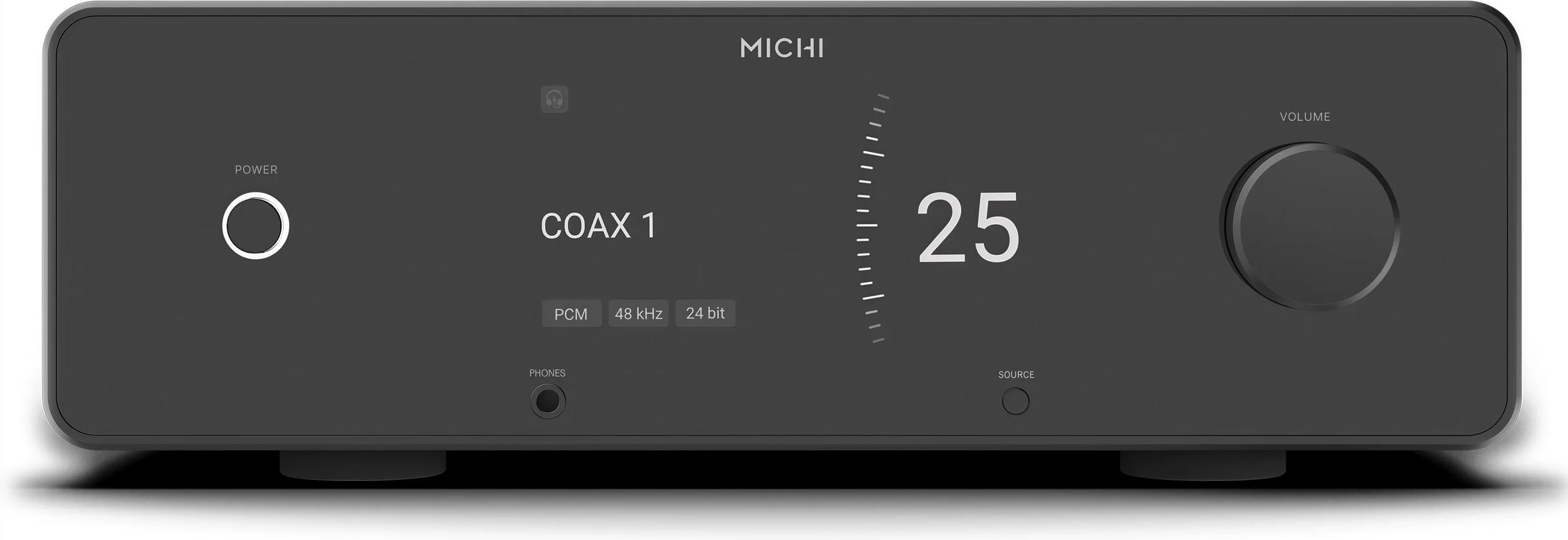
The P430 delivers no power to the speakers. Its role comes upstream: selecting the active input, adjusting the volume, applying tone correction if required, and sending the line-level signal to a power amplifier through its RCA or XLR outputs. Rotel pairs it with the S430, a stereo power amplifier from the same series. Together, they form a separates alternative to the X430, the integrated amplifier that combines preamplification and power in a single chassis.
This Prestige series arrived in 2026 with the X430 and the Q430 CD player; the P430 and S430 complete it on the separates side. Michi is Rotel’s high-end line, relaunched in 2019, and the Prestige series adopts design principles from the more expensive Reference series. Separating the functions serves a practical purpose: isolating the control circuits, which handle low-level signals, from the power stage, where high currents and heat are present.
Connecting vinyl, TV and computer
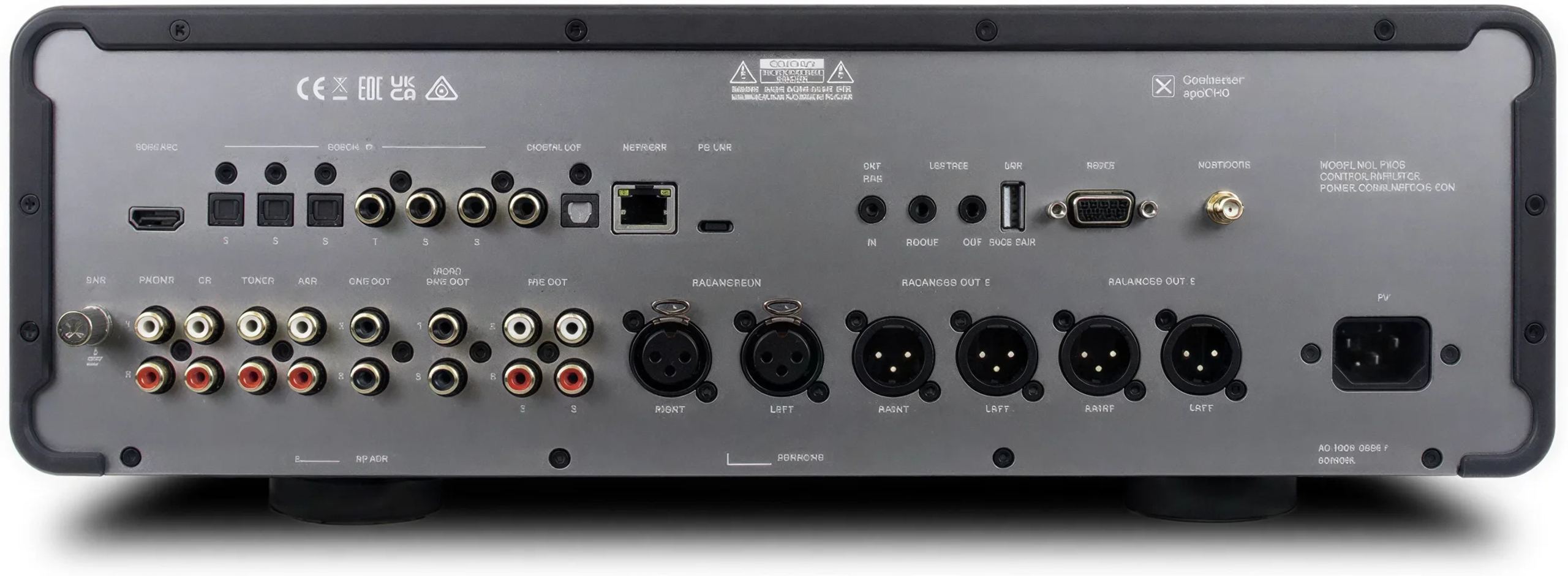
On the analogue side, the P430 accepts two line-level connections, one unbalanced RCA and one balanced XLR, plus a phono input for a turntable. The balanced XLR connection carries the signal over two wires in opposite phase, helping reject interference picked up along the cable, which is useful between separate components or over long distances. The phono input accepts moving magnet (MM) cartridges, with a 47 kΩ load and 2.5 mV sensitivity; moving coil (MC) cartridges, whose signal is much weaker, require a dedicated phono preamp upstream.
The digital section covers optical and coaxial inputs (up to 24-bit/192 kHz), an HDMI ARC input to retrieve sound from the television, and a USB-B port for a computer. HDMI ARC is limited to two-channel PCM up to 24-bit/48 kHz: it returns the television’s stereo track, not a multichannel stream. Bluetooth reception supports aptX HD and AAC codecs. On output, RCA and XLR sockets feed the power amplifier.
The ESS converter and supported files
Digital conversion is handled by an ESS SABRE ES9028PRO chip, a 32-bit eight-channel converter from ESS’s SABRE PRO series, supported by a carefully designed clock to limit jitter, the tiny timing variations that impair digital stream playback.
Supported formats depend on the input. USB accepts PCM up to 32-bit/384 kHz, native DSD up to DSD256 (11.2 MHz), and DoP up to DSD128 (5.6 MHz); optical and coaxial inputs support up to 24-bit/192 kHz. PCM is the standard format, used by CDs at 16-bit/44.1 kHz as well as high-resolution files; DSD is the modulation used by SACD. The USB input operates in USB Audio Class 2, with driver installation depending on the operating system.
The P430 is Roon Tested certified: Roon software recognises and controls it as a connected converter via USB. This is distinct from the Roon Ready label, reserved for devices that receive the stream directly over the network. The P430 does not incorporate a network player and relies on a computer or source connected to its inputs.
A controlled noise floor
The role of a preamplifier is to add as little as possible to the signal passing through it. The P430 uses a balanced design, with isolated power regulation and a very low-noise power supply. Signal-to-noise ratios reflect this approach: 110 dB on the RCA line input, 106 dB on XLR, 103 dB on digital inputs and 82 dB on phono (A-weighted). This ratio measures the difference between the music and residual hiss: the higher it is, the quieter the background. The lower phono value is explained by the tiny signal from a cartridge, which is heavily amplified at the input.
Total harmonic distortion remains below 0.002%, as does intermodulation distortion, two measurements of what the electronics add to the original signal. Outputs deliver 1 V via RCA and 2 V via XLR, with low impedance (100 and 200 Ω) that makes it easier to drive the following amplifier. Tone control allows adjustment of ±10 dB at 100 Hz and 10 kHz to tailor bass and treble. Frequency response extends from 10 Hz to 100 kHz on line inputs, wider than the audible range; it narrows to 20 Hz-20 kHz on digital and phono inputs, limited by converter sampling and the vinyl correction RIAA curve.
Chassis, dimensions and integration
The P430 features an aluminium chassis and the understated styling of the Prestige series, matching that of the S430. It measures 431 × 148 × 404 mm, with a 131 mm-high front panel, and weighs 10.8 kg. The power supply is designed for 230 V/50 Hz, power consumption reaches 45 W in operation and drops below 0.5 W in standby (less than 2 W in network standby); heat dissipation is rated at 98 BTU/h. Rotel provides a dimensioned drawing for custom installation, allowing the P430 to be housed in furniture or an audio-video rack, provided ventilation is maintained.
Technical specifications
General
- Type: stereo preamplifier
- Certification: Roon Tested
Digital-to-analog conversion
- ESS ES9028PRO chip, 32-bit / 8-channel DAC
Connectivity
- Analog inputs: RCA, balanced XLR, MM Phono
- Digital inputs: HDMI ARC, USB-B PC, optical, coaxial
- Bluetooth: aptX HD, AAC
Supported digital formats
- HDMI ARC: CEC, 2-channel PCM up to 24-bit / 48 kHz
- Coaxial / optical input: PCM up to 24-bit / 192 kHz
- USB Audio: up to 32-bit / 384 kHz
- DSD via USB: DSD64, DSD128, DSD256 up to 11.2 MHz
- DoP via USB: up to DSD128 / 5.6 MHz
Frequency response
- RCA input: 10 Hz – 100 kHz, ±0.3 dB
- XLR input: 10 Hz – 100 kHz, ±0.3 dB
- Digital inputs: 20 Hz – 20 kHz, ±0.3 dB
- Phono input: 20 Hz – 20 kHz
Audio performance
- THD: < 0.002%
- Intermodulation distortion: < 0.002%
- Signal-to-noise ratio
- RCA: 110 dB
- XLR: 106 dB
- Digital: 103 dB
- Phono: 82 dB
- Tone control: ±10 dB at 100 Hz / 10 kHz
Input specifications
- Sensitivity
- RCA: 160 mV
- XLR: 320 mV
- MM Phono: 2.5 mV
- Input impedance
- RCA: 33 kΩ
- XLR: 55 kΩ
- Digital: 75 Ω
- MM Phono: 47 kΩ
- Input overload
- RCA: 4.1 V
- XLR: 12 V
- MM Phono: 69 mV
Output specifications
- Output level
- RCA: 1 V
- XLR: 2 V
- Output impedance
- RCA: 100 Ω
- XLR: 200 Ω
Power supply and consumption
- Power supply: 230 V / 50 Hz
- Power consumption: 45 W
- Standby power consumption: < 0.5 W
- Network standby power consumption: < 2 W
Dimensions and weight
- Dimensions (W × H × D): 431 × 148 × 404 mm
- Panel height: 131 mm
- Net weight: 10.8 kg
Heat dissipation
- 98 BTU / h
Frequently Asked Questions
What is the difference between the P430 and the X430?
The X430 is an integrated amplifier: preamplification and power amplification in a single enclosure. The P430 is the preamplification section only, to be paired with the S430 power amplifier. The separate-components solution distributes the two stages across two distinct chassis, at the cost of additional space and cabling.
Can the P430 be used with active speakers?
Yes. Its RCA and XLR line outputs can feed either a power amplifier or active speakers, which have their own built-in amplification. In both cases, the volume is adjusted on the P430.
Can you listen to Qobuz or Tidal directly from the P430?
No, the P430 does not have a built-in network streamer. For these services, a network streamer or computer is connected to it (via USB, coaxial or optical), or audio is streamed via Bluetooth. Its Roon Tested certification applies to this use as a connected DAC, not to direct network reception.
Does the P430 support a turntable with a moving-coil (MC) cartridge?
Its phono input is designed for moving magnet (MM) cartridges. An MC cartridge delivers too low a voltage for this input: a MC-compatible phono preamp, or a step-up transformer, must be placed between the turntable and the P430.
Does HDMI ARC output multichannel sound from the TV?
No. The HDMI ARC input handles two-channel PCM up to 24-bit/48 kHz. It retrieves the TV’s stereo track for listening through the hi-fi system, without multichannel decoding, which remains consistent with a stereo preamplifier.
Can the P430's Bluetooth send sound to wireless headphones?
The P430’s Bluetooth works in receive mode: it receives audio streams from a phone or computer using the aptX HD and AAC codecs. It cannot transmit to headphones or a wireless speaker.
Can the P430 be installed in an enclosed cabinet or rack?
Yes, Rotel provides a dimensioned drawing for custom installation. With heat dissipation rated at 98 BTU/h, a ventilated space should be provided: an enclosed cabinet without air circulation promotes heat buildup and is not suitable for this type of electronics.
- Eco-contribution included in the sale price.




