
Rotel Michi X430

Complementary product
Overview
Following the success of the X3 and X5 integrated amplifiers, Michi is launching a new range called Prestige. The X430 is the first amplifier in this series, designed to narrow the gap between standard Rotel electronics and Michi reference models. For more than 60 years, Rotel has been manufacturing amplifiers renowned for their power-to-quality ratio, and this time, the idea is to bring the aesthetic and technical codes of the Reference models into a slightly more compact format, without sacrificing wattage or connection versatility.
A chassis balancing understated design and substantial build
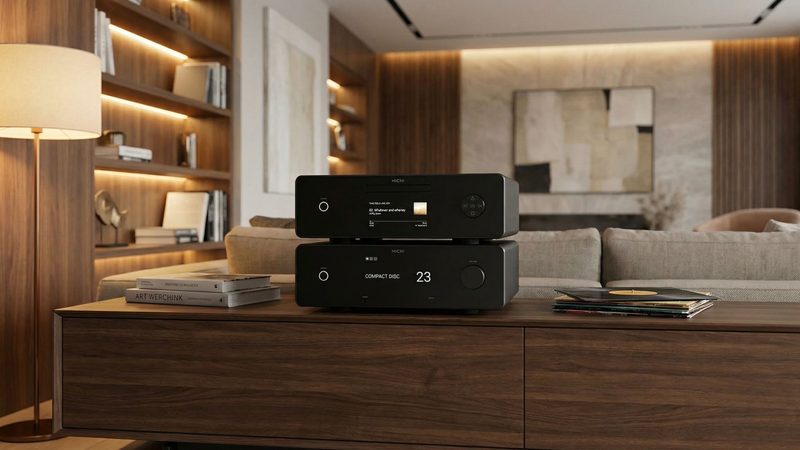
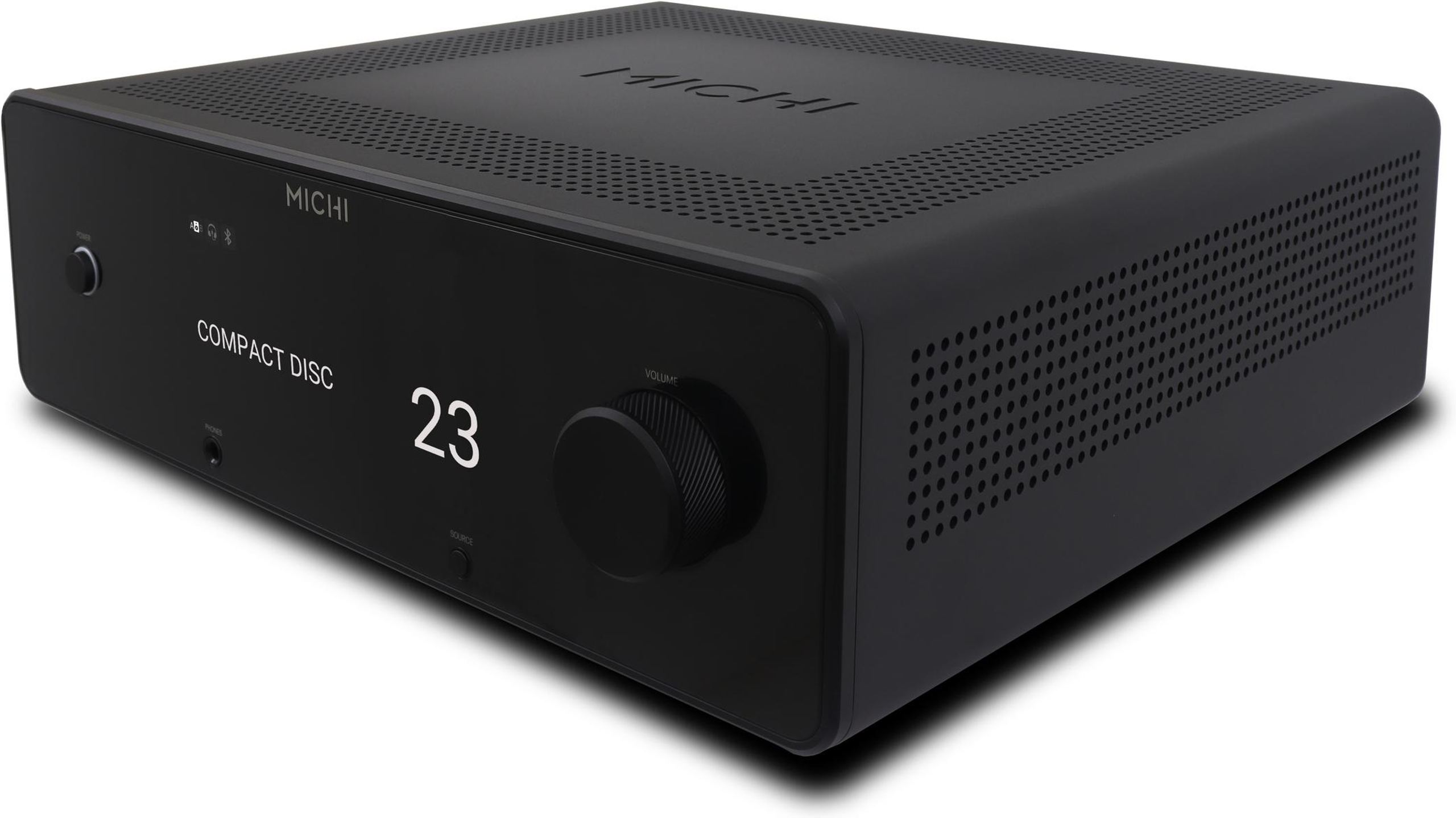
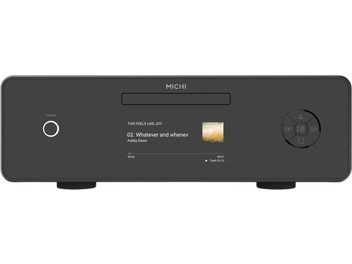
The X430 adopts the lines that have defined Michi’s visual identity since the brand’s return in 2019: a solid black glass front panel, with a top cover and knurled volume knob made from precision-machined anodized aluminum. The high-resolution color TFT display shows the active source, volume level, and signal format; it also offers customizable spectrum and VU meter modes. The unit weighs 16.9 kg and measures 43.1 cm wide, 42.2 cm deep, and 14.8 cm high; it is a substantial component that requires a sturdy cabinet. The heat sinks remain discreet, and the unit runs moderately warm in normal operation thanks to its Class AB amplification.
340 watts into 4 ohms and a high damping factor
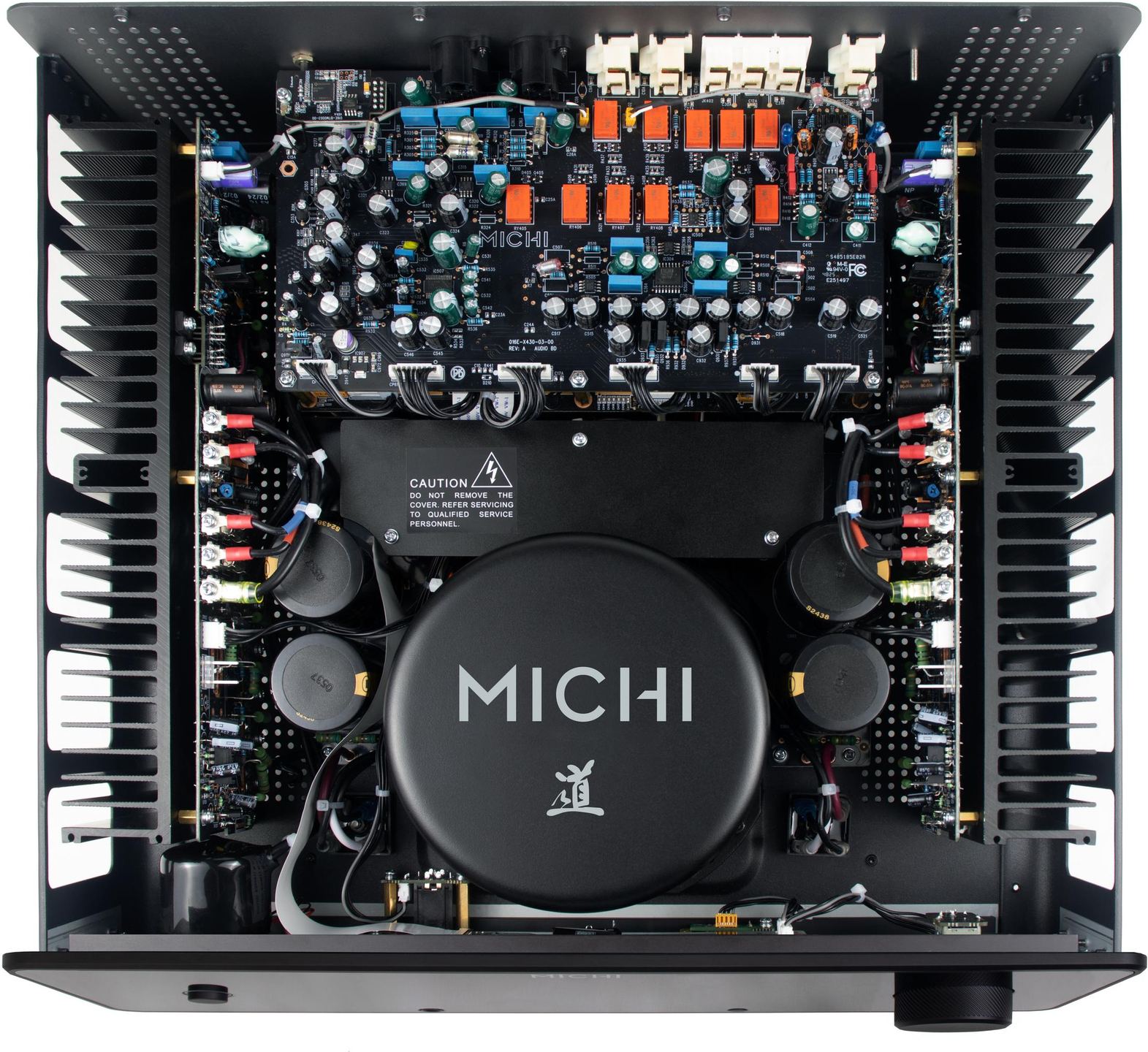
The output stage uses custom-optimized high-current push-pull transistors. Output power reaches 220 W per channel into 8 Ω (FTC measurement), 210 W continuous, and rises to 340 W into 4 Ω. The damping factor of 260 (measured from 20 Hz to 20 kHz into 8 Ω) reflects the amplifier’s ability to control speaker movement, especially in the bass. The massive toroidal transformer, manufactured in-house and housed in a shielded enclosure, powers proprietary ultra-low-noise circuits. Total harmonic distortion remains below 0.03%, as does intermodulation distortion.
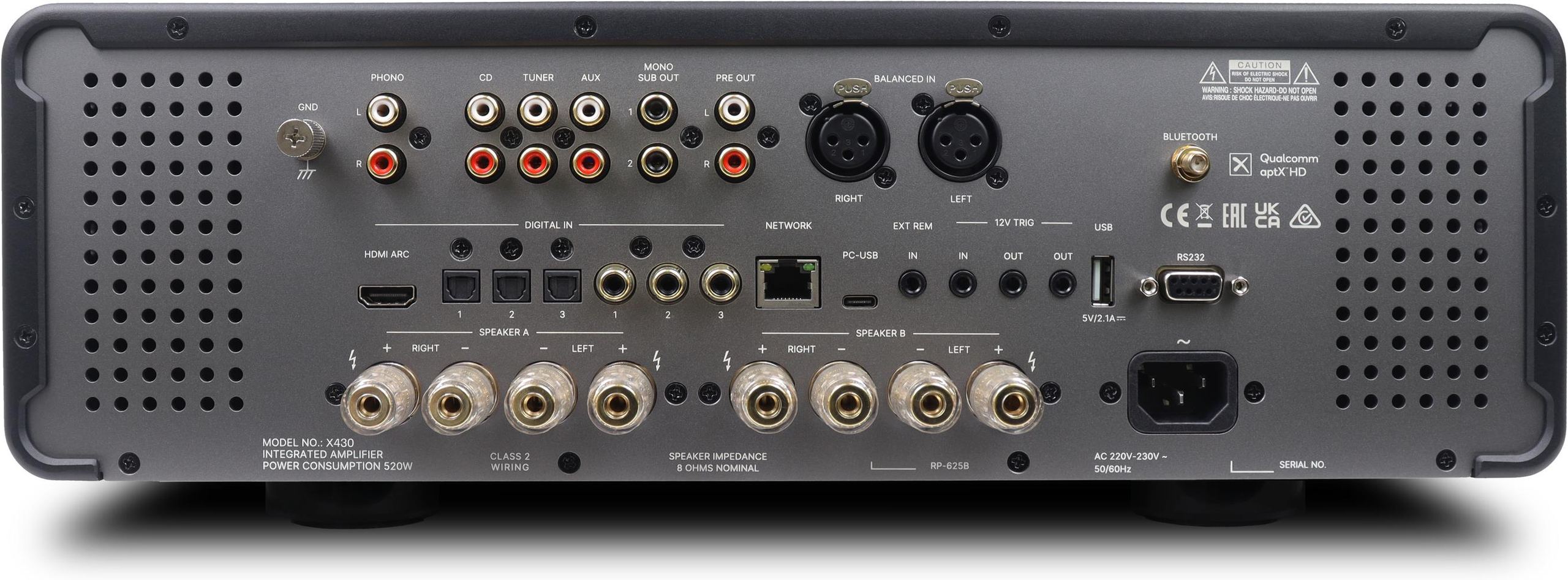
Speakers with low impedance or moderate sensitivity will not be a problem. Two selectable pairs of speaker terminals (A and B) allow two pairs of speakers to be connected or support bi-wiring, while two mono subwoofer outputs make 2.1 configuration easier.
A 32-bit ESS DAC and very comprehensive connectivity
The built-in converter is a 32-bit ESS SABRE ES9039Q2M. The PC-USB port accepts PCM streams up to 32 bits / 384 kHz and DSD up to 11.2 MHz (DSD256, 4X), as well as DoP at 5.6 MHz (2X); driver installation is required on PC. The three coaxial inputs and three optical S/PDIF inputs support LPCM signals up to 24 bits / 192 kHz. The signal-to-noise ratio of the digital section exceeds 110 dB, and the frequency response extends from 10 Hz to 20 kHz (+0 / −0.4 dB). The unit has received Roon Tested certification.
The HDMI ARC input with CEC allows retrieval of a TV’s stereo PCM stream (limited to 24 bits / 48 kHz in two channels), which simplifies integration in a living room setup. Bluetooth aptX HD and AAC cover mobile use from a smartphone or tablet.
On the analog side, there is one balanced XLR input (743 mV sensitivity, 50 kΩ impedance) and three unbalanced RCA inputs (356 mV, 100 kΩ). The MM phono stage (5.56 mV, 47 kΩ, 66 mV overload threshold) accommodates a moving magnet cartridge. A preamp output (1.92 V / 100 Ω) allows the use of a separate power amplifier if needed. The overload thresholds of the line inputs reach 4 V on RCA and 10 V on XLR, providing comfortable headroom with modern sources featuring high output levels.
Tone control and everyday use
The X430 includes tone control of ±10 dB at 100 Hz (bass) and 10 kHz (treble). This setting, accessible via the menu, avoids cluttering the front panel with potentiometers but requires navigation through the options to adjust frequency balance. Those who set it once and leave it will appreciate the clean front panel; others will find it less immediate than dedicated rotary controls.
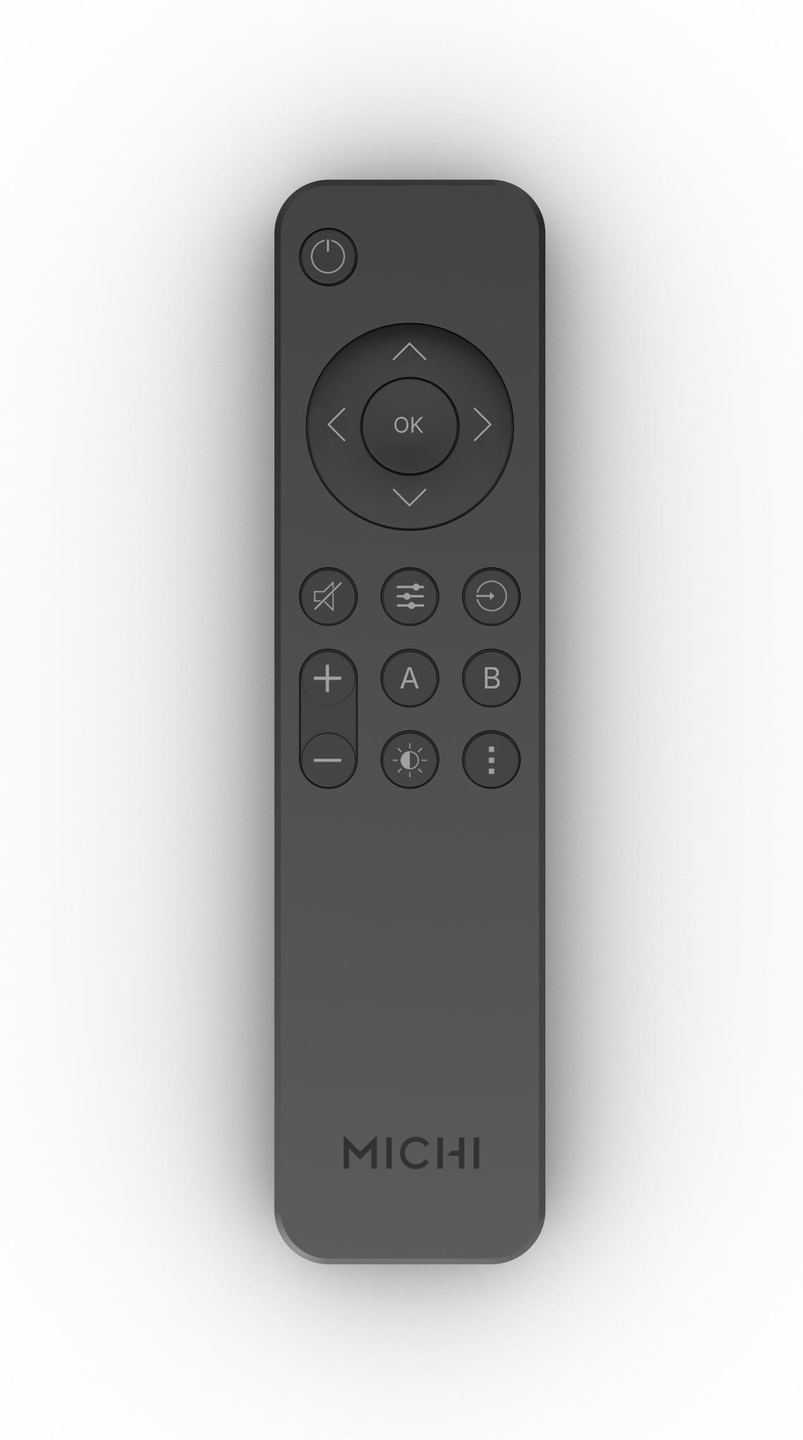
The supplied IR remote covers the main functions. Firmware updates are performed via the Ethernet port or using a USB stick connected to the rear connector; the network is also used for RS232 or IP home automation control, and the 12 V trigger jack (input/output) allows power-on synchronization with other devices.
Positioning compared with the Reference models
The X430 launches the Prestige range, one step below the Michi X3 Series 2 and X5 Series 2. The differences concern power output (the X5 S2 reaches 600 W into 4 Ω), the absence of an MC phono preamp (present on the X5), and a more compact form factor. The DAC also differs: the Series 2 models feature an eight-channel ES9028PRO configured in stereo, while the X430 uses the ES9039Q2M, a newer two-channel chip. The transformer and storage capacity are slightly reduced, which explains the weight difference (16.9 kg versus nearly 29 kg for the X3 Series 2).
In practice, the X430 is aimed at buyers who want access to Michi’s hallmarks (generous power supply, refined finish, extensive connectivity, HDMI ARC) without reaching the budget or bulk of the higher-end reference models.
What the press says
Irrespective of the partnering speaker, this amplifier sounds clean, crisp and balanced. Tonally, it sounds essentially neutral to us, with no discernible emphasis in any particular part of the frequency range. [...] Those who listen to headphones are served a little less well. The headphone module built into the X430 has no trouble driving any of the headphones we plugged into it, but it lacks the transparency and dynamic expression to impress. [...] This Rotel Michi Prestige X430 amplifier is, in most ways, a superb all-rounder. We can't think of a rival that is as uniformly capable across its inputs as this one.
Technical specifications
Power and amplification
- Amplification class: class AB
- Output power (FTC): 2 x 220 W / 8 Ω
- Continuous power: 2 x 205 W / 8 Ω
- Maximum power: 2 x 340 W / 4 Ω
- Damping factor: 260 (20 Hz – 20 kHz, 8 Ω)
Audio performance
- Total harmonic distortion (THD): < 0.03%
- Intermodulation distortion: < 0.03% (60 Hz : 7 kHz, 4:1)
- Channel separation: > 55 dB
- Frequency response
- Line inputs: 10 Hz – 100 kHz (+0 / -0.5 dB)
- Digital inputs: 10 Hz – 20 kHz (+0 / -0.4 dB)
- Phono input: 20 Hz – 20 kHz (+0 / -0.5 dB)
- Signal-to-noise ratio (IHF, A-weighted)
- RCA line: > 105 dB
- XLR line: > 100 dB
- Digital: > 110 dB
- MM phono: > 80 dB
Sensitivity, impedance, and overload threshold
- Input sensitivity
- RCA: 356 mV
- XLR: 743 mV
- MM phono: 5.56 mV
- Input impedance
- RCA: 100 kΩ
- XLR: 50 kΩ
- MM phono: 47 kΩ
- Overload threshold
- RCA: 4 V
- XLR: 10 V
- MM phono: 66 mV
Digital conversion and processing
- Digital-to-analog converter: ESS SABRE ES9039Q2M (32-bit)
- USB-B (PC-USB)
- PCM up to 32-bit / 384 kHz
- DSD up to 11.2 MHz (DSD256)
- DoP 5.6 MHz compatible
- Coaxial / optical inputs
- S/PDIF LPCM up to 24-bit / 192 kHz
- HDMI
- ARC + CEC
- PCM 2.0 (24-bit / 48 kHz max.)
- Certification: Roon Tested
Connectivity and features
- Bluetooth: aptX HD, AAC
- Phono input: MM (moving magnet)
- Preamplifier output: 1.92 V / 100 Ω
- Tone control: ±10 dB (100 Hz / 10 kHz)
Power supply and consumption
- Power supply: 120 V / 60 Hz
- Internal power supply: proprietary Michi toroidal transformer
- Power consumption: 520 W
- Standby power consumption
- Standard: < 0.5 W
- Network: < 2 W
- Heat dissipation: 1476 BTU / h
Dimensions and weight
- Dimensions (W x H x D): 43.1 x 14.8 x 42.2 cm
- Front panel height: 13.1 cm
- Weight: 16.9 kg
General information
- Display: high-resolution color display
- Remote control: included
Frequently Asked Questions
Does the X430 have a headphone output?
Yes, a 6.35 mm jack is located on the front panel, below the volume knob. It is powered by a dedicated circuit.
Can the built-in DAC be used with a CD player via coaxial?
Yes. The three coaxial inputs (75 Ω) and the three optical inputs accept LPCM signals up to 24 bits / 192 kHz, which more than covers standard CD playback and makes it possible to take advantage of a high-quality external transport.
What is the difference between the X430 and the X3 Series 2?
The X3 Series 2 delivers 200 W into 8 Ω and 350 W into 4 Ω thanks to a more generous power supply. It uses the eight-channel ESS ES9028PRO DAC and weighs nearly 29 kg. The X430 is more compact (16.9 kg) and uses a newer ES9039Q2M DAC, but does not include an MC phono input. The X430 adds an HDMI ARC input, absent on the X3 S2.
Which Bluetooth codecs are supported?
The X430 supports aptX HD and AAC, allowing higher-quality wireless transmission from most Android and iOS smartphones.
- Eco-contribution included in the sale price.