Van den Hul The Digi-Coupler 1,5m
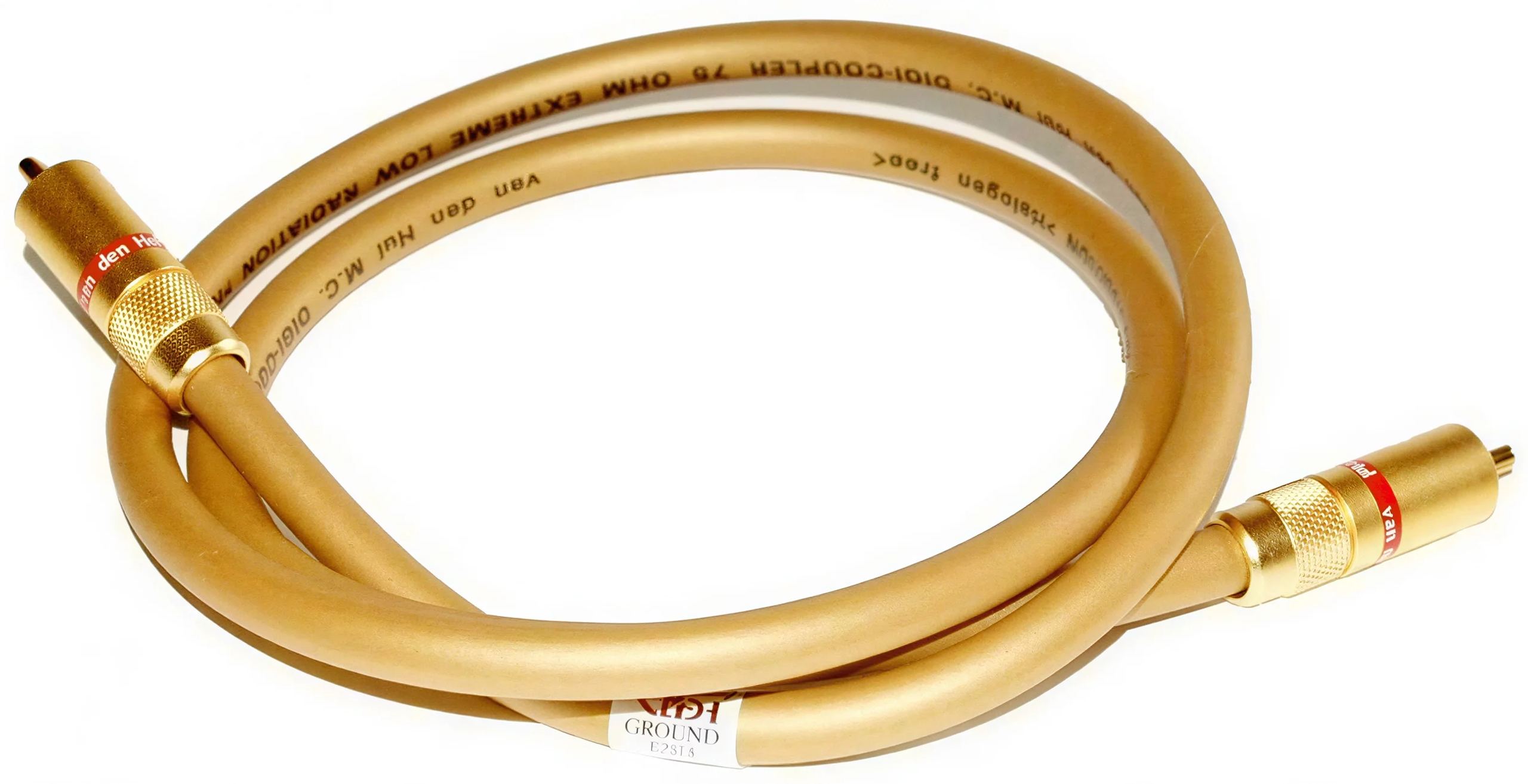
Overview
Between a CD player, a television or a streamer and the converter that turns data into music, the coaxial connection carries a very fast digital signal, sensitive to impedance reflections as well as radio interference. Van den Hul addresses this with the most advanced cable in its S/PDIF range: a triaxial construction with multiple shields, impedance maintained within half an ohm and a halogen-free jacket developed by the Dutch brand.
75-ohm impedance maintained into the gigahertz range
The coaxial S/PDIF standard is based on an impedance of 75 ohms, and any deviation along the connection reflects part of the signal back towards the source. These reflections distort the rising and falling edges of the data, blurring the precise moment when the converter’s receiver reads each bit: this is jitter, which Van den Hul aims to reduce by maintaining the Digi-Coupler’s impedance at 75 ohms ± 0.5 ohm up to 3 GHz. The cable claims wide bandwidth and low attenuation per metre, two parameters that naturally deteriorate as the length increases.
The central oxygen-free copper (OFC) conductor, with a cross-sectional area of 0.283 mm², is insulated with foamed polyethylene. The air bubbles trapped in this foam lower the insulation’s dielectric constant and limit losses at high frequencies. This geometry remains stable only if the cable is not bent too tightly: Van den Hul specifies a minimum bend radius of 8 cm to maintain constant impedance, which requires a little space behind the equipment.
Three braids and three foils against interference
A triaxial cable is a coaxial cable surrounded by an additional, separately insulated shield. The Digi-Coupler takes this principle quite far, alternating three aluminium foils with three dense braids of 128, 128 and then 192 strands of OFC copper coated with high-density silver, all wrapped in a carbon-saturated layer that the brand calls Linear Structured Carbon. Van den Hul classifies this cable among its “superscreened” models, with very low transfer impedance: an interference current flowing on the outer surface induces virtually no voltage inside, where the signal travels.
This protection works both ways. The signal remains shielded from interference from Wi-Fi, phones or switching power supplies, and the cable itself radiates very little towards neighbouring analogue connections. Van den Hul also recommends always keeping digital and analogue cables separate in a system. The low resistance of the intermediate conductor (0.814 Ω per 100 m) and the outer shield (0.747 Ω per 100 m) provides a very low-resistance path for the return current. The brand highlights this immunity for long connections, up to the distances found in a recording studio.
A Hulliflex jacket without halogens or plasticisers
The gold-coloured outer jacket is made of Hulliflex, a polymer developed by Van den Hul that contains neither halogens nor plasticisers. Without plasticisers, the material does not harden or crack over the years; it protects the silver-coated braids from air containing corrosive compounds, preserving their conductivity over time. In the event of a fire, the absence of halogens prevents the release of acidic gases. The intermediate conductor is insulated with polyethylene, and the jacket withstands a voltage of at least 300 V RMS.
The outer diameter of 8.2 mm makes for a fairly stiff cable. It places more strain on RCA sockets than a thin cable and does not tolerate being pressed against a wall or the back of a cabinet, making it worth planning its routing before positioning the equipment.
Gold-plated plugs and possible connections
The gold-plated RCA plugs connect any coaxial S/PDIF output to an input of the same type: CD transport to converter, television to amplifier, streamer or server to external DAC. Van den Hul states that the Digi-Coupler also carries video and high-frequency signals, since its impedance and shielding qualities apply to any 75-ohm connection.
What the cable can improve is the signal’s timing integrity and the noise picked up, not the nature of the data, which reaches the receiver unchanged in any case. The audible difference therefore depends largely on the converter: a receiver stage equipped with an effective phase-locked loop or internal reclocking already rejects much of the jitter, whereas a simpler receiver remains sensitive to it. Within the Van den Hul range, the Digi-Coupler is a technically enhanced version of The Triaxial Professional 75 Ohm cable.
Technical Specifications
Physical Structure
- Cable type: Asymmetrical triaxial super-shielded
- Outer diameter: 8.2 mm
- Sheath color: Hulliflex gold
- Connectors: gold-plated
Conductors
Nature
- Core: oxygen-free copper (OFC)
- Intermediate and shield: high-density pure silver plated on oxygen-free copper (OFC)
Dimensions
- Core: 0.283 mm
- Intermediate and shield: aluminum foil + 128 + aluminum foil + 128 + aluminum foil + 192
Electrical Characteristics
Resistance
- Core: 5.92 Ω / 100 m
- Intermediate: 0.814 Ω / 100 m
- Shield: 0.747 Ω / 100 m
Other Parameters
- Characteristic impedance: 75 Ω
- Capacitance:
- Core-Intermediate: 56.2 pF / m
- Intermediate-Shield: 470 pF / m
Frequently Asked Questions
Which audio formats can be transmitted over a coaxial S/PDIF connection?
S/PDIF carries stereo PCM, typically up to 24 bits / 192 kHz depending on what the transmitter and receiver support, as well as compressed Dolby Digital and DTS 5.1. DSD can be carried encapsulated in PCM (DoP) if both devices support it. Dolby TrueHD, DTS-HD Master Audio and full-resolution Dolby Atmos require an HDMI eARC connection.
Is a coaxial or optical connection better?
Van den Hul advocates coaxial for its wider bandwidth, which helps reduce jitter at the receiver. Optical retains one advantage: it creates no electrical connection between devices, eliminating any risk of a ground loop from the outset. When hum occurs over a coaxial connection between a TV connected to an antenna and a hi-fi system, optical may be the simplest solution.
Is the Digi-Coupler suitable for an AES/EBU connection?
No. AES/EBU is a balanced connection using XLR connectors that requires a 110-ohm cable. The 75-ohm Digi-Coupler is intended for coaxial S/PDIF.
Is there a version with BNC connectors?
Yes, Van den Hul offers it in RCA and BNC versions. BNC connectors, with their bayonet locking mechanism, are mainly used on professional equipment and some high-end converters. Their design maintains a 75-ohm impedance, avoiding the need for a BNC-to-RCA adapter, which introduces an impedance discontinuity.
How do I route the cable behind a piece of furniture?
The minimum bend radius of 8 cm must be respected, with no sharp bends where the cable exits the plugs. It is best to avoid running it alongside power cords or analog audio cables; if they must cross, crossing at a right angle limits interference coupling.
What is the purpose of gold plating on plugs?
Gold does not oxidize and ensures a stable contact surface over time. It does not improve the conductivity of the underlying metal. Occasional cleaning of sockets and plugs, without abrasive products, is enough to maintain good contact.
- Eco-contribution included in the sale price.
- Manufacturer reference: B22AA015