

Which Pro-Ject turntable to choose between E1, T1 EVO and T2?
28 May 2026

Contents
Three turntables, prices ranging from around 300 to 650 euros, and names that do not say much about the actual hierarchy. Pro-Ject’s entry-level range requires a bit of decoding. The E1, T1 EVO, and T2 are built on the same manufacturing logic, each exists in several versions, and the price differences correspond to specific technical choices. The real question is: which of these choices matter for your setup.
→ Discover Pro-Ject turntables
A common foundation before the differences
All three models work on the same principle: belt drive, fully manual playback, with no automatic tonearm or end-of-record detection. The chassis is CNC-machined, with no hollow internal space, and manufacturing remains European. Speed switching between 33/45 rpm is done electronically on current versions, without moving the belt by hand.
All arrive factory-calibrated, ready to play a record right out of the box. What sets them apart comes down to four elements: the platter, the cartridge, the tonearm, and the amount of adjustment left to the user. The rest mostly comes down to price and finish.
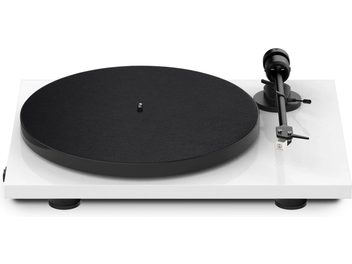
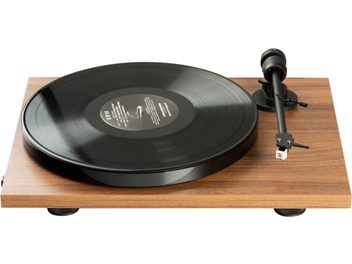
E1: the turntable you set down and forget
The E1 opens the range. Its platter is made of ABS polymer, reinforced with internal ribs intended to limit resonance. It is a light platter, which does not rely on the flywheel effect of a heavy platter to stabilize speed. Pro-Ject compensates with the rigidity of the part, but this remains the model’s most visible compromise.
The 8.6-inch aluminum tonearm comes fitted with an Audio Technica AT3600L according to Pro-Ject’s official documentation. Several retailers still list an Ortofon OM 5E on their product pages: a discrepancy worth checking with the seller before purchase, as the two cartridges do not sound the same. Tracking force and anti-skating are factory-set, with nothing to adjust. This is a turntable you connect and listen to.
Three versions exist. The standard version outputs a raw phono signal and requires an external preamp. The Phono version includes a switchable preamp. The BT version adds a Bluetooth transmitter, with the aptX Adaptive codec, in addition to the preamp. Expect around 300 euros for the standard version, a bit more for the others.
One detail to know: Pro-Ject has since introduced an E1.2, equipped with a cast aluminum platter and a revised cartridge. Depending on the retailer, one generation or the other may be offered, and the platter difference is not insignificant.

T1 EVO: moving into the T-Line
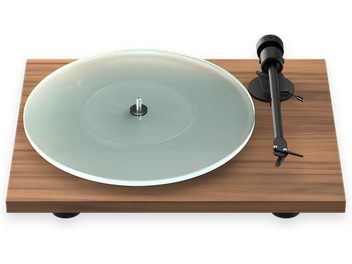
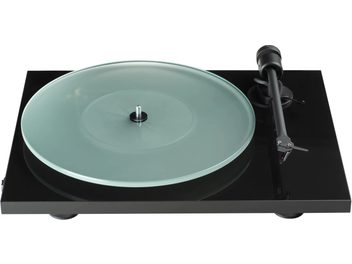
The T1 EVO changes platter. In place of polymer, it uses an 8 mm frosted glass platter, heavier and chosen for its neutral behavior toward resonance. It sits on a larger-diameter sub-platter, taken from the Debut range, mounted on a main bearing machined to 0.001 mm with a hardened steel axle and brass bushing.
The other change is more audible: the cartridge. Pro-Ject equips the T1 EVO with an Ortofon OM10, whose elliptical stylus delivers more detail and better-extended treble than entry-level cartridges. This is the clearest jump between the E1 and this model. The 8.6-inch one-piece aluminum tonearm remains close to that of the E1, but the counterweight can be readjusted if you change cartridges later. The manufacturer supplies its own low-capacitance shielded phono cables, rather than generic RCA cables.
On paper, wow and flutter (0.25% at 33 rpm) and signal-to-noise ratio (65 dB) remain identical to those of the E1. The gain therefore lies in the platter material, the cartridge, and the cabling, not in raw rotational stability. Again, there are three versions: T1 EVO, T1 EVO Phono, and T1 EVO BT, the latter with Bluetooth 5.0 and aptX HD codec. Prices start at around 350 euros for the standard version, about 400 euros for the Phono, and 430 euros for the BT.
It is the least expensive model in the selection to offer truly hi-fi sound.
T2: more mass, a longer tonearm
On the T2, the changes affect structural parts. The tonearm moves to 9 inches, with an effective length of 230 mm. A longer tonearm reduces tracking error along the groove, as the cartridge stays better aligned from the outside to the center of the record. The headshell is integrated into the tube, which limits resonance compared with a screwed-on head.
The T2 also adds spring-adjustable anti-skating, absent from the E1 and T1 EVO. On those two models, this setting is fixed at the factory; on the T2, you can adjust it, which becomes useful the day you fit a different cartridge. The platter increases to 10 mm thick and 1.7 kg, heavier than that of the T1 EVO. The stock cartridge is a Sumiko Rainier moving-magnet model, assembled in Japan.
The measurements follow: wow and flutter rated at 0.19% at 33 rpm, signal-to-noise ratio at 67 dB, two figures showing slight improvement. The T2 range comes in three versions: the T2 without preamp (around 500 euros), the T2 Super Phono with a dual-stage MM phono preamp (649 euros), and the T2 W, which adds network streaming via Wi-Fi (around 1,000 euros).
The gap with the T1 EVO is real, but it remains gradual. For a more marked jump within the Pro-Ject range, you need to look toward the Debut series.

Side-by-side reference points
| Model | Platter | Cartridge | Tonearm | Indicative price (standard version) |
|---|---|---|---|---|
| E1 | ABS polymer | Audio Technica AT3600L | 8.6 inches | around €300 |
| T1 EVO | 8 mm glass | Ortofon OM10 | 8.6 inches | around €350 |
| T2 | 10 mm glass, 1.7 kg | Sumiko Rainier | 9 inches | around €500 |
Standard, Phono, or BT: the preamp question
A turntable delivers a very low-level signal, which requires RIAA correction before feeding an amplifier. Hence the three variants found in each line.
The standard version outputs a raw phono signal. It is suitable if your amplifier has a phono input, or if you have a separate phono preamp: you then keep control over the choice of that stage. The Phono version includes a switchable preamp, practical when the amplifier has no dedicated input. The BT version adds a Bluetooth transmitter for wireless speakers or headphones, and also includes the preamp. Wireless simplifies the setup but takes away some of the playback finesse in the process.
This version choice concerns connectivity, not playback quality itself. So it is better to decide first on the line (E1, T1 EVO, or T2), then on the suffix.

Which turntable for which setup?
If the budget is tight and the turntable is meant to join active speakers or a compact system, with no adjustments to plan for, the E1 gets the job done. The Phono or BT version avoids adding a preamp.
For a first truly hi-fi setup, with an amplifier and passive speakers, the T1 EVO is the right entry point, at around 350 to 430 euros depending on the version. The OM10 cartridge explains most of the price difference with the E1, and that is what you will hear.
The T2 is aimed at a more resolving system. Its longer tonearm and adjustable anti-skating provide cleaner playback and more leeway if you change cartridges later on. If your amplifier does not have a phono input, the T2 Super Phono solves the issue with its built-in preamp.
One simple reference point remains: between these three turntables, it is the platter and the cartridge that make themselves heard. The Phono or BT suffix only determines how the turntable connects to the rest of the system.
Featured products
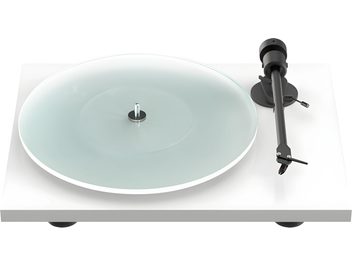
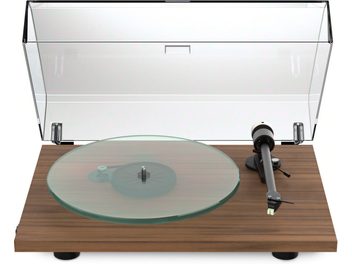
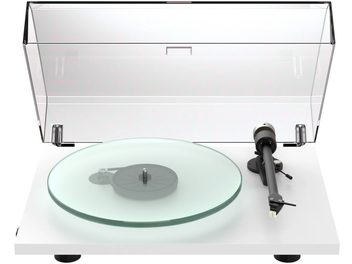
- Pro-JectE1 BT white AT3600LVinyl TurntableAvailable on order€399
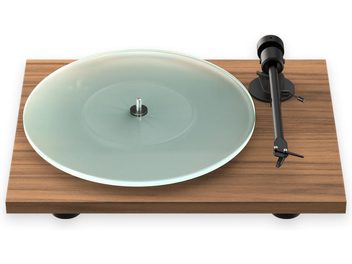
- Pro-JectE1 BT walnut AT3600LVinyl TurntableIn stock€399
- Pro-JectE1 Phono whiteVinyl TurntableAvailable on order€299
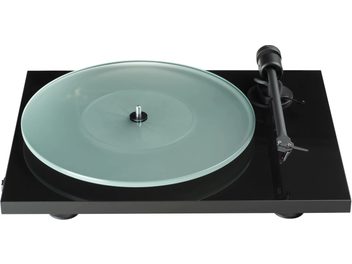
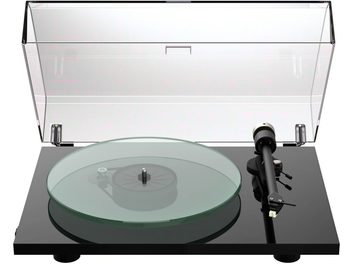
- Pro-JectE1 Phono blackVinyl TurntableAvailable on order€299
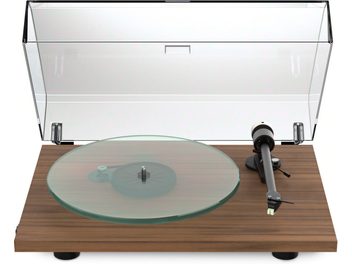
- Pro-JectE1 Phono walnutVinyl TurntableIn stock€299







You may also like to read
 Guide: how to connect a turntable to wireless, Bluetooth, or multiroom speakersTutorials and practical guides
 Turntable and speaker package: our best combinations under €1,000Comparisons and buying guides
 Which turntable to start with without making a mistakeComparisons and buying guides
 Turntable Speakers: The Complete Guide Before BuyingComparisons and buying guides
 Stream Box E and Wireless Box E: Pro-Ject goes wireless multiroomHi-fi and home cinema news
 Beginner’s Vinyl Guide: How to Get Properly Equipped in 2026Tutorials and practical guides


