Turntable Speakers: The Complete Guide Before Buying
July 30, 2026
Contents
Between the groove cut into the record and the air in the room, you need a phono preamp, amplification and two speakers, and each of these links imposes its constraints on the next. Yet speakers are chosen last, once the turntable has been delivered and the cartridge fitted, even though they determine the achievable listening level, the required power and, more surprisingly, the mechanical stability of the turntable itself.
The phono preamp, only once in the chain
A few millivolts for a moving magnet cartridge, ten times less for a moving coil cartridge: the signal coming out of a turntable is one hundred times below the level expected by a line input. Record cutting makes matters even more complicated, as it reduces bass and boosts treble to prevent grooves from overlapping. The phono preamp solves both problems at once by amplifying the signal and applying the inverse correction of the RIAA curve.
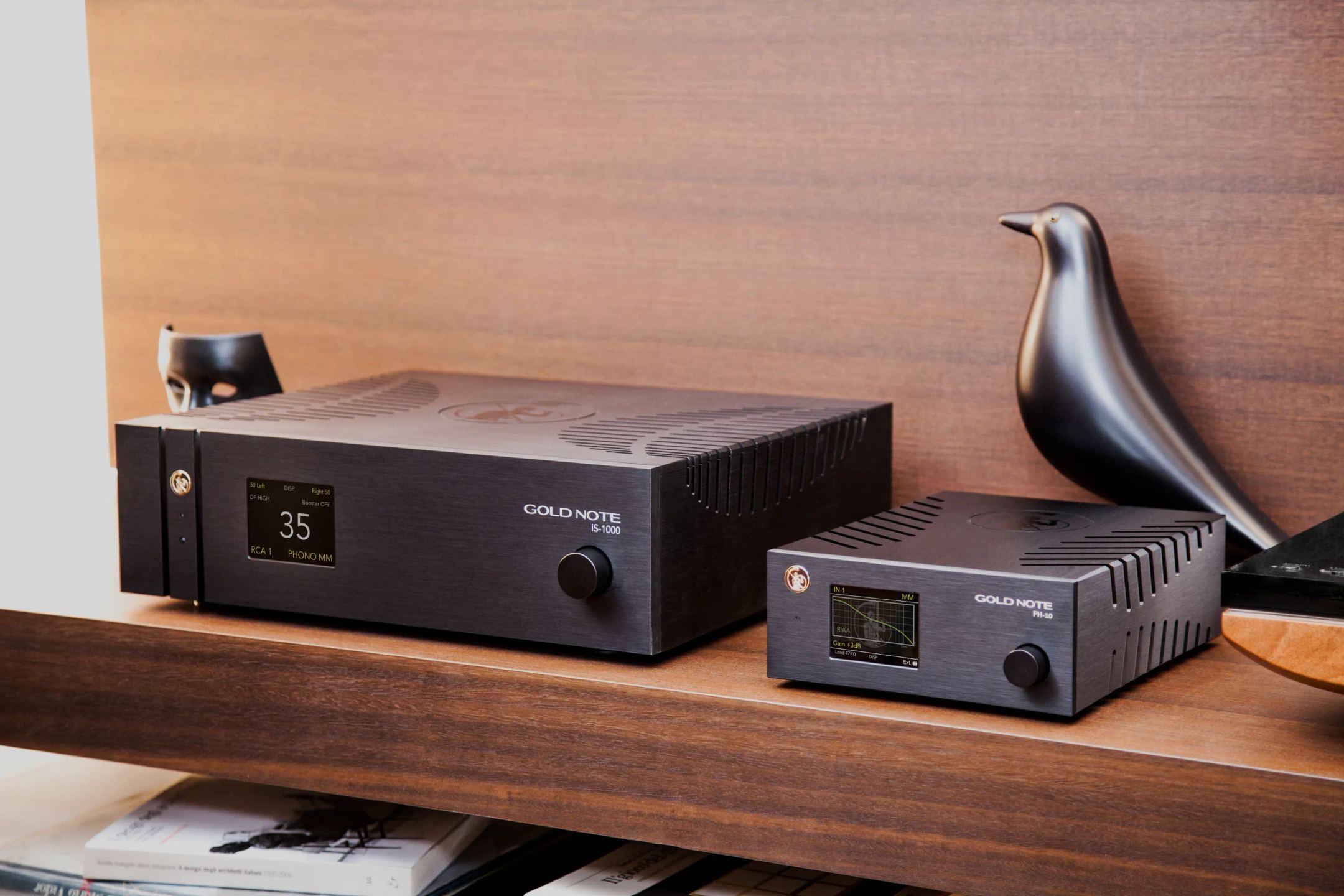
This stage can be housed in the turntable, the amplifier or the active speaker itself, but only one is needed and no one will warn you if you install two. The symptom is immediately recognizable: saturated, shrill, unmanageable sound from the first notch of the volume control.
Because it conditions everything else, this point eliminates half the candidates before the first listen. A turntable without a preamp requires a speaker able to accept a cartridge directly, or a separate box inserted between the two.
Active or passive, two different approaches
Amplification lives inside the active speaker, along with the converter, crossover and bass correction, leaving the manufacturer in control of the amplifier-speaker pairing. Two cables, one power outlet, and music comes out. For a first vinyl system, this shortcut is hard to beat, since none of the budget goes into an amplifier enclosure.
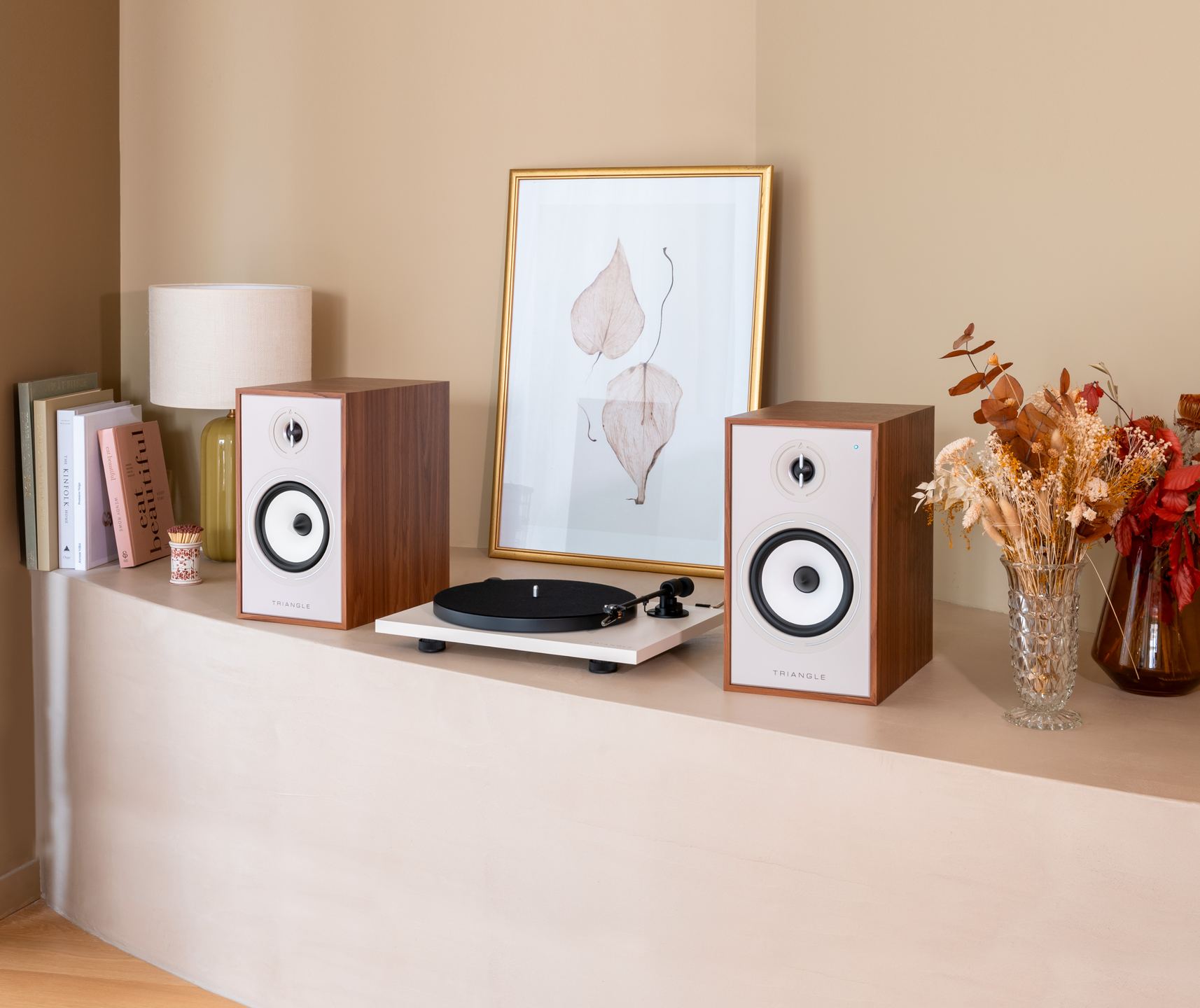
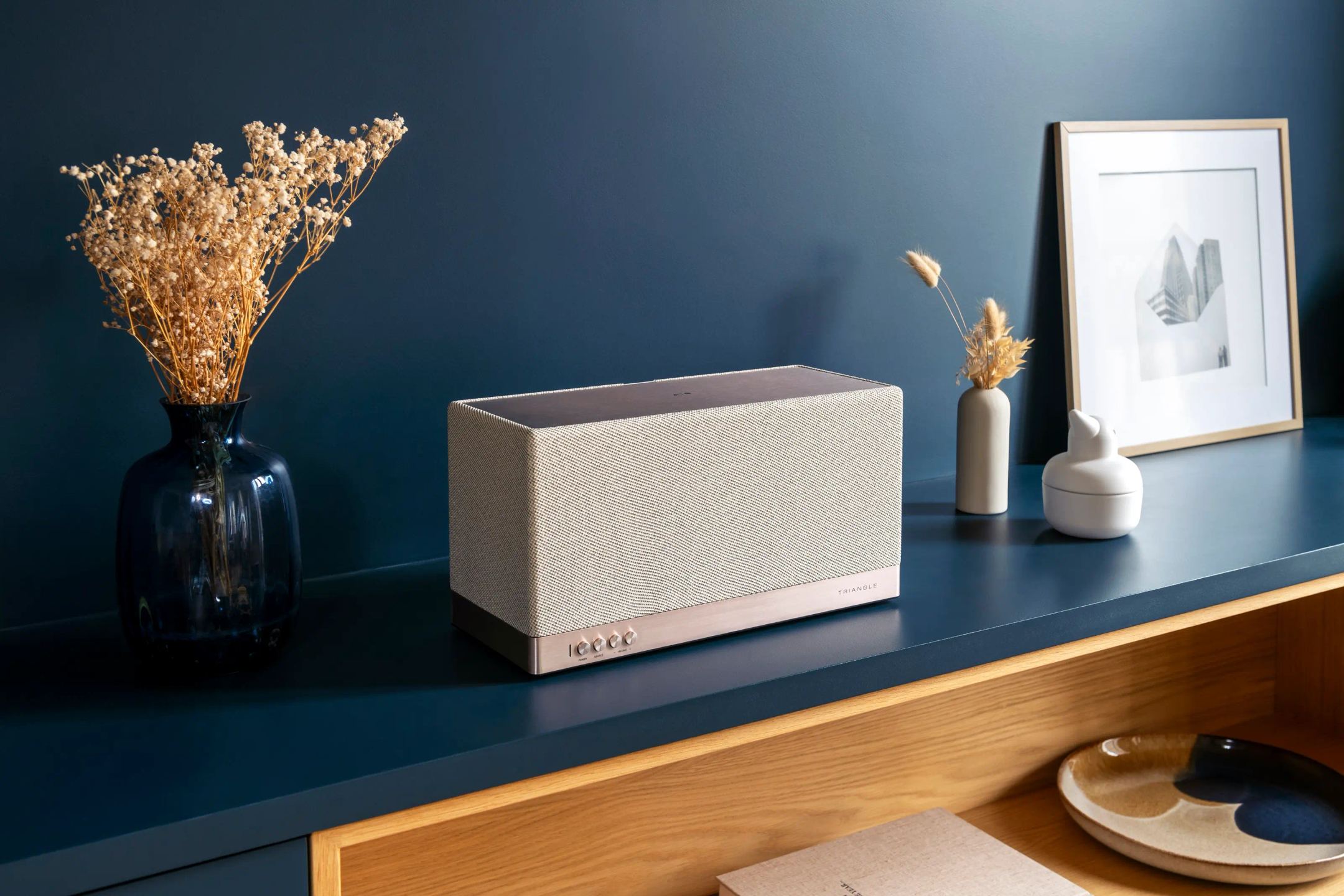
With a passive pair, that enclosure becomes mandatory, along with the purchase that comes with it. In return, the pair has no ceiling: it can span two generations of electronics, a cartridge change, a more serious turntable. The amplifier then becomes a tuning tool, and a Triangle Borea BR03, lively at the top of the spectrum, does not tell the same story with rich-sounding electronics as it does with analytical electronics.
Asking which of the two families is better does not make much sense. The question is about the path ahead: a fixed, compact system, or one that follows your wishes for ten years.
Four ways to connect a turntable
It all starts with the phono input, which is far from universal in this category. Four pairs offer one, with four distinct approaches.
With Elipson, the model name says it all: the Horus 6 Active BT Phono accepts the turntable directly, for €499, and its subwoofer output supports the natural limits of a bookshelf speaker of this size. The French brand has long cultivated a rounded tonal balance, forgiving of average pressings and entry-level cartridges, which is appreciated when the collection includes as many used records as carefully made reissues.
Triangle applies the same idea in two formats: the BR02 Connect for rooms up to 25 m² and the BR03 Connect for rooms between 15 and 35 m², with a more generous woofer-midrange driver and 2 × 60 watts behind it. The drivers come from the passive Borea range, with the open treble and lively pace that characterize the brand. One detail matters more than it seems: the phono input can be disabled, preventing you from stacking two preamps if the turntable already has one. Few manufacturers take this precaution.
Another issue arises when a vinyl collection coexists with a streaming subscription, which has become the norm. The AIO Twin, at €599, accept the turntable through their MM phono input and, above all, include a complete network player. They are the only ones in this selection to handle both sources without any additional box.
The Fyne Audio Cubitt 5 takes a different approach for €649. Its 12.5 cm IsoFlare coaxial driver places the tweeter at the center of the woofer-midrange driver, producing a point source and a stereo image that remains stable when you leave the listening chair. The phono stage accepts both moving magnet cartridges and high-output moving coil cartridges, with a ground terminal on the rear panel, and the response extends down to 43 Hz at minus six decibels, leaving room for a subwoofer.
The Klipsch horn, liveliness and trade-offs
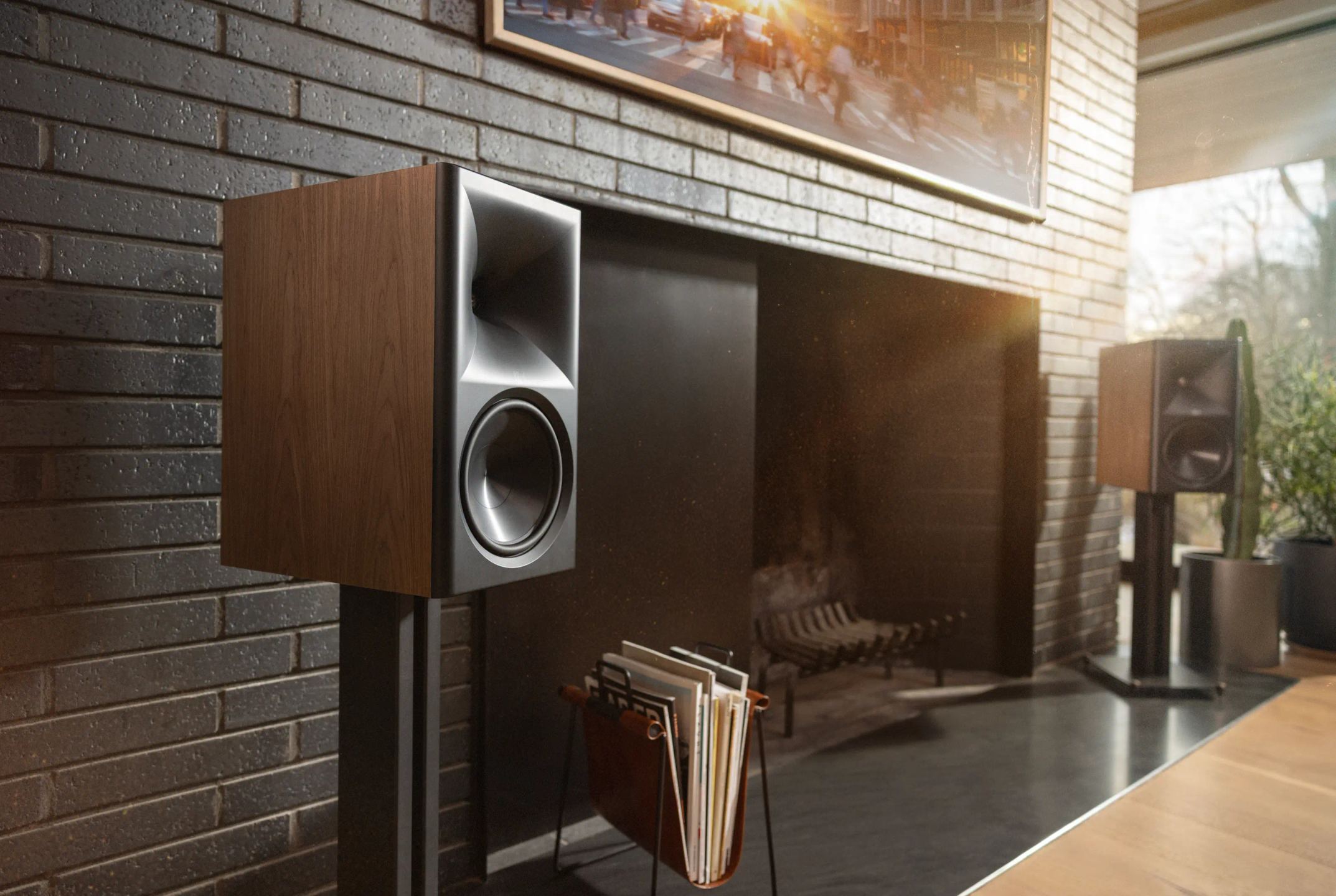
With Klipsch, the Series II introduced in spring 2026 hands the electronics over to Onkyo and adds Wi-Fi streaming, without changing the Tractrix horn that loads the titanium dome tweeter. Treble remains clear, direct and frankly dynamic. With rock or soul pressed in the 1970s, it brings life to recordings that seem dull elsewhere, while with strings recorded too closely, it calls for a smooth cartridge to avoid tipping into harshness. The choice between a Klipsch and a Triangle lies there, in temperament.
The Sevens II and Nines II come with a Dirac Live license and a measurement microphone, which deserves the attention of anyone who listens to records. The included version corrects the spectrum up to 500 Hz, covering bass and lower midrange, precisely the area where the room creates its peaks and where feedback loops between speaker and cartridge develop. The Fives II do not get this feature.
Pricing has moved into a different league, at around €1,399 for the Fives II, €1,999 for the Sevens II and €2,399 for the Nines II, compared with €590, €989 and €1,290 for the first generation still in the catalog. A significant part of this extra cost will never be useful to anyone who only listens to records. The original Fives, with their phono switch and ground terminal, do the job for a third of the price, and Series II is justified when the system must also provide sound for the television, replace a network player and correct a difficult room.
When analog goes through digital
All the active speakers mentioned here use digital crossover processing, without exception. The signal entering through the phono input, analog from the groove onward, is converted before reaching the crossover, then converted again to drive the speakers.
The converters used today at €500 or €700 are excellent, and digital processing allows bass correction that no passive crossover can produce at this price. The Cubitt 5 sound very good, as do the Borea Connect. That is not the issue.
It becomes relevant if your project is to keep vinyl in the analog domain from the groove to the driver cone. No active speaker with digital crossover processing will do that. You then need a passive pair, an amplifier, a phono preamp, and must accept the three enclosures that come with them. The question is as much philosophical as technical, and it should be asked before buying rather than afterward.
Formats to avoid for vinyl
That leaves single-enclosure models, such as The One Plus or The Three Plus, which play in mono. They reproduce music, not the soundstage, and that soundstage is precisely what stereo cut into grooves since 1958 seeks to reproduce. Two speakers forty centimeters apart in the same cabinet create only an impression of width.
The Triangle AIO 3 is an exception. Sold individually for €319, it can be paired with a second unit to form a complete stereo system for a little over €600, with the network player and phono input of the AIO Twin.
Sensitivity, impedance and available power
With a passive pair, sensitivity governs amplifier choice. It measures the level produced by one watt, and a six-decibel difference between two models means a factor of four in the power required: a horn-loaded Klipsch needs only ten watts where a compact bookshelf speaker requires forty for the same volume level.
The calculation becomes decisive as soon as the amplifier lacks headroom, which happens with integrated tube amplifiers or small Class A amplifiers often associated with vinyl for their smoothness. A fifteen-watt-per-channel amplifier breathes easily with high-efficiency speakers, but runs out of steam and hardens with an insensitive load.
As for nominal impedance, it often lies: a speaker rated at eight ohms can drop below five ohms at certain frequencies. Modern electronics handle this without flinching; a vintage amplifier acquired alongside a 1970s turntable, much less so.
Bass, the room and the bass-reflex port
A floorstander goes lower than a bookshelf speaker because it contains more air, and in a 15 m² room this advantage works against it. Room resonance modes amplify certain frequencies, making the lower range muddy, lingering and tiring over the duration of a record side.
Look at the port position before buying. A front port, as on the passive Borea models, tolerates proximity to a wall or a bookshelf niche. A rear port compressed against a wall boosts bass by several decibels around its tuning frequency. With a speaker placed on a low piece of furniture, this constraint matters more than the difference in quality between two closely related models.
Adding a subwoofer remains possible, but it introduces a problem that digital does not encounter.
When the turntable hears the speakers
The stylus resting in the groove is a vibration sensor, and it does not distinguish between vibrations cut into the record and those coming up through the furniture or the air. Turn up the volume: bass emitted by the speakers returns to the cartridge, is amplified, comes out again, then returns once more. The loop sets in, the cones begin to oscillate slowly, a rumble rises, and beyond a certain threshold the amplifier and speakers are genuinely at risk.
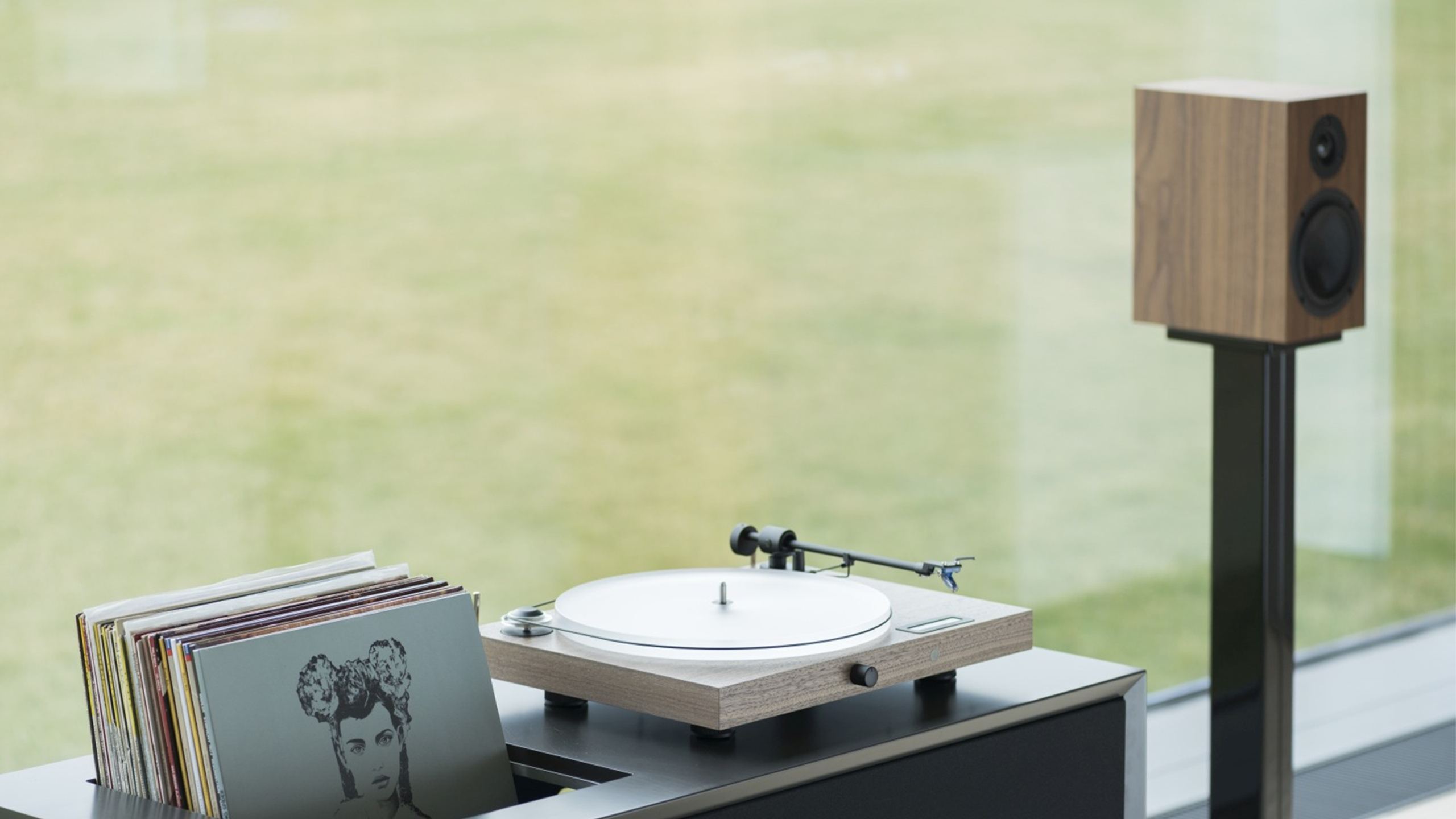
Connected speakers often make the problem worse unintentionally, because they group the amplification and connections in a single speaker, known as the master. Five cables come out of it, so you naturally push it toward the low furniture, against the wall, next to the turntable. Commercial photographs reinforce the habit by showing a turntable placed between the two speakers, on the same shelf. It is the worst possible location.
Separate the surfaces. Put speakers on stands or on the floor, and the turntable on a separate support, preferably a shelf fixed to a load-bearing wall, with at least one and a half meters between the stylus and the nearest bass driver. A test settles the matter in ten seconds: play a record at normal volume and tap the furniture holding the turntable. If the tap comes clearly through the speakers, you know where the problem is traveling.
Serious phono preamps offer a subsonic filter that cuts below 20 Hz, a frequency occupied by no music and generated in abundance by record warps. As soon as a subwoofer enters the room, this filter is no longer a refinement.
The myth of the warm speaker for vinyl
No speaker is specialized for vinyl records, since it reproduces what it is sent without knowing where the signal comes from. The character attributed to vinyl originates upstream, in the stylus profile, tonearm geometry, phono stage and the record cut itself.
Hence a common mistake: choosing a deliberately dark speaker to compensate for an aggressive cartridge. The flaw disappears in one part of the spectrum and reappears elsewhere, while all other sources connected to the system suffer. It is better to act where the problem originates, by adjusting tracking force, vertical tracking angle or the cartridge itself.
The order in which to decide
Start by locating the phono stage, because it eliminates half the candidates. Then look at where the turntable will sit and how far it will be from the speakers, because this constraint matters more than any frequency-response curve. The choice between active and passive comes afterward, depending on what you imagine doing with this system in five years. Comparing models comes last, once the ground has been cleared, and is settled by listening to your own records.
Popular products
You may also like to read
 Which Pro-Ject turntable to choose between E1, T1 EVO and T2?Comparisons and buying guides
 Turntables 2026: which turntables for a budget of €400, €1,000, and €2,500?Comparisons and buying guides
 Review of the Audio-Technica AT-LP7X turntable: is it worth €799 compared with the competition?Product reviews
 Which turntable should you choose for under €700? (Pro-Ject, Rega, Dual, Audio Technica)Comparisons and buying guides
 When should you replace your turntable stylus? The unmistakable signsTutorials and practical guides