

How many speakers do you need for a Dolby Atmos setup?
28 October 2026
Contents
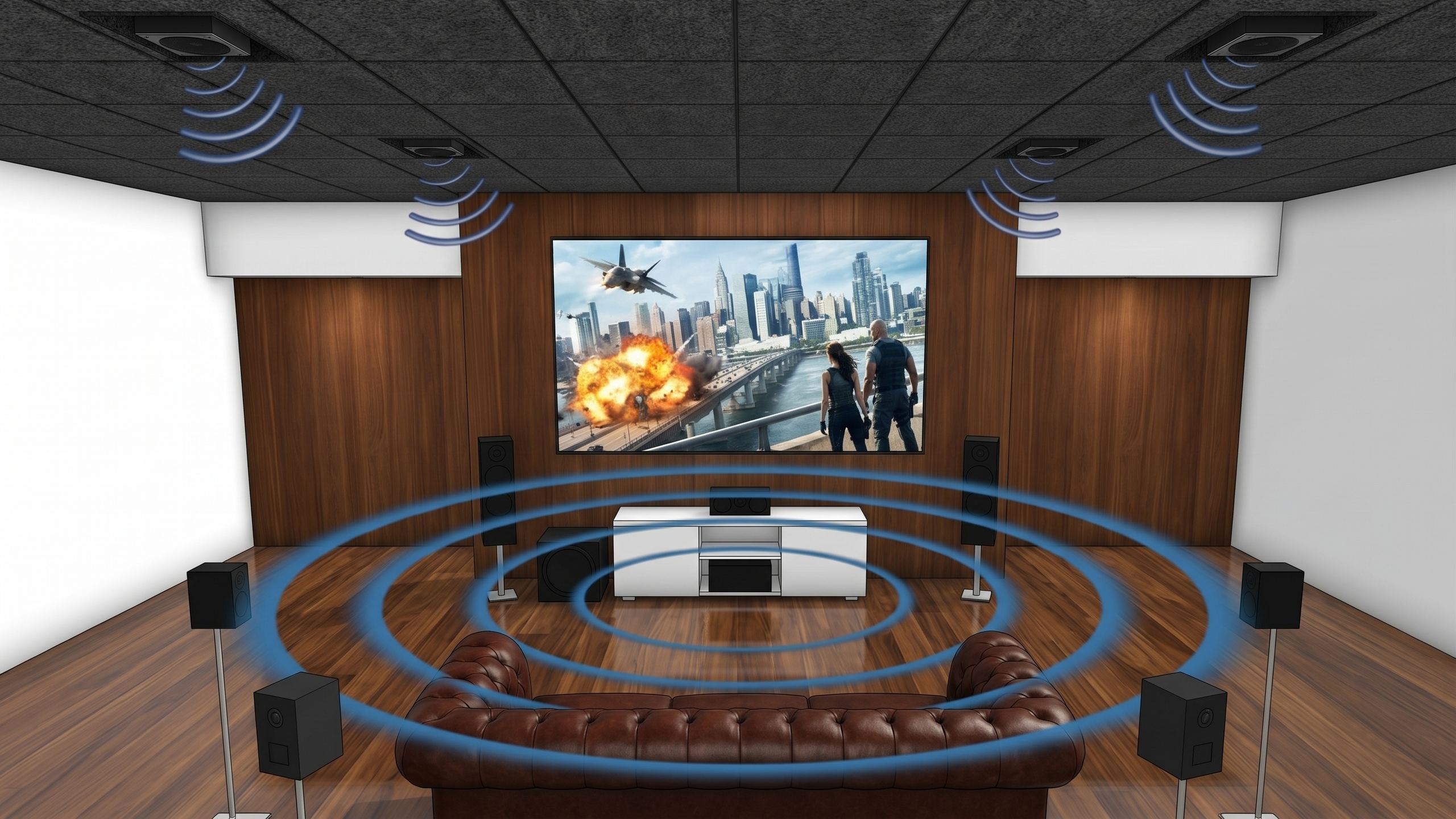
A Dolby Atmos setup requires at least seven speakers and a subwoofer, arranged in 5.1.2: five speakers at ear level, one subwoofer and two height speakers. Yet Dolby recommends placing four above the listening position, and its rendering engine can drive up to 34 speakers. Between these two extremes, the right number of Dolby Atmos speakers depends on the room, ceiling and amplifier channels: here is how to decide.
How to read a Dolby Atmos configuration: 5.1.2, 5.1.4, 7.1.4
Dolby’s naming system takes conventional surround notation and adds a third number. It builds on standard designations (stereo, 5.1 and 7.1) and adds a number at the end to indicate how many height speakers the system includes. The first number refers to the speakers placed around the sofa, at a common height of around 1.20 m, or the ear level of a seated viewer. The second counts the subwoofers, and the third the speakers that reproduce sounds from above, whether recessed into the ceiling or aimed towards it.
Two rules affect the count. With the exception of the center speaker and rear center channel, all speakers in a Dolby Atmos system are added in pairs: there is no such thing as a 5.1.3 configuration. The format also generates only one low-frequency effects (LFE) signal, even though some manufacturers provide multiple subwoofer outputs, so a “.2” denotes two subwoofers sharing this signal to distribute bass more evenly throughout the room.
| Configuration | Ear-level speakers | Subwoofer | Height speakers | Total (including subwoofer) | Amplified channels required |
|---|---|---|---|---|---|
| 5.1.2 | 5 | 1 | 2 | 8 | 7 |
| 5.1.4 | 5 | 1 | 4 | 10 | 9 |
| 7.1.2 | 7 | 1 | 2 | 10 | 9 |
| 7.1.4 | 7 | 1 | 4 | 12 | 11 |
| 9.1.4 | 9 | 1 | 4 | 14 | 13 |
| 9.1.6 | 9 | 1 | 6 | 16 | 15 |
Moving from 7 to 9 ear-level speakers means adding a pair of front wide speakers to a 7.1.2 layout, positioned between the front speakers and the side surrounds. The guide 5.1, 7.1, Dolby Atmos, DTS:X: which configuration to choose looks at formats without height channels.
Two height speakers, the minimum for Dolby Atmos
5.1.2 is the manufacturer’s chosen starting point: the technology adapts sound objects to the number and location of the speakers, starting with a system of five floor-level speakers and two height speakers. The ceiling pair sits above the listening area, directly over the sofa or slightly in front, aligned with the front left and right speakers. It is enough to make rain fall on viewers or position a flyover above them, and the difference from conventional 5.1 is audible from the first scenes mixed in Atmos.
Its limitation comes down to geometry. With just one pair, a sound cannot move from the front to the back of the ceiling: it appears overhead, without a trajectory. 5.1.2 remains the most widespread configuration because it works with a 7-channel amplifier, the standard entry-level format, and it is a sensible starting point in a living room where the sofa sits against the wall, provided you plan for what comes next.
Four Dolby Atmos ceiling speakers, Dolby’s recommendation
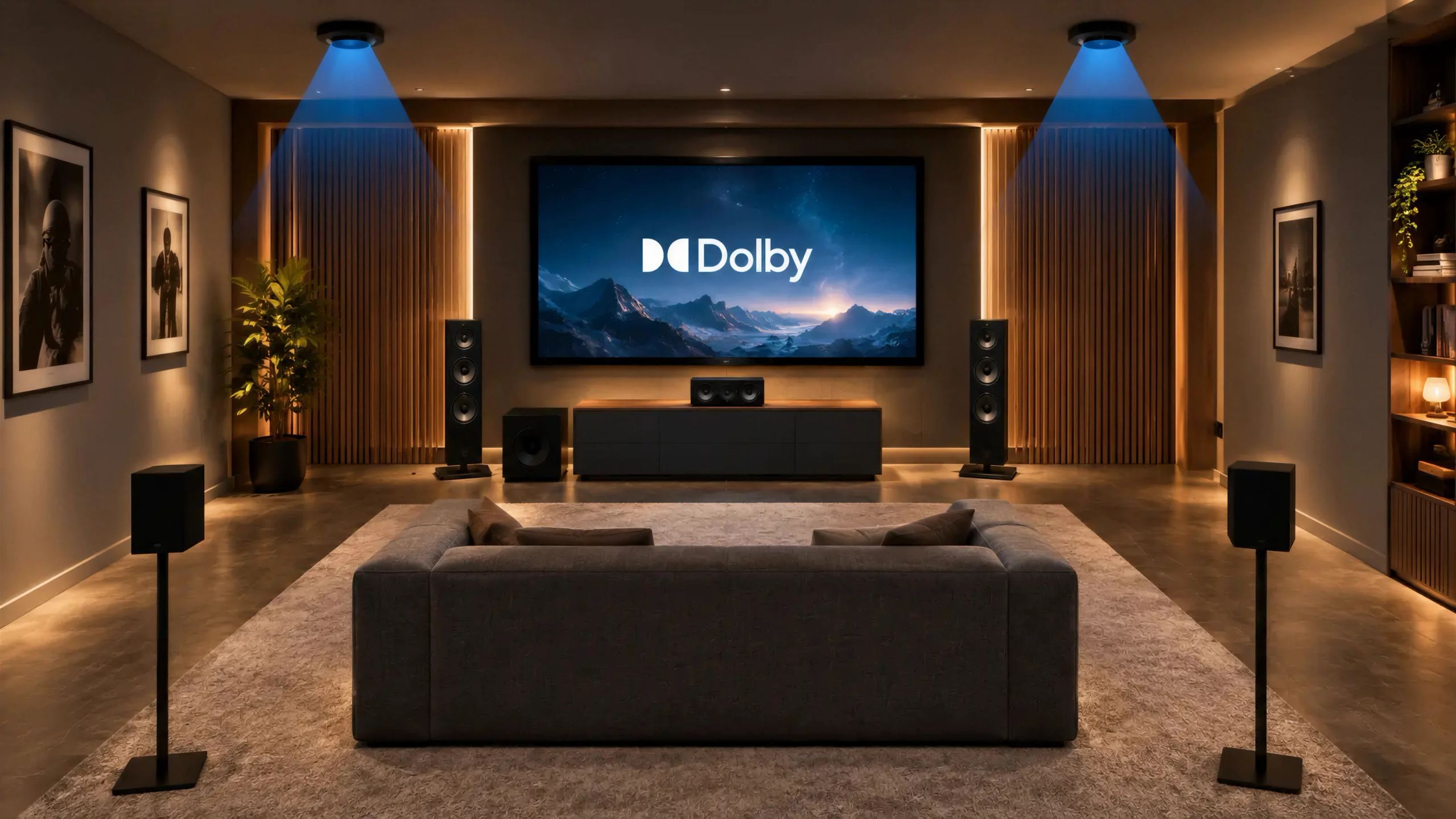
At least two speakers, either ceiling-mounted or upward-firing, are needed to produce sounds from above, but Dolby recommends installing four. The manufacturer explains why in its guides: four speakers position overhead sounds more accurately, and an object such as a helicopter passes overhead more precisely and realistically.
Their position is set using an elevation angle measured from the central seat. In a reference 7.1.4 layout, the angle between the listening position and the front and rear ceiling speakers should be 45°, adjustable between 30 and 55° if necessary. Their lateral spacing roughly matches that of the left and right speakers positioned at ±30°, and the whole arrangement benefits from remaining centered front to back above the listening area, even if the screen is farther away than the surrounds. In practice, with a 2.50 m ceiling and ears at 1.20 m, a 45° angle places the front row approximately 1.30 m in front of the viewer’s head and the rear row the same distance behind.
5.1.4 or 7.1.2 with a 9-channel amplifier
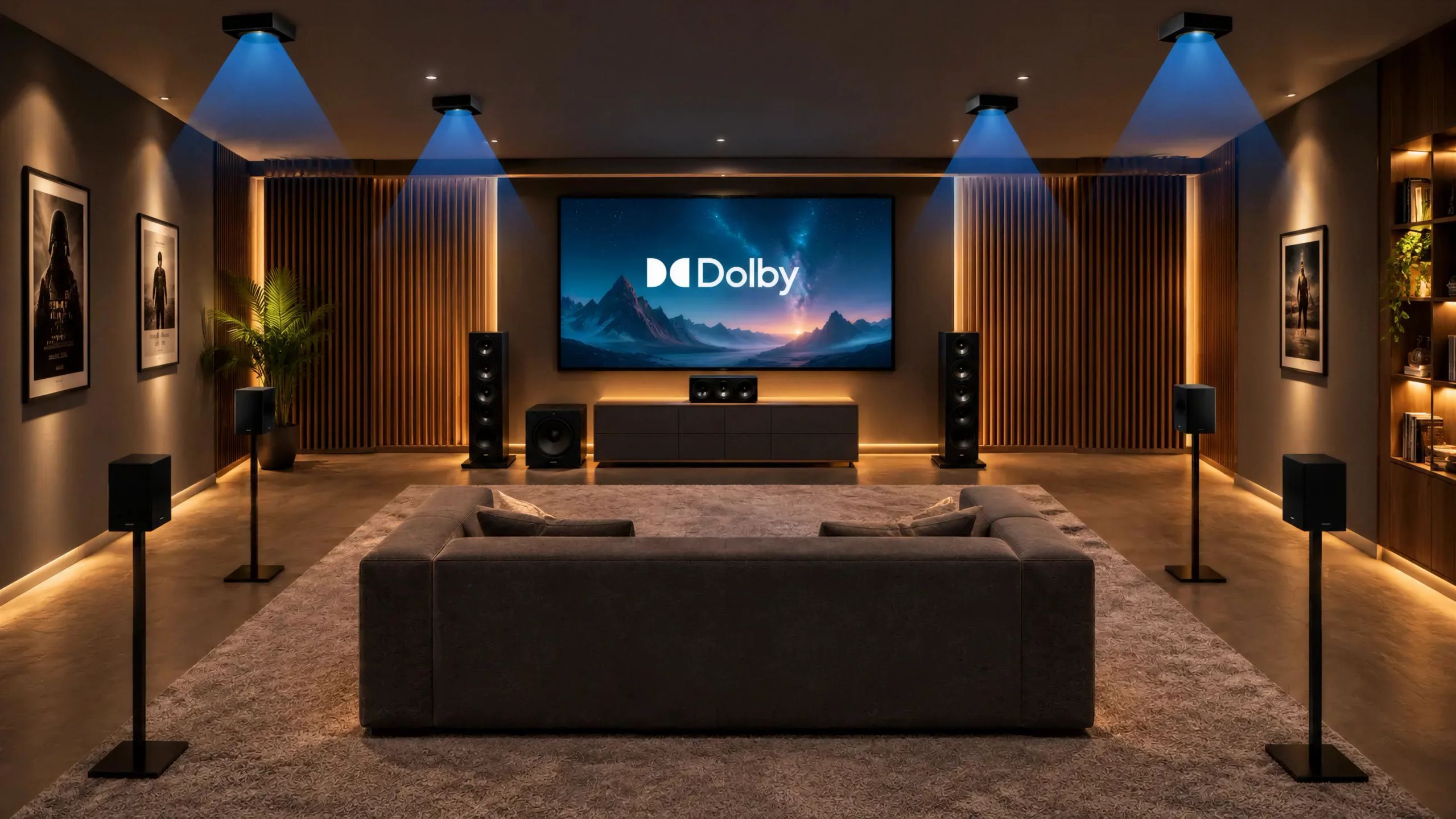
A 9-channel amplifier offers two options: two rear surround speakers at ear level (7.1.2) or a second pair on the ceiling (5.1.4). We prefer 5.1.4 for most living rooms. The rear surrounds in a 7.1 setup require space behind the sofa, which is rarely available when it touches the wall, whereas the second height pair adds the front-to-back movement described by the Atmos soundtrack.
7.1.2 retains the advantage in a deep dedicated room with several rows of seats, where the rear surrounds maintain the ambience for viewers at the back. In this case, moving to 7.1.4 becomes the logical next step.
More than four height speakers: 9.1.6 and up to 34 speakers
An Atmos soundtrack combines fixed channels and sound objects with coordinates. The channel bed can range from a simple left-center-right trio to 7.1.2, and of the 128 tracks available during production, a 7.1.2 bed leaves up to 118 for objects. The amplifier’s decoder then distributes these objects across the speakers actually present: Dolby Atmos supports up to 34 speaker positions in total, for example in 24.1.10.
Adding speakers only brings a benefit if the mix uses objects. Since the largest possible bed is 7.1.2, a mix that stayed entirely within it would not reach all the speakers in a larger layout such as 9.1.6. In streaming, Dolby Digital Plus spatial coding reduces the channels and objects to 12 or 16 grouped elements, which also limits the detail a very large system can exploit. A 9.1.6 setup is therefore justified in a large dedicated room, where the distances between speakers become significant; in a 25 m² living room, four well-positioned height speakers cover the essentials.
The additional speakers do not stay silent outside films mixed in Atmos. The Dolby Surround upmixer distributes stereo, 5.1 and 7.1 content across up to 17 listening-level positions and 10 height speakers, adding an overhead ambience to shows and series broadcast in conventional multichannel sound.
How many amplification channels to plan for
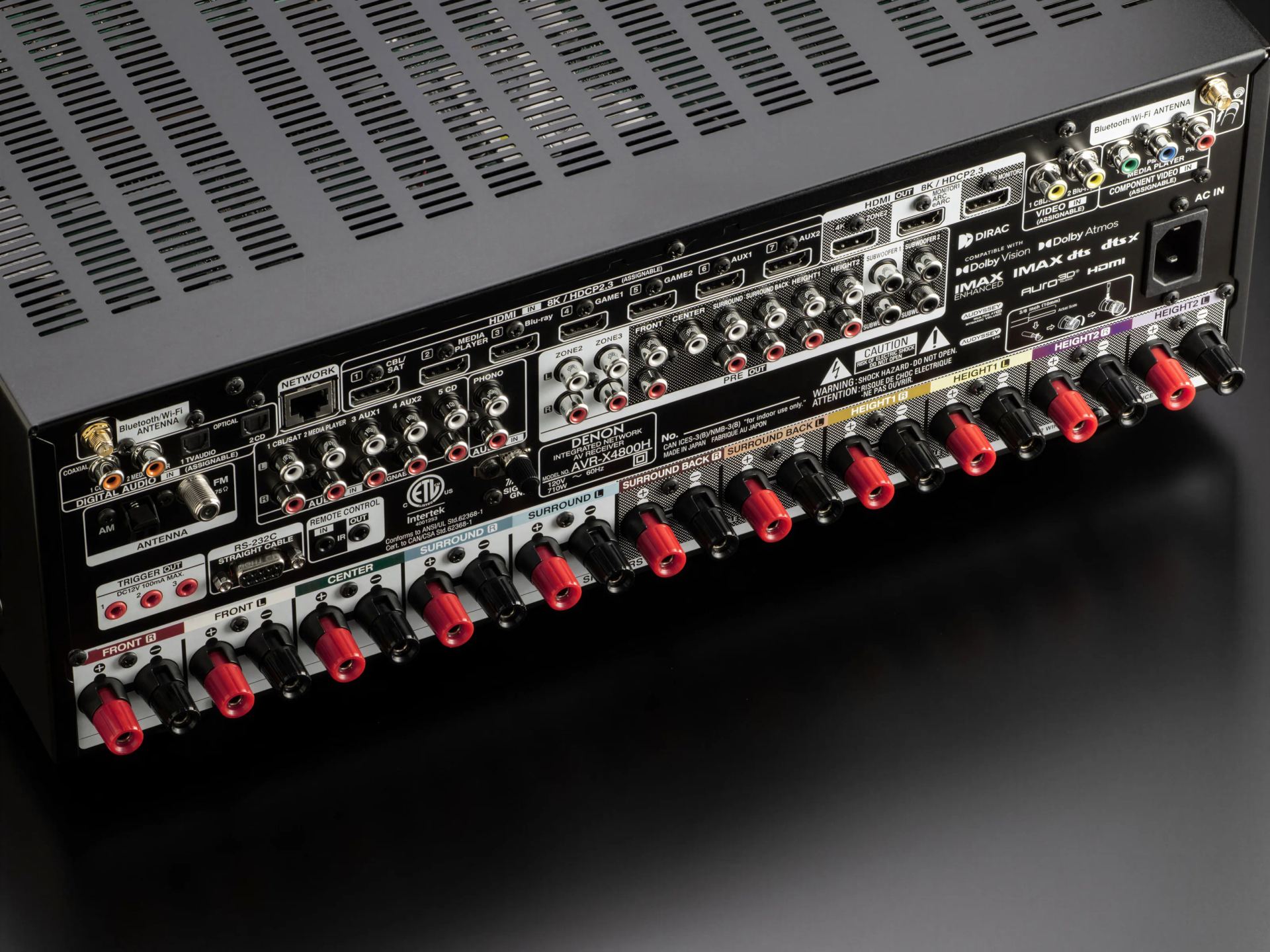
Each passive speaker uses one amplification channel, excluding the powered subwoofer. Many amplifiers distinguish between the number of amplified channels and the number of processed channels: a model with 9 amplifiers and 11-channel processing handles 7.1.4 by assigning two channels to a stereo power amplifier connected to its preamp outputs. The table below lists a few models from the home theater amplifiers category.
| Home theater amplifier | Amplified channels | Processed channels | Possible Atmos configurations |
|---|---|---|---|
| Denon AVR-X2900H DAB | 7 | 7.2 | 5.1.2 |
| Marantz Cinema 60 DAB Serie 2 | 7 | 7.1 (7.2 pre-out) | 5.1.2 |
| Onkyo TX-RZ50 | 9 | 11.2 (pre-out) | 5.1.4, 7.1.2; 7.1.4 with external amplifier |
| Denon AVC-X3900H | 9 | 11.4 | 5.1.4, 7.1.2; 7.1.4 with external amplifier |
| Marantz Cinema 50 Serie 2 | 9 | 11.4 | 5.1.4, 7.1.2; 7.1.4 with external amplifier |
| Denon AVC-X6800H | 11 | 13.4 | 7.1.4; 7.1.6 or 9.1.4 with external amplifier |
| Denon AVC-A1H | 15 | 15.4 | 9.1.6 |
Height speakers are not supplementary speakers. Atmos objects are mixed full-range and can move anywhere in space: Dolby therefore requires ceiling speakers to match the main speakers in frequency response, output level and power handling. The selection of Dolby Atmos amplifiers for 2026 details models by budget.
Ceiling, distances and height speaker types
Speakers recessed into or mounted on the ceiling
Dolby places ceiling speakers at a height between two and three times that of the listening-level speakers, meaning a ceiling between 2.40 and 3.60 m for speakers at 1.20 m. A wide-dispersion model (around 45° off-axis between 100 Hz and 10 kHz) can point straight down; with narrower dispersion, adjustable drivers aimed at the listening position are preferable. The manufacturer also recommends a tonal character as close as possible to that of the main speakers, so that a sound moving from the wall to the ceiling does not change character along the way.
→ Discover in-ceiling speakers
Installing all the speakers in the ceiling, including the surrounds, goes against the principle of the format. Dolby Atmos requires separation between the listening-level speakers and those in the ceiling, and Dolby advises against recessing everything overhead. Dipole surround speakers are also discouraged. The complete guide to in-wall and in-ceiling speakers covers installation in a suspended ceiling.
Upward-firing Dolby Atmos speakers
When drilling into the ceiling is not an option (rented accommodation, concrete slab, aesthetic choice), upward-firing speakers project sound towards the ceiling, which reflects it back towards viewers. They are available as add-on modules and integrated into floorstanding speakers, with two separate sets of terminals, one for the front section and the other for the upward-firing driver, each connected to its own amplifier output. For optimal results, the ceiling must be flat (neither sloped nor vaulted), between 2.30 and 4.30 m high, and made of a reflective material such as plaster or wood; the most favorable range is 2.30 to 3.66 m.
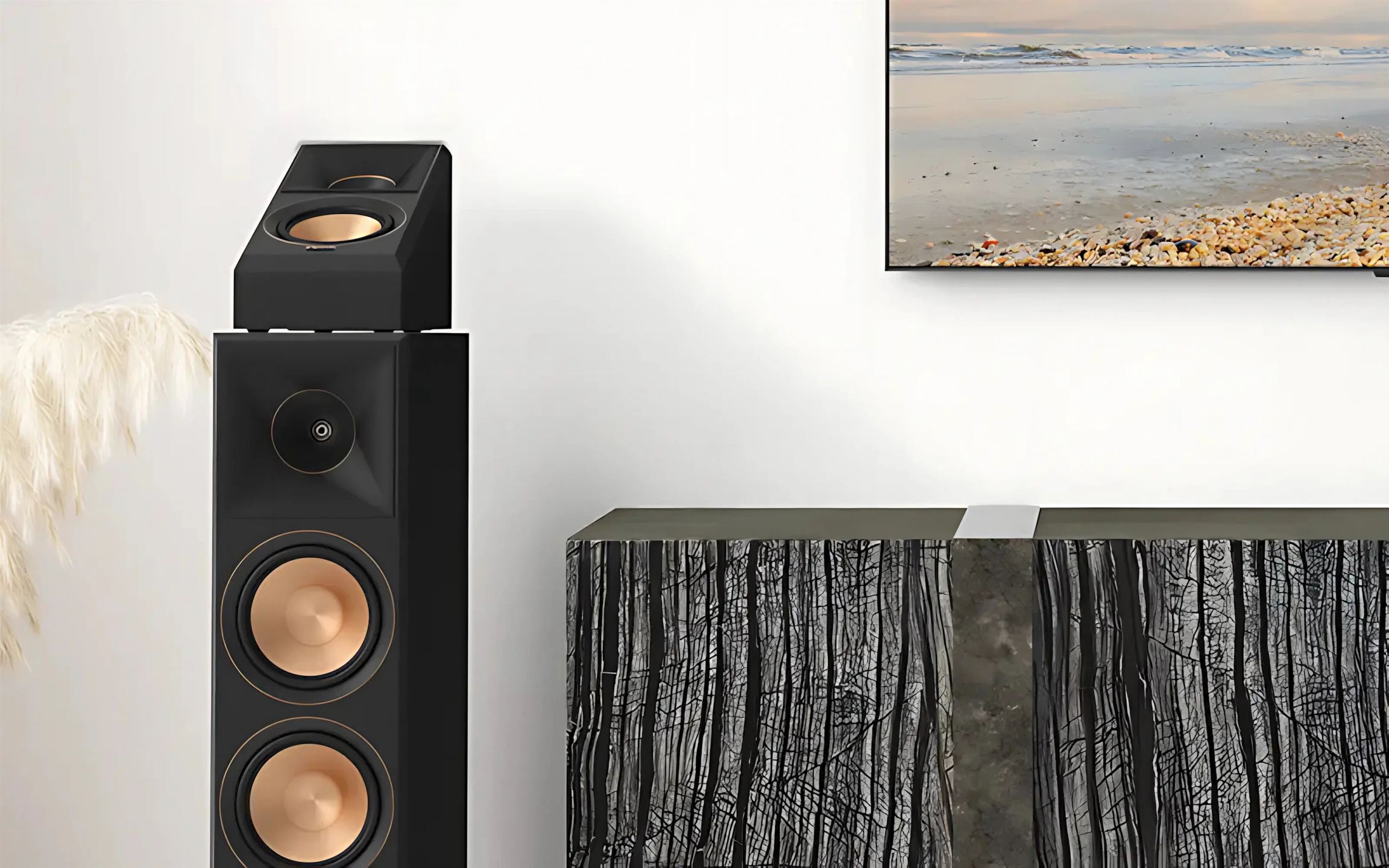
The recommended number remains four. Two sit on the front left and right speakers, with the other two preferably on the rear surrounds, or failing that, on the side surrounds; with only two, they go on the front speakers. They sit at ear level or slightly above, never higher than halfway up the wall, and at least 0.90 m from the seats, ideally 1.50 m. During manual setup, the distance must include the path from the speaker to the ceiling and then from the ceiling to the listener, and automatic calibration systems sometimes get this value wrong.
→ Discover Dolby Atmos speakers
The result differs from that of in-ceiling speakers: reflection makes the overhead effect more diffuse, and Dolby sometimes considers it preferable under a low ceiling, where ceiling speakers that are too close can be individually pinpointed. The two solutions can be combined: ceiling speakers at the front and upward-firing modules at the rear, or vice versa. The article in-ceiling, upward-firing or floorstanding Dolby Atmos speakers compares the three approaches according to ceiling height.
Dolby Atmos soundbars: channels without separate speakers
A Dolby Atmos soundbar advertises channels, not speakers. Sonos describes its Arc Ultra as a 9.1.4 system and its Beam Ultra as a 7.1.2: the height channels come from upward-firing drivers, the side channels from drivers aimed at the walls, all within a single enclosure. The process relies on reflection, with the same ceiling requirements as Atmos modules.
The rear effect remains limited as long as no speakers are placed behind the sofa. Adding a subwoofer and then two wireless rear speakers brings the result closer to a separates system, without the placement freedom or upgrade potential offered by an amplifier and home theater speakers.
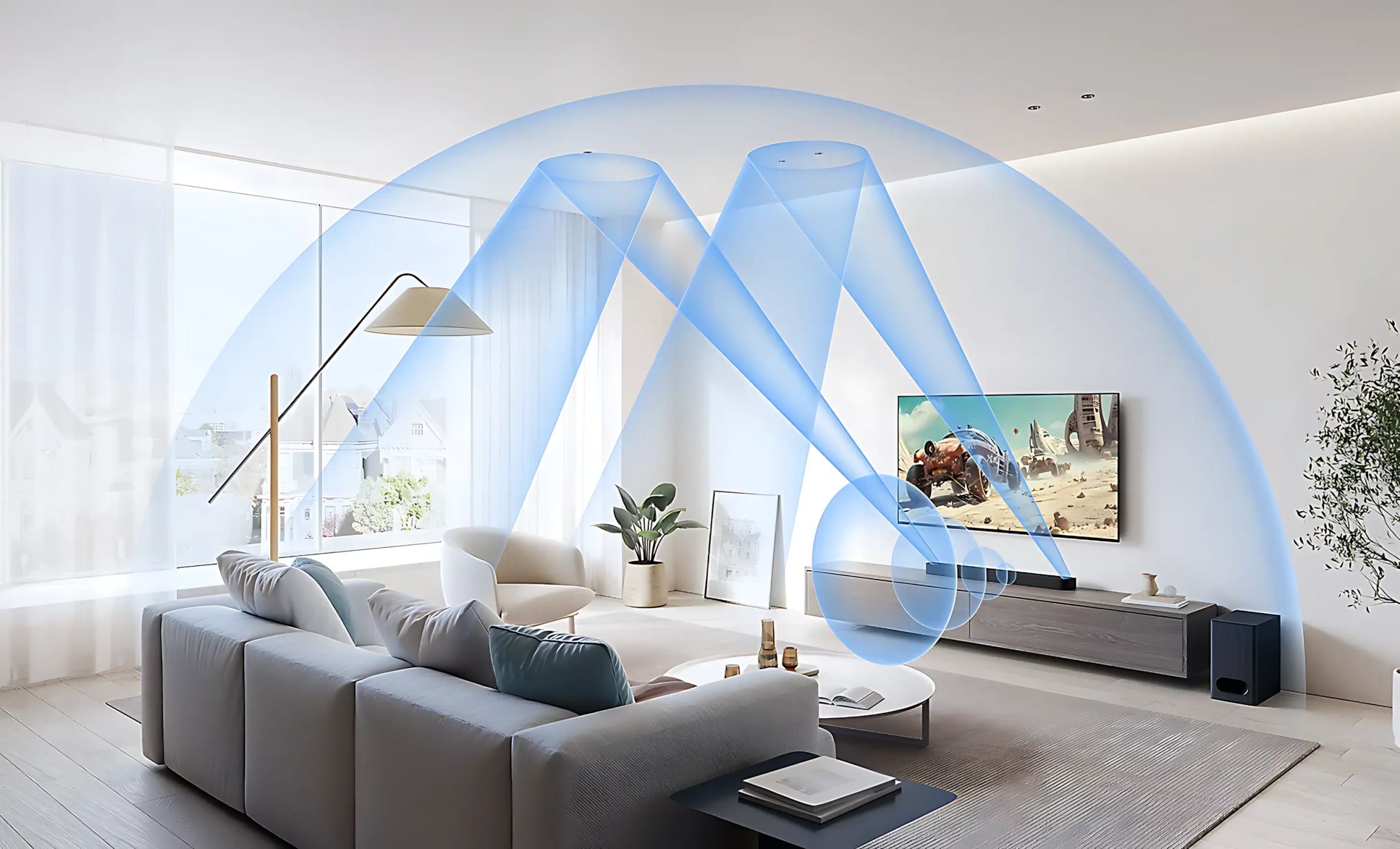
Plan for four height outputs from your first Dolby Atmos installation
The right answer to the question of speaker count often has less to do with the initial purchase than with the next step. Dolby puts it simply: if four height speakers are planned, even for later, you need an amplifier capable of providing four height outputs. A 9-channel amplifier used in 5.1.2 leaves two channels available for a second ceiling pair, and in a home undergoing renovation, running four ceiling cables instead of two costs a few meters of wire, whereas reopening a finished suspended ceiling means redoing the finishing work.
Numbers are not everything. A 5.1.2 setup positioned at the right angles, calibrated and tonally matched sounds more accurate than a 7.1.4 setup with approximate placement: for a Dolby Atmos installation, four height speakers remain the target, and the quality of their placement matters as much as their number.
Frequently asked questions
What is the minimum number of speakers required for Dolby Atmos?
Seven speakers and a subwoofer, according to Dolby’s installation guides: five speakers at ear level, a subwoofer and two height speakers, making a 5.1.2 system. This setup requires a 7-channel home theater receiver compatible with Dolby Atmos. Soundbars go lower by housing all the drivers in a single enclosure.
Is 5.1.4 or 7.1.2 better?
In most living rooms, 5.1.4. Both require a 9-channel amplifier, but the second pair of ceiling speakers allows sounds to move from front to back above the viewers, which Dolby recommends. 7.1.2 holds its own in a deep room, with space behind the seats for rear speakers.
Do you need special speakers for the ceiling?
No for in-ceiling or ceiling-mounted speakers: any wide-dispersion model will do, preferably with a timbre similar to that of the front speakers. Yes for up-firing modules, which follow Dolby specifications (driver angle, specific filtering) so that sound reflected off the ceiling seems to come from above.
Can you get Dolby Atmos without drilling into the ceiling?
Yes, with upward-firing Dolby Atmos speakers placed on the front and rear speakers, or with floorstanding speakers that have them built in. The ceiling must be flat, reflective and between 2.30 and 4.30 m high. Wall-mounted speakers installed high up are another option, which Dolby ranks behind the first two.
Do height speakers need to perform as well as the other speakers?
Yes, as far as possible. Dolby requires height speakers to match the main speakers in frequency response, output level and power handling, as audio objects span the entire audio range. Upward-firing modules, with their more limited bass extension, route their bass to the subwoofer through the amplifier settings.
Popular products

You may also like to read
 Dolby Atmos speakers: in-ceiling, reflective, or floor-standing, which solution should you choose?Comparisons and buying guides
 Our Selection of Movies, Series, and Concerts That Fully Utilize Dolby AtmosHi-fi and home cinema news
 Why isn’t your TV outputting Dolby Atmos to your amplifier?Tutorials and practical guides
 Guide: Enhance Your Gaming Sessions with Dolby AtmosTutorials and practical guides


