Denon AVC-X3900H


Specifications and features


Overview
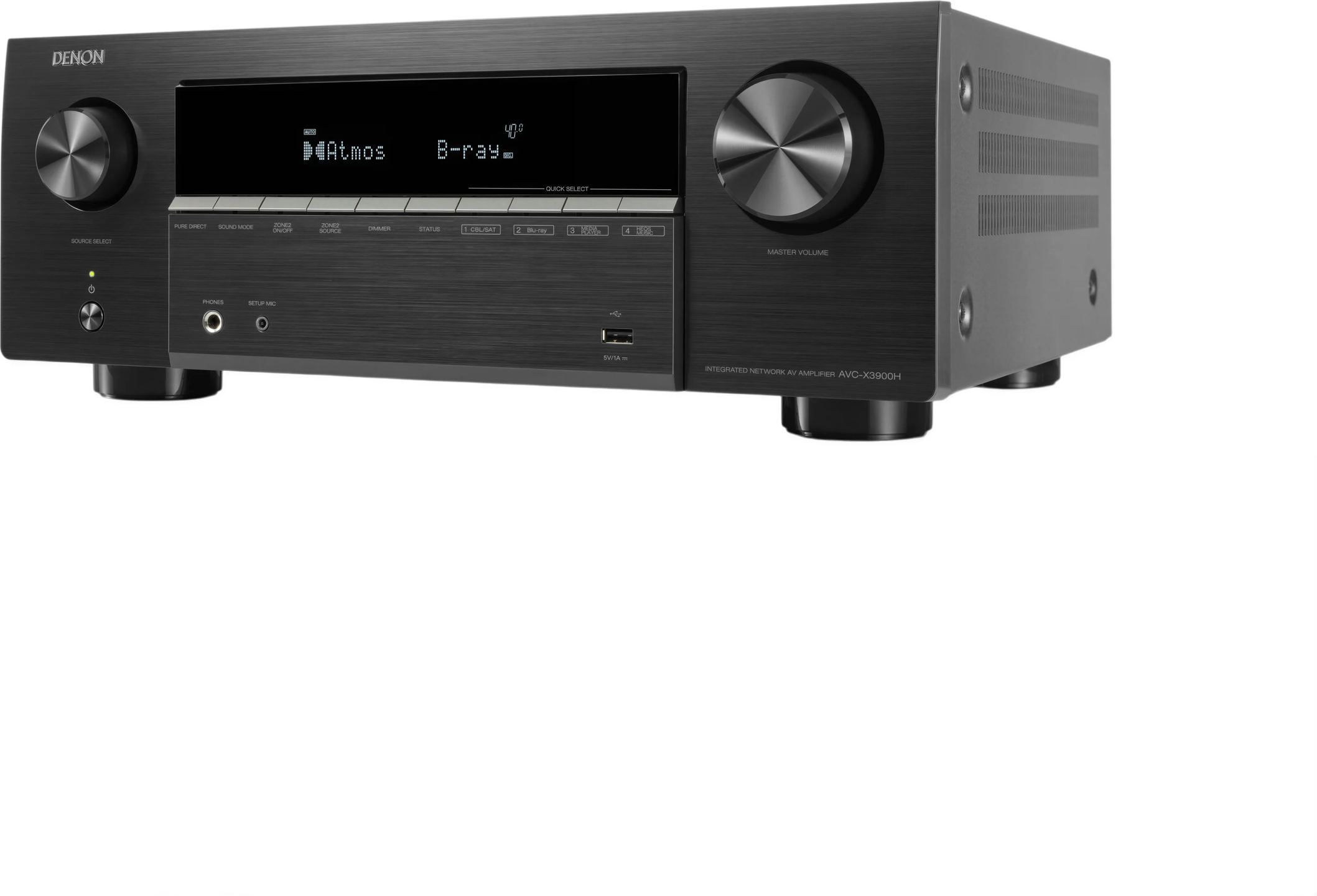
Successor to the AVC-X3800H, this amplifier retains the 9.4-channel formula and 105 W per channel in class AB, while updating its conversion section, calibration, and network functions. The AVC-X3900H processes up to 11.4 channels in pre-amplification, manages four independent subwoofers, and supports all current three-dimensional audio formats, from Dolby Atmos to 360 Reality Audio.
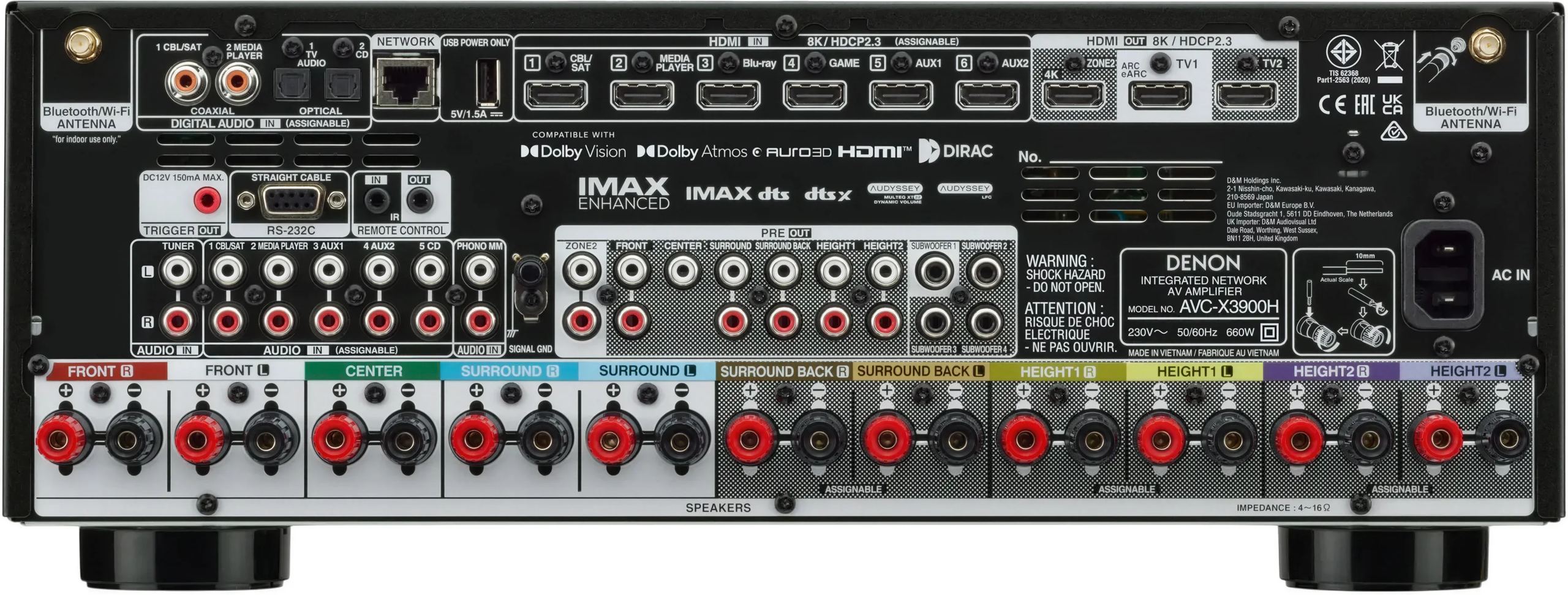
Nine channels and a real-load power guarantee
Each channel is based on a high-current discrete amplification stage. The stated power output is 105 W into 8 ohms (20 Hz to 20 kHz, 0.08% distortion, two channels driven) and 135 W into 6 ohms (1 kHz, 0.7%, two channels driven). These values are measured with two active channels, which corresponds to the usual industry standard but does not reflect the real operation of a multichannel system.
Denon addresses this issue with its 70% guarantee: when five channels are driven simultaneously, the amplifier maintains at least 70% of its rated power per channel. This is a concrete commitment, useful for evaluating the device’s behavior in a 5.1 or 5.1.2 configuration at sustained volume.
Audio processing goes up to 11.4 channels via the pre-outs, making it possible to add an external stereo amplifier to reach larger configurations such as 7.1.4.
Three-dimensional audio formats
The AVC-X3900H decodes Dolby Atmos, DTS:X, Auro-3D, and Sony 360 Reality Audio. IMAX Enhanced certification is also included, with its dedicated DTS:X processing. For older 5.1 or 7.1 content, Dolby Atmos Height Virtualization and DTS Neural:X recreate a vertical dimension without height speakers.
Auro-3D deserves a mention: this format adds a sound layer above the listener according to a different logic from Dolby Atmos (fixed channels rather than sound objects). The AVC-X3900H supports it natively, with the Auro-Matic function that can apply vertical processing to standard stereo or multichannel content.
8K video, HDR, and gaming features
The six HDMI inputs support 8K/60 Hz and 4K/120 Hz, with HDCP 2.3 compatibility and 4K-to-8K upscaling. Supported HDR formats include HDR10+, dynamic HDR, HLG, and Dolby Vision in passthrough. The two HDMI outputs (including one eARC-compatible) allow simultaneous connection of a TV and a video projector.
Three features relate to gaming: VRR (variable refresh rate), ALLM (automatic low-latency mode switching), and QFT (Quick Frame Transport, which reduces the display delay of each frame). These three protocols require a compatible display and source to be active.
Audyssey Platinum calibration and the full Dirac Live suite
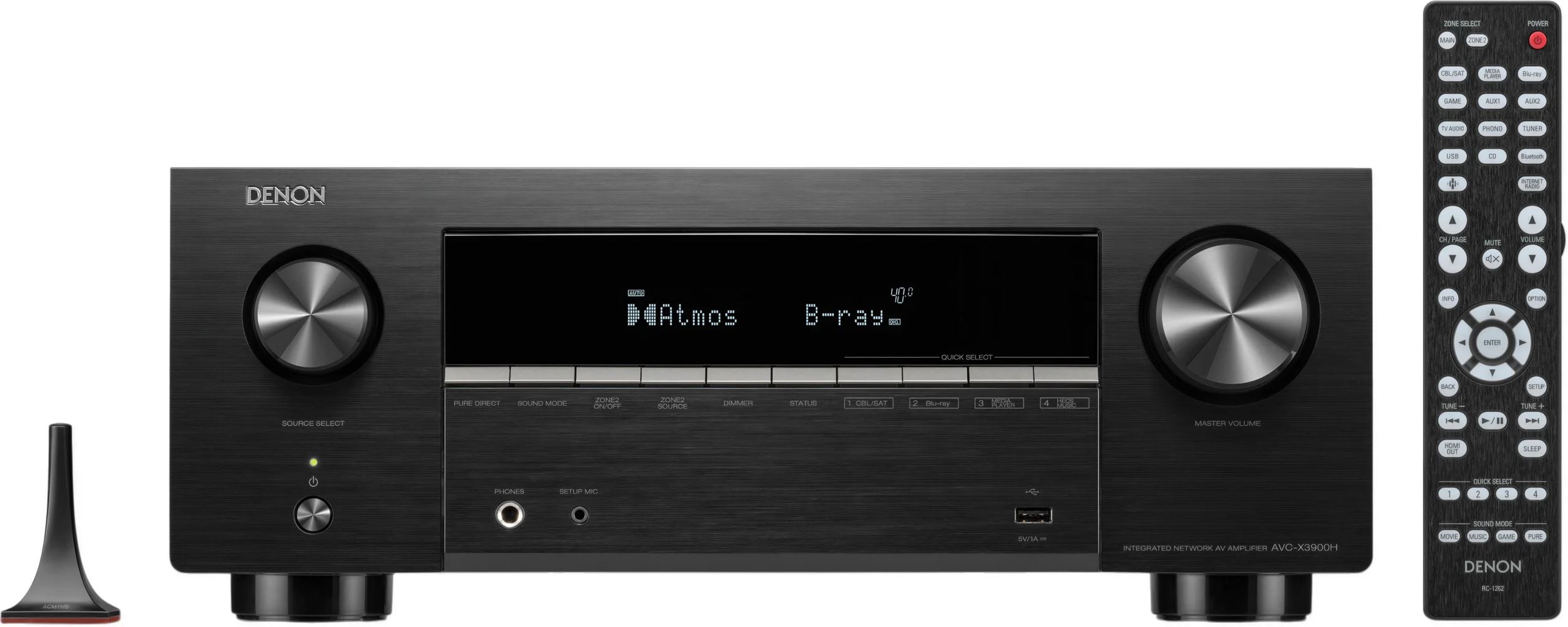
Audyssey Platinum, included as standard with a measurement microphone, brings together several complementary functions. MultEQ XT32 measures the room’s acoustic response from eight listening positions, with more than 10,000 control points per channel. Sub EQ HT calibrates the subwoofers individually. Dynamic EQ adjusts the tonal balance when the volume is reduced (a classic issue linked to human perception of frequencies), and Dynamic Volume smooths out level differences between quiet passages and action scenes. LFC (Low Frequency Containment) limits bass propagation to neighboring rooms.
To go further, the AVC-X3900H is compatible with the full Dirac Live suite, available via an optional license. This includes three modules: Room Correction (correction of the room’s frequency and phase response), Bass Control (advanced management of one or more subwoofers), and Active Room Treatment (which uses the speakers themselves to attenuate the room’s acoustic modes). Dirac Live requires a third-party USB microphone (such as the miniDSP UMIK-1), as the included Audyssey microphone is not compatible.
A directional subwoofer mode completes the setup: in configurations with multiple subwoofers, it lets you choose between bass that is distributed uniformly throughout the room or localized bass associated with certain speakers.
Music streaming, HEOS, and multiroom
The HEOS platform handles wireless streaming to other compatible products and provides access to streaming services from the HEOS app. The AVC-X3900H also supports AirPlay 2 (with Siri compatibility), Bluetooth transmission (to send sound to wireless headphones), and Bluetooth reception. Roon Ready certification makes it possible to integrate the amplifier directly into music libraries managed by the Roon software.
Playback of high-resolution files (FLAC, ALAC, WAV, DSD) is via the front USB port or the local network. Denon states that digital processing and conversion preserve signal integrity to reproduce these formats with maximum detail, dynamics, and tonal nuance.
Bluetooth transmission to headphones lets you continue watching a movie at night without disturbing others, with the possibility of streaming sound simultaneously through the speakers and the headphones. Only one pair of headphones can be connected at a time.
Connectivity, zones, and remote control
The AVC-X3900H features six analog inputs, one MM phono input, two optical inputs, and two coaxial inputs. The pre-outs cover all 11.4 channels, with four independent subwoofer outputs. Eleven speaker terminals allow for varying configurations: bi-amping, A/B speakers, or a wired Zone 2 output, all assignable according to needs.
Multi-zone management allows two sources and two zones simultaneously. The main room can receive a Dolby Atmos movie while a second zone plays a different music source, or the same source can feed both zones.
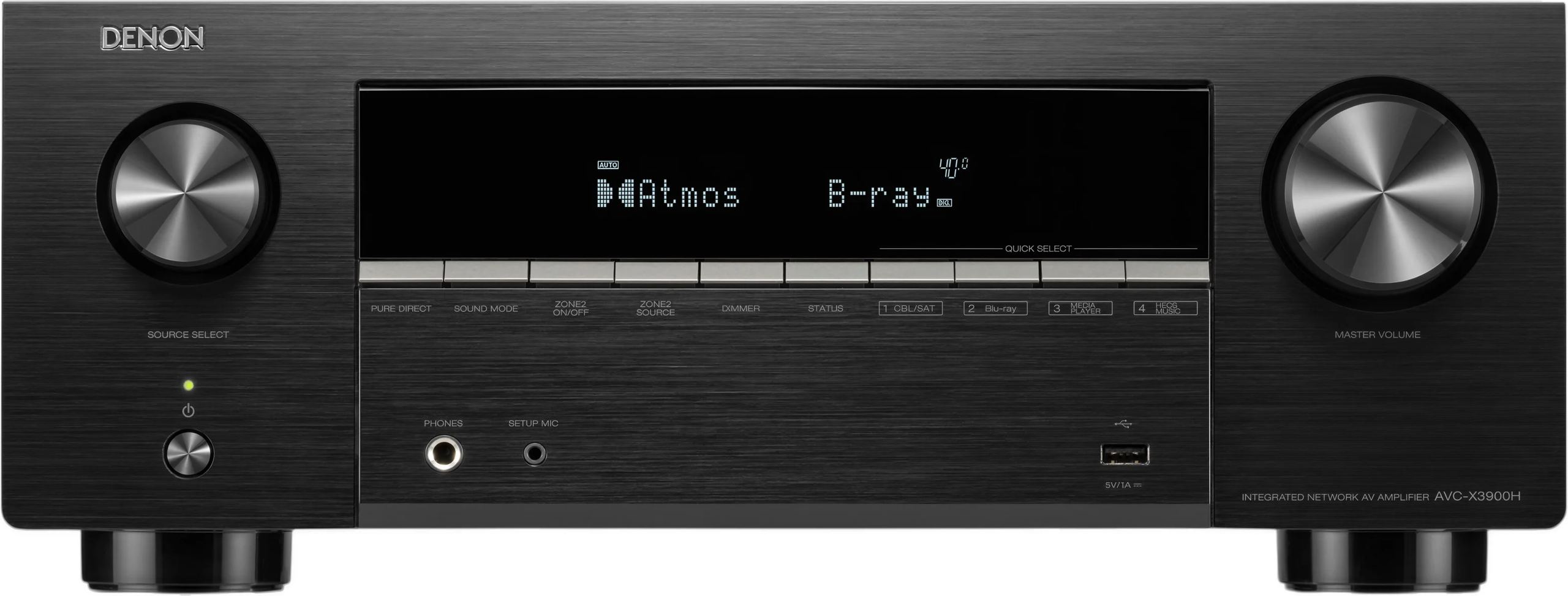
Everyday control is handled via the RC-1262 remote, the Denon AVR Remote app, or a web interface accessible from a computer or mobile device, without the TV needing to be turned on. Compatibility with Amazon Alexa, Google Assistant, Siri (via AirPlay 2), and Josh.ai voice assistants expands the control options. The Denon setup assistant, displayed full-screen on the TV, guides installation step by step.
Real-time per-channel level display (“Onscreen channel level monitoring”) makes it possible to visualize the activity of each speaker during playback, making it easier to verify the configuration and identify any imbalances.
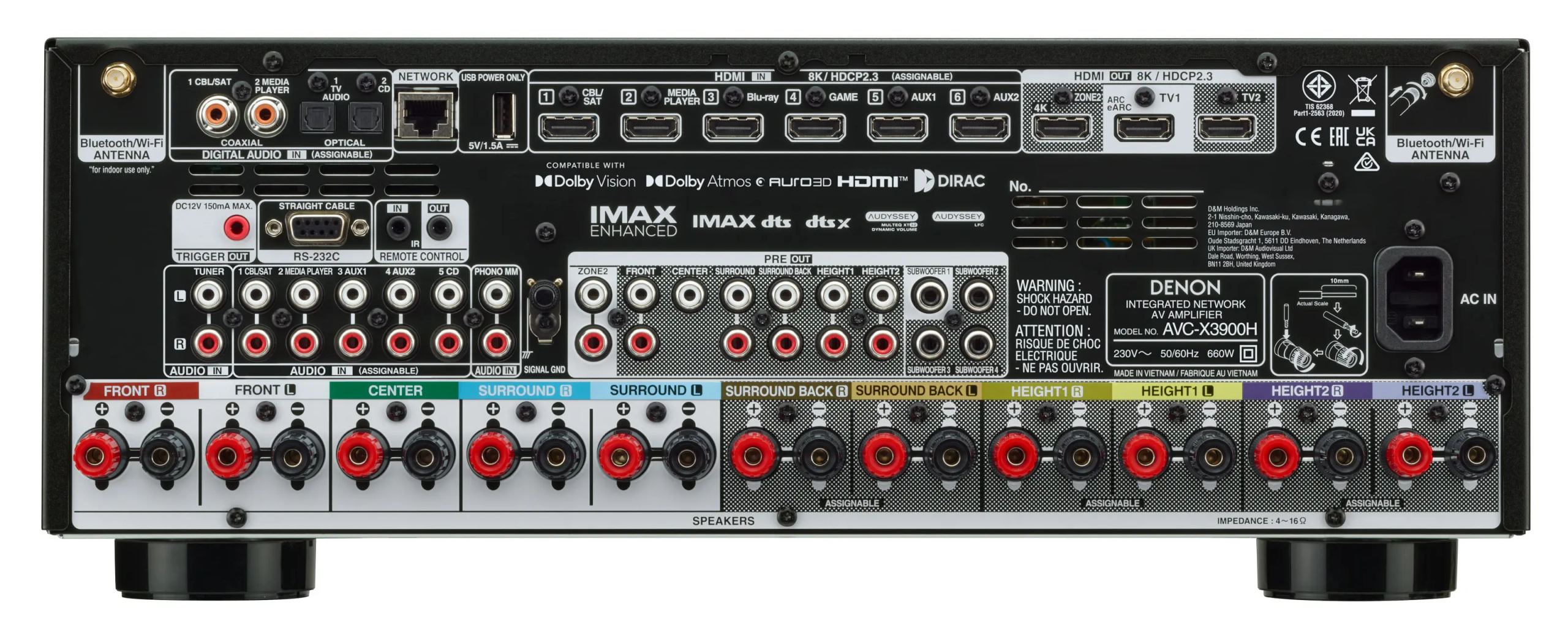
Technical specifications
Amplification and audio processing
- 9.4-channel audio/video amplifier
- Processing up to 11.4 channels
- Output power
- 105 W per channel (8 Ω, 20 Hz – 20 kHz, 0.08%, 2 channels driven)
- 135 W per channel (6 Ω, 1 kHz, 0.7%, 2 channels driven)
- Bi-amp compatible
- Flexible channel and zone assignment
Supported audio formats
- Dolby Atmos, DTS:X, Auro-3D, IMAX Enhanced, 360 Reality Audio
- Dolby Atmos Height Virtualization
- DTS Neural:X
Video and HDMI
- 8K Ultra HD compatible
- 4K to 8K upscaling
- HDCP 2.3 compatibility
- Supported HDR formats: HDR10+, Dynamic HDR, HLG, Dolby Vision
- 6 HDMI inputs and 2 HDMI outputs
- ARC / eARC compatibility
Audio connectivity
- 6 analog inputs
- 1 MM phono input
- 2 optical inputs
- 2 coaxial inputs
- 11.4-channel pre-out outputs
- 4 independent subwoofer outputs
Streaming and network
- Built-in HEOS technology
- Wireless multiroom audio
- High-resolution audio playback
- Control via the HEOS app
Acoustic calibration and optimization
- Denon Setup Assistant
- Dirac Live compatible (optional upgrade)
- Advanced bass management and acoustic correction
Multiroom and zone management
- Multi-zone management
- Multi-source playback
- Dedicated Zone 2 outputs
Power consumption and dimensions
- Maximum power consumption: 660 W
- Standby power consumption: 0.1 W
- Dimensions (W × D × H): 434 × 379 × 167 mm
- Weight: 12.5 kg
Frequently Asked Questions
Can the AVC-X3900H drive a 7.1.4 system without an external amplifier?
No. With nine amplification channels, the possible configurations go up to 5.1.4 or 7.1.2. For 7.1.4 (eleven channels), you need to connect an external stereo amplifier to the pre-outs. The AVC-X3900H then handles processing of all 11.4 channels in pre-amplification.
What is the difference between Audyssey MultEQ XT32 and Dirac Live?
Both correct the room’s acoustic response, but with different algorithms and approaches. Audyssey XT32 is included and works with the supplied microphone. Dirac Live requires a paid license and a third-party USB microphone, but offers additional features such as Bass Control and Active Room Treatment. The two systems cannot operate simultaneously: you must choose one or the other in the settings.
What is the directional subwoofer mode for?
In an installation with multiple subwoofers, this mode lets you choose between uniform bass (the low-frequency signal is mixed and distributed among all subwoofers) or directional bass (each subwoofer reproduces the bass from the nearest speakers). Directional mode can enhance the sense of localization of low-frequency effects in movies.
Which high-resolution audio file formats are supported?
The AVC-X3900H plays FLAC, ALAC, WAV, and DSD files via the front USB port or over the network. Playback from a USB flash drive or hard drive supports resolutions up to 24-bit / 192 kHz for PCM formats.
- Eco-contribution of €2.58 included in the sale price.
- Manufacturer reference: AVCX3900HBKE2
- GTIN / EAN: 747192148058