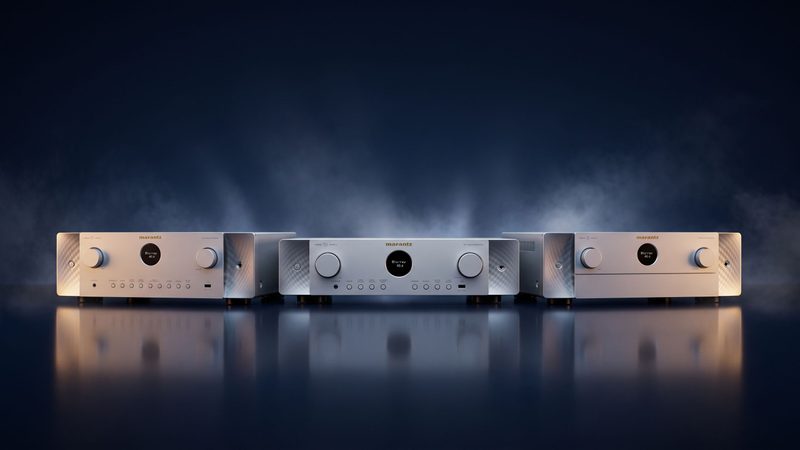
Marantz Cinema 50 Series 2 black



Specifications and features


Marantz Cinema 50 Series 2, 9.4-channel home theater AV receiver
Four years after the original Cinema 50, Marantz has refined rather than redesigned it. Power and channel count remain unchanged; the converter, room correction and compatibility with recent gaming setups do not. It remains a nine-channel model that processes eleven, drives four subwoofers and unlocks the full Dirac Live suite, the only one in its series to do so.
Nine amplified channels, eleven processed channels
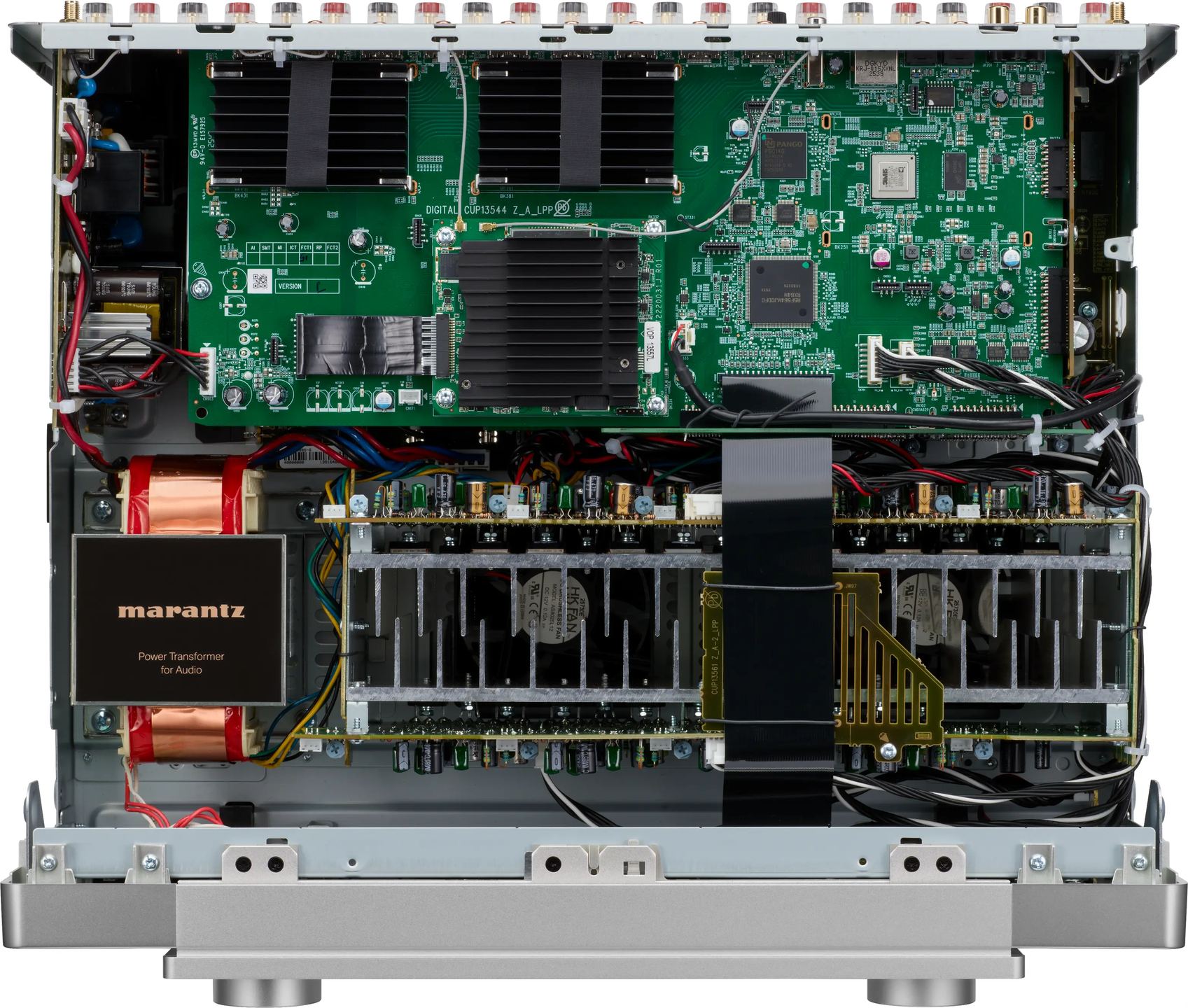
The power stage is rated at 110 W per channel into 8 ohms, measured across the full 20 Hz-20 kHz range with two channels operating and 0.08% distortion. The second figure, 150 W into 6 ohms, is measured at 1 kHz only with 0.7% distortion: more flattering, less representative of what a speaker receives on a movie soundtrack. The nine channels rely on discrete-component stages, HDAM-SA2 modules and a current-feedback topology, powered by an EI transformer and new power capacitors for this generation. Marantz has changed neither the amplification topology nor the transformer: the work has focused on what surrounds them.
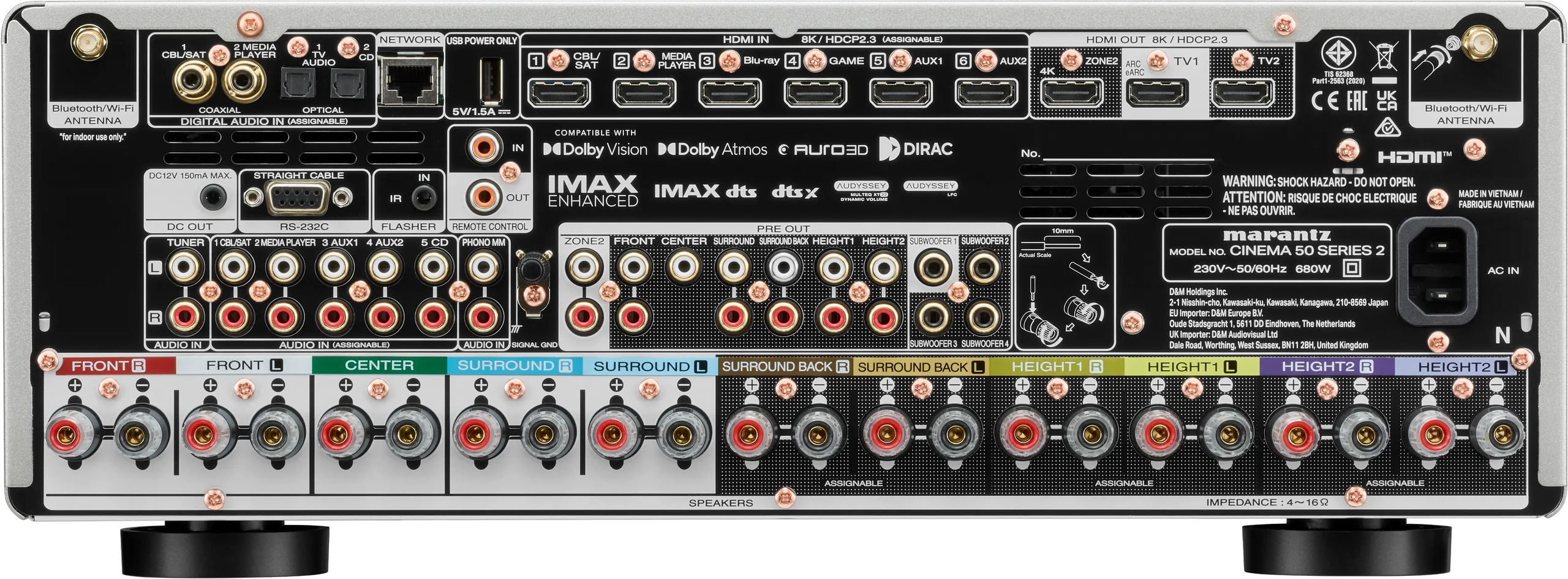
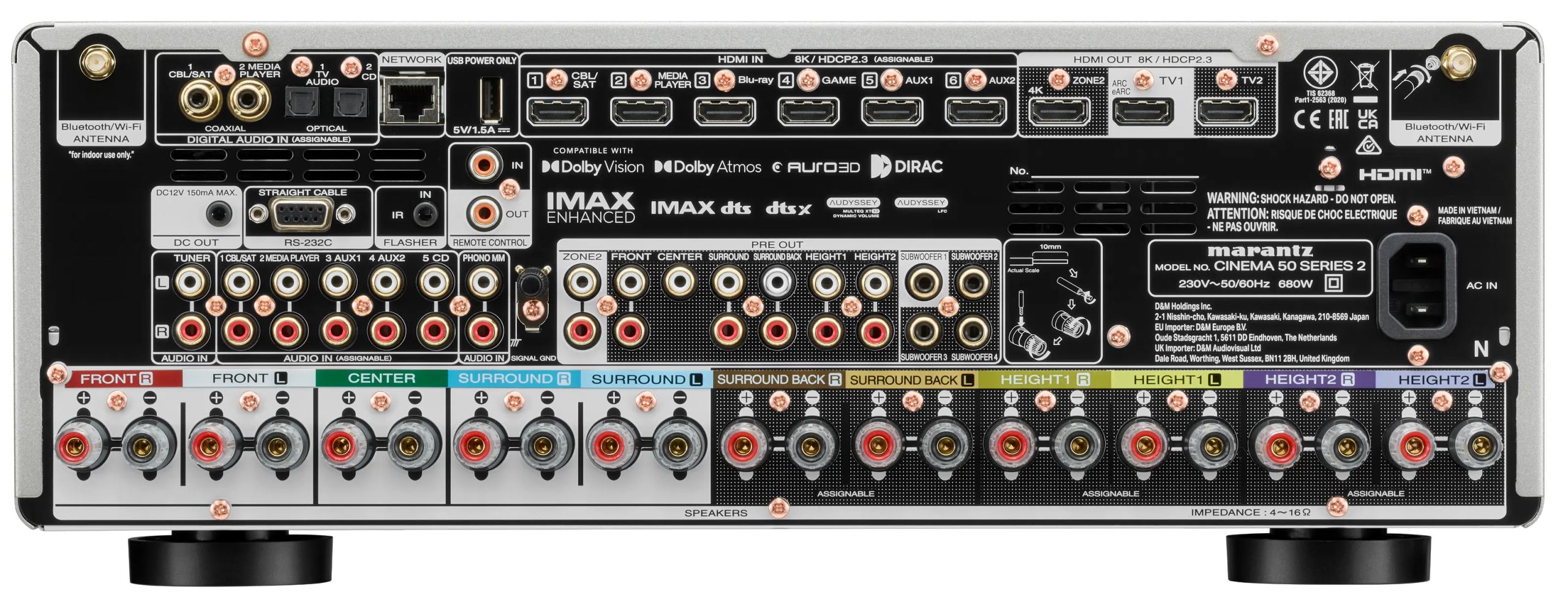
Eleven gold-plated screw terminals accept an additional pair assignable to B speakers, bi-amping or zone 2. Preamplification covers 11.4 channels, with four independent subwoofer outputs that can be adjusted separately.
The new 32-bit converter
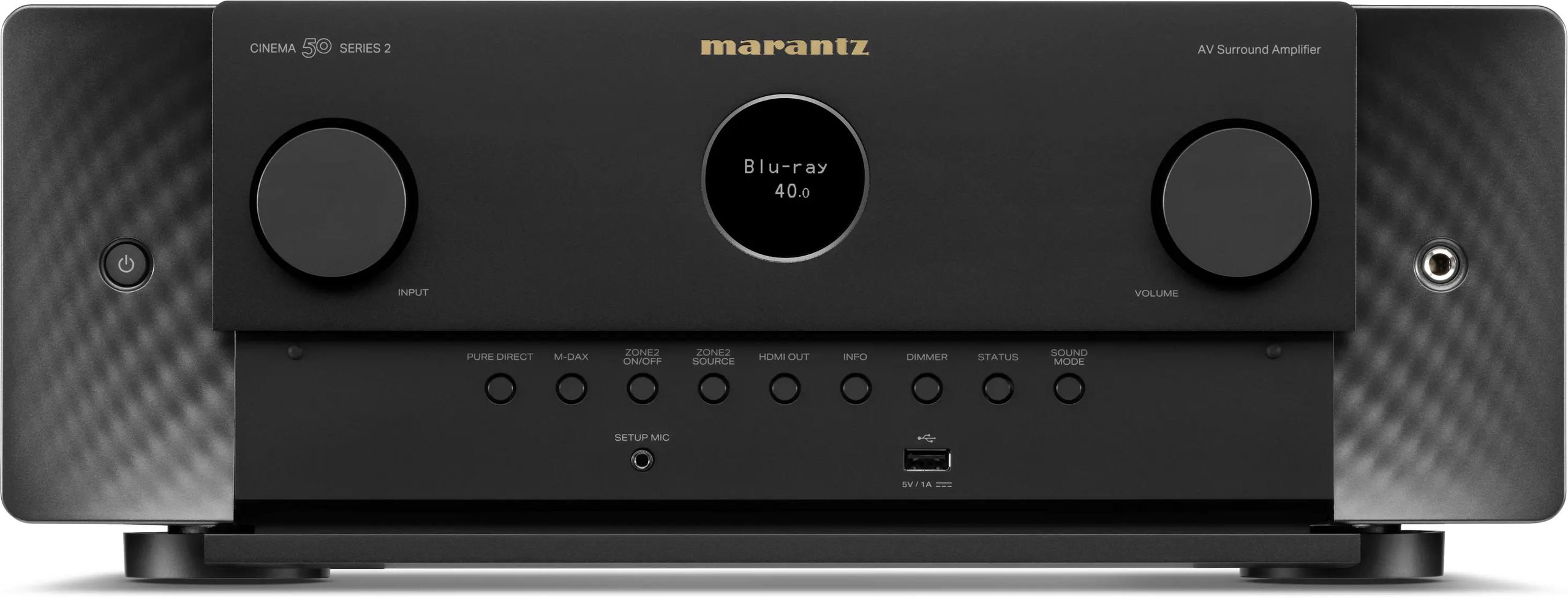
The entire Series 2 range shares an eight-channel 32-bit converter that processes channels simultaneously rather than one at a time. Marantz highlights a simplified signal path and reduced timing errors between channels, which matters especially with object-based soundtracks, where the same sound moves across several speakers within a few dozen milliseconds. The clock jitter reducer and MDAX2 processing, which reconstructs high frequencies lost in compressed files, complete the digital section. For two-channel listening, Pure Direct mode bypasses processing and turns off the display.
Audyssey included, Dirac Live optional
The supplied microphone with its cardboard stand provides access to Audyssey MultEQ XT32, the most precise version of Audyssey calibration, accompanied by Dynamic EQ, Dynamic Volume and LFC to limit bass leakage into neighboring rooms. Dirac Live compatibility must be purchased separately in the form of licenses: Room Correction for general correction, Bass Control for combined management of several subwoofers, Active Room Treatment for the next stage, which uses the speakers themselves to neutralize room resonances. The Cinema 50 Series 2 is the only model in the new series to unlock all three levels, while the Cinema 60 and 70s Series 2 are limited to the first. The four independent subwoofer outputs truly come into their own here, as this is the configuration ART requires to perform at its best.
Dolby Atmos, Auro-3D and the Channel Expander
Decoding covers Dolby Atmos and TrueHD, DTS:X and Neural:X, Auro-3D, IMAX Enhanced, 360 Reality Audio and MPEG-H. DTS:X Pro, which expands the number of processed channels, is not included. New and exclusive to this model in the Series 2 range, the Dolby Atmos Channel Expander uses all installed speakers when playing channel-based Atmos content, whereas the original track only uses some of them. Its logic assumes an installation already equipped with height speakers, which explains why it remains limited to nine-channel devices.
With the nine internal channels, the configuration can be set up as 5.1.4 or 7.1.2. A 7.1.4 setup requires an external power amplifier connected to two of the preamp outputs. The center-channel bi-amping mode, also new, dedicates two channels to a compatible center speaker when the configuration leaves channels available.
Six HDMI inputs and 1440p passthrough
All six HDMI inputs are located on the rear panel, with none placed on the front behind the flap. Each accepts 8K/60 Hz and 4K/120 Hz up to 40 Gbit/s, as do the two main outputs; a third output serves zone 2. HDR10+, Dolby Vision, HLG and dynamic HDR pass through the unit untouched, with HDCP 2.3 and eARC for retrieving TV audio.
For gaming, Series 2 adds 1440p passthrough and AMD FreeSync compatibility on inputs 4 to 6, alongside the already available VRR, ALLM and Quick Frame Transport. Quick Media Switching, which eliminates the black screen during frame-rate changes, remains absent from the list.
HEOS streaming, networking and phono input
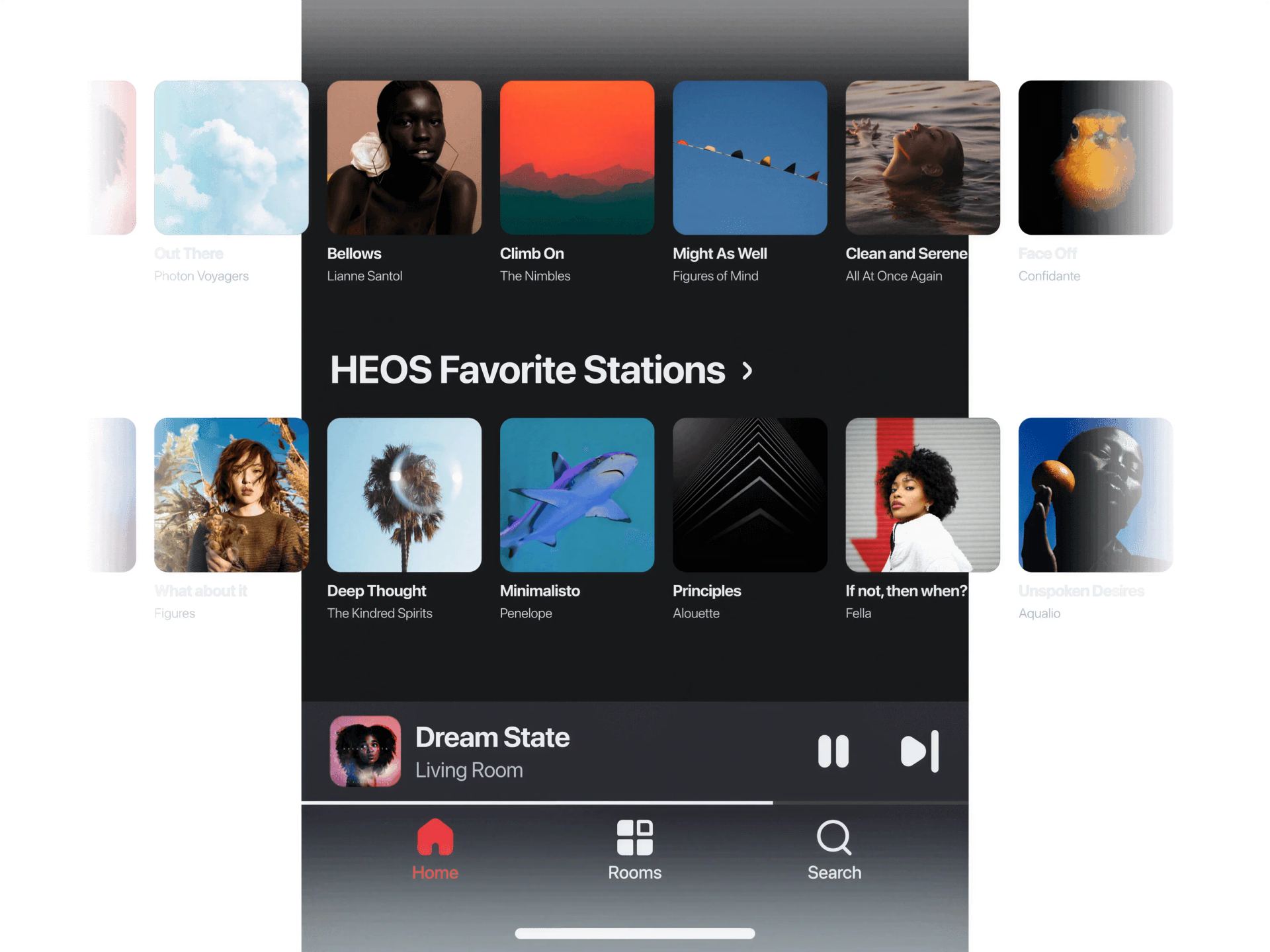
The HEOS module has been revised for this generation, with improved responsiveness claimed by the manufacturer. It provides access to AirPlay 2, Spotify Connect, Tidal Connect, Qobuz Connect, Amazon Music, Deezer and TuneIn radio, while the unit is also Roon Ready. FLAC, WAV and ALAC files are supported up to 192 kHz/24-bit, DSD up to 5.6 MHz, with gapless playback. Two services listed by the manufacturer, Pandora and SiriusXM, are not available in France. Bluetooth works both ways, receiving and retransmitting to headphones with volume adjustment; Marantz announces the addition of low-latency Bluetooth LE Audio via an update.
The phono input accepts a moving-magnet cartridge, while a moving-coil cartridge requires a dedicated preamplifier. The FM/AM tuner and front USB port complete the local sources.
Two zones and integration tools
Zone 2 can be controlled through speakers or preamplification, with a dedicated HDMI output capable of relaying an HDMI source. Installers have access to IP control, RS232, the app and an updated web interface, supplemented by HDMI diagnostics, an on-screen channel-level monitor, an IR Flasher input, Marantz Remote Bus and a trigger output. The setup assistant and Smart Select memories cover everyday adjustments, while the high-definition graphical interface remains available in three languages.
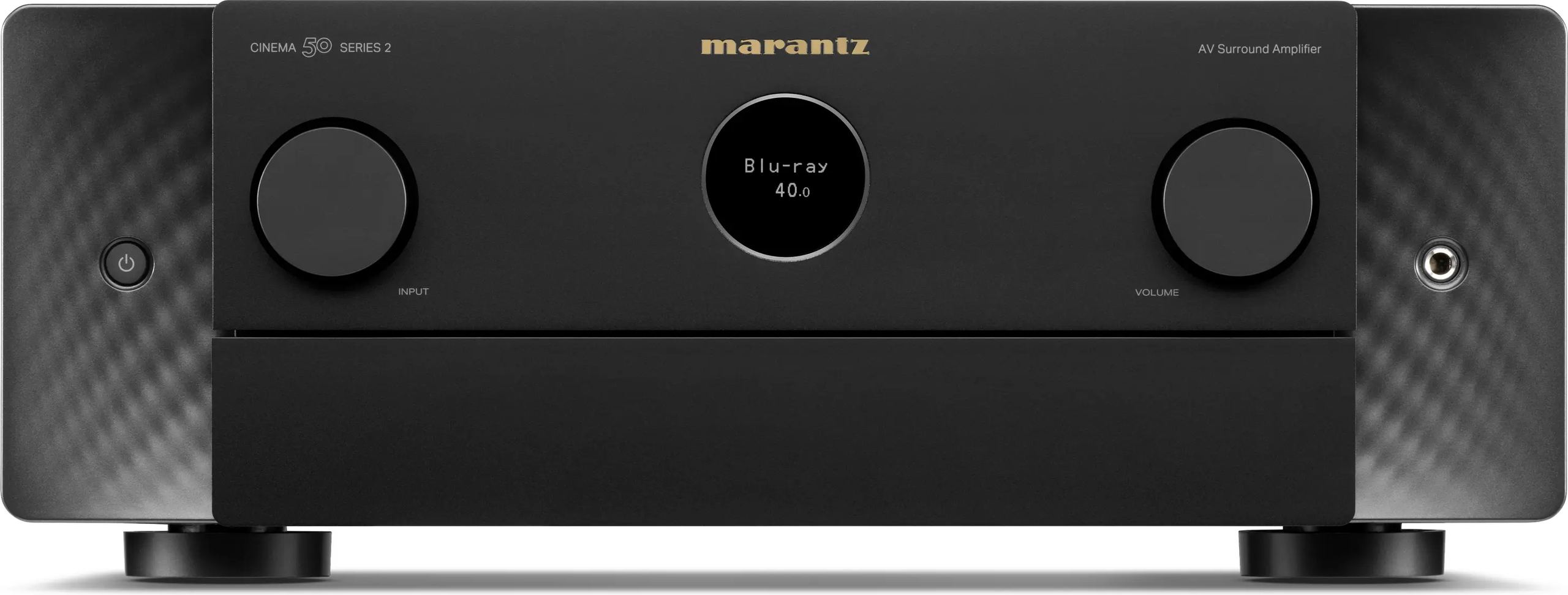
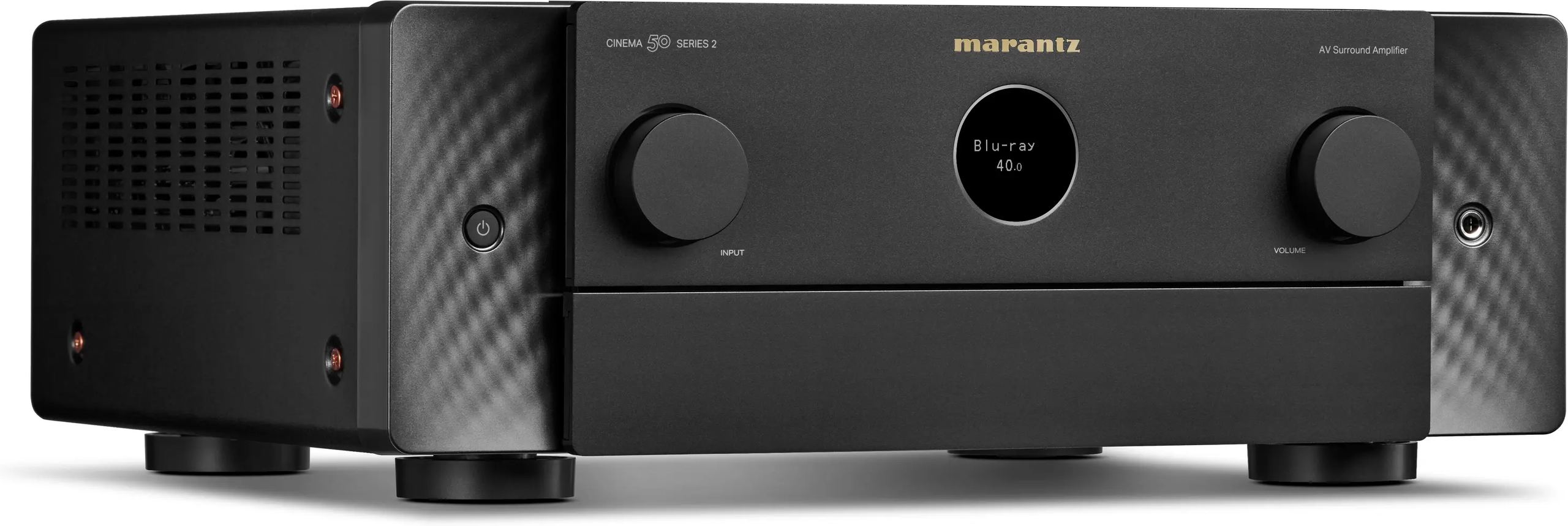
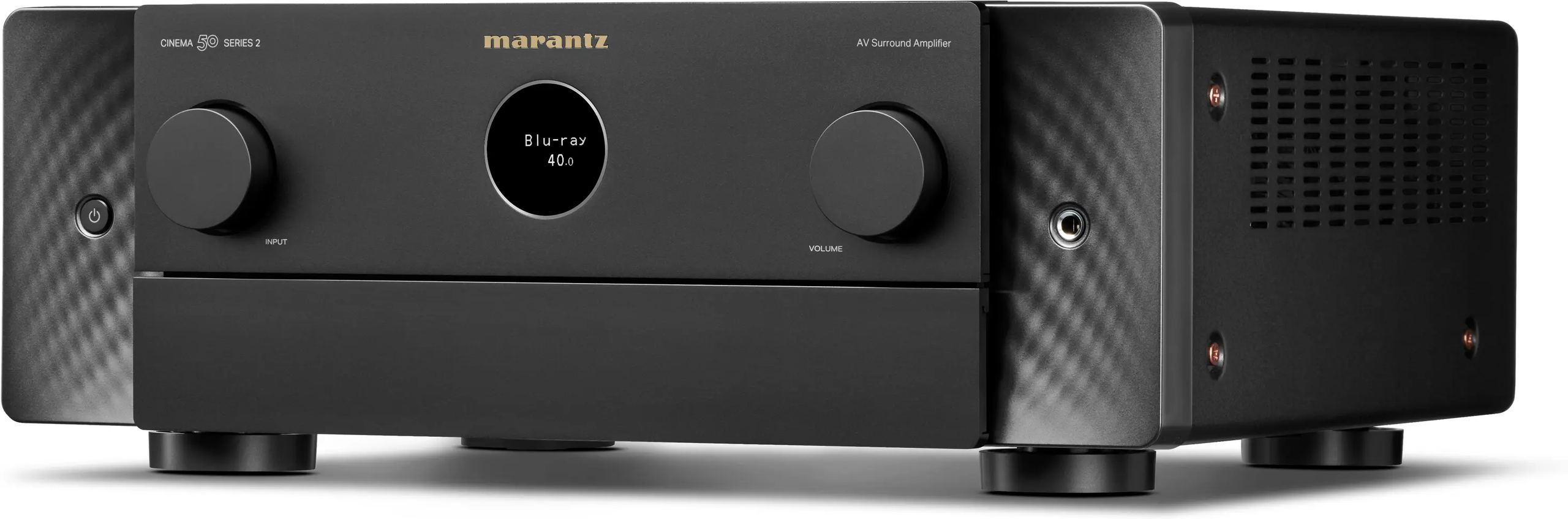
A metal front panel and OLED porthole
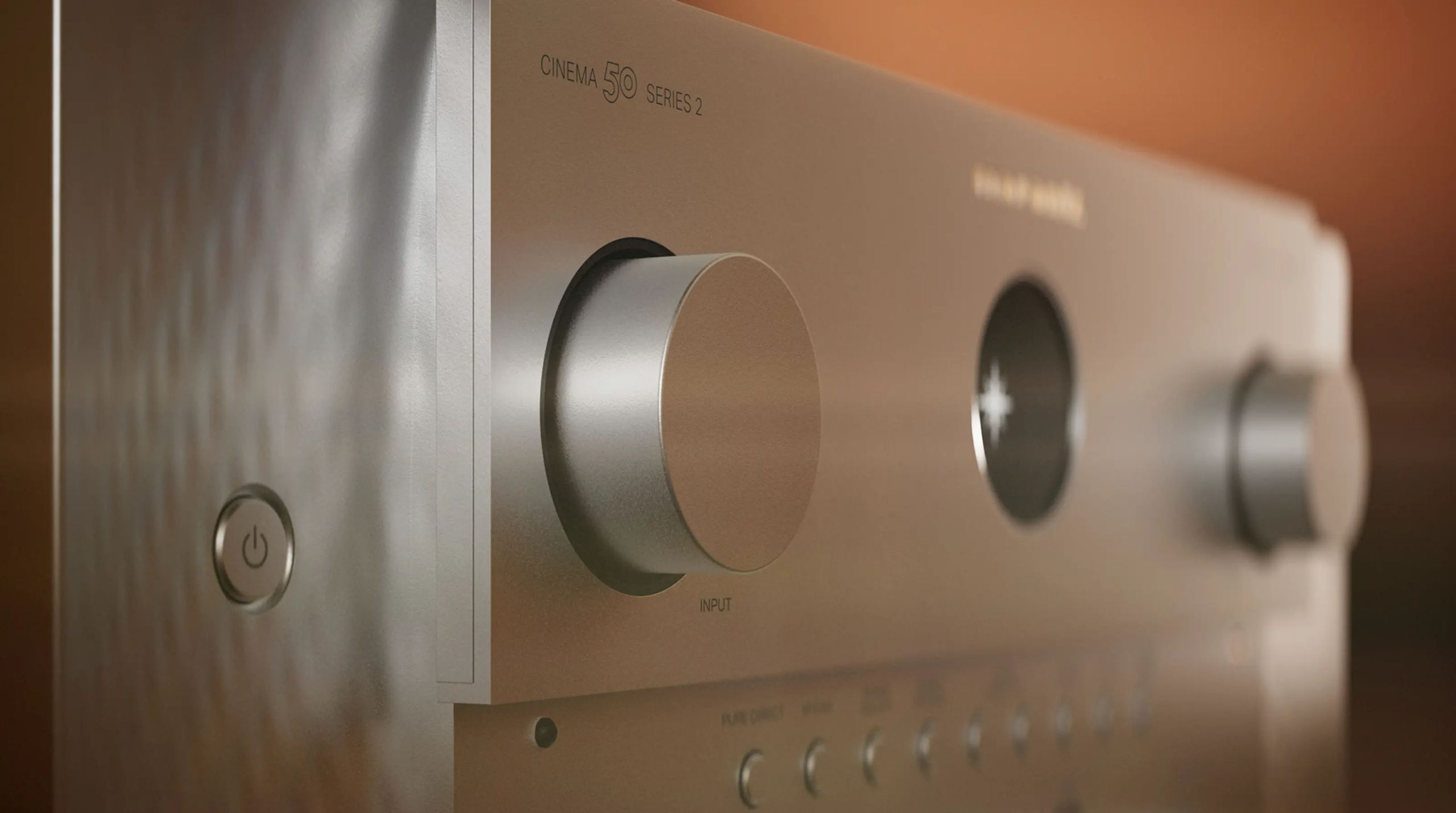
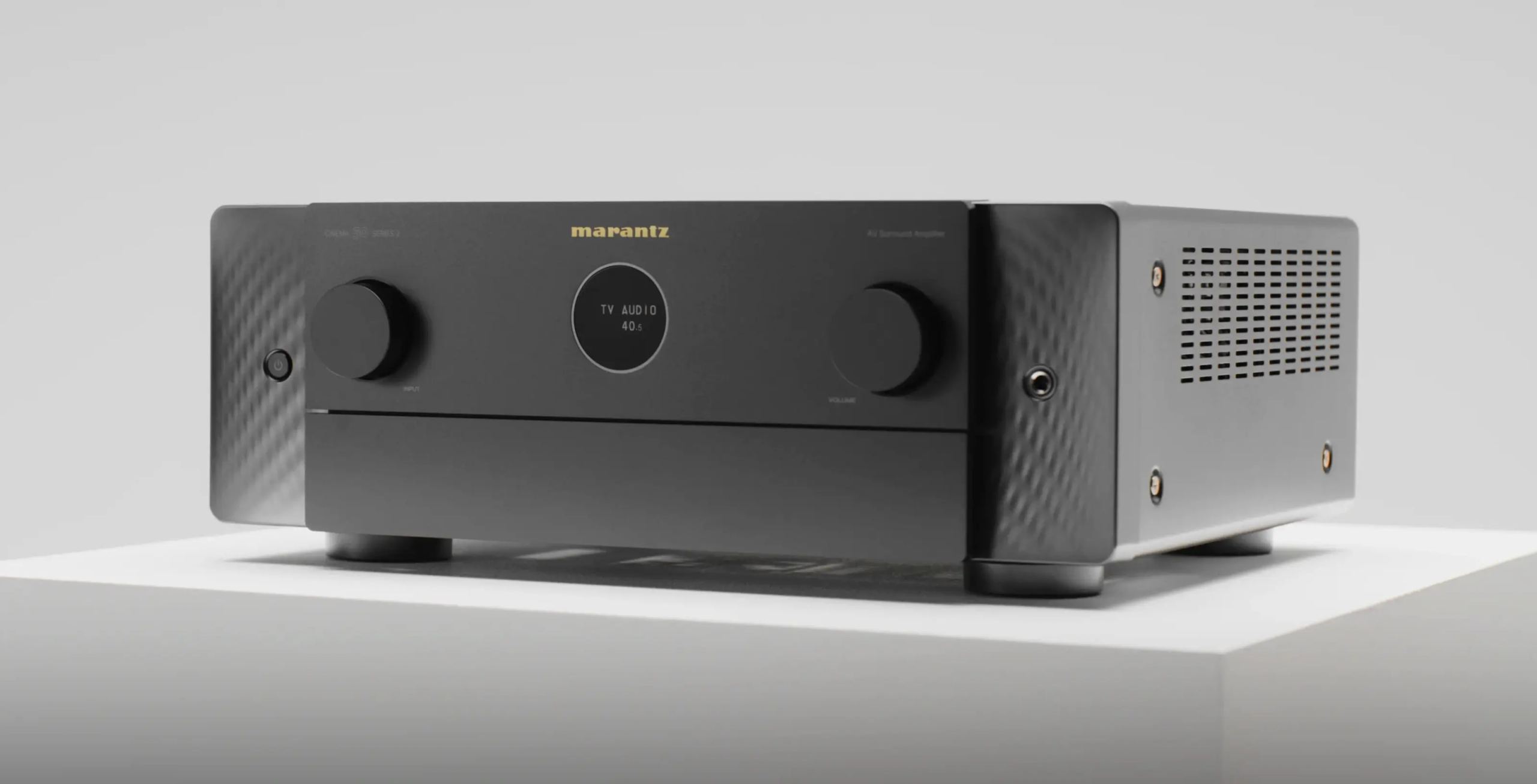
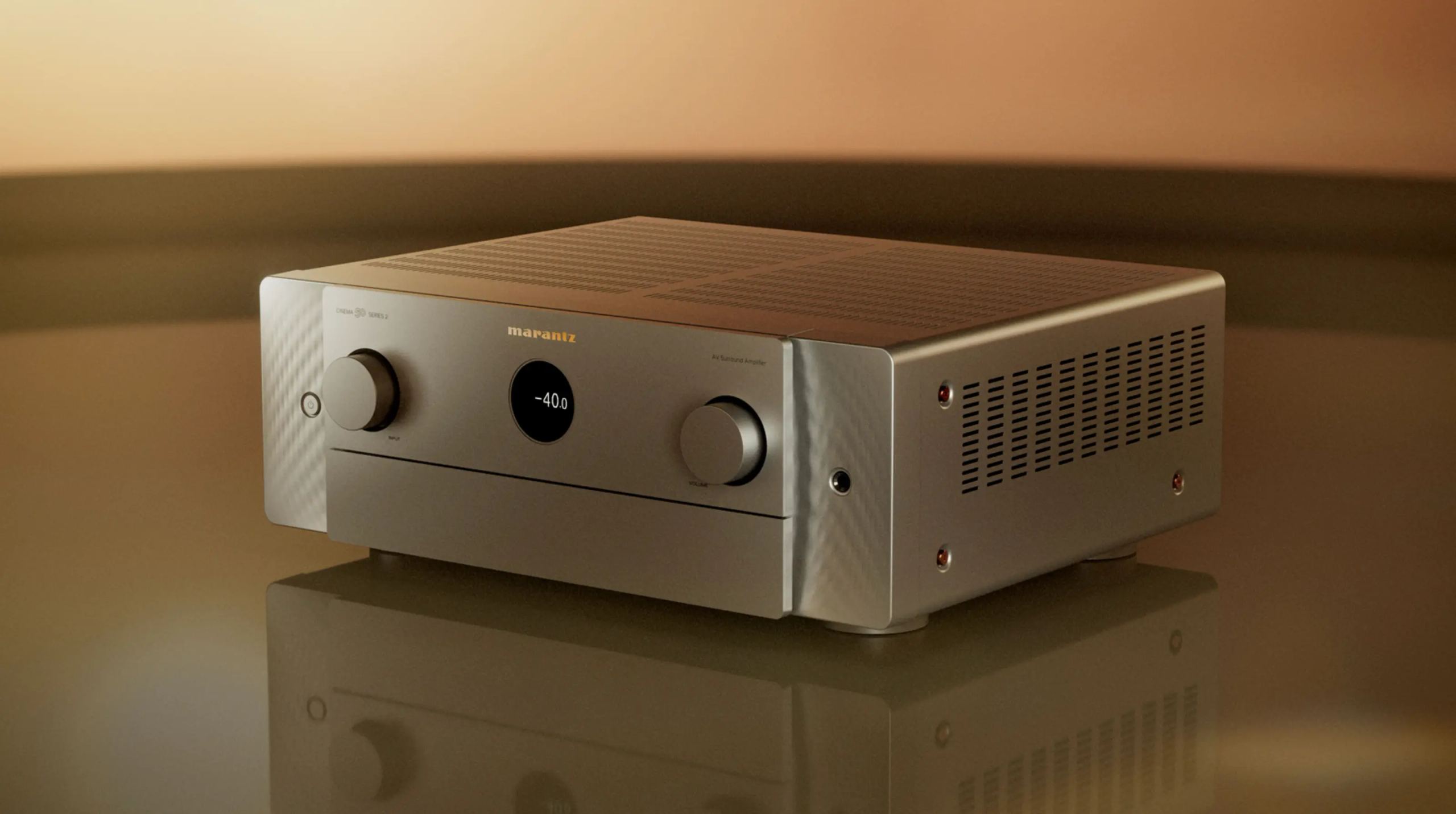
The front panel is metal, with the brand’s signature OLED porthole in the center and a flap concealing the adjustment controls and USB port. The unit measures 442 × 392 × 165 mm without antennas, 235 mm high with the antennas raised, and weighs 13.5 kg. Two finishes are available: black and silver-gold. Power consumption reaches 680 W at peak, 100 W at idle and 60 W in ECO mode, compared with 0.2 W in standby: enough to require good ventilation and rule out a closed cabinet without airflow. The RC054SR remote control, calibration microphone, antennas and cable labels are supplied with the unit.
Documentation
Technical specifications
Power and amplification
- Number of amplification channels: 9
- Output power
- 110 W (8 Ω, 20 Hz-20 kHz, 0.08%, 2 channels)
- 150 W (6 Ω, 1 kHz, 0.7%, 2 channels)
- Power transformer: EI
- Discrete component power stage
- Current feedback topology
- Hyper Dynamic Amplifier modules: HDAM-SA2
- Pure Direct mode
- Gold-plated RCA connectors
- Clock jitter reducer
- Compressed file restoration: MDAX2
Room correction and calibration
- Audyssey MultEQ XT32
- Audyssey Dynamic EQ and Dynamic Volume
- Audyssey LFC
- Subwoofer mode: standard and directional
- Dirac Live Room Correction compatible (upgrade)
- Automatic microphone calibration: Audyssey MultEQ XT32, Dirac Live available as an upgrade
- Variable filtering, optimized bass redirection, Bass Sync
Surround formats and multichannel processing
- DTS-HD, DTS:X, DTS Neural:X, DTS Virtual:X
- IMAX Enhanced
- Dolby TrueHD, Dolby Atmos, Dolby Atmos Music, Dolby Surround
- Atmos height channel virtualization
- AURO-3D
- 360 Reality Audio
- MPEG-H
- Multichannel stereo
- Maximum number of processed channels (pre-amplification): 11.4
HDMI connectivity and video compatibility
- HDMI inputs: 6 (rear panel)
- HDMI outputs: 2 main and 1 zone
- HDCP 2.3 support
- HDMI upscaling: 1080p and 4K to 8K
- HDMI 2.1: 8K / 60 Hz and 4K / 120 Hz
- 8K / 60 Hz and 4K / 120 Hz passthrough: 6 inputs and 2 outputs up to 40 Gbit / s
- eARC and ARC
- HDR, HLG, Dolby Vision, HDR10+, Dynamic HDR
- ALLM (Auto Low Latency Mode) for gaming
- VRR (Variable Refresh Rate)
- Quick Frame Transport
- AMD FreeSync compatible
- 3D signal passthrough
- HDMI standby passthrough
- CEC, DSD playback, Auto LipSync
- HDMI Diagnostics
Network and streaming services
- Wi-Fi, Bluetooth and Ethernet port
- HEOS multiroom and streaming
- Bluetooth transmission to headphones
- Bluetooth transmitter volume adjustment
- Network audio sharing
- Lossy formats: MP3, WMA, AAC
- Lossless formats: FLAC HD 192 / 24, WAV 192 / 24, ALAC 192 / 24
- DSD playback: 2.8 and 5.6 MHz
- Gapless playback: FLAC, WAV, ALAC, DSD
- AirPlay 2
- Internet radio: TuneIn
- Spotify Connect, Tidal Connect, Qobuz Connect
- Pandora and SiriusXM
- Other services: Amazon Music, Amazon Music HD, TIDAL, Deezer, iHeart Radio, SoundCloud, Mood Mix
- Roon Ready
- Smartphone app: Marantz AVR Remote and HEOS
- Tablet app: Android, iOS, Amazon Kindle
Multiroom and integration
- Built-in HEOS multiroom
- HEOS Link compatibility: IR and IP
- Multiroom zones: 2
- Zone sources: HDMI (2 channels), optical and coaxial (2 channels), network, USB, analog
- Zone audio output: speakers and pre-amplification
- Zone HDMI output from an HDMI source
- IP, RS232, web and app control
- IR Flasher input and Marantz Remote Bus
- Continuous trigger output: 1
Inputs and outputs
- HDMI inputs and outputs: 6 and 3
- Multiroom video output: HDMI
- Analog inputs: 5
- MM phono input
- Digital inputs: 2 optical and 2 coaxial
- Analog multiroom output: 1
- Multichannel pre-amplification: 11.4
- Subwoofer outputs: 4 independent
- Front-panel input: USB
- USB audio
- Rear USB power supply
- FM / AM tuner
Speaker terminals
- Gold-plated screw speaker terminals
- Number of speaker terminals: 11
- Assignable A and B speakers
- Assignable bi-amplification
- Assignable multiroom speaker terminal
Settings and user interface
- Display: OLED porthole
- Graphic interface: Modern HD GUI
- Interface languages: 3
- Setup Assistant and Smart Select
- Firmware update via network and USB
General specifications
- Metal front panel
- Maximum dimensions with horizontal antenna: 442 × 404 × 165 mm
- Maximum dimensions with vertical antenna: 442 × 404 × 235 mm
- Dimensions without antenna: 442 × 392 × 165 mm
- Weight: 13.5 kg
Power supply and consumption
- Power consumption: 680 W
- No-signal consumption: 60 W in ECO mode, 100 W outside ECO mode
- Standby consumption: 0.2 W
- CEC standby consumption: 0.5 W
- Network standby consumption: less than 2 W
- ECO mode, automatic shutdown, sleep timer
Included accessories
- Main unit
- RC054SR remote control
- Batteries
- AM / FM antennas
- 2 detachable external antennas
- Audyssey microphone
- Cardboard microphone stand
- Cable labels
- Power cord
- Quick start guide
Frequently Asked Questions
Does the Cinema 50 Series 2 replace the Cinema 50 in the range?
Yes, it takes its place within the Cinema series, where the Cinema 30 and Cinema 40 remain the higher-end, unchanged models. An owner of the first-generation Cinema 50 retains the same power, the same number of channels, and the same level of Audyssey correction: the enhancements concern digital conversion, video gaming, Atmos functions, and installation tools.
Is the supplied microphone sufficient to use Dirac Live?
No. The supplied microphone is used for Audyssey calibration. Dirac Live requires a calibrated USB measurement microphone, sold separately, in addition to the software license. Calibration is then performed from a computer or mobile device, with the unit remaining connected to the network.
What is required to use the 11.4 processing channels?
An external power amplifier connected to the corresponding preamp outputs, since only nine channels are internally amplified. Preamp mode also allows all channels to be assigned to separate amplifiers, with the unit then serving solely as a processor.
Can headphones be connected?
Yes, via the front headphone jack, or wirelessly via Bluetooth streaming to headphones, with the volume adjustable from the device.
Does the Dolby Atmos Channel Expander work with all soundtracks?
It works with channel-encoded Dolby Atmos content, distributing the information across the height speakers actually installed. A setup without ceiling speakers or up-firing speakers will not benefit from it.
How are the announced features updated after purchase?
Via the network or USB drive. This is how Bluetooth LE Audio and updates to the HEOS module, as well as any decoding fixes, should arrive.
What is the difference compared with the Cinema 60 Series 2?
The Cinema 60 Series 2 amplifies seven channels instead of nine, processes 7.2 channels instead of 11.4, is limited to Audyssey MultEQ, only unlocks the first tier of Dirac Live, and supports neither Channel Expander nor center-channel bi-amping. Both share the DAC, HEOS module, and gaming features.
- Eco-contribution included in the sale price.
- Manufacturer reference: CINEMA50S2N1B
- GTIN / EAN: 747192148171