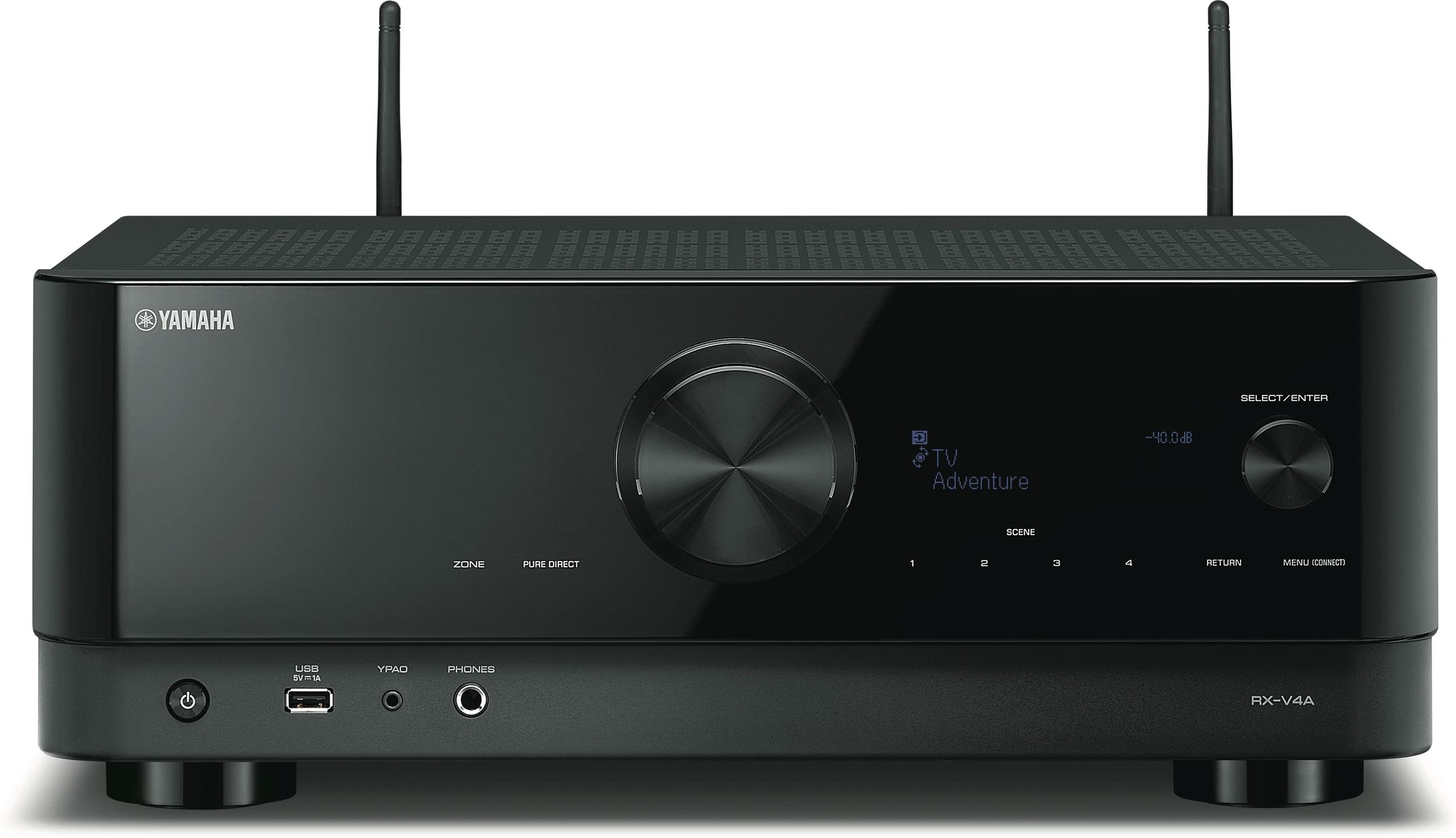
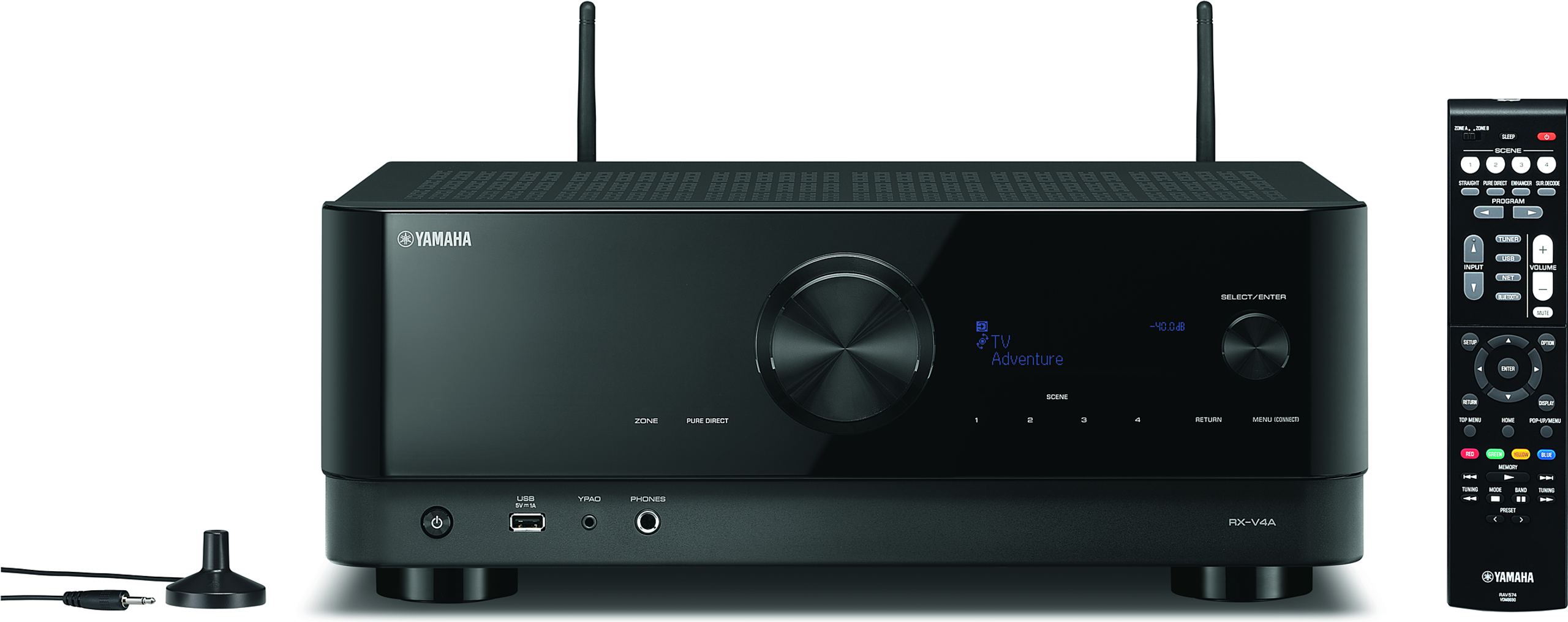
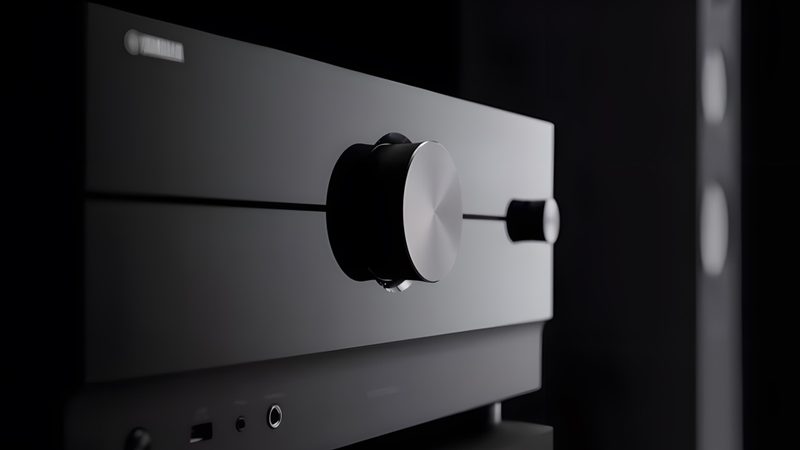
The RX-V4A marks a turning point in Yamaha’s approach to entry-level home theater amplifiers. With 80 watts per channel and full HDMI 2.1 connectivity, this 5.2-channel amplifier combines solid audio performance, modern connectivity, and a controlled price. Its redesigned architecture and technologies inherited from higher-end models make it a particularly coherent choice for anyone looking to build an efficient home theater system without unnecessary complexity.
A Bold Aesthetic Break
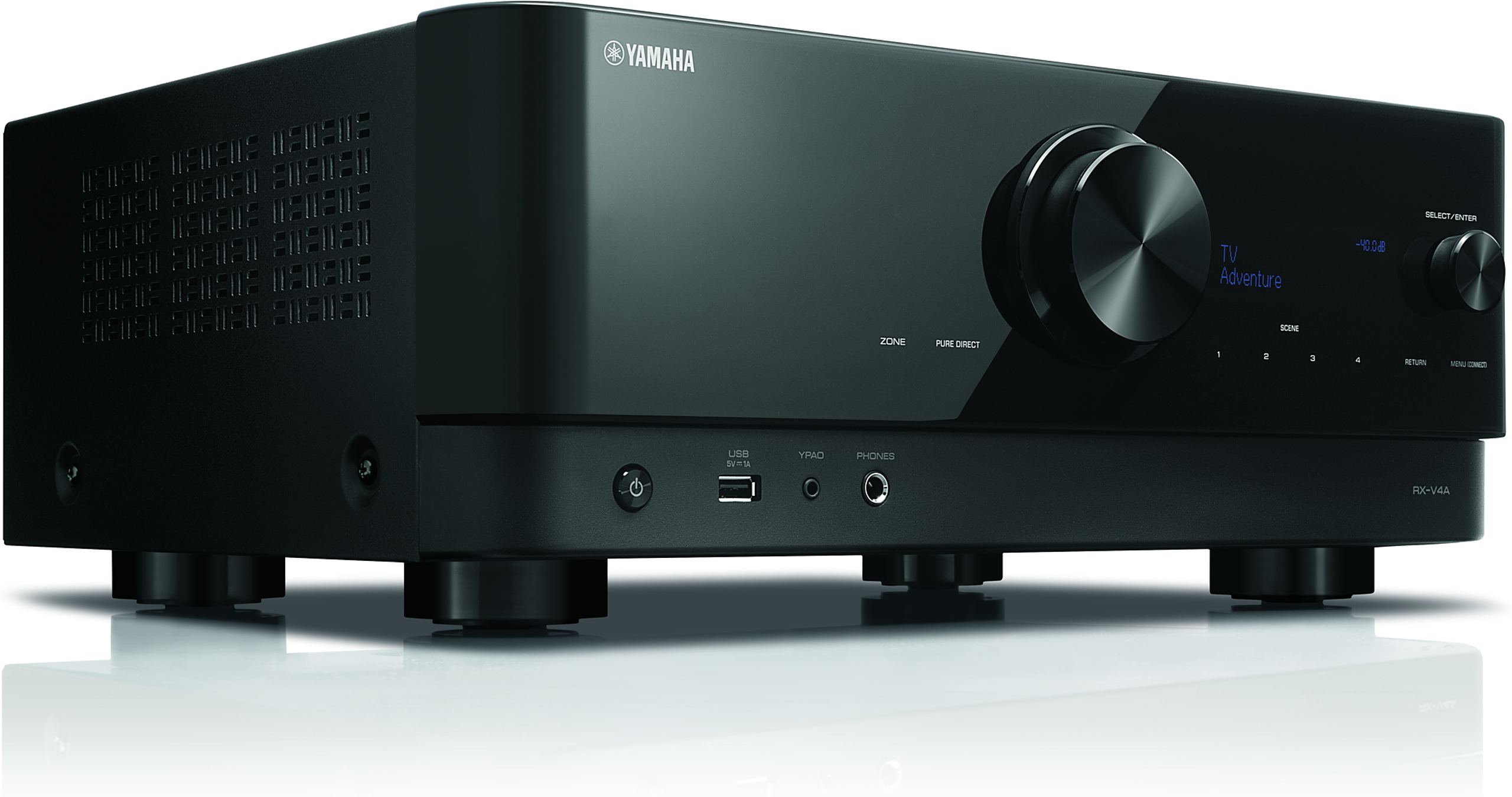
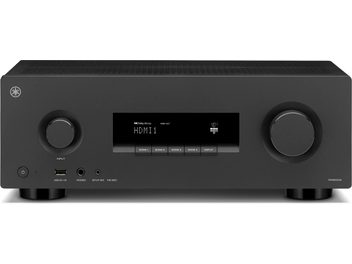
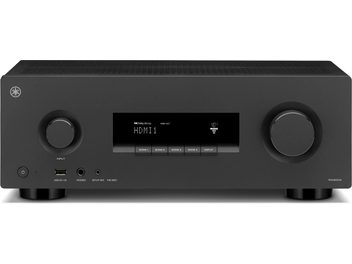
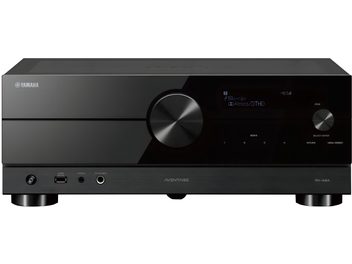
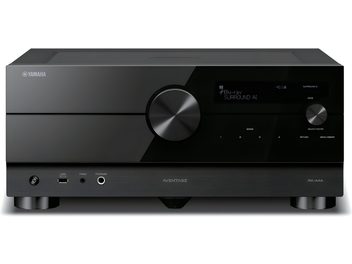
The RX-V4A introduces a new visual signature that radically breaks with decades of Yamaha tradition. Gone is the classic design with its multiple aligned buttons and large two-line central display: in its place is a piano black lacquered front panel with rounded edges, where only two circular knobs stand out. This minimalist approach places the volume control at the center, accompanied by a more compact source selector on the right. The LCD display, now more discreet, is shifted to the right side of the front panel.
Below this screen, four touch-sensitive SCENE buttons provide instant access to pre-recorded sound environments. The front connectivity remains practical with an easily accessible USB port and headphone jack, as well as the YPAO input for the calibration microphone. This aesthetic overhaul, though disconcerting for longtime fans of the brand, gives the RX-V4A a decidedly modern look that fits naturally into contemporary interiors.
The chassis maintains reasonable dimensions (435 × 171 × 377 mm for 8.8 kg), making it easy to fit into a standard TV cabinet. The build quality remains solid for this price range, with a properly sized power transformer and efficient passive cooling that ensures silent operation even under heavy use.
Amplification Technologies and Signal Processing
Beneath its apparent simplicity, the RX-V4A incorporates sophisticated amplification technologies directly derived from Yamaha’s high-end models. The high slew rate amplifier is at the heart of this architecture. This technology, identical to that used in the prestigious MX-A5200 modules, allows the amplifier to respond to rapid changes in input level with remarkable precision. Fast transients, especially present in modern soundtracks rich in effects, are reproduced without compression or distortion.
The digital-to-analog conversion section uses a Burr-Brown PCM5101A chip capable of processing signals up to 384 kHz at 32 bits. This generous resolution ensures precise conversion of high-definition audio streams, preserving the subtlety of the most demanding recordings. The Total Purity Concept architecture, a design philosophy dear to Yamaha, minimizes interference between analog and digital circuits through separate power supplies and optimized signal routing.
The Cinema DSP 3D processor offers 17 sound spatialization programs, the result of decades of acoustic research by Yamaha. Unlike simple reverb effects, these programs are based on real acoustic measurements taken in concert halls and cinemas around the world. Each program recreates the specific acoustic characteristics of these spaces: primary reflections, late reverberation, frequency absorption. The Adventure and Spectacle modes, specially designed for cinema, virtually expand the soundstage by recreating the acoustics of a large hall, thus compensating for the limitations of a modestly sized home room.
HDMI 2.1 Connectivity and Gaming Compatibility
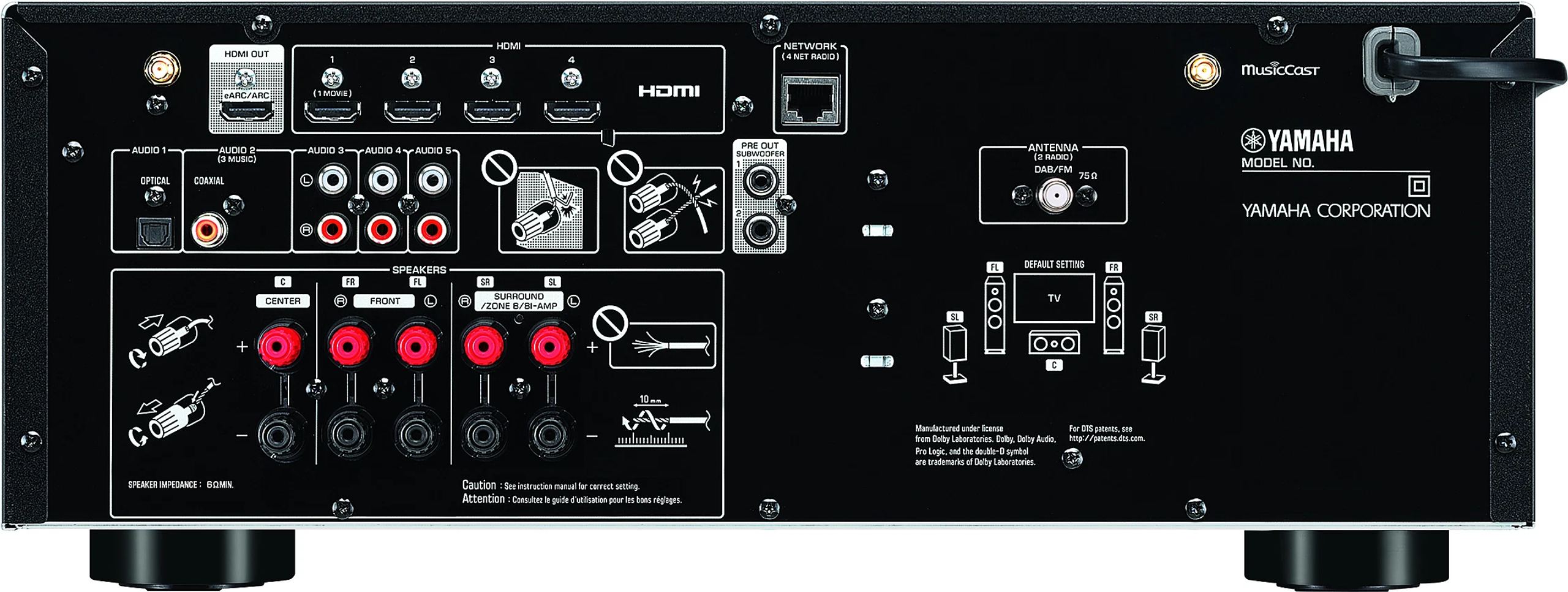
Yamaha made a strong strategic choice by equipping all HDMI inputs on the RX-V4A with the 2.1 standard. The four inputs and single output support 8K at 60 Hz and 4K at 120 Hz, positioning this amplifier as a future-proof solution for years to come. This technical generosity contrasts with the frugality of some competitors who limit HDMI 2.1 compatibility to a single input, even on significantly more expensive models.
Compatibility with the latest HDR formats is complete: HDR10, HDR10+, Dolby Vision, and HLG are all supported in pass-through. Video upscaling up to 4K optimizes the display of standard or HD sources, ensuring a consistently sharp image on an Ultra HD TV. The HDMI output includes the eARC (Enhanced Audio Return Channel) protocol, allowing high-resolution multichannel audio streams to be retrieved directly from the TV, greatly simplifying cabling and daily use.
Gamers will especially appreciate the ALLM (Auto Low Latency Mode), VRR (Variable Refresh Rate), QMS (Quick Media Switching), and QFT (Quick Frame Transport) features. These technologies, essential for next-generation consoles like PlayStation 5 and Xbox Series X, ensure a smooth gaming experience with minimal latency and no screen tearing. The ALLM mode automatically switches the TV and amplifier to low latency mode as soon as a console is detected, eliminating any delay between the action and its audio reproduction.
YPAO Acoustic Calibration and Listening Optimization
The YPAO (Yamaha Parametric room Acoustic Optimizer) acoustic calibration system is one of the RX-V4A’s major assets. Developed by Yamaha since 2003, this system analyzes the listening room’s acoustics and automatically optimizes audio parameters to ensure balanced sound reproduction. The process, remarkably simple, is completed in a single pass from the main listening position.
The supplied microphone, placed at ear height in the preferred listening spot, allows the system to precisely measure the distances between each speaker and the listener. The amplifier emits test signals through each channel to analyze frequency response, detect phase issues, and identify room resonances. The applied parametric equalization automatically compensates for acoustic flaws, flattening peaks and filling dips in the frequency response.
In testing, the YPAO system proved particularly effective at detecting distances and adjusting levels. Unlike some competing systems that tend to over-amplify the center channel, the RX-V4A generally finds a natural balance on the first calibration. Only the subwoofer level often requires manual adjustment, as the system tends to set it conservatively.
The YPAO Volume function, automatically activated after calibration, dynamically adjusts the response curve according to the listening level. At low volume, bass and treble are subtly boosted according to the Fletcher-Munson curves, compensating for the human ear’s reduced sensitivity at the spectrum’s extremes. This psychoacoustic correction ensures a balanced perception of sound even during nighttime listening.
MusicCast Ecosystem and Multiroom
Integrating the RX-V4A into the MusicCast ecosystem transforms this home theater amplifier into the true nerve center of a multiroom audio system. This proprietary Yamaha technology, initially launched in 2003 and constantly refined since, allows music to be streamed throughout the home via the domestic WiFi network. The MusicCast Controller app, available free on iOS and Android, offers intuitive control of the entire system from a smartphone or tablet.
MusicCast’s flexibility is evident in its ability to stream either the same music in every room for a unified atmosphere, or different content in each space according to individual preferences. Compatible sources include popular streaming services (Spotify, Deezer, Tidal, Amazon Music), web radios, files stored on a NAS or computer, as well as any physical source connected to the amplifier. This last feature is particularly practical: the sound from the TV, a Blu-ray player, or even a turntable connected to the RX-V4A can be streamed to any room equipped with a MusicCast device.
The MusicCast Surround function is a particularly clever innovation. It allows MusicCast 20 or MusicCast 50 wireless speakers to be used as rear surround channels, eliminating the traditional cabling that is often problematic in home theater setups. The MusicCast SUB 100 subwoofer can also be integrated wirelessly, offering total freedom of placement to optimize the room’s bass response. Configuration is done entirely via the app, with automatic synchronization ensuring no perceptible delay between wired and wireless speakers.
Compatibility with Amazon Alexa, Google Assistant, and Siri (via AirPlay 2) modernizes daily use. Simple voice commands allow you to control playback, adjust volume, or change source without touching the remote. The bidirectional Bluetooth adds another layer of versatility: the amplifier can receive music from a smartphone or, conversely, send sound to Bluetooth headphones for late-night private listening.
Audio Performance and Practical Use
In 5.1 configuration, the RX-V4A delivers performance that far exceeds what its price point might suggest. The front soundstage benefits from remarkable width and depth, with precise localization of elements in space. Dialogues stand out with clarity and naturalness from the center speaker, without masking effects or excessive coloration. Dynamic management impresses with its ability to reproduce both intimate passages and the most spectacular action sequences without audible compression.
The integration of surround speakers creates a coherent sound bubble, even if the precision of effect placement lags behind high-end amplifiers. Side and rear effects tend to stick to the speakers rather than float freely in space, a limitation inherent to the absence of Dolby Atmos or DTS:X processing. The DSP modes partially compensate for this limitation by virtually expanding the soundstage, at the cost of a slight artificiality that may not appeal to purists.
In pure stereo, the RX-V4A surprises with its musicality. The Pure Direct mode bypasses all digital processing to offer a direct signal path from source to speakers. The reproduction gains in transparency and detail, revealing the quality of the Burr-Brown converters. Timbres remain natural, the stereo image extends generously beyond the speakers, and the dynamics retain all their liveliness. Admittedly, a dedicated stereo amplifier at a similar price will probably offer superior performance, but the RX-V4A handles this secondary task honorably.
The Music Enhancer function deserves special mention. This proprietary Yamaha processing restores harmonics lost during MP3 file compression or streaming. The algorithm analyzes the spectral content and intelligently reconstructs missing frequencies, giving body and presence back to otherwise dull recordings. The effect remains subtle and musical, avoiding the artificiality of less sophisticated enhancement processors.