Rudi
Does what it's supposed to do
Just good
Comment from 24 September 2026 — Experience from 18 August 2026
Automatically translated — Show original (Dutch)
Doet wat het moet doen
Gewoon goed
Gewoon goed
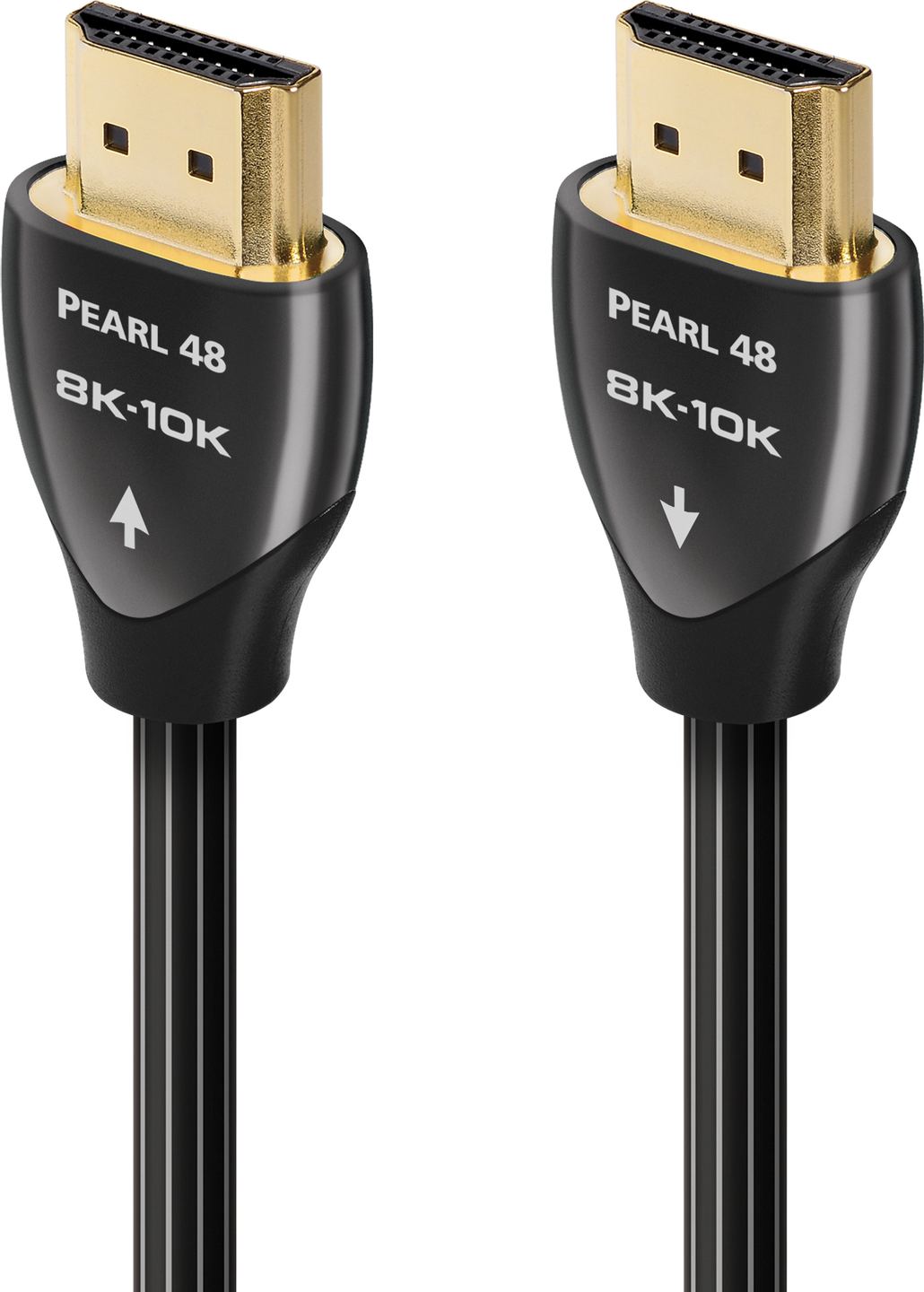







Playing in 4K at 120 frames per second on a recent console or sending a Dolby Atmos track from the TV to the amplifier requires an HDMI cable capable of reaching 48 Gbit/s, the maximum bandwidth of the HDMI 2.1 standard. The Pearl 48 is the first model in AudioQuest’s 48 series. Its conductors are solid copper, and all nineteen wires in the cable are treated to combat radio-frequency interference, including those that carry audio.
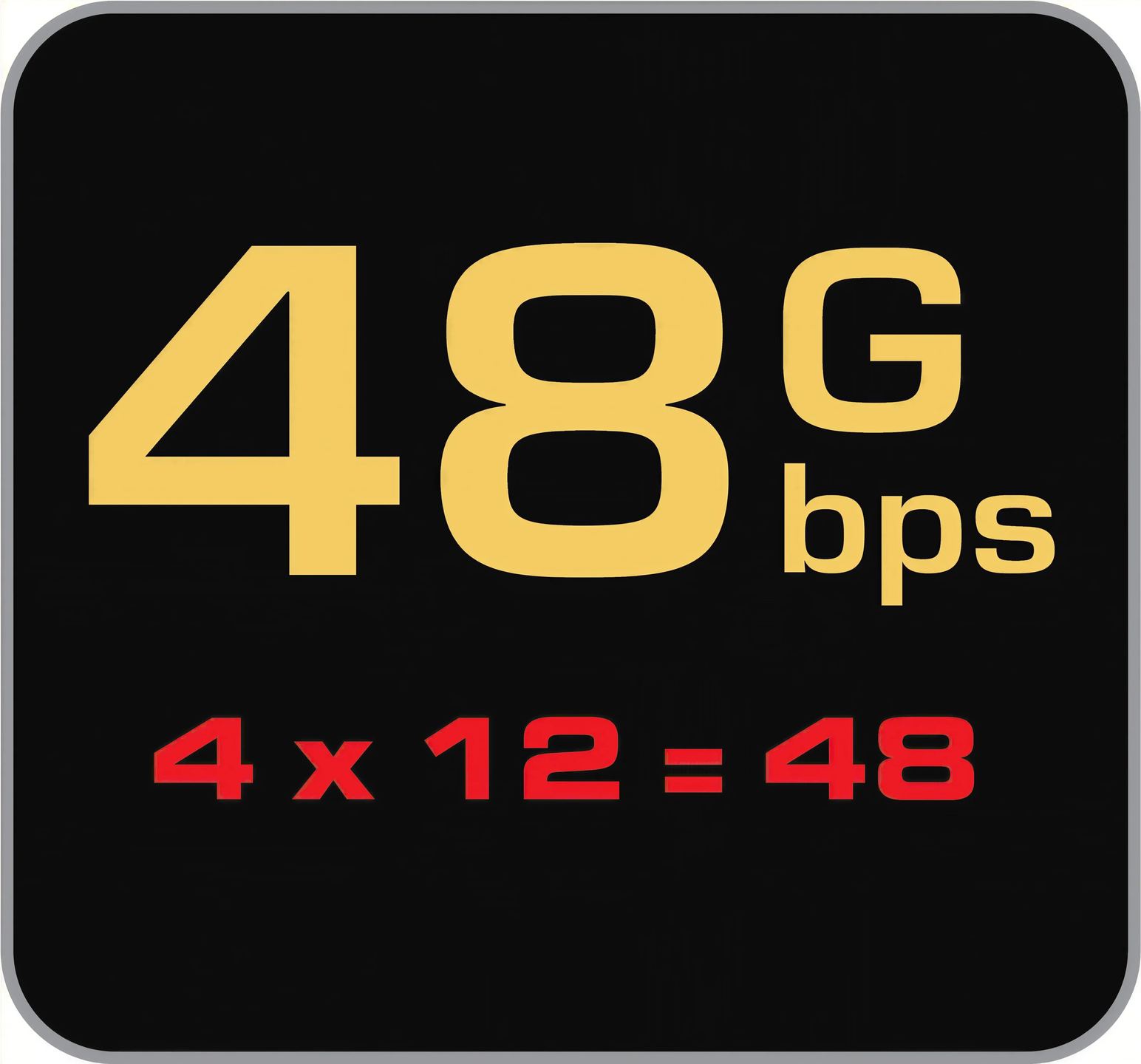
Video travels over four balanced pairs. Each carries 12 Gbit/s, for a total of 48 Gbit/s. This bandwidth supports 4K at 120 Hz, 8K at 60 Hz and professional resolutions up to 10K. It also carries dynamic HDR (Dolby Vision, HDR10+), whose metadata adjusts brightness and contrast frame by frame rather than applying a single setting to the entire film. The Pearl 48 remains compatible with HDMI 2.0 devices: a 4K Blu-ray player or a set-top box running 4K at 60 Hz will work without difficulty, even if they only use part of the bandwidth.
A cable does not add any features: it passes through those that the source and display can handle. On many TVs, only one or two HDMI inputs support the full bandwidth of the 2.1 standard. It is therefore best to check which port to connect the console or amplifier to.
Most HDMI cables use stranded conductors, made up of many very fine wires twisted together. In the Pearl 48, each conductor is a single solid wire. According to AudioQuest, electrical and magnetic interactions between strands within the same conductor are a major source of distortion in a cable, and a solid wire eliminates them.
The metal is the brand’s Long-Grain Copper (LGC). This is copper treated so that its crystals are longer than those in ordinary copper, reducing the number of crystal boundaries the signal has to cross. The ground reference wires are tinned copper.
An HDMI signal is digital: as long as the cable supports the required bandwidth, the pixels arriving at the screen are identical to those that left the source. AudioQuest’s material choices target something else, namely the electrical noise that accompanies the signal to the devices’ circuitry.
An HDMI connector has nineteen pins, and the cable has just as many conductors: audio-video pairs, an eARC pair, ground references, control lines and a power line. According to AudioQuest, 100% shielding is not enough to combat the waves emitted by Wi-Fi routers, phones and other wireless devices. The Pearl 48 therefore features level 1 of the brand’s Noise-Dissipation technology: each conductor is installed in a specific direction (Direction-Controlled) so that high-frequency noise is directed away from sensitive circuitry rather than back towards it.
This level 1 is the foundation of AudioQuest’s entire HDMI range. Models above the Pearl 48 add other dissipation techniques and silver-plated conductors.
eARC (enhanced audio return channel) carries sound from the TV to a home theater receiver or soundbar through the HDMI cable that already connects them. With much higher bandwidth than the older ARC, it transmits Dolby TrueHD, Dolby Atmos, DTS-HD Master Audio and DTS:X without compression, as well as multichannel PCM. It is the simplest solution when all sources are connected to the TV and the amplifier only receives audio.
In the Pearl 48, the pair carrying eARC is built like the video pairs: the same solid LGC copper, the same conductor orientation. Both the TV and amplifier must still support eARC, on the ports labeled as such. If either device only has ARC, audio remains limited to compressed formats.
The PlayStation 5 and Xbox Series X consoles, along with PC graphics cards equipped with an HDMI 2.1 output, use several features of the standard that depend on the cable’s bandwidth. VRR (variable refresh rate) synchronizes the TV’s display with the console’s actual frame rate, eliminating screen tearing when the number of frames per second varies. ALLM automatically switches the TV to game mode when a game starts to reduce response time. QFT (Quick Frame Transport) sends each frame faster from the source to the screen to reduce display lag. The Pearl 48 passes through all three features, as well as 4K at 120 Hz.
Which way should the Pearl 48 be connected?
Arrows on the plugs indicate the direction: they should point from the device sending the picture (console, player, receiver) towards the one displaying it. Connected backwards, the cable will still work, since the HDMI signal travels in both directions on certain lines, but AudioQuest’s chosen orientation for directing noise away is then no longer followed.
Why does the screen stay black or remain stuck at 60 Hz with a console set to 4K at 120 Hz?
The cable is rarely to blame. On most TVs, you need to enable a setting such as “extended HDMI signal,” “enhanced HDMI” or “Ultra HD signal format” for the input being used, depending on the brand. You also need to connect the console to an HDMI 2.1 port on the TV and enable 120 Hz in the console’s video settings. If a receiver sits between the two, its own inputs and outputs must also support 4K at 120 Hz.
Does the Pearl 48 improve picture quality compared with an entry-level HDMI cable?
If both cables support the required bandwidth, the pixels transmitted are the same. A visible difference mainly appears when a cable cannot sustain that bandwidth: intermittent black screens, sparkling white dots or audio dropouts. AudioQuest’s claims concern the stability of the 48 Gbit/s connection and the electrical noise transmitted to devices, not a more colorful or more detailed picture.
How does it differ from the Forest 48, the next model up?
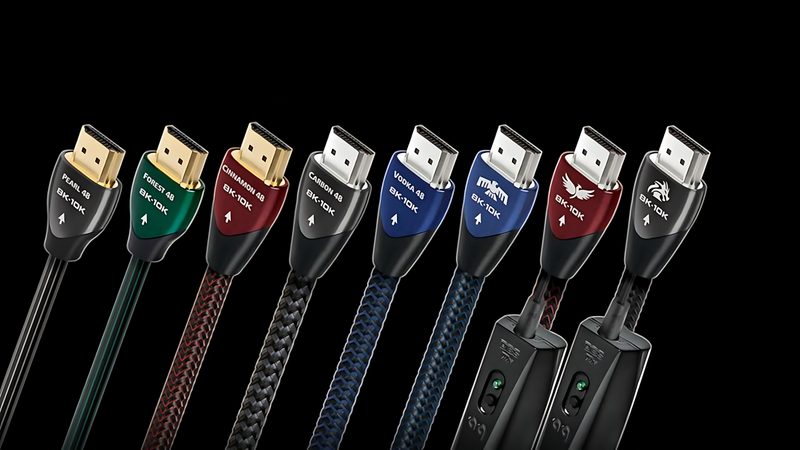
The Forest 48 retains the solid long-grain copper conductors and level 1 noise dissipation, with 0.5% silver plating on the conductors. This is the first step in a progression towards conductors with increasingly higher silver content, and towards higher levels of noise dissipation, in the 48 series.
Can you connect a computer to a monitor or TV with the Pearl 48?
Yes, provided that both the graphics card and the display have an HDMI port. To benefit from 4K at 120 Hz or VRR, the graphics card’s output must be HDMI 2.1. The cable is not suitable for a monitor that only has DisplayPort inputs, and an adapter does not guarantee the highest bandwidths.
Is the Pearl 48 suitable for a projector?
Yes. Most 4K projectors have HDMI 2.0 inputs, which the cable supports thanks to its backward compatibility. HDMI 2.1 models will benefit from 4K at 120 Hz if the source provides it. The features passed through depend on the projector, not the cable.
Yes, the cable is fully backward compatible with all existing HDMI equipment. It will work perfectly with your current 4K devices while being ready for future upgrades to 8K or advanced gaming features.
The Pearl 48 stands out thanks to its LGC copper conductors and directional control noise dissipation system. These technologies aim to reduce distortion and interference, which is especially important in environments rich in wireless devices.
Technically yes, the Pearl 48 has the necessary bandwidth for 10K streams. However, for critical professional applications, higher-end AudioQuest models with advanced noise dissipation would be more appropriate.
Long-grain copper is designed to reduce distortion related to the metal’s crystalline structure. The benefits will be more noticeable in high-quality audio systems and will depend on the listener’s sensitivity to sonic nuances.
Based on reviews from customers who purchased this product, summarised by AI
Rudi
Does what it's supposed to do
Just good
Comment from 24 September 2026 — Experience from 18 August 2026
Martial
Very good product purchased on the salesperson's recommendation
Comment from 10 September 2026 — Experience from 29 August 2026
Armand
As expected 👍🖖
Comment from 10 April 2026 — Experience from 13 March 2026
* Attention ! Un crédit coûte de l'argent et doit être remboursé
Pour un achat de 300 € en 4 fois : acompte de 75 €, puis 3 mensualités de 75 €. Crédit de 225 € au taux débiteur fixe de 0% sur 3 mois. Coût du crédit 0 €. Montant total dû 300 €. TAEG 0%. Le coût du crédit est pris en charge par l'enseigne.
Sous réserve d'acceptation par Alma SAS (almapay.com), société de financement agréée par l'ACPR (code CIB : 17408). RCS Nanterre 839100575. Contact : support@almapay.com