Panasonic TV-77Z95BEG


Specifications and features




Overview
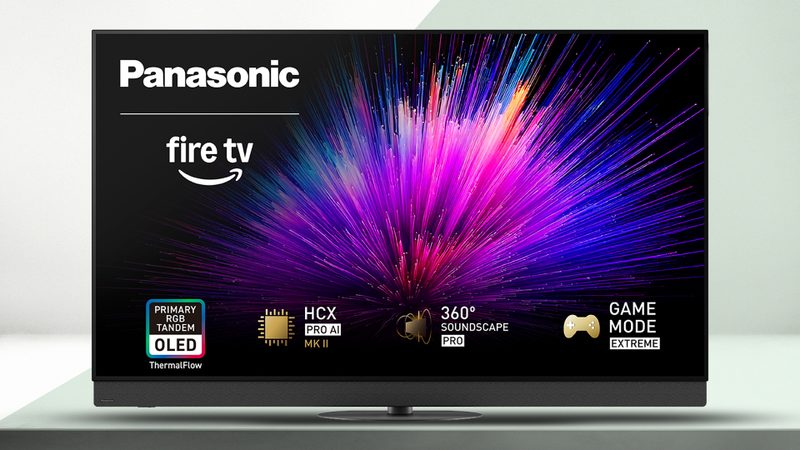
Until 2024, the largest screen size stood apart in Panasonic’s high-end OLED range: the 77-inch model made do with a less advanced panel than the 55- and 65-inch versions. This 195 cm TV now has the same foundation as the smaller sizes, with a brighter OLED panel that produces purer colors, redesigned cooling, a 180 W sound system tuned by Technics engineers, and the Fire TV interface. It remains the brand’s flagship OLED model in 2026.
Four light-emitting layers and a chassis ventilated from bottom to top
On an OLED screen, each pixel produces its own light and switches off completely to display black, with no backlight spilling into dark areas. The previous generation of panels stacked three emissive layers, one of which combined several hues. The Primary RGB Tandem structure stacks four: two blue, one red, and one green, each separate. Each color is purer, and Panasonic puts the gain in luminous efficiency at around 40%, resulting in a brighter image and a wider color palette at comparable power consumption. A white subpixel still complements the red, green, and blue for the brightest highlights.
An OLED panel’s brightness runs up against a physical obstacle: heat. The ThermalFlow system reorganizes the inside of the chassis with repositioned vents and a subwoofer moved from the bottom to the top of the rear panel, where it previously obstructed airflow. Air rises freely from the base to the top of the screen, allowing the panel to sustain peak brightness for longer without having to scale back. The refresh rate reaches up to 144 Hz, and Smooth Motion Drive Pro processing smooths fast motion, from sports to tracking shots.
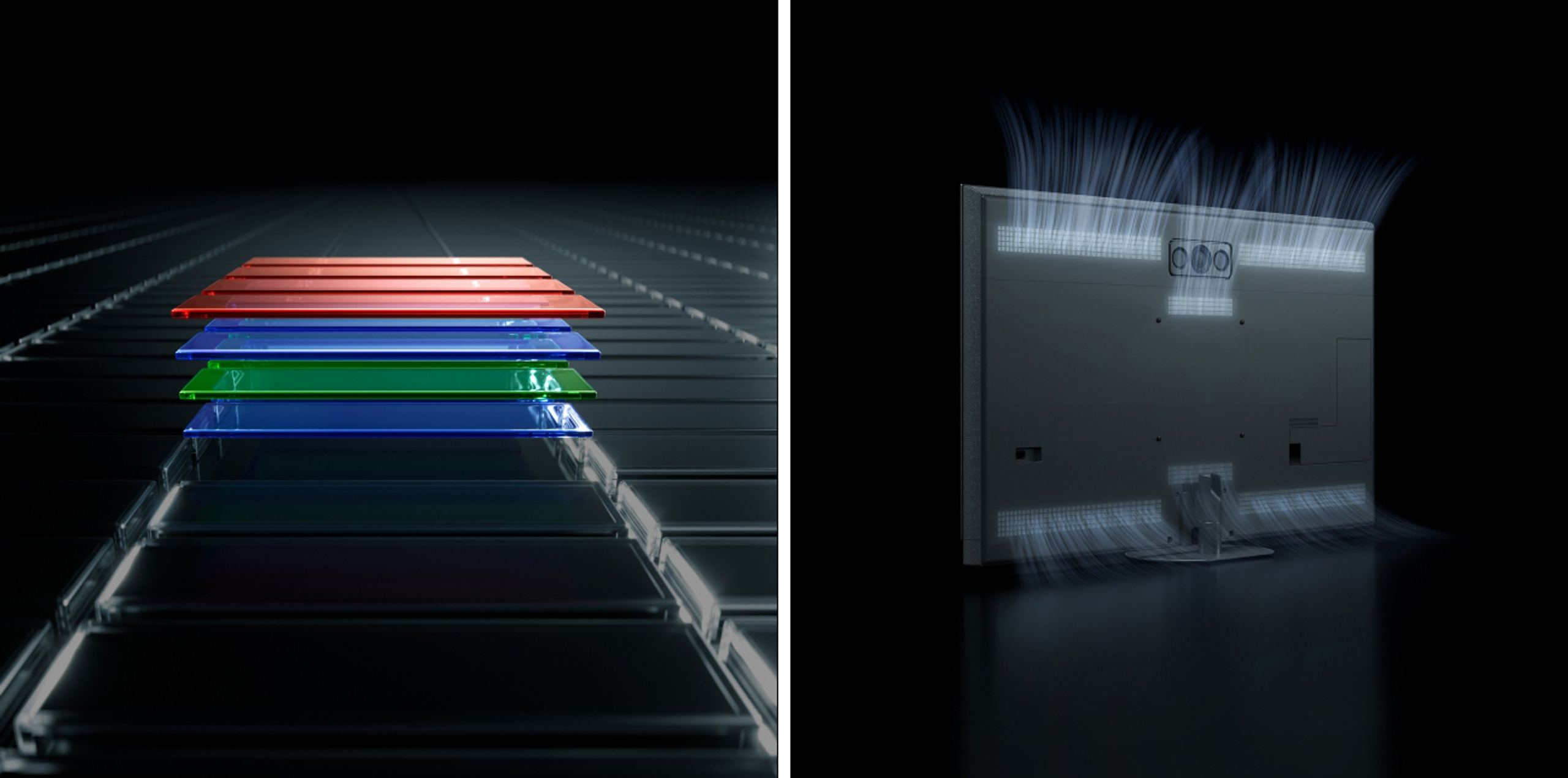
Image processing aligned with studio grading
The HCX Pro AI MK II processor analyzes the content on screen and recognizes the type of program (film, sport, game) to adjust the picture and sound in automatic AI mode. It uses three-dimensional color lookup tables that vary with brightness level, keeping hues accurate in both shadows and bright areas. High-definition and lower-quality sources pass through a 4K upscaling engine that reconstructs detail across the panel’s 3,840 × 2,160 pixels.
For HDR, the TV supports all common formats: Dolby Vision IQ, HDR10+ Adaptive, HDR10, and HLG. The first two use dynamic metadata—that is, brightness instructions that change from scene to scene—and the ambient light sensor adapts them to the room’s actual lighting. The same sensor supports Filmmaker Mode, which respects the settings chosen during grading while compensating for a bright room. There is also Netflix Adaptive Calibrated Mode, Prime Video Calibrated Mode, and True Cinema mode, developed through Panasonic’s work with colorist Stefan Sonnenfeld, founder of grading studio Company 3. The two professional modes, ISF certification, and compatibility with Calman calibration software give an installer the tools to calibrate the screen with a probe.
Seven channels and a subwoofer tuned by Technics
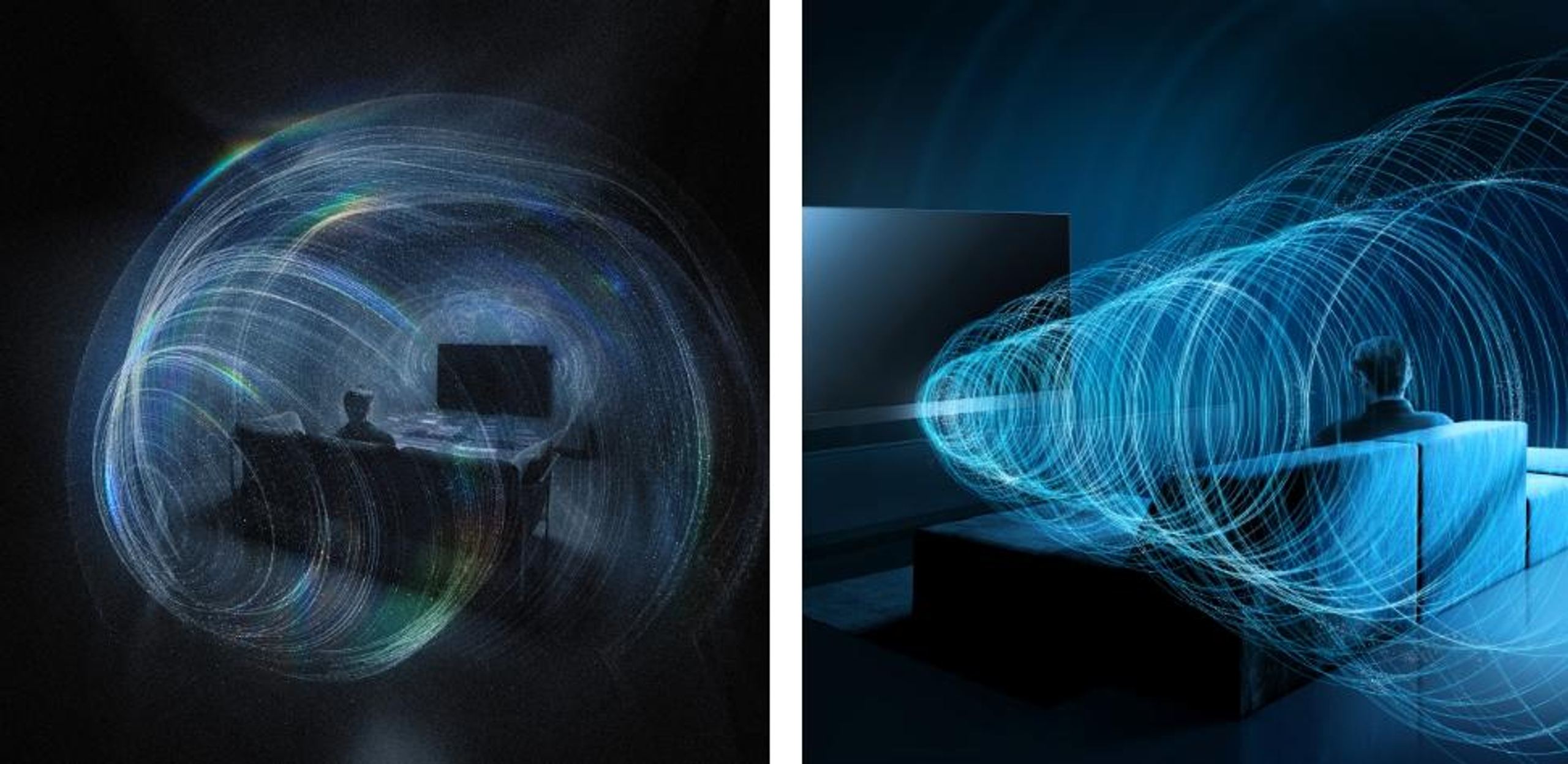
The 360° Soundscape Pro system delivers a total of 180 W across several groups of fabric-covered speakers. A front row of small drivers (90 W) carries dialogue and most of the sound, two side speakers (2 × 15 W) widen the soundstage, two upward-firing speakers (2 × 15 W) reproduce Dolby Atmos height effects by reflecting sound off the ceiling, and a 30 W subwoofer, supported by two passive radiators, handles the low frequencies. The final tuning is by engineers from Technics, Panasonic’s hi-fi brand.
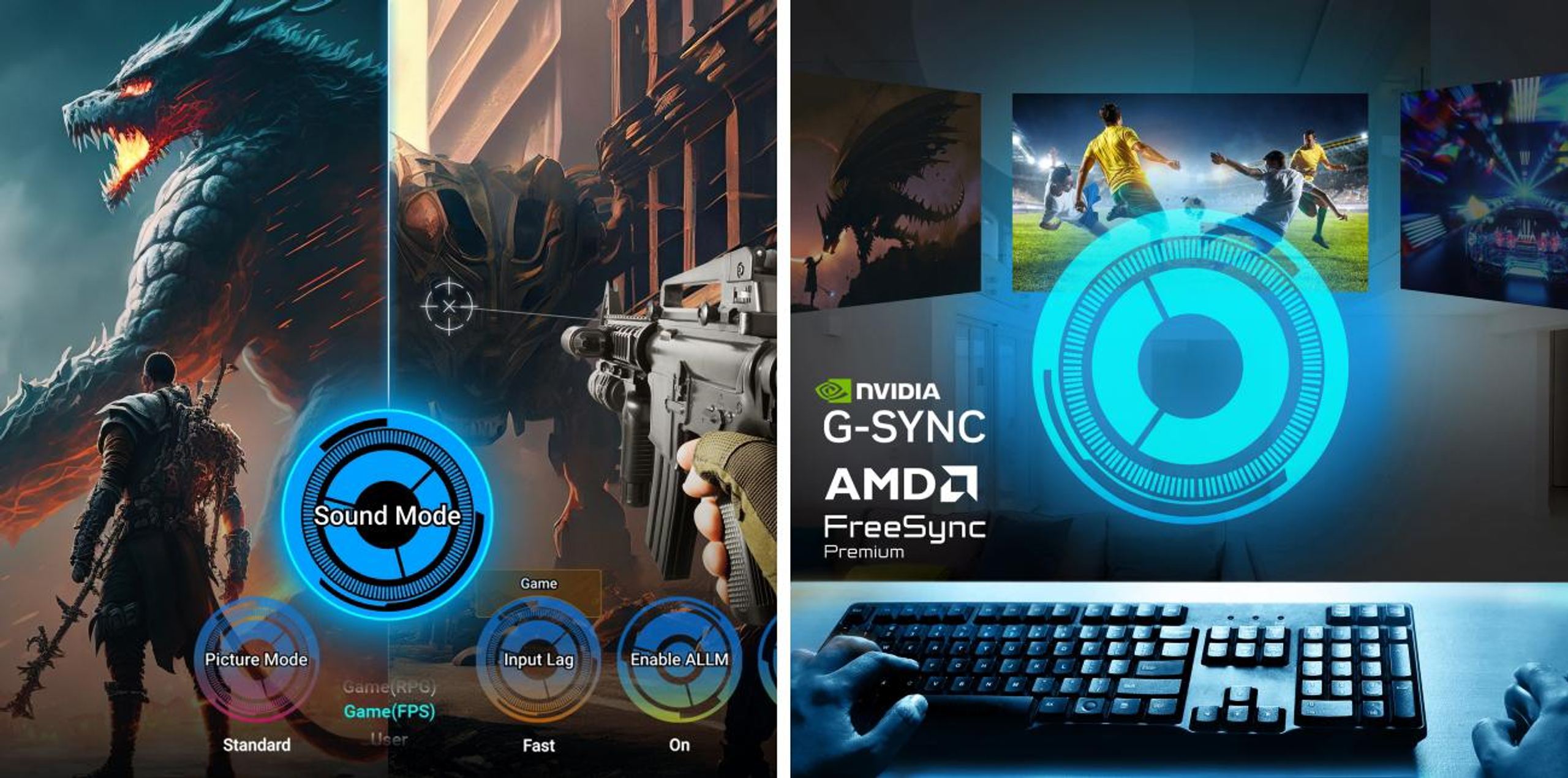
The front row handles beamforming: Sound Focus directs sound toward a specific seat on the sofa or creates listening zones at different volume levels in the room. Space Tune measures the room’s acoustics using the remote control’s microphone and adjusts the sound accordingly. The sound modes cover music, speech, sports, and two gaming profiles, one geared toward first-person shooters and the other toward role-playing games. A 61 mm-thick chassis cannot reach as deep into the bass as a dedicated subwoofer: the headphone output, which can be switched to a subwoofer output, accepts an external powered subwoofer to give action films more impact.
Two 144 Hz HDMI 2.1 inputs for consoles and PCs
Extreme Game Mode brings together the features gamers expect. HDMI inputs 1 and 2 support high-refresh-rate 4K up to 144 Hz, variable refresh rate (VRR), which synchronizes the screen with the game’s actual frame rate and eliminates screen tearing, as well as AMD FreeSync Premium and Nvidia G-Sync Compatible technologies. Auto Low Latency Mode (ALLM) switches the TV to game mode as soon as a console starts, on all four inputs. An on-screen control panel displays the frame rate, VRR, and quick settings without leaving the game, while True Game mode maintains a faithful picture with reduced latency. Dolby Vision also has a Game mode.
The input layout calls for a little planning. eARC, which sends sound to a home theater receiver or soundbar, uses HDMI input 2, one of the two high-speed inputs. With a receiver connected via eARC and two recent consoles, the second console ends up on an input without high-refresh-rate 4K or VRR, unless it is routed through the receiver.
Fire TV, Alexa, and AirPlay in one interface
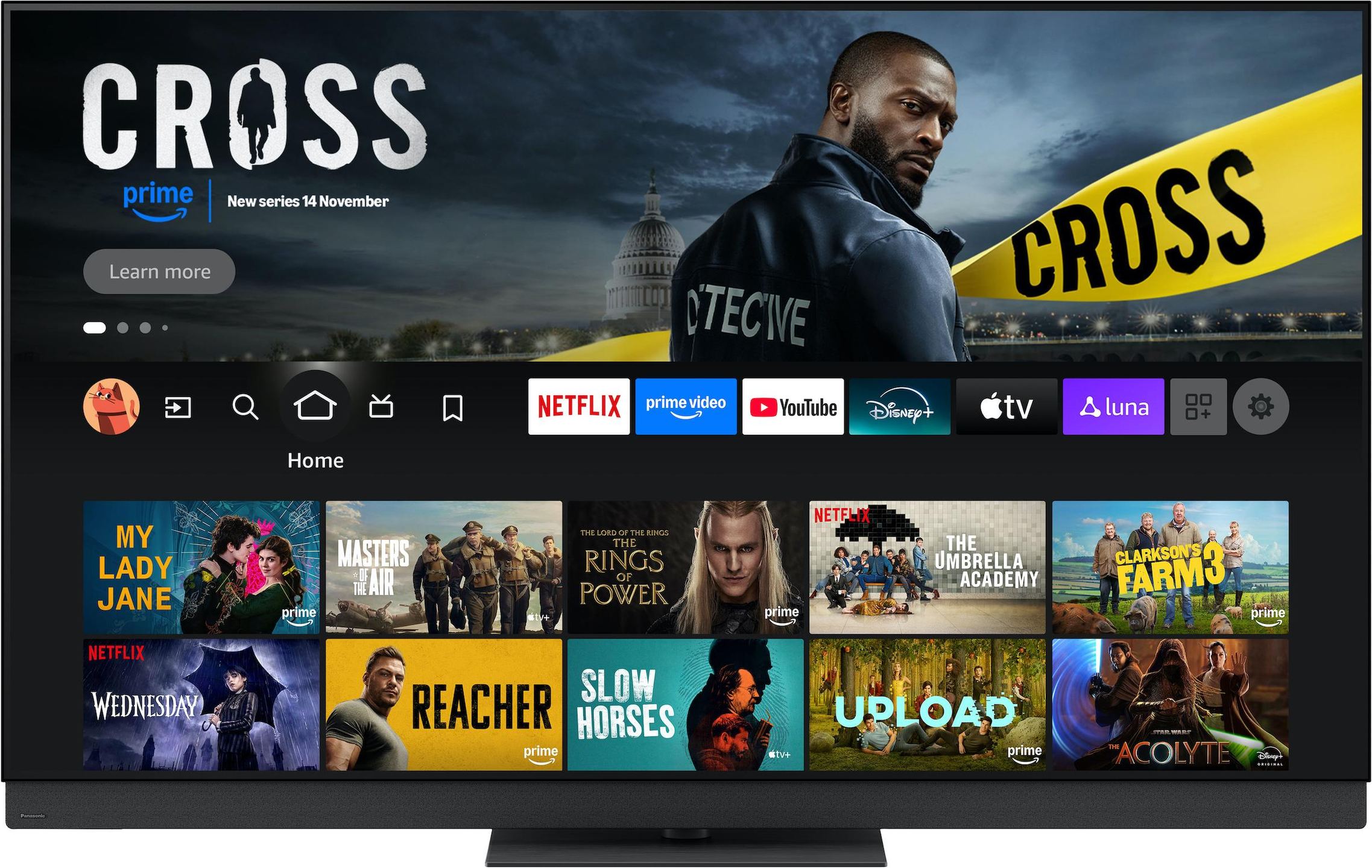
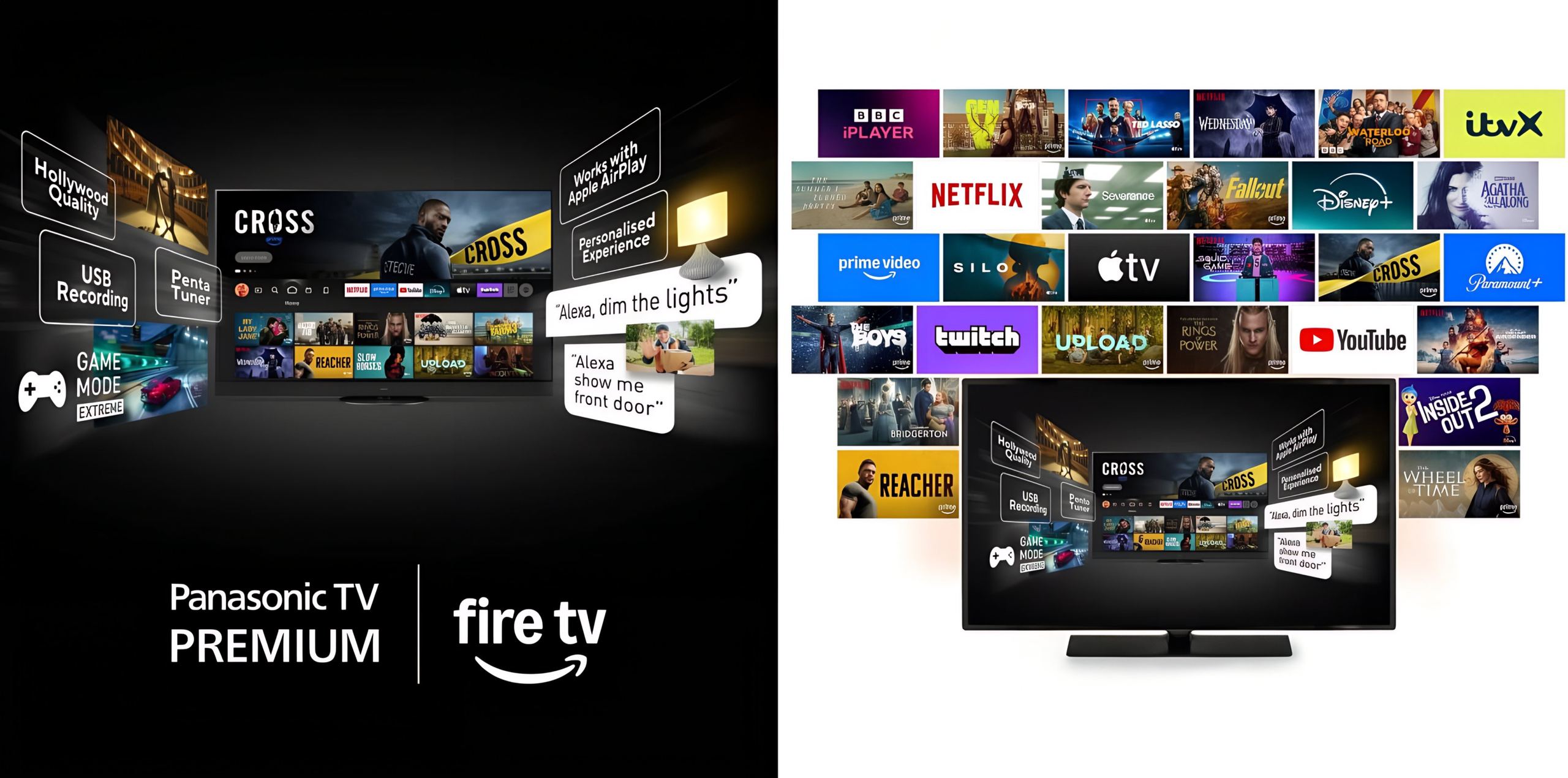
The Fire TV interface brings streaming apps, channels received by the tuner, and HDMI inputs together on one home screen, with user profiles and personalized recommendations. Built-in microphones make Alexa accessible by voice without using the remote control, to start a program or control connected devices around the home. The TV also works with Google Assistant and fits into the Apple ecosystem thanks to AirPlay and Apple’s Home app. Fire TV’s Ambient Experience turns the idle screen into a frame for artwork, personal photos, or information widgets.
Bluetooth handles audio output to headphones or a speaker, audio input (so the TV plays music from a phone), and the connection of a keyboard or mouse, which are more convenient than a remote control for entering a password or browsing the web.
Terrestrial, satellite, and cable TV with USB drive recording
The TV has tuners for digital terrestrial TV (DVB-T/T2), satellite (DVB-S2), and cable (DVB-C). The twin tuner records one channel to a USB hard drive while another is watched, and multi-window display places two programs side by side. The SAT>IP server and client function streams received channels to other TVs on the home network or receives channels from another device. The CI+ 1.4 slot accepts an operator module for subscription channels, and HbbTV provides access to channels’ interactive services. Audio description and a program guide complete the package.
Installing 43 kg on a stand or wall
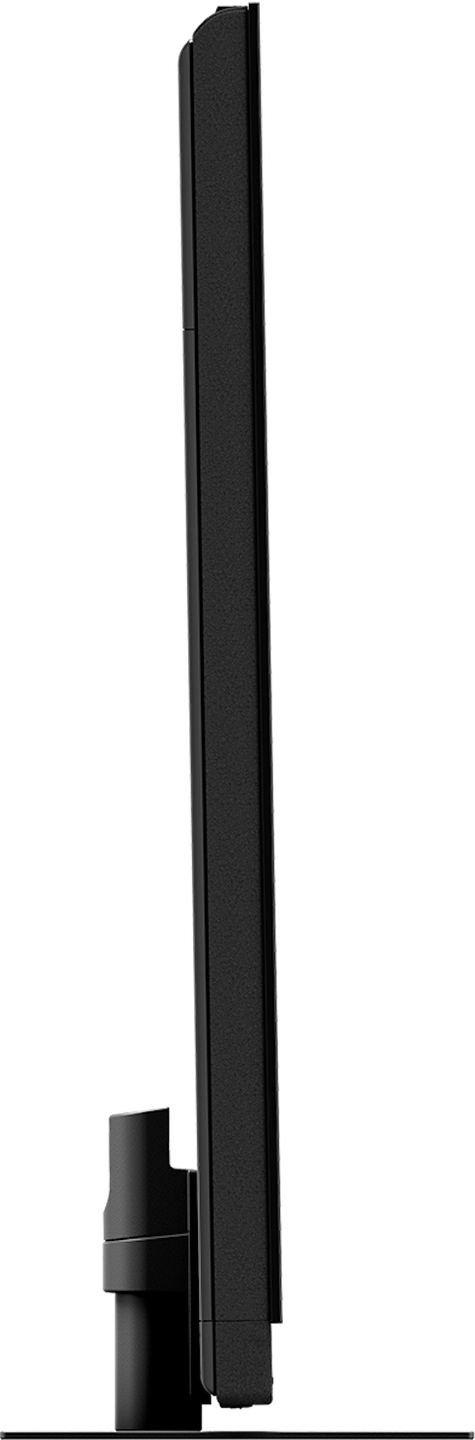
Without its stand, the screen measures 1,712 × 1,040 mm, is 61 mm deep, and weighs 43 kg. The central stand has a 500 × 350 mm footprint, so a relatively narrow TV cabinet will suffice as long as it is at least 35 cm deep. Unlike the 55- and 65-inch versions, this stand does not swivel. It raises the screen by only about 2.5 cm: a soundbar placed in front would obscure the bottom of the picture, and the built-in system often makes one unnecessary.
For wall mounting, the TV uses the VESA 400 × 300 standard. All four HDMI ports face sideways and remain accessible even when the screen is mounted, while removable covers conceal the connections. Weighing 63 kg in its packaging, with a box over two meters long, delivery and installation require two people.

Technical Specifications
Feature Summary
- Latest-generation OLED: ultra-precise image, vibrant colors, deep blacks
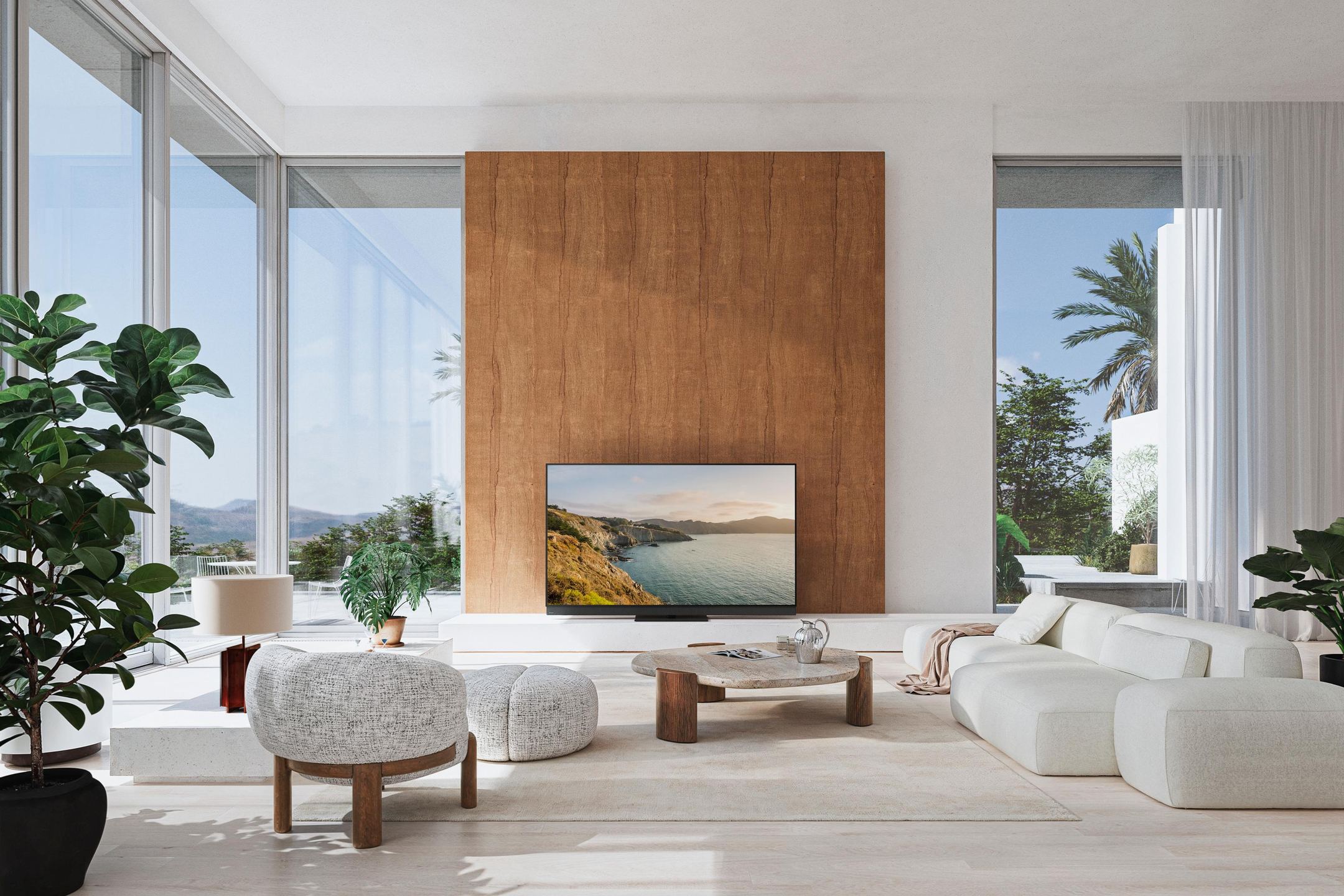
- Sleek design: blends seamlessly into any interior
- Built-in Fire TV: smooth navigation and personalized content
- Tandem OLED Panel + ThermalFlow: enhanced brightness and contrast
- HCX PRO AI MK II Processor: AI-optimized picture quality
- 360° sound with Dolby Atmos: total audio immersion, by Technics
- Extreme Gaming Mode: 144 Hz, VRR, HDMI 2.1 for a smooth gaming experience
- Full HDR compatibility: Dolby Vision IQ, HDR10+ Adaptive, etc.
- Premium features: USB recording, Penta Tuner, high-end remote control
Display Technology
- Diagonal: 195 cm
- Screen resolution: 3,840 × 2,160
- Screen technology: 4K OLED display / Primary RGB Tandem OLED with ThermalFlow
- Resolution: Ultra HD 4K / 3,840 × 2,160
- Refresh rate: up to 144 Hz
- Smooth Motion Drive Pro: Yes
- Multi HDR support: HDR10+ Adaptive / HDR10 / HLG / Dolby Vision IQ
- Dimming / Contrast: OLED / Ultimate Contrast
- Color gamut: wide color range
- Dolby Vision IQ: Yes
- HDR10+ Adaptive: Yes
- Filmmaker Mode: Yes (with intelligent sensor)
Processor and Artificial Intelligence
- Processor: HCX Pro AI MKII
- Automatic AI for image: Yes
- Picture modes: Auto AI, Dynamic, Normal, Cinema, True Cinema, Filmmaker, Custom, Professional 1, Professional 2, Sport, Game, True Game, Dolby Vision (Vivid / IQ / Dark / Game), Netflix Calibrated Mode, Prime Video Calibrated Mode
- ISF Mode: Yes
Audio
- Dolby Atmos: Yes
- Surround soundscape: 360° Soundscape Pro
- Speaker output power: 180 W
- Front speaker array: 90 W
- Side: 15 W × 2
- Up-firing: 15 W × 2
- Woofer: 30 W
- Configuration: 7 channels + mono woofer with 2 passive radiators
- Automatic AI for sound: Yes
- Sound modes: Auto AI, Standard, Music, Speech, Stadium, FPS, RPG, User
Smart Features
- Smart TV: Fire TV
- Built-in Google Assistant: compatible with Google Assistant
- Alexa: Yes (hands-free)
- Works with Alexa: Yes
- Fire TV Ambient Mode: Yes
- Apple AirPlay: Yes
- Apple Home: Yes
- Home network: Yes (client)
- Internal TV streaming (SATIP / DVB-IP): Yes (server / client)
- Mirroring / Google Cast (Chromecast built-in): mirroring
- Media Player: Yes
Gaming
- Game mode: Yes (extreme game mode with enhanced game control panel)
- HDMI 2.1 VRR support: Yes (up to 144 Hz)
- HDMI 2.1 HFR support: Yes
- AMD FreeSync Premium: Yes
- G-Sync compatible: Yes
Connectivity
- Built-in wireless LAN: Yes
- Bluetooth: Yes
- HID / HOGP (keyboard / mouse)
- A2DP (stereo audio: input / output)
- Bluetooth Audio Link: Yes
Connectors and Ports
- HDMI inputs: 4 (side: 4)
- HDCP: Yes (HDCP2.3)
- Supported HDMI 2.1 features:
- eARC (Enhanced Audio Return Channel) (input 2)
- ALLM (Auto Low Latency Mode) (all inputs)
- VRR (Variable Refresh Rate) (input 1 and 2)
- 4K HFR (High Frame Rate) (input 1 and 2)
- AMD FreeSync Premium (inputs 1 and 2)
- G-Sync compatible (inputs 1 and 2)
- Power Link with HDMI signal: Yes
- USB: 3 (2 side, 1 bottom; 1 USB 3.0, 2 USB 2.0)
- Ethernet: 1
- CI (Common Interface): 1 (CI Plus, version 1.4, ECP)
- Optical digital audio output: 1 (bottom)
- Headphone output: 1 (bottom, switchable to subwoofer)
Broadcasting
- Digital tuner: DVB-T / T2 / DVB-S2 / DVB-C
- Data broadcasting: HbbTV
- USB hard drive recording: Yes
- Multi-window display: 2T PAP
- HDAVI control: Yes
- Audio description: Yes
- Program guide: Yes
- On-screen menu languages: 27 languages
- Dual HD tuner: Yes
General Information
- Power supply: AC 220 - 240 V, 50 / 60 Hz
- Ambient sensor (CATS): Yes
- Included accessory: remote control
- Dimensions without stand (W × H × D): 1,712 × 1,040 × 61 mm
- Dimensions with stand (W × H × D): 1,712 × 1,066 × 350 mm
- Weight without stand: 43.0 kg
- Weight with stand: 50.0 kg
- Stand dimensions (W × D): 500 × 350 mm
- VESA standard: Yes
- VESA dimensions (W × H): 400 × 300 mm
- External unit packaging dimensions (W × H × D): 2,130 × 1,180 × 282 mm
- Total packaged weight: 63.0 kg
Frequently Asked Questions
What viewing distance should I allow for a 195 cm screen?
With an image width of around 1.70 m, a viewing distance of 2.3 to 3.2 m falls within the range typically recommended for home theater. At around 2.3 m, the screen fills a large part of your field of view, much like watching a film from the middle rows of a movie theater; at this distance, 4K resolution keeps individual pixels from being visible. Beyond 3.2 m, the image remains comfortable to watch but loses some of its immersive effect.
Is OLED screen burn-in something to worry about?
A static element displayed for hours on end, day after day (such as a news channel logo or game interface), can leave a mark on any OLED panel. With varied use across films, series, TV shows and games, the risk remains low. The TV runs compensation cycles in standby after use: it’s better to turn it off with the remote than to switch off the power at the wall.
Do I need an Amazon account to use the TV?
Apps, recommendations, and Alexa require a free Amazon account; a Prime subscription is not required. You can still receive channels via antenna, satellite, or cable and use the HDMI inputs without an account.
Is the built-in sound good enough to skip a soundbar?
For TV series, shows and films watched at a reasonable volume, the 180 W system with upward-firing speakers delivers a wide soundstage and clear dialogue. It has two limitations: the deepest bass, which can be added by connecting a powered subwoofer to the switchable output, and the lack of rear speakers, which only a home theater system with an amplifier can provide.
Which audio formats can be sent to a home theater receiver?
The eARC connection on HDMI input 2 sends multichannel audio tracks and Dolby Atmos to a compatible receiver or soundbar using a single HDMI cable. The optical output, at the bottom of the chassis, provides a fallback for older equipment, but is limited to PCM stereo and compressed 5.1 audio, without Atmos.
Can I listen to the TV through headphones?
Yes, in two ways. Via Bluetooth, the TV sends audio to wireless headphones using the Bluetooth Audio Link feature. For a wired connection, the headphone jack accepts standard headphones, provided it has not been switched to subwoofer output mode: the two uses are mutually exclusive.
Can the TV be used as a computer monitor?
Yes, via HDMI inputs 1 or 2, provided the graphics card has an HDMI 2.1 output: the TV has no DisplayPort port. G-Sync and FreeSync Premium compatibility applies to both Nvidia and AMD graphics cards, and the 144 Hz refresh rate is mainly useful on PC, as current consoles are limited to 120 Hz. A Bluetooth keyboard and mouse can connect directly to the TV for navigating Fire TV.
- Eco-contribution of €12.67 included in the sale price.
- GTIN / EAN: 5025232981106