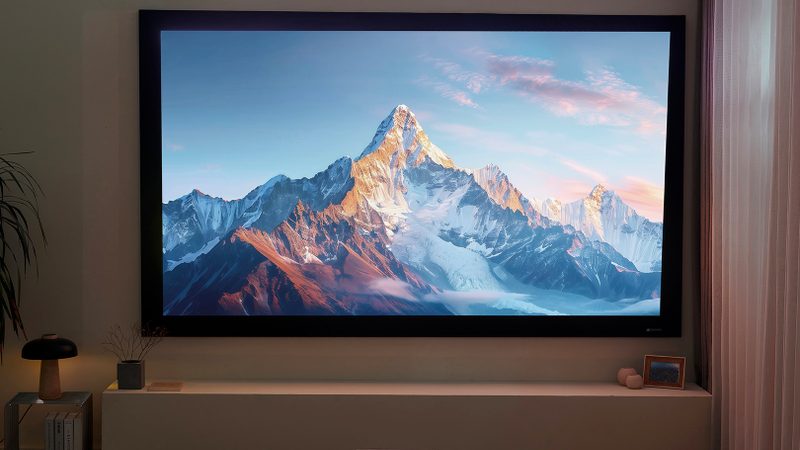
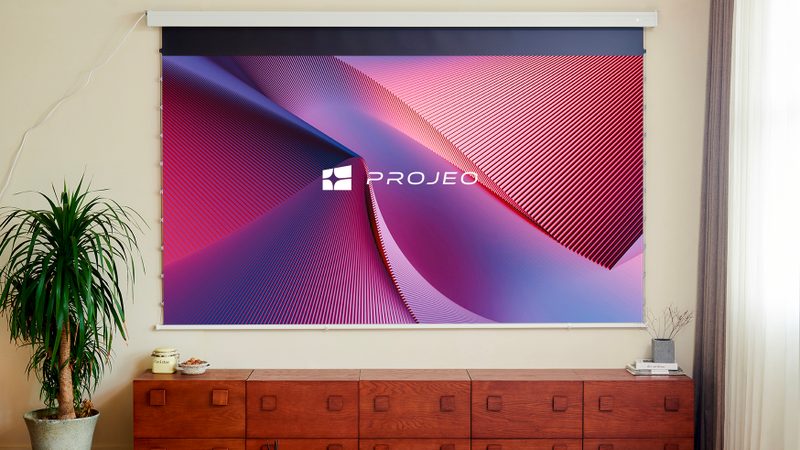
Projeo Frame HD 135
Overview
A perfectly flat screen determines the sharpness a recent projector can display. The slightest crease or ripple distorts the image geometry and blurs focus at the edges. The Frame HD 135 addresses this point with a surface that is permanently tensioned on a rigid frame, a 135-inch diagonal and a 16:9 format, for rooms where the projection setup no longer moves.
A readable image from every seat
The projection surface is a white PVC screen with a gain of 1.1. This value is read against a reference white surface set at 1.0: the Frame HD 135 reflects a little more light than this reference, without entering the category of high-gain screens. That choice has concrete consequences. A high-gain screen concentrates light toward the central axis and increases brightness for viewers seated directly in front of the screen, at the cost of dimming on the sides and a risk of hotspotting. Here, light is spread widely, with a stated directivity of 170°, meaning a wide viewing angle. Brightness remains similar from one seat to another, including for side seats on a sofa or in a second row. The screen’s uniformity completes this balance: the density and consistency of the surface limit brightness differences between the center and the edges of the image.
In return, a white screen of this type does not filter ambient light. It reflects the projector beam as well as stray light from a window or light fixture. Blacks and contrast reach their best level in a room with controlled lighting, or even in complete darkness.
The velvet frame and perceived contrast
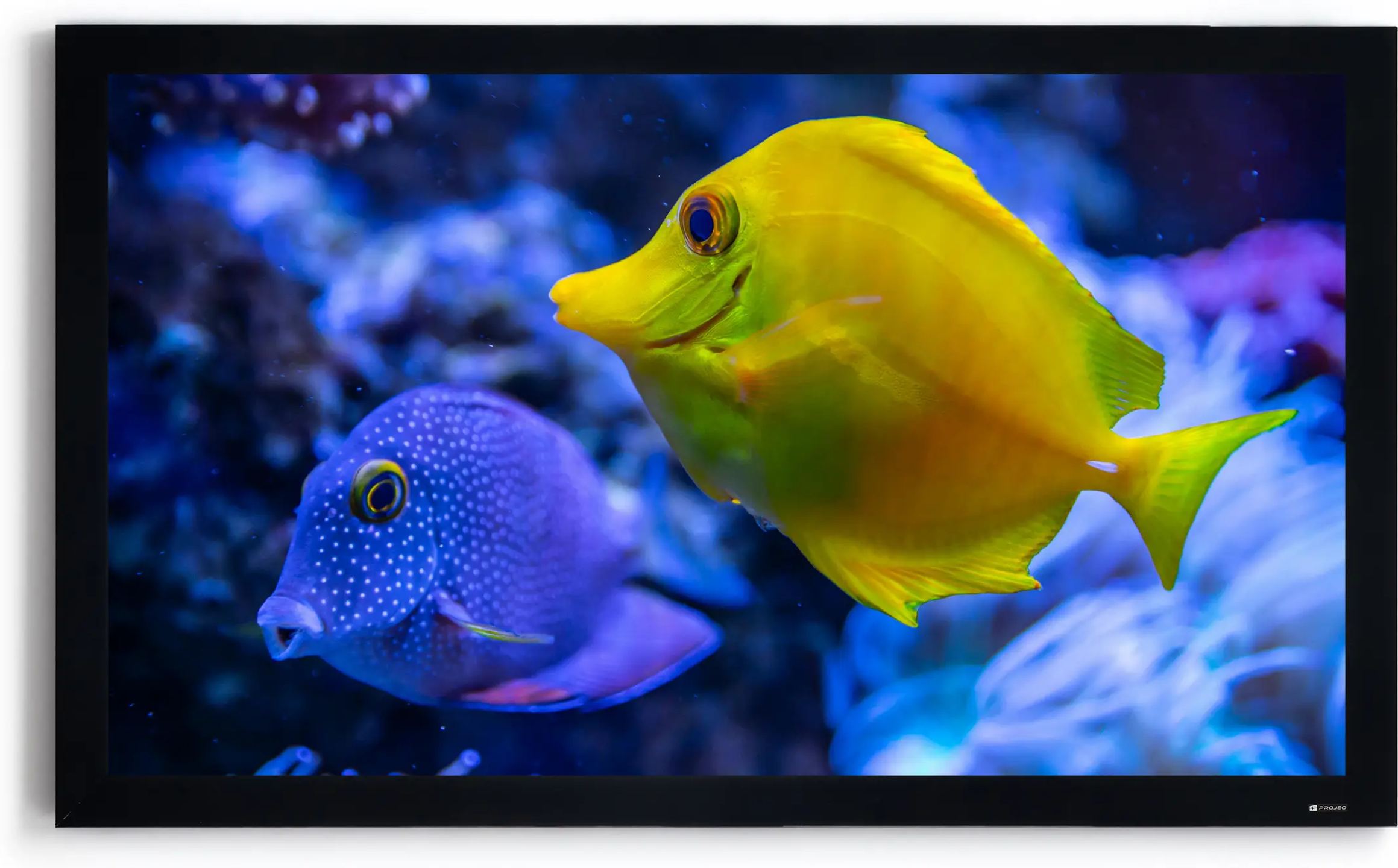
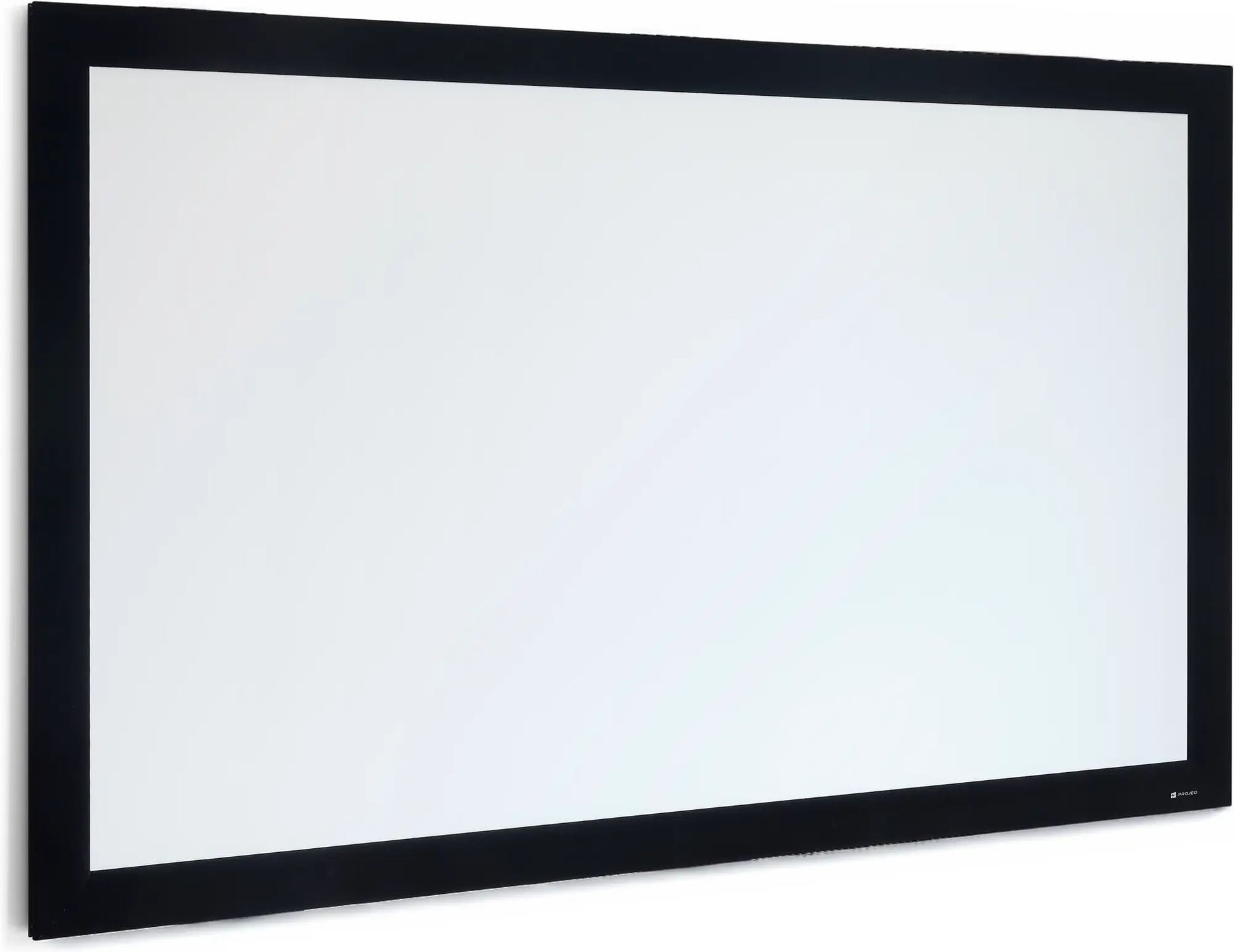
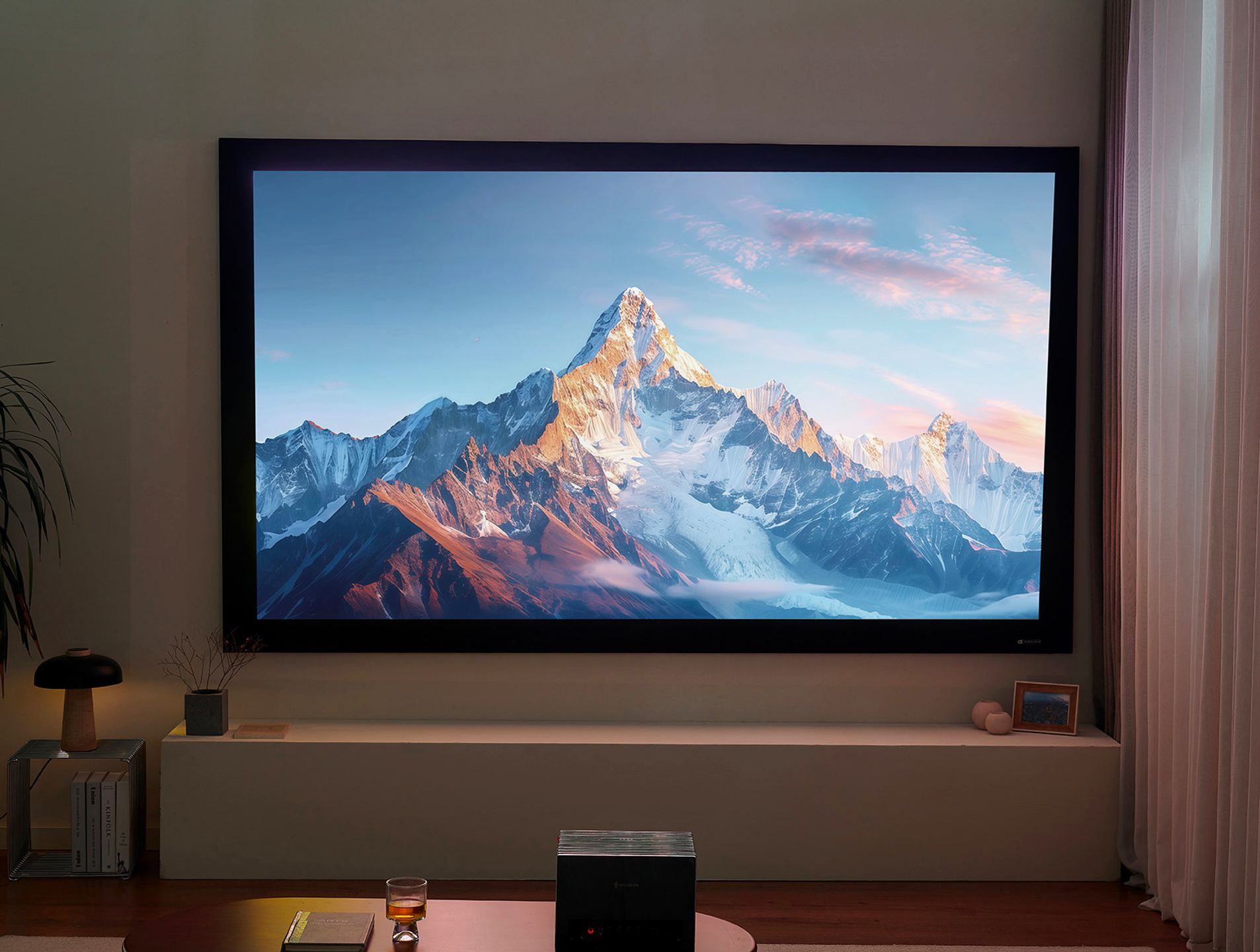
The screen border measures 100 mm wide. Its structure is made of black lacquered aluminum alloy, then covered with a black velvet finish. This velvet does not serve a purely decorative purpose. The material traps light that spills beyond the image, for example a beam slightly wider than the screen, or reflections coming from the illuminated area. The result is visible in the image boundary: a clean, sharp edge, without a gray halo around the frame. This dark border also affects perceived contrast. The eye judges black depth by comparison with what surrounds it, and a distinctly black frame makes the image appear more contrasted than a light-colored wall or a reflective border.
The frame’s rigidity serves another purpose. A fixed aluminum structure does not deform once installed, which keeps the screen in the same plane across its entire 135-inch diagonal. That is the condition required for a projector to stay in focus from one corner of the image to the other. A screen that ripples forces the optics into focus compromises, noticeable as slightly blurry areas.
Wall installation and tensioning
Installation is wall-mounted, and the system is fixed: no motor, no roll-up mechanism. Once in place, the screen no longer moves. Assembly is based on a clip system, which Projeo describes as quick to set up. The screen is tensioned over the frame to remain flat across its entire surface, and wall mounting is done with screws.
The packaging requires one precaution. The screen arrives in long, flat packaging, 328 cm in length for the 135 model, to be stored horizontally until installation. Stood upright vertically, the frame is subjected to concentrated stress on a single support point, with a risk of warping the structure or marking the screen. The width of the assembled frame, close to 3.20 m, justifies installation by two people.
The 135 inches and the room that accommodates it
Four sizes make up the Frame HD range, and the 135 is the largest, ahead of the Frame HD 90, 110 and 127 models. All share the same white PVC screen, the same 100 mm frame and the same 16:9 format; only the surface changes. The 135 model displays a usable image area of 300 by 169 cm. Including the frame, the whole unit occupies about 320 cm in width and 189 cm in height, a footprint that requires a clear wall section.
A fixed frame does not retract. The screen permanently occupies the wall, with no retractable version. In a multipurpose living room, this constant presence may be inconvenient; it is mainly justified in a room dedicated to projection. The 135-inch diagonal goes in the same direction: comfortable viewing distance generally exceeds four meters, and an image that is too close results in visible pixel structure and a gaze that scans the screen instead of taking it in as a whole.
The screen is designed for a long-throw video projector, installed at the back of the room or on the ceiling, several meters from the screen. This rules out ultra-short-throw projectors, placed just below the screen: their very shallow-angle beam requires a screen with a specific structure, which the Frame HD 135 does not include. On the content side, the 16:9 format matches the resolution of high-definition and 4K sources, and the majority of television and streaming programs.
Documentation
Technical Specifications
Format and dimensions
- Model: Frame HD 135
- Format: 16:9
- Diagonal: 135 inches
- Image viewing area: 300 × 169 cm
- Frame size (L1 × L2): 10 × 10 × 4 cm
- Frame border: 100 mm
Projection screen fabric
- Material: White PVC
- Gain: 1.1
- Viewing angle: 170°
- Excellent image uniformity
- Surface ensuring perfect image reproduction
Frame
- Robust aluminum alloy structure
- Black lacquered finish
- Black velvet coating that absorbs light
- Fixed high-rigidity structure
- Design ensuring perfect flatness
Installation
- Wall-mounted installation with screw fastening system
- Optimal screen fabric tension retention
Compatibility
- Long-throw projectors
Packaging
- Packaging dimensions: 328 × 45 × 18.8 cm
- Horizontal storage recommended
Frequently asked questions
What type of wall can the Frame HD 135 be mounted on?
Mounting is done using a screw system, which requires a wall capable of permanently supporting the load of the aluminum frame and the tensioned screen. A solid concrete, brick or cinder block wall is fully suitable with appropriate anchors. On a hollow plasterboard partition, you need to target the frame studs or use fixings designed for heavy loads. Marking the anchor points before installation avoids unpleasant surprises.
Does the Frame HD 135 work with an ultra-short-throw video projector?
No. The screen is designed for a long-throw projector, placed at a distance from the screen. An ultra-short-throw model projects its image at a very shallow angle from a position close to the wall, and that angle makes the slightest relief in the screen stand out in the form of sheen and irregularities. These projectors require a screen with a specific structure, often micro-textured, which this series does not offer.
Is this screen suitable for a room with ambient light?
The white PVC screen, with a gain of 1.1, reflects the projector’s light, but also stray light in the room. In a lit environment, blacks turn gray and contrast drops. Rendering remains correct with dim lighting, and a dark room puts the screen in its best conditions. For a bright living room that cannot be darkened, an ambient light rejecting screen is better suited to the need, with other trade-offs involved.
Does the 16:9 format handle films in the 2.35:1 cinema format?
Yes, with one caveat. A 2.35:1 film projected on a 16:9 screen displays two black bars, at the top and bottom of the image. The frame’s black velvet border makes them discreet, since the projector’s black and the frame’s black blend together. The cinema image then occupies the full width of the screen. For 2.35:1 projection without black bars, a 2.35-format screen is required, which is absent from this series.
- Eco-contribution included in the sale price.
- Manufacturer reference: PROFRA135HD
- GTIN / EAN: 3700795165225