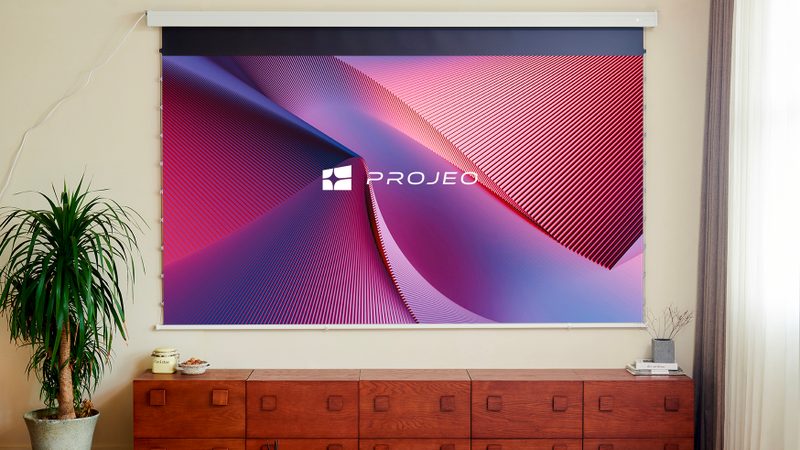
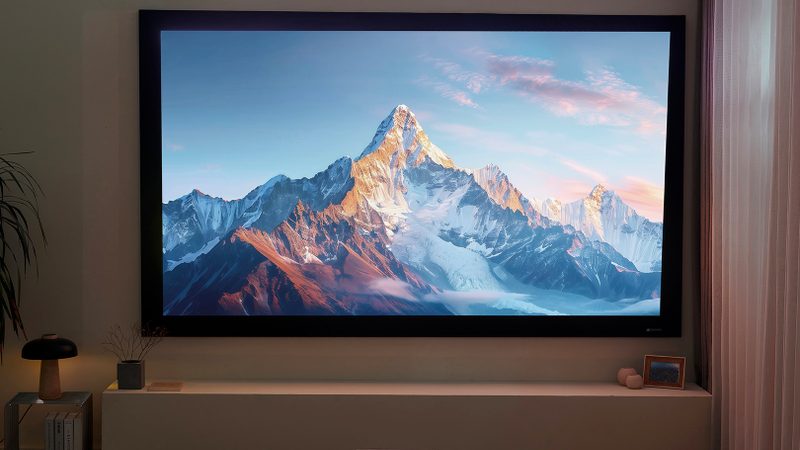
Projeo Frame HD 127

Overview
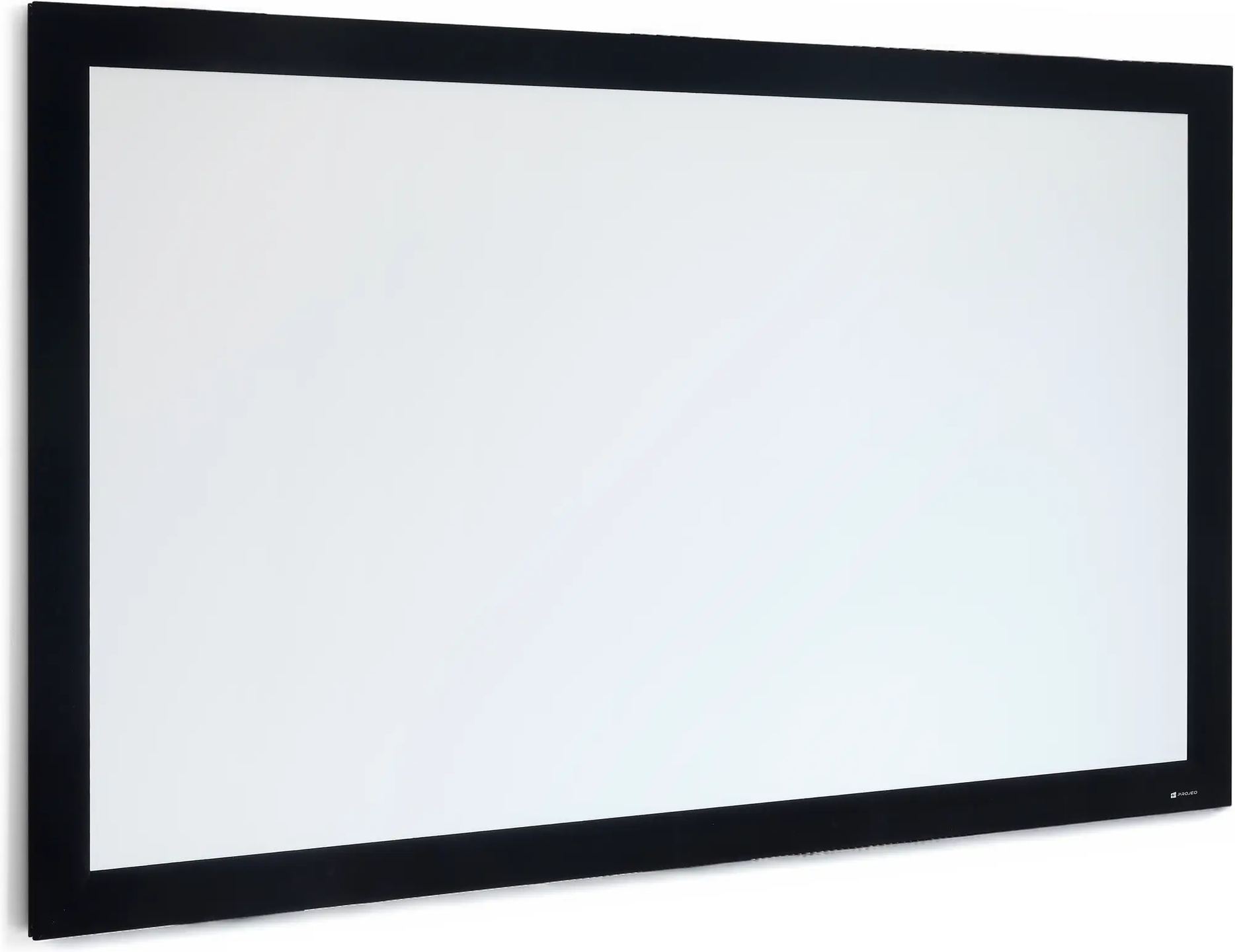
In a room dedicated to cinema, image quality depends as much on the projection surface as on the projector. A poorly stretched screen that ripples, a light-colored frame that reflects light, and the rendering deteriorates. The 16:9 fixed-frame screen in 127 inches by Projeo addresses both points with a PVC screen kept under constant tension and an aluminum profile covered in black velvet.
A black frame that tightens contrast
The frame of the Frame HD 127 is 100 mm wide and is built on an aluminum alloy profile. Its rigidity keeps the screen perfectly flat across its entire surface, with no dips or ripples, whereas a roll-up screen often ends up developing waves over time. The visible face receives a black lacquer finish, doubled with a velvet covering all around the perimeter.
This velvet has an optical function. It absorbs light instead of reflecting it. When the projector beam extends slightly beyond the image area, this excess is captured by the frame rather than reflected as a halo around the screen. Perceived contrast improves: the boundary between the image and the wall stays sharp, and blacks appear deeper because nothing brightens their edges.
The PVC screen and its light output
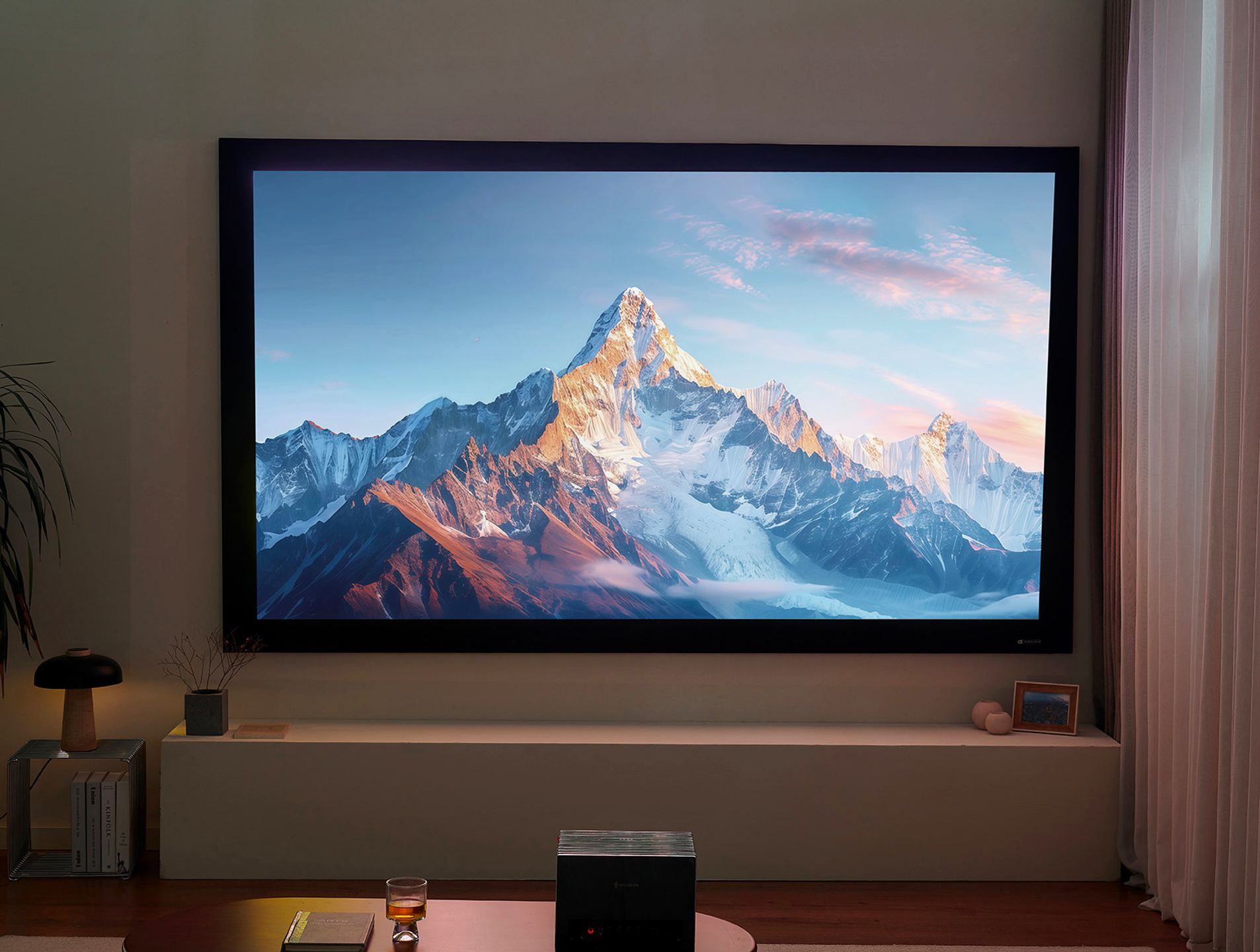
Next comes the screen, made of white PVC, with a gain of 1.1. This figure measures the amount of light reflected toward viewers compared with a reference surface set at 1.0. At 1.1, the gain remains close to neutral: the image is slightly brighter, without the light concentrating into a narrow axis. High-gain screens improve brightness at the center, but often cause a hot spot, a brighter patch in the middle of the screen. The Frame HD 127 avoids this pitfall.
The 170° viewing angle follows the same logic. The image retains its brightness and colors over a wide viewing angle, which matters as soon as a room has several rows of seats or seating on the sides. The trade-off lies in the very nature of a white screen: it diffuses light without filtering it and reflects ambient lighting just as well as the projected image. This screen performs at its best in a dark room, with rather dark walls, where light remains under control. It works with long-throw projectors, those placed at a distance or on the ceiling, and not with ultra-short-throw models positioned just below the image.
Wall mounting and space requirements
The screen is shipped in an elongated box measuring 308 cm. Inside, the frame is divided into profile sections. Assembly first requires putting them together and tensioning the screen around the perimeter using a clip system. The whole unit is then fixed to the wall with screws, and this even tension keeps the surface flat across its full height and width.
In terms of dimensions, it is better to think in overall measurements. The usable image measures 280 × 158 cm, and the 100 mm frame adds 10 cm on each edge: the screen occupies a wall area of about 300 × 178 cm. So you need a clear section of wall on that scale, with no switch or molding in the way. The length of the package also deserves a look before delivery, since 308 cm will not fit up all staircases or in all elevators. Before installation, Projeo recommends storing the box horizontally, to prevent the profiles from bending under their own weight. Once installed, the screen remains fixed and permanently occupies its wall, with no option to conceal it.
The 127-inch model in the Frame HD range
Four sizes make up the Frame HD range: 90, 108, 127, and 135 inches. From one model to another, the PVC screen, gain, viewing angle, and frame profile remain identical. Only the diagonal changes. The choice therefore depends on the room and the seating distance.
At 280 cm wide, the 127-inch model fits in rooms where the first seats are four meters or more from the image. Too close, the eye can distinguish the pixel structure; too far, the large-screen effect fades. The 16:9 ratio matches the native format of HD and 4K projectors, as well as that of the majority of content streamed or played from disc. Films shot in 2.35:1, wider than 16:9, are displayed with two black bars at the top and bottom of the image. This is the normal behavior of a 16:9 screen, useful to know for those who mainly watch widescreen films.
Documentation
Technical specifications
Format and dimensions
- Model: Frame HD 127
- Format: 16:9
- Diagonal: 127 inches
- Image area: 280 × 158 cm
- Frame size (L1 × L2): 10 × 10 × 4 cm
- Frame border: 100 mm
Projection screen
- Material: White PVC
- Gain: 1.1
- Viewing angle: 170°
- Excellent image uniformity
- Surface ensuring perfect image reproduction
Frame
- Robust aluminum alloy structure
- Black lacquered finish
- Black velvet coating that absorbs light
- Fixed high-rigidity structure
- Design ensuring perfect flatness
Installation
- Wall installation with screw mounting system
- Optimal screen tension retention
Compatibility
- Long-throw projectors
Packaging
- Packaging dimensions: 308 × 45 × 18.8 cm
- Horizontal storage recommended
Frequently Asked Questions
What is the warranty period?
Projeo covers the Frame HD 127 with a two-year warranty. It applies to manufacturing defects in the frame and screen under normal use. Keeping the purchase invoice and original packaging makes any potential claim easier to handle.
At what height should the screen be installed on the wall?
The usual rule places the center of the image at the eye level of a seated viewer, or about 110 to 120 cm from the floor. For the Frame HD 127, whose image is 158 cm high, the bottom of the screen is then around 30 to 40 cm from the floor. The exact height depends on the seats and the possible presence of several rows, which may justify raising the whole assembly slightly.
Is the screen suitable for a 4K projector?
A projection screen does not have its own resolution: it reproduces the image sent to it by the projector, in HD as well as in 4K. The smooth white PVC surface of the Frame HD 127 therefore does not limit definition. With a 4K source, the flatness of the frame becomes even more important, because the slightest dip in the screen would distort very fine sharpness. The fixed, tensioned structure meets this need.
How far should the projector be placed?
This distance depends on the projector’s throw ratio, a specification specific to each model, and not on the screen. For an image 280 cm wide, a device with a ratio of 1.5 should be placed about 4.2 meters from the screen; a ratio of 1.2 reduces this distance to nearly 3.4 meters. The device’s technical sheet, or the manufacturer’s distance calculator, gives the exact value.
- Eco-contribution included in the sale price.
- Manufacturer reference: PROFRA127HD
- GTIN / EAN: 3700795165218