

Rotel Michi S430


Overview
When a system reaches a certain level, housing signal control and power in a single enclosure eventually reveals its limits. Separating the two functions means isolating the sensitive preamp electronics from the high currents flowing through the output stages. The S430 is the “muscle” component of this approach from Michi: a stereo power amplifier designed to drive demanding speakers, in tandem with the P430 preamplifier or another high-quality preamp.
Two enclosures instead of one integrated amplifier
The Michi Prestige range began with the X430 integrated amplifier and the Q430 CD player. Paired with the P430 preamp, the S430 completes this family by offering a separate-component configuration. Its logic differs from that of an integrated amplifier such as the X430, which combines preamplification and power amplification in the same chassis: here, low-level control circuits and high-current amplification reside in two separate enclosures. This physical separation limits interference between the signal-processing electronics and the circuitry that delivers power, a principle that Rotel also applies to its M8 monoblocks, adapted here to a two-enclosure stereo format.
The two components of the Prestige pair share the same dimensions (431 mm wide, 148 mm high) and the same visual language, allowing them to be stacked neatly with the rest of the series.
What the power stage delivers
The S430 operates in Class AB, an amplification topology that combines some Class A operation (favorable to linearity at low levels) with the greater efficiency of Class B at high levels. Rated output is 230 W per channel into 8 ohms in continuous operation, with an FTC rating of 250 W per channel into 8 ohms, rising to 390 W per channel into 4 ohms. FTC (Federal Trade Commission) is a standardized measurement method, more demanding than a simple peak-power figure: it requires power to be sustained on both channels simultaneously, across the entire audio band, for a defined duration. In other words, these figures reflect what the amplifier can sustain over time, not an instantaneous peak.
This reserve is especially important with power-hungry speakers or tricky impedance loads. The damping factor of 350 (at 1 kHz into 8 ohms) reflects the amplifier’s ability to control woofer movement: the higher it is, the better the amplifier “holds” the woofer and prevents it from continuing to vibrate after the signal, resulting in tighter, more controlled bass. The minimum supported speaker impedance is 4 ohms.
In terms of measurements, total harmonic distortion remains below 0.03%, as does intermodulation distortion, while the signal-to-noise ratio exceeds 115 dB (A-weighted, IHF). Frequency response extends from 10 Hz to 100 kHz with a tolerance of ±0.4 dB, remaining flat across the entire audible range and well beyond.
The power supply, the heart of a power amplifier
A power amplifier is first and foremost defined by its power supply, and this is where the S430 concentrates most of its 17.5 kg. At its center is an oversized toroidal transformer, custom-designed and manufactured in Rotel’s workshops. The toroidal format (a ring-shaped core) radiates less stray magnetic field than a conventional transformer and takes up less space for the same output. It feeds a high-capacity bank of reservoir capacitors, which act as an energy reserve: during transients (a bass drum strike, an orchestral tutti), they instantly provide the current the speakers need without the supply voltage collapsing.
Critical circuits are physically and electrically isolated along the signal path to preserve signal integrity against interference. The output stages use multi-stage push-pull transistors, a configuration in which two sets of transistors share the work (one handles the positive halves of the signal, the other the negative halves). Power consumption reaches 550 W at full load and drops below 0.5 W in standby.
Connections and integration
The S430 accepts two input types: balanced XLR and unbalanced RCA. The balanced connection (XLR) carries the signal on two conductors in opposite phase, allowing noise picked up along the cable to be cancelled; it is preferable over long cable runs or in electrically noisy environments. The RCA input has a sensitivity of 2 V for 12 kΩ impedance, while the XLR input is 4 V for 200 kΩ. Gain differs depending on the input: 26.5 dB unbalanced, 20.5 dB balanced.
This dual connectivity leaves plenty of freedom when choosing a preamp. Its natural partner is the P430 from the same range, but nothing prevents using the S430 with another preamplifier featuring an XLR or RCA output. Speakers connect via dual five-way binding posts, compatible with the main termination types (spades, banana plugs, bare wire).
Chassis and display
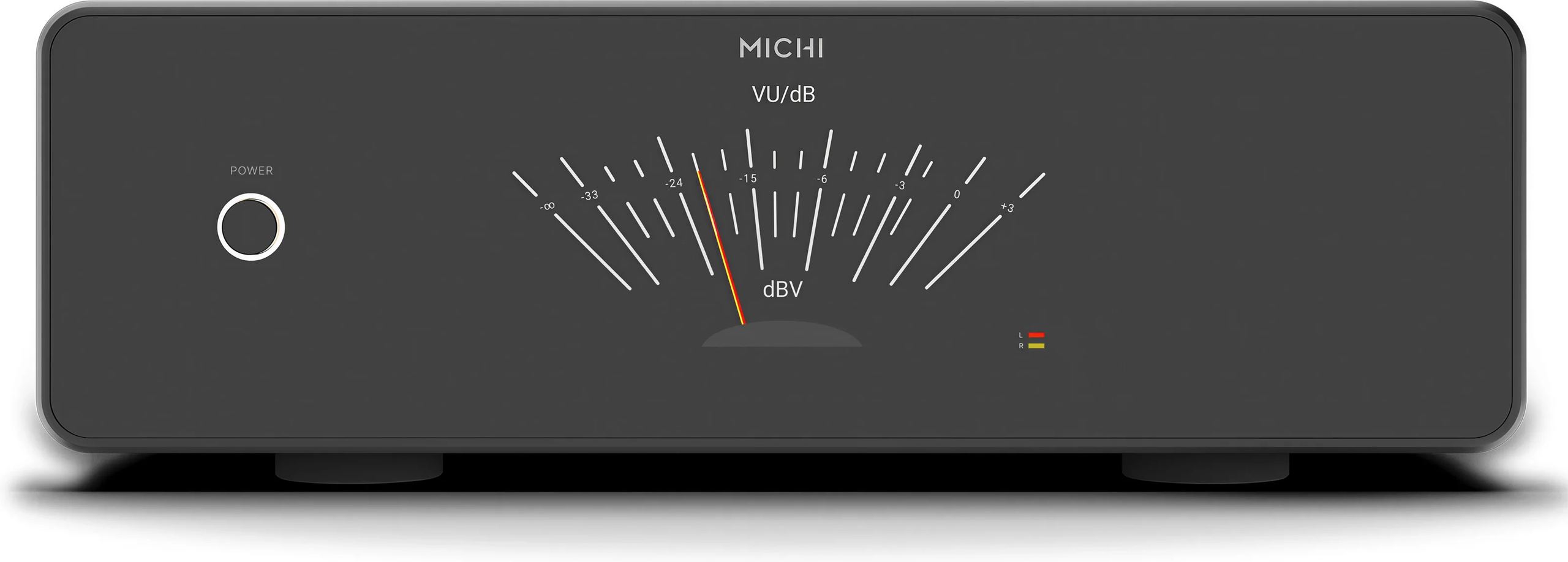
The machined aluminum enclosure serves two purposes: it gives the device its visual presence while damping mechanical vibrations and protecting the internal circuits from external interference. The front panel incorporates a configurable TFT color display, capable of showing VU meters during listening or switching off completely for a clean front panel during focused listening sessions. A backlit power switch completes the front panel.
For a weight of 17.5 kg spread across 431 × 148 × 405 mm, heat dissipation remains moderate at 1513 BTU/h (measured at 4 ohms, at one-eighth of rated power), giving an indication of the ventilation required in a cabinet.
Technical Specifications
General
- Type: stereo power amplifier
- Amplification class: Class AB
- Remote control included
Output Power
- FTC power: 2 × 250 W into 8 Ω
- Continuous power: 2 × 230 W into 8 Ω
- Maximum power: 2 × 390 W into 4 Ω
- Minimum speaker impedance: 4 Ω
Audio Performance
- Total harmonic distortion (THD): < 0.03%
- Intermodulation distortion: < 0.03% (60 Hz / 7 kHz, 4:1)
- Frequency response: 10 Hz – 100 kHz (±0.4 dB)
- Signal-to-noise ratio: > 115 dB (A-weighted IHF)
- Damping factor: 350 (1 kHz, 8 Ω)
- Crosstalk / channel separation: > 70 dB
Inputs and Sensitivity
- Audio inputs: balanced XLR, unbalanced RCA
- Gain
- Unbalanced input: 26.5 dB
- Balanced input: 20.5 dB
- Input sensitivity and impedance
- RCA: 2 V / 12 kΩ
- XLR: 4 V / 200 kΩ
Power Supply
- Supply voltage: 230 V / 50 Hz
- Power consumption: 550 W
- Standby power consumption: < 0.5 W
- Oversized toroidal transformer, custom-designed and manufactured in-house
- High-efficiency storage capacitors
Dimensions and Weight
- Dimensions (W × H × D): 431 × 148 × 405 mm
- Front panel height: 131 mm
- Net weight: 17.5 kg
Heat Dissipation
- 1513 BTU / h (4 Ω, 1/8 rated power)
Frequently Asked Questions
Is the P430 preamp required to use the S430?
No. The S430 is a stereo power amplifier with XLR and RCA inputs: it works with any preamplifier equipped with a compatible output. The P430 is its designed partner within the Prestige range, with a matching chassis and a cohesive aesthetic, but the unit remains open to other combinations.
What is the difference compared with the Michi Prestige X430 integrated amplifier?
The X430 combines the preamplifier and power amplifier in a single chassis, with an integrated digital converter and source inputs as well. The S430 is only a power amplifier: it simply amplifies, with no preamplification stage or digital conversion. It is the choice for a separate-component configuration, where each function has its own chassis and power supply.
Can the S430 drive speakers with low sensitivity or difficult impedance?
That is precisely what it is designed for. Its 390 W per channel into 4 ohms, high damping factor, and substantial power reserve provide the current needed to handle demanding loads without weakening during dynamic passages. The minimum supported speaker impedance is 4 ohms.
What do the FTC and continuous power ratings, both given for 8 ohms, mean?
They describe the same output measured in two ways. Continuous power (230 W) corresponds to what the amplifier delivers under steady-state conditions; the FTC rating (250 W) follows the standardized Federal Trade Commission protocol, which verifies that power is maintained on both channels, across the entire audio band, for a defined duration. Both figures reflect sustained performance, not a momentary peak.
What practical purpose do the on-screen VU meters serve?
They display in real time the signal level sent to each channel. Above all, they serve as a visual reference, useful for monitoring levels at a glance and assessing the dynamics of a track. As the display is configurable, it can also be switched off to eliminate any light source during listening.
Can two pairs of speakers be connected or can bi-wiring be used?
The S430 features dual speaker terminals per channel. This double set of terminals makes it easier to bi-wire a compatible speaker (two separate cables to the bass and treble sections from the same channel). It is a two-channel stereo power amplifier, dedicated to a pair of speakers.
How much space should be allowed in a hi-fi cabinet?
It measures 431 mm wide, 405 mm deep and 148 mm high, weighing 17.5 kg. Beyond the dimensions, allow for ventilation around the enclosure: a Class AB amplifier of this power generates heat (1513 BTU/h under the stated measurement conditions), and good airflow around the aluminium chassis helps dissipate this heat.
- Eco-contribution included in the sale price.




