

Audioquest Star 6 (2 x 3m) black
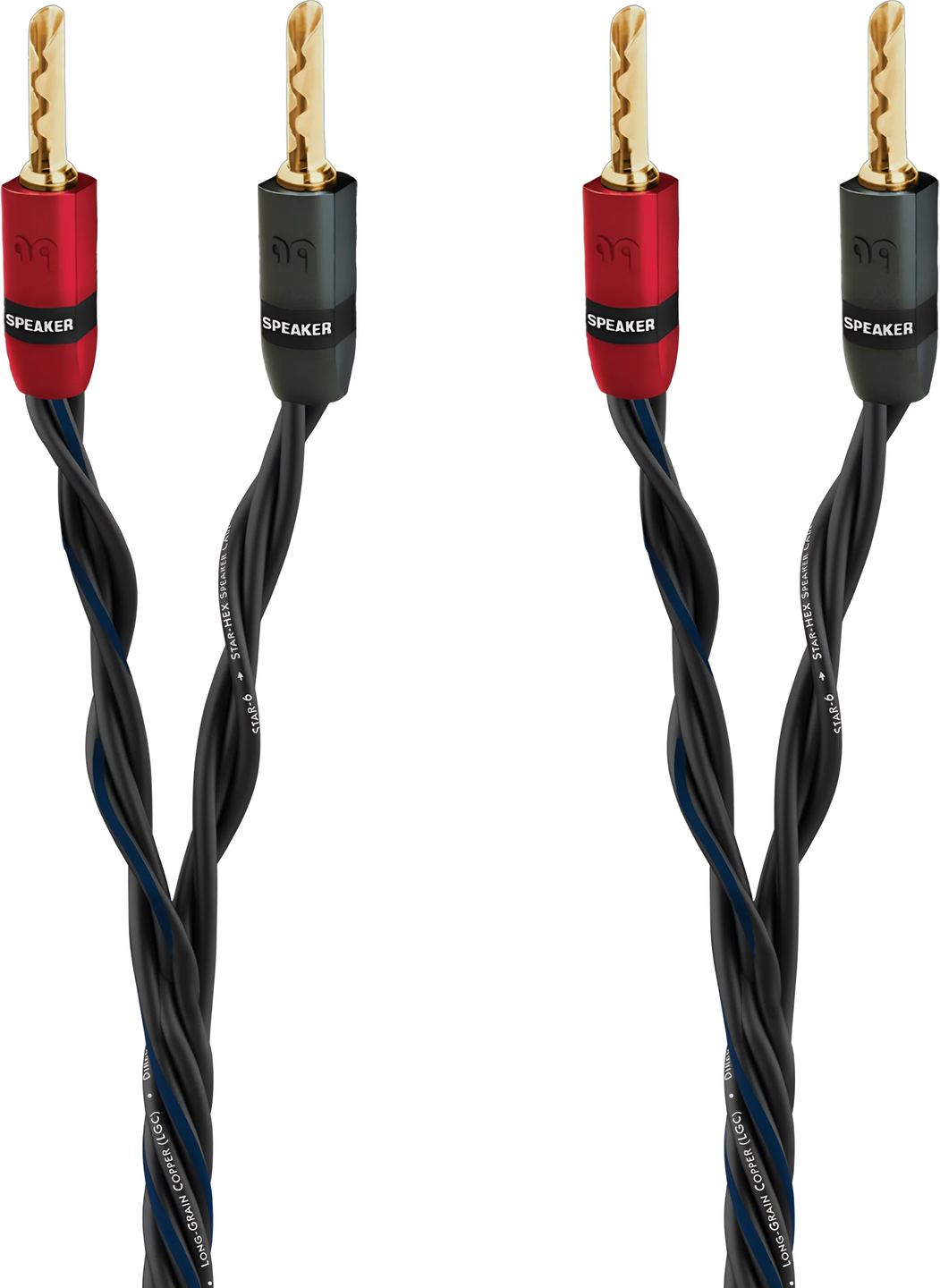
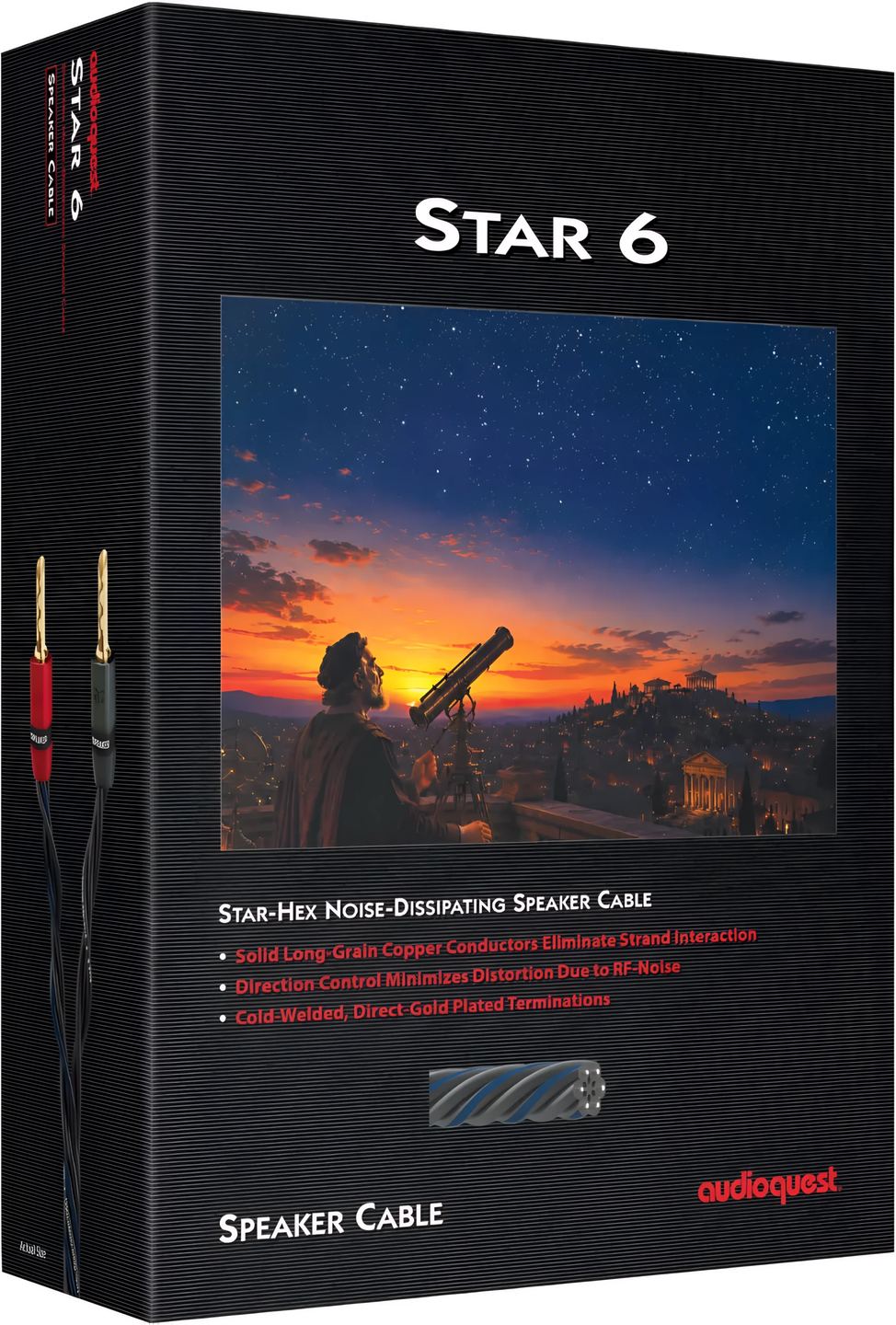
AudioQuest Star 6 black, terminated speaker cable
Between the amplifier and the speakers, the cable carries a powerful signal that is nevertheless exposed to interference circulating in a room full of electronic devices. This model follows the formula AudioQuest has been refining since its first star-configured cables in the 1980s: solid copper conductors, carefully arranged and oriented in a specific direction. It comes ready to connect, with factory-fitted banana plugs at each end.
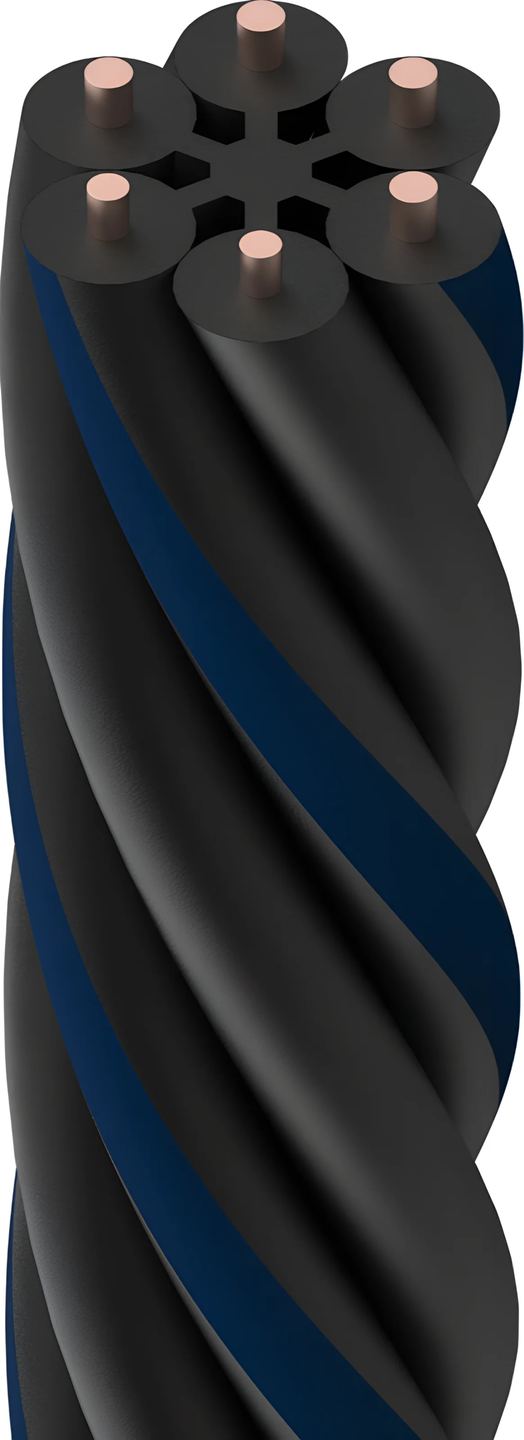
Six conductors arranged in a star around the center
An ordinary speaker cable places two conductors side by side, one for the positive pole and the other for the negative. The Star 6 brings together six, hence its name, braided around the cable’s axis in a geometry AudioQuest calls Star-Hex. This is the six-conductor extension of the Star-Quad principle the brand has used since the C-4 in 1980 and then the Type 4: conductors of the same polarity face each other on opposite sides of the center, so the magnetic fields they produce partially cancel each other out. The cable has lower inductance (inductance resists rapid changes in current and primarily affects high frequencies) and picks up less external interference than a simple parallel pair.
Solid copper rather than strands
In a conventional stranded cable, dozens of fine wires touch one another and change position along the cable’s length. These points of contact create small electrical and magnetic interactions between strands, which AudioQuest considers a major source of distortion. Each Star 6 conductor is a single, solid wire, eliminating the problem at its source. The metal is the brand’s Long-Grain Copper (LGC), a copper with large crystals: as it cools, copper forms grains whose boundaries are discontinuities the signal must cross, and longer grains reduce their number. This copper also contains fewer oxides and impurities than standard OFHC copper, the oxygen-free copper used in most commercially available cables.
The cable remains flexible despite its solid conductors and slips easily behind furniture or along a baseboard. Solid copper does, however, harden when repeatedly bent and straightened in the same place: it is better to establish a route with wide curves than to bend it at sharp angles every time the speakers are moved.
Connection direction marked on the plugs
AudioQuest controls the direction of each conductor during manufacturing. Copper drawn into wire does not behave quite the same in both directions when exposed to radio-frequency noise (the high-frequency interference emitted by Wi-Fi, phones, or switching power supplies), and the brand orients its conductors to minimize the distortion this noise induces in the amplifier. The plugs have markings for the amplifier end and the speaker end. Connecting the cable backwards poses no danger to the equipment; it simply loses its intended orientation.
Cold-welded SureGrip 300 plugs
Both ends are fitted with AudioQuest SureGrip 300 banana plugs with gold-plated contacts. The plating is applied directly to the plug’s metal, without the nickel underlayer often found on gold-plated connectors. The connection between the conductor and the plug is cold-welded: the two metals are joined under pressure, without adding solder or applying heat, avoiding the introduction of a different alloy into the signal path.
The banana format requires speaker and amplifier terminals that can accommodate these plugs. On most devices, the binding post accepts a banana plug in its center, sometimes after removing a small plastic cap. Older spring-clip terminals do not accept them, and the Star 6 is not available with spade connectors or in custom lengths.
For stereo hi-fi and home theater alike
The Star 6 is a full-range cable, with a pair of plugs at each end: it connects a speaker output on an integrated amplifier, power amplifier, or home theater receiver to a speaker’s terminals. In a stereo setup, it handles the complete connection. In a multichannel system, it connects each speaker separately, and using the same cable for the three front speakers (left, center, right) maintains a consistent sound as audio moves from one speaker to another. The black version blends into dark surroundings, while a white version with identical construction is available for light-colored walls.
Technical specifications
Overview and design
- Type: high-quality speaker cable
- Noise-dissipating Star-Quad architecture
- Solid Long-Grain copper conductors
- No interaction between strands
- Conductor direction control: minimizes distortion caused by radio-frequency (RF) noise
- Flexible design
- Available colors: black, white
- Configuration: full-range
Connectivity and terminations
- Connection: 2 → 2
- Connectors: AudioQuest SureGrip 300 banana plugs
- Fitted at both ends of the cable
- Direct gold-plated contacts
- Cold-welded terminations
- Other connector types and custom lengths not available to order
Sound characteristics
- Designed to deliver fuller, more balanced music reproduction
- Firmer sonic foundation
- Treble perceived as less thin
- Better sonic coherence across frequency ranges
- More natural and more mature musical presentation, according to the retailer’s listening impressions
Compatibility and use
- Use: connection between an amplifier or audio receiver and speakers
- Applications: hi-fi installations, home theater systems
Frequently asked questions
Is the cable sold individually or in pairs?
Per pair: two identical cables, one for each speaker in a stereo setup. For a home theater system, you need as many cables as there are speakers to connect.
My speakers have two pairs of terminals, can I use the Star 6?
Yes, by connecting it to one of the two pairs and keeping the metal jumper bars (the “straps”) that link the bass and treble terminals in place. The Star 6 is not available in a bi-wire version with two pairs of plugs at the speaker end.
What happens if I reverse the connection direction?
Nothing serious: the sound passes through normally and the equipment is not at risk. The cable simply loses the benefit of the direction chosen by AudioQuest to limit the effects of radio-frequency noise. Observing polarity, red to red and black to black, matters far more: a speaker connected out of phase with the other significantly weakens the bass and blurs the stereo image.
The banana plugs don't fit into my amplifier's terminals, is this normal?
For many years, some amplifiers sold in Europe came with plastic plugs fitted in the centre of the terminals to prevent banana plugs from being inserted. These plugs can be removed with a fine point or a small drill bit held by hand. If the terminal is solid or spring-loaded, the Star 6 is not suitable.
Can the cable be cut to a specific length?
It is technically possible, but this removes the factory cold-welded terminations, which are then replaced with screw-on or solder-on plugs. It is better to choose a suitable length from the outset and let any excess form a wide loop behind the furniture.
Can the Star 6 fit inside a wall or a suspended ceiling?
This is a pre-terminated cable with plugs, designed for surface mounting or installation in trunking. For concealed routing, AudioQuest offers cables on reels rated for in-wall installation and burial (CL3 and FT4 standards), such as the SLiP/DB series, which can then be terminated with the plugs of your choice.
Are the black and white versions identical?
Yes, only the color of the outer jacket changes. The conductors, geometry, installation direction and plugs are the same.
- Eco-contribution included in the sale price.
- Manufacturer reference: STAR603.0BGBB
- GTIN / EAN: 92592199224


