


Contents
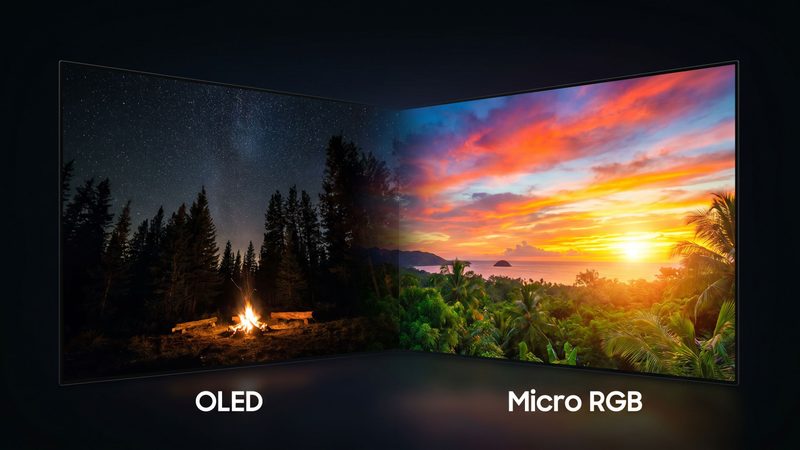
A nighttime scene, two black bars at the top and bottom of the image, a white subtitle floating in the middle. On a backlit screen, these bars often tend toward gray and a slight halo surrounds the text. On an OLED panel, they blend into the frame of the television, to the point where you can no longer tell where the image ends and the edge of the screen begins. The entire debate around contrast lies in this difference in behavior when displaying black.
The self-emissive pixel principle
On an OLED panel, each pixel produces its own light from organic compounds through which an electric current passes. To display black, the electronics cut this current: the pixel turns off and emits zero nits. There is no light source behind the image that could leak through. Since contrast is the ratio between the brightest white and the deepest black a screen can produce, this ratio becomes mathematically infinite when black is zero.
An LCD panel works differently. A backlight permanently illuminates a layer of liquid crystals which, depending on their orientation, allow more or less light to pass through colored filters. The crystals never completely block the light: black remains dark gray, and the native contrast of the best VA panels tops out at around a few thousand to one. The difference is not a matter of settings, but of design.
Absolute black, the driving force behind contrast
Image quality is often associated with peak brightness, that famous figure in nits highlighted in technical specifications. Yet for perceived depth and the richness of a dark scene, the black floor carries the most weight. The human eye is highly sensitive to differences in low light and much less so in highlights. A screen capable of reaching close to zero gives images a solidity that a brighter panel with grayish blacks cannot match.
This explains OLED’s reputation for end credits, space scenes, or nighttime shots: details stand out against a truly black background, without a veil of light that flattens the scene. Contrast is not boosted by image processing; it results directly from the behavior of the panel.

Local dimming and its limits
Mini-LED has considerably narrowed the gap. This technology is still LCD, but its backlight consists of thousands of tiny LEDs grouped into dimming zones, sometimes more than two thousand on high-end models. Each zone dims independently to deepen blacks where the image requires it. Advertised dynamic contrast can then rise to one million to one, whereas the panel’s native static contrast is closer to five thousand to one.
The issue lies in the size of the zones. A single zone covers a group of pixels, never an individual pixel. When a bright object appears against a black background, a subtitle on a letterbox bar, a star in the sky, the entire zone lights up and lets a halo escape around the bright element. This phenomenon, known as “blooming,” diminishes as the number of zones increases but does not disappear: it is a physical limitation of backlighting, not a calibration flaw.
In return, Mini-LED delivers much greater brightness. The best models exceed 3,000 to 4,000 nits at HDR peaks, while the brightest OLEDs are more around 2,000 to 2,400 nits. And their LCD panels do not carry the risk of burn-in associated with organic compounds.
Infinite contrast remains theoretical
Zero-nit black and infinite contrast describe the behavior of a panel in a perfectly dark room. As soon as a light source illuminates the surface, reality becomes more nuanced. Ambient light reflects off the screen and adds brightness to areas that are supposed to be black: the perceived black floor rises, and OLED’s advantage over a good Mini-LED narrows. Specialists refer to ambient contrast, which depends on emitted brightness, the panel’s black level, and the light reflected by its surface.
Not all OLED panels react in the same way. A QD-OLED panel, without a polarizer, tends to diffuse some of the ambient light toward the viewer: its blacks turn gray more quickly, sometimes with a slightly purplish tint under a lamp, whereas a WOLED panel retains more stable black. Manufacturers respond with matte, anti-reflective surface treatments, such as Samsung’s Glare Free filter or LG’s anti-reflective coatings, complemented by electronics-driven gamma adjustments. In a very bright living room, a matte OLED panel or a bright Mini-LED can display better perceived contrast than a glossy OLED panel positioned opposite a window.
WOLED, QD-OLED and tandem panels
Behind the OLED acronym are two main families. LG Display’s WOLED combines red, green, blue subpixels and a white subpixel to gain brightness. Samsung Display’s QD-OLED combines a blue source and a Quantum Dots layer to generate primary colors, without a white subpixel, giving it slightly greater color volume with saturated shades.
The significant development of the past two years concerns tandem panels. By stacking two emissive layers, LG Display has dramatically increased the brightness of its WOLED panels without affecting black levels: the 2025 LG G5 reaches around 2,400 nits at peak, nearly twice that of the previous generation, according to independent measurements. The 2026 version, called Primary RGB Tandem 2.0, further increases brightness and reportedly halves perceived reflections according to LG. For its part, Samsung Display announces peaks of up to 4,500 nits for its Penta Tandem QD-OLED panels intended for televisions. These gains bring OLED closer to Mini-LED’s brightness peaks while retaining its hallmark: a pixel that truly turns off.
One point about these figures deserves clarification. Since organic compounds heat up under high voltage, an OLED television limits its full-screen brightness through a protective mechanism, the automatic brightness limiter. The advertised peaks apply to small bright areas, not to a white window filling the entire screen, whose sustained brightness remains significantly lower.

Choosing according to the room
For a dedicated room or a living room that can be made completely dark, OLED remains the choice that provides the greatest depth in dark scenes and the cleanest detail in shadows. No backlight can compete with a switched-off pixel. In a very bright living room filled with daylight, a powerful Mini-LED or a matte OLED panel will often maintain better perceived contrast during the brightest hours, while neutral bias lighting placed behind the screen reduces eye strain without washing out blacks.
Based on contrast and black level alone, OLED therefore retains a clear lead, rooted more in its design than in any setting. However, this advantage is measured mainly in the dark: your room, as much as the panel, determines how much of it you will actually see.